
10K Gold vs. 14K Gold for Daily Wear: Which Is the Better Long-Term Choice?
The short answer: for jewelry you'll wear every single day, 10K gold is the more durable and budget-smart choice — its higher alloy content makes it harder and more scratch-resistant. 14K gold wins on richer color, gentler wear against sensitive skin, and higher resale value. Both are solid, real gold that lasts generations.
This is the question we field most often at the counter: a customer holds two pieces that look nearly identical, sees two different prices, and wants to know which one they'll be glad they bought in twenty years. The honest answer depends on how the piece will live on you. Here's how a family jeweler actually thinks it through.
What is actually different between 10K and 14K gold?
Pure gold is 24 karat. It's also too soft to survive daily life — it bends, dents, and scratches almost like clay. So gold for real jewelry is mixed with stronger metals (copper, silver, zinc, sometimes nickel or palladium). The karat number tells you how much of the mix is pure gold:
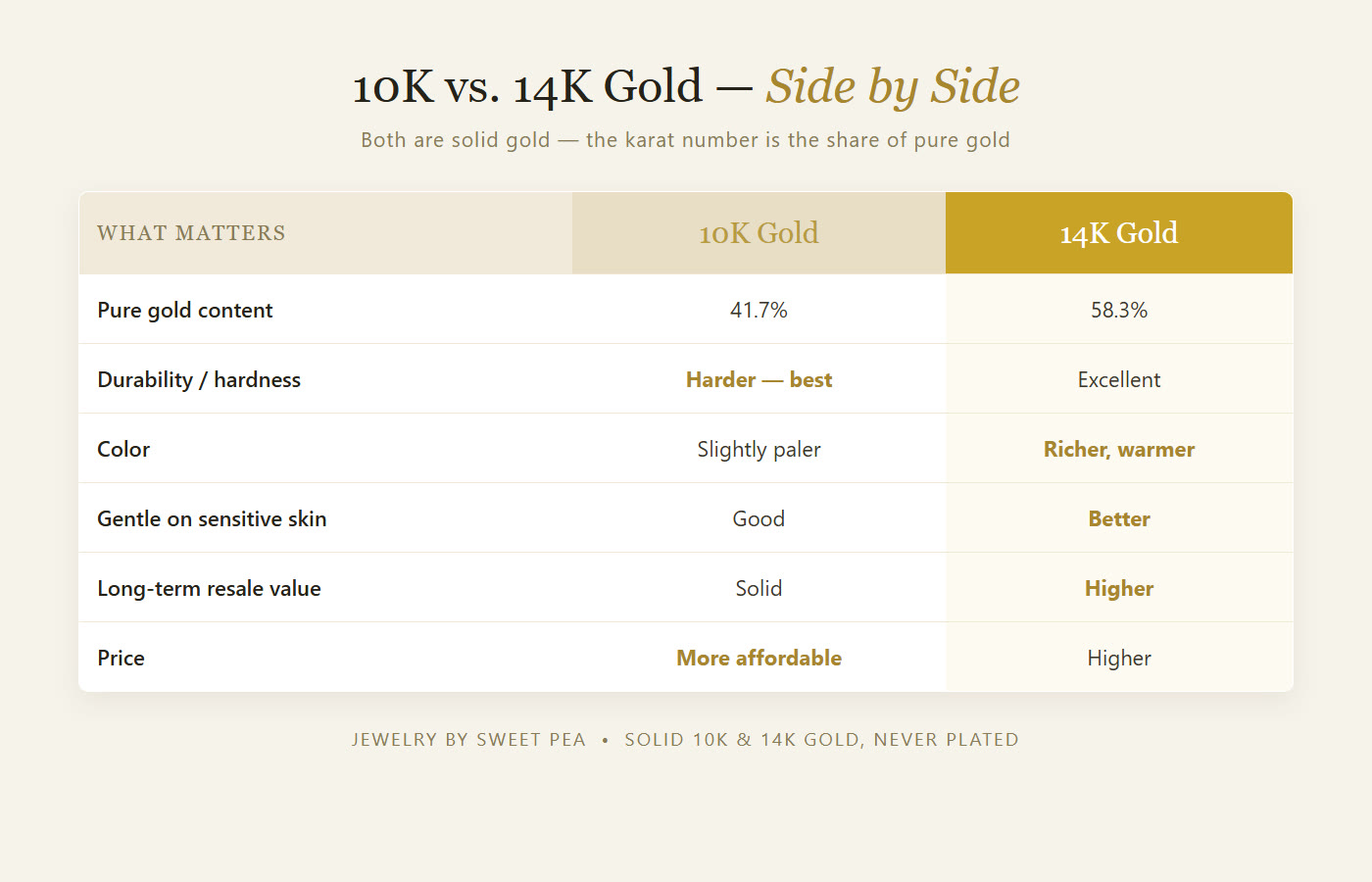
- 14K gold is 58.3% pure gold (14 parts of 24). It's the most popular standard for U.S. fine jewelry — a warm, rich yellow with plenty of durability.
- 10K gold is 41.7% pure gold (10 parts of 24). It's the lowest mix that can legally be called "gold" in the United States — slightly paler in color, harder to the touch, and noticeably more affordable.
Both are unquestionably "real gold." The difference is the ratio of pure gold to alloy — and that single ratio drives everything else: durability, color, skin-friendliness, and resale value. (For a deeper primer on how karat and gold purity work, the Gemological Institute of America keeps an excellent gold education page.)
Which gold is more durable for daily wear?
Counterintuitively, the less pure gold is the tougher one. Because 10K has more hardening alloy in the mix, it resists scratches, dings, and bending better than 14K. For a piece that's going to take a beating — a chain you never take off, hoop earrings worn to the gym, a ring that meets the keyboard and the car door every day — 10K shrugs off daily wear a little better.
That said, the gap is smaller than most people imagine. 14K is plenty durable for everyday wear; it's the standard for engagement rings and heirloom pieces precisely because it holds up for decades. Unless you're genuinely hard on jewelry, you will not "wear out" a 14K piece in your lifetime with basic care. The durability edge of 10K is real, but it's a tiebreaker, not a dealbreaker.
Which holds its value better over the long term?
Here's where 14K pulls ahead. A 14K piece contains roughly 40% more pure gold than a 10K piece of the same weight, so its intrinsic (melt) value is higher — and that's what drives resale or trade-in value down the road. If you think of fine gold as a small, wearable store of value, 14K stores more of it per gram.
There's also a slow-burn longevity factor: because pure gold never tarnishes, higher-karat gold is marginally more resistant to the faint discoloration that heavy alloys can develop after many years of exposure to lotions, chlorine, and perspiration. With 10K you may occasionally need a polish to bring the shine back; with 14K, slightly less often. Neither tarnishes the way costume or plated jewelry does — and unlike plated pieces, solid gold of either karat will never flake, peel, or turn your skin green.
One more long-term note that matters to some buyers: 10K's higher alloy content means a higher chance of nickel, which a small number of people with very sensitive skin can react to. If you know you're nickel-sensitive, 14K (or our sterling silver) is the gentler everyday choice.
The real-world test: the same hoop in 10K and 14K
Theory is easy; let's price it. We stock the same classic polished hoop earring in both karats, so you can see exactly what the karat decision costs:
- 10K Yellow Gold Hoop Earrings (13mm) — about $193. The durable, everyday-warrior pick.
- 14K Yellow Gold Hoop Earrings (13mm) — about $281. Same size and style, richer gold color, higher gold content.
That's roughly a $90 difference on an identical-looking pair. Step up to a bigger 19mm hoop and the spread is similar: the 10K version runs about $232 versus the 14K version at about $337. At conversation distance, almost no one can tell the two karats apart — the 14K simply reads a touch warmer up close.
The same logic applies to chains, the ultimate daily-wear piece. A solid everyday option like our 14K Yellow Gold Rope Chain with Barrel Bead (about $233) gives you the richer color and higher gold content for something worn against the skin all day; the 10K equivalent would save you money while wearing slightly harder. Browse more in our Earrings and Necklaces collections.
Prices shown are at the time of writing; solid gold pieces move with the gold market.
So which should you choose?
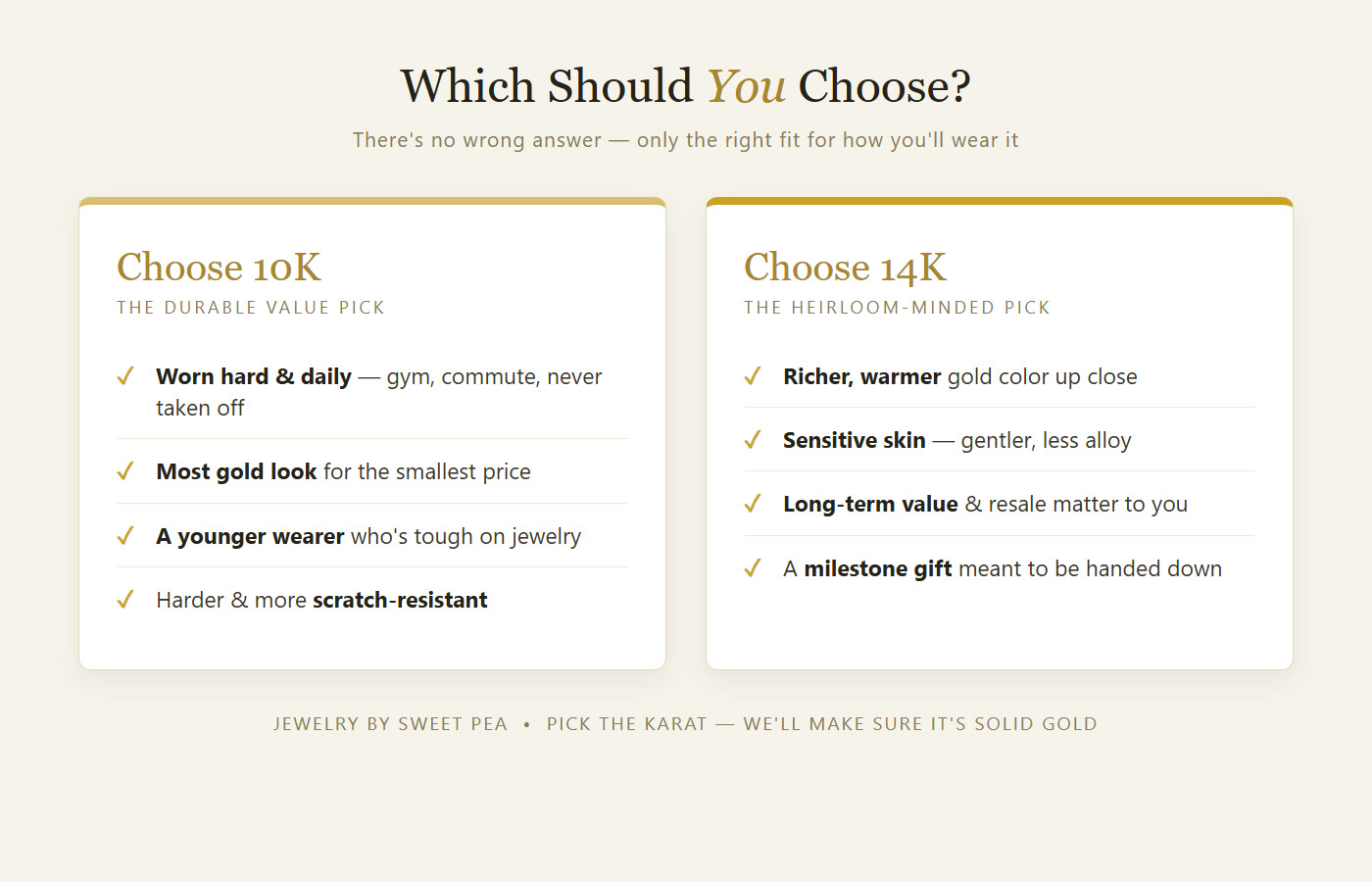
A simple way to decide:
- Choose 10K if the piece will be worn hard and constantly, you want the most gold-look for the least money, or you're buying for a younger wearer who's tough on things. It's the smart, durable value pick — not a compromise.
- Choose 14K if you want the richer, warmer gold color, you have sensitive skin, you care about long-term resale value, or the piece is a milestone gift meant to be handed down. It's the heirloom-minded choice.
For most everyday buyers, our honest counter advice is this: pick the karat that lets you buy a solid piece you love, rather than stretching for a bigger or flashier plated one. Purity and longevity beat size every time. We don't sell plated "looks-like-gold" jewelry — every piece is stamped, solid 10K or 14K gold or sterling silver. U.S. sellers are bound by the FTC Jewelry Guides (16 CFR Part 23) on how karat must be described, so a listing that won't state its karat plainly is telling you something.
How to make either karat last a lifetime
Whichever you choose, a few habits keep solid gold looking new for decades:
- Take it off for chlorine and harsh chemicals. Pools, hot tubs, and bleach are the real enemies — far more than ordinary daily wear.
- Clean it gently at home. Warm water, a drop of dish soap, a soft toothbrush, then pat dry. That's genuinely all most pieces need.
- Store pieces separately. Gold scratches gold — a soft pouch or a divided box keeps chains from tangling and hoops from nicking each other.
- Have heavily-worn pieces checked yearly. A jeweler can tighten earring backs and check clasp springs before something is lost.
Frequently asked questions
Is 10K gold "real" gold?
Yes. 10K is 41.7% pure gold and is the minimum purity that can legally be sold as gold in the United States. It is solid gold throughout — not plated — so it never flakes or peels. It simply contains more hardening alloy than 14K, which makes it more durable and more affordable.
Will 10K gold tarnish or turn my skin green?
Solid 10K gold will not turn your skin green the way plated jewelry can. Over many years its higher alloy content can develop faint discoloration from chemicals or heavy perspiration, but a simple polish restores it. If you have nickel-sensitive skin, 14K gold or sterling silver is the gentler daily-wear choice.
Can you tell the difference between 10K and 14K gold by looking?
Up close, 14K has a slightly warmer, richer yellow because it contains more pure gold. At normal conversation distance, most people cannot tell two otherwise-identical pieces apart. The bigger practical difference is price and long-term value, not appearance.
Which gold is the better long-term investment?
14K holds more value over time because it contains roughly 40% more pure gold by weight than 10K, giving it a higher intrinsic and resale value. If long-term value or heirloom potential matters most to you, choose 14K. If durability and price matter most, 10K is the better everyday buy.
Is 14K worth the extra money for everyday jewelry?
It depends on what you value. For a milestone gift, sensitive skin, or a piece you want to pass down, the richer color and higher gold content of 14K are well worth it. For a hard-worn daily piece where durability and budget come first, 10K delivers nearly the same look for noticeably less.
Jewelry by Sweet Pea is a family-run fine jewelry store. Every piece is solid 10K or 14K gold or sterling silver — never plated — sourced from U.S. wholesalers and shipped from the USA. Browse our Earrings and Necklaces, or ask us anything before you buy.