Birthstone Jewelry vs Diamond Jewelry: Which Carries More Personal Meaning as a Gift?
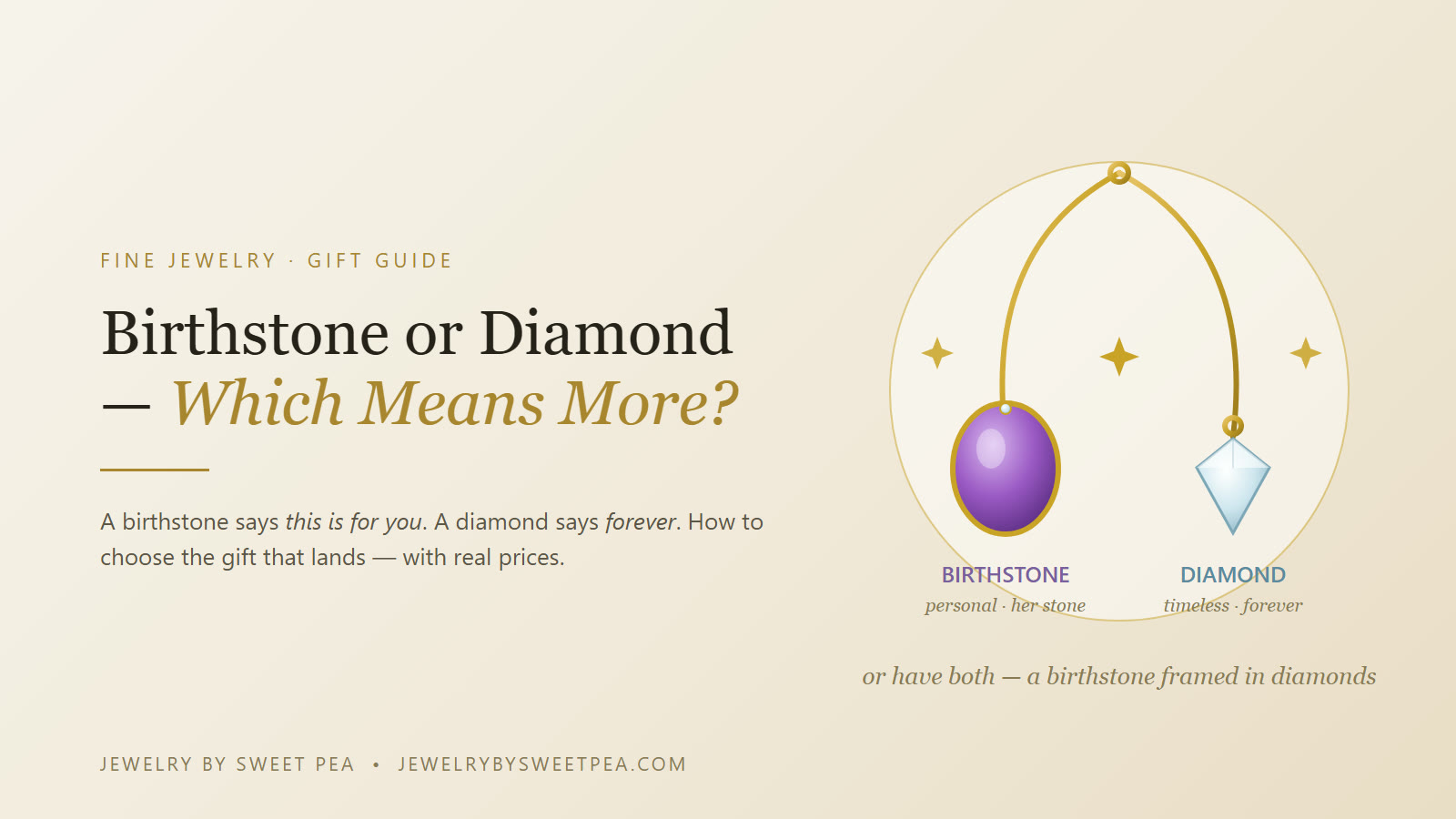
The short answer: a birthstone usually carries more personal meaning — it's tied to a specific person, month, or memory, so it says “this is for you.” A diamond carries more universal meaning — timelessness, milestone, forever. For most everyday gifts the birthstone wins on heart; for engagements and once-in-a-lifetime moments, the diamond wins on weight. The happiest answer is often a piece that has both.
This is the question we hear most often when someone is choosing a gift and standing between the colorful case and the sparkly one. Both are wonderful; they just speak different languages. After years of helping families pick gifts that actually get worn, here's an honest, parent-to-parent comparison — what each one means, what they cost, and how to choose the one that lands.
What does a birthstone gift actually say?
A birthstone is personal by design. Each month has its own gem — garnet for January, amethyst for February, aquamarine for March, on through to blue topaz and citrine in the winter — so the stone you choose is hers, or her child's, or the month something important happened. (The Gemological Institute of America keeps a lovely month-by-month birthstone guide if you want to confirm the right one.)
That specificity is the whole point. A birthstone gift quietly says I know you, I thought about you specifically. It's why birthstone pieces are the runaway favorite for moms (one stone per child is a perennial), for daughters, and for anyone you want to feel seen rather than simply given something nice.
It's also the most budget-friendly way to give real, solid-gold jewelry. A piece like our 14K Yellow Gold Diamond & Citrine Birthstone Pendant (about $74) pairs a genuine November citrine with a tiny accent diamond in solid 14K gold — meaningful, real metal, and under a hundred dollars. If she wears rings more than pendants, a 10K Yellow Gold Genuine Aquamarine Birthstone Ring (about $162) puts her March stone front and center in solid gold.
What does a diamond gift say?
A diamond speaks a different language: permanence and significance. It isn't tied to a month or a memory the way a birthstone is — instead it carries a shared, cultural meaning of this matters, and it's meant to last forever. That's exactly why it's the stone of engagements, landmark anniversaries, and milestone birthdays.
Diamonds also win on pure versatility and longevity of look. A white diamond goes with everything and never reads as “dated,” and it's the hardest gem there is, so it shrugs off decades of daily wear. The most-worn diamond gift of all is a simple pair of studs — our 10K White Gold Round 4-Prong .20Ct. Diamond Stud Earrings (about $320) are the classic: real diamonds, solid gold, a secure four-prong setting she'll reach for every single day.
If you want maximum sparkle for the money and you're comfortable with a modern, certified stone, a lab-grown diamond stretches the budget remarkably far. Our 14K White Gold 1/3 Carat Certified Lab-Grown Diamond Solitaire Pendant (about $188) is a genuine, certified diamond — chemically identical to a mined one — for the price of a smaller natural stone. We label it plainly as lab-grown, because you deserve to know exactly what you're giving.
Birthstone vs diamond, side by side
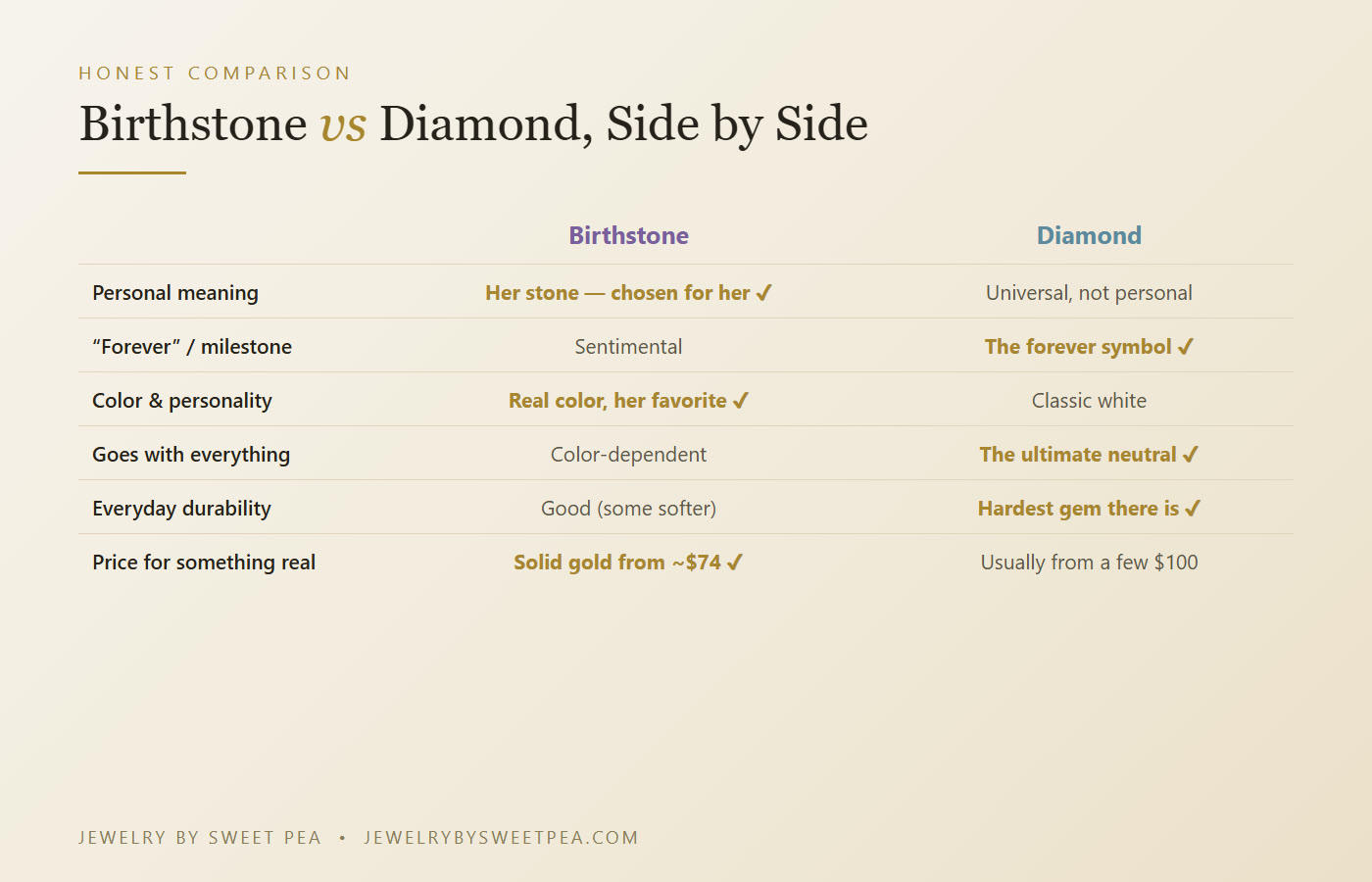
Here's the honest trade-off in plain terms:
- Personal meaning: Birthstone wins. It's tied to a specific person or month, so it feels chosen-for-her.
- Universal “forever” meaning: Diamond wins. It carries milestone and permanence without a word.
- Color & personality: Birthstone wins. Real color, and a chance to match her favorite shade or style.
- Goes-with-everything versatility: Diamond wins. White diamonds are the ultimate neutral.
- Everyday durability: Diamond wins on hardness, though most birthstones (topaz, garnet, amethyst) are plenty durable for normal wear; softer stones like opal and pearl need a little more care.
- Price to give something real: Birthstone wins. Solid-gold birthstone pieces start under $100; comparable diamond pieces usually start a few hundred.
Notice that neither is “better.” They're optimized for different feelings. The trick is matching the stone to the message you want the gift to send.
Why not both? The best-of-both option
Our most-given gifts quietly solve the whole debate: a birthstone framed by diamonds. You get the personal meaning of her stone and the sparkle and significance of diamonds in one piece. A great example is the 10K Yellow Gold Oval Amethyst & Diamond Pendant (about $132) — a genuine February amethyst at the center with diamond accents around it. It says “this is your stone” and “you matter” at the same time.
For a richer, more grown-up version of the same idea, the 14K Yellow Gold Diamond & Ruby Birthstone Pendant (about $118) pairs a deep July ruby with a diamond in heavier 14K gold — a birthstone gift that still feels like a real occasion. These combination pieces are, honestly, the easiest “can't go wrong” choice when you're torn.
How to choose: which one is right for your gift?
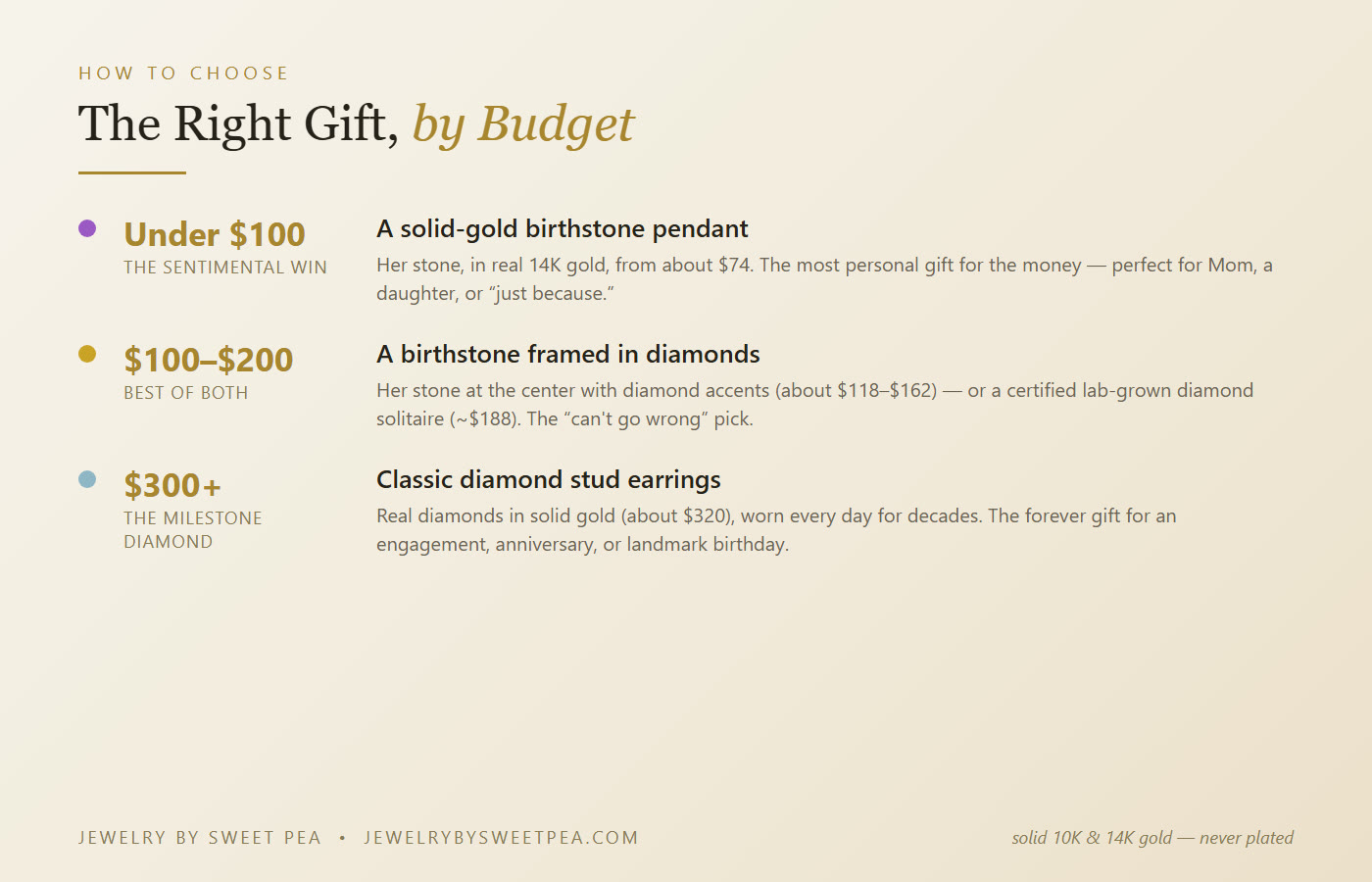
Use the occasion and the relationship as your guide:
- Choose a birthstone when you want it to feel personal and thoughtful: Mother's Day, a daughter's or granddaughter's birthday, a “just because” gift, a new baby (mom often loves the baby's stone), or any moment where I was thinking of you specifically is the message.
- Choose a diamond when the moment is a milestone: an engagement, a big anniversary, a 16th, 21st, 40th or 50th birthday, a graduation, or a once-in-a-lifetime “forever” gift.
- Choose both when you want the safest, most-loved option, or when the birthstone is a softer/less-sparkly stone and you want a little diamond fire alongside it.
Picks by budget
- Under $100 — the sentimental win: a solid-gold birthstone pendant (about $74). Personal, real metal, worn for years.
- $100–$200 — the best-of-both: a birthstone-and-diamond pendant (about $132), a ruby & diamond pendant (about $118), or a genuine birthstone ring (about $162). A certified lab-grown diamond solitaire (about $188) also lives here.
- $300+ — the milestone diamond: classic diamond stud earrings (about $320), the piece she'll wear every day for decades.
Prices shown are at the time of writing; solid gold and diamond pieces move with the market.
One thing that matters more than the stone: the metal
Whichever you choose, the gift only becomes an heirloom if the metal is real. Plated and “gold-tone” jewelry is base metal under a microscopic gold coating that wears through — often within a year of regular wear — leaving a dull, discolored piece nobody keeps. Solid 10K or 14K gold is gold all the way through; it can be polished back to new for decades. 14K gold is 58.3% pure (richer color), 10K is 41.7% pure (a touch paler, harder, more affordable) — both are genuinely solid gold and both last generations.
In the U.S., how a seller may describe precious-metal content is governed by the FTC Jewelry Guides (16 CFR Part 23). A listing that won't plainly state the karat — or whether a diamond is natural or lab-grown — is telling you something. Everything we sell is stamped, solid 10K or 14K gold or genuine sterling silver, with diamonds and gems described honestly, because the meaning of a gift falls apart fast if the piece doesn't.
Frequently asked questions
Is a birthstone or a diamond more personal as a gift?
A birthstone is more personal. Because each gem is tied to a specific month, it's chosen for one particular person, which reads as “I was thinking of you.” A diamond is more universal — it signals milestone and forever rather than a personal connection. For thoughtful everyday gifts, birthstones usually feel more personal; for engagements and big milestones, a diamond carries more weight.
Are birthstones real gemstones or cheaper substitutes?
Genuine birthstone jewelry uses real gems — genuine amethyst, citrine, aquamarine, garnet, topaz and so on — not glass or plastic. Some pieces use lab-created versions of pricier stones (like created ruby or sapphire), which are real gemstones grown in a lab and should be labeled as such. We state plainly whether a stone is genuine or created so you know exactly what you're giving.
Is a lab-grown diamond a “real” diamond?
Yes. A lab-grown diamond is chemically and optically identical to a mined diamond — it's real carbon crystal, just grown in a lab instead of the earth. It typically costs significantly less, so you can give a larger or higher-quality certified stone for the same budget. The only thing that matters is that the seller labels it clearly as lab-grown, which we always do.
Which lasts longer for everyday wear, a birthstone or a diamond?
A diamond is the hardest gem and the most scratch-resistant, so for a piece worn every single day it has the edge. That said, many birthstones — topaz, garnet, amethyst — are plenty durable for normal wear. Softer stones like opal and pearl are beautiful but need a little more care. In every case the gold setting matters as much as the stone: solid gold is what carries it through the decades.
What if I can't decide between a birthstone and a diamond?
Choose a piece that has both. A birthstone framed by diamonds — like an amethyst-and-diamond pendant (about $132) — gives you her personal stone and diamond sparkle in one gift. It's the most reliable “can't go wrong” choice when you're torn, and usually costs less than a diamond-only piece of similar size.
Jewelry by Sweet Pea is a family-run fine jewelry store. Every piece is solid 10K or 14K gold or sterling silver — never plated — with diamonds and gemstones described honestly, sourced from U.S. wholesalers and shipped from the USA. Browse Pendants & Charms, Rings, and Earrings, or ask us anything before you buy.