
Buying Jewelry Online vs In a Local Store: Which Gets You Better Quality for the Money?
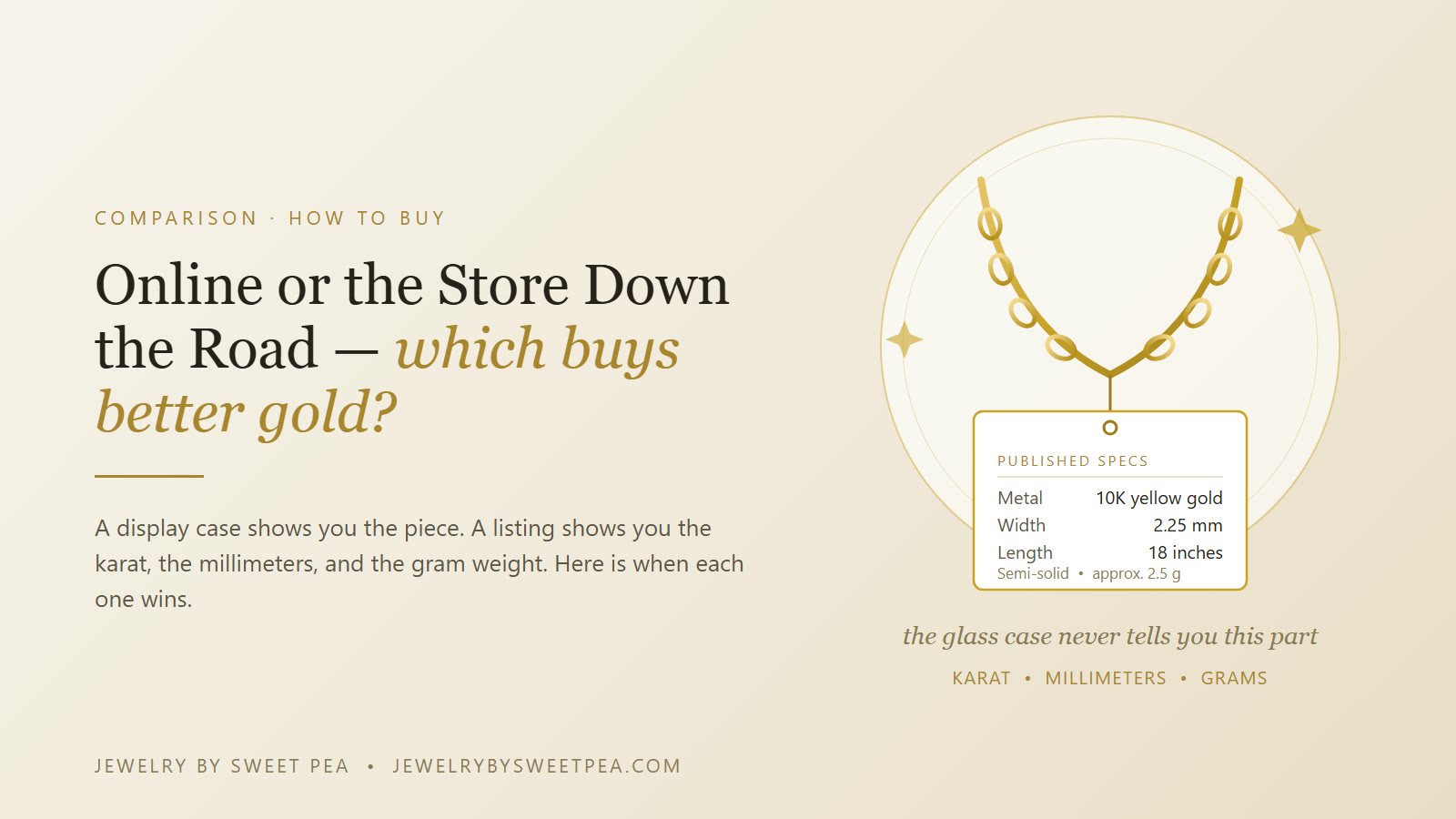
The short answer: online usually wins on price and on knowing what you are buying, because the listing has to publish the karat, width, length, and gram weight a display case never shows you. A local store wins when fit, skin tone, or scale is the deciding factor. Buy spec-driven pieces online; try on anything sized.
We are an online store, so treat what follows accordingly — but the honest version helps you more than the flattering one. There are pieces we would tell you to go handle in person, and pieces where walking into a shop costs you money for nothing. The difference is not price. It is whether the thing you need to judge can be written down.
Why is the same gold chain cheaper online?
Not because the gold is different. Gold is a commodity; a gram of 10K yellow gold costs a wholesaler in Ohio what it costs a wholesaler in Georgia. The difference is what sits on top of that gram.
A storefront carries rent, insured display inventory that may sit for a year before selling, sales staff, and security. Those are real costs for a real service, and they are recovered in the markup. An online store carries none of the frontage and stocks against orders, so the same piece leaves at a smaller multiple of its metal cost. What you give up is the thirty seconds of holding it.
What can a local store do that a website genuinely cannot?
Four things, and they are not small:
- Sizing a ring on your actual finger. Printable sizers and string tricks are approximations; knuckle shape, seasonal swelling, and band width all move the answer. A jeweler with steel sizers gets it right the first time.
- Judging metal color against your skin. Yellow, white, and rose gold read differently on different complexions, and no screen is color-accurate. If you have never worn rose gold, seeing it on your own wrist settles it in a second.
- Scale. A pendant is photographed alone on a white field. It is 14 millimeters. People are routinely surprised in both directions.
- Repairs, resizing, and cleaning. A relationship with a bench jeweler is worth having, and worth paying a little more to build. This is the strongest argument for local — and it has nothing to do with the original purchase.
How do you judge quality online when you cannot hold the piece?
You read the spec block — and here the advantage flips hard, because a display case does not have one. A card in a glass case says "10K Gold Rope Chain, $340." It does not give the width, the length, whether the construction is solid, semi-solid, or hollow, or what it weighs. You would have to know to ask.
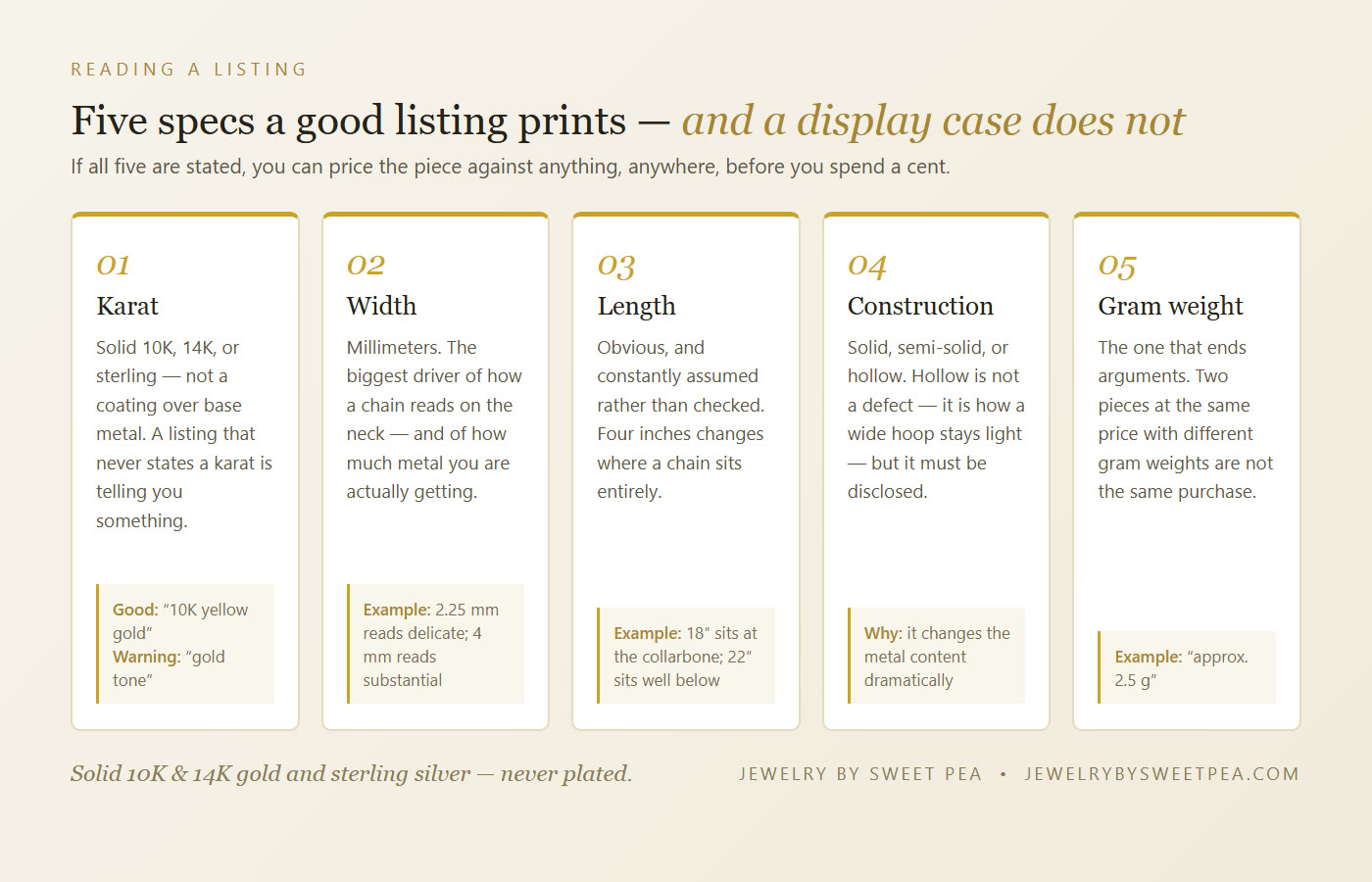
Five specs decide whether a gold piece is worth its price. Every one of them is printed on a good listing:
- Karat. 10K, 14K, or sterling silver — solid metal, not plating. The FTC Jewelry Guides (16 CFR Part 23) set the federal rules for how karat gold, gold-filled, and gold-plate may be described in the United States. A listing that never states a karat is telling you something.
- Width in millimeters. The single biggest driver of how a chain reads on the neck, and of how much metal you are getting.
- Length. Obvious, and constantly assumed rather than checked.
- Construction. Solid, semi-solid, or hollow. Hollow is not a defect — it is how you get a substantial-looking hoop that does not drag on your earlobe — but it must be disclosed, because it changes the metal content dramatically.
- Gram weight. The one that ends arguments. Two chains at the same price with different gram weights are not the same purchase.
For example, our 10K Yellow Gold 2.25mm Semi-Solid Diamond-Cut Rope Chain (about $271) lists all five: 10K, 2.25mm, 18 inches, semi-solid, approximately 2.5 grams. You can price that against anything, anywhere, before you spend a cent.
A real comparison: two chains, nearly the same price
Here is why the spec block is not academic. Two rope chains from our own catalog, priced within two dollars of each other:
- 2.25mm diamond-cut, 18 inches — about $271
- 2.5mm polished, 22 inches — about $269
Same metal, same construction, essentially the same money — and the second is wider and four inches longer. That does not make it the better buy: if you want a chain sitting at the collarbone, 22 inches is simply wrong for you, and the diamond-cut finish catches considerably more light. It makes it the better buy for a different person — and you can see that and decide. In a display case, those two chains look like the same necklace at the same price.
Where diamonds change the calculation
With gemstones the published specs matter even more, because "diamond stud earrings" spans two orders of magnitude in price. Carat weight, clarity, color, and setting are what you are buying, and the Gemological Institute of America's overview of diamond quality explains what those grades mean.
Our 10K White Gold 4-Prong .20Ct Diamond Studs (about $341) publish it in full: 0.186 carat total weight, 2.9mm stones, I2 clarity, G–I color, four-prong setting. I2 is an included clarity grade — that is exactly why they are $341 and not $1,300 — and at 2.9mm on an earlobe, that is a trade most people make happily once it is stated plainly.
If you want visible size for less, black diamonds are the honest shortcut, since clarity grading does not apply the same way to an opaque stone. The 14K White Gold .40Ct Black Diamond Studs (about $185) carry twice the carat weight in a higher karat gold for roughly half the price, and are made in the USA.
What should you buy where?
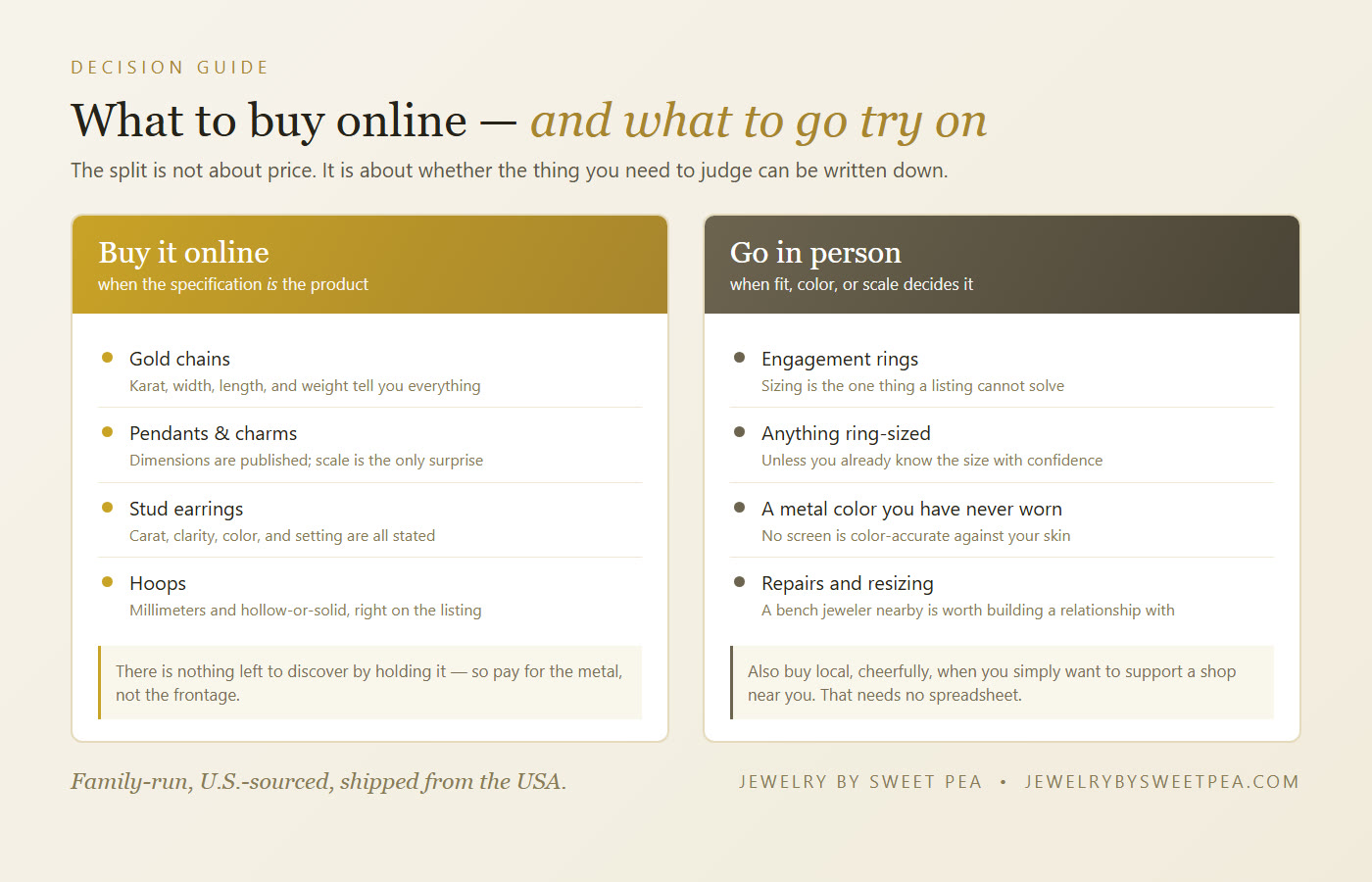
Buy online when the specification is the product: gold chains, pendants and charms, stud earrings, and hoops. Our 10K Yellow Gold Polished and Satin Hoops (about $93) and 10K Claddagh Hollow Hoops (about $101) both publish their millimeter dimensions and state the hollow construction. There is nothing left to discover by holding them.
Buy local for engagement rings and anything ring-sized you cannot return easily, for a first purchase in a metal color you have never worn, and when you want the reassurance of a person who will stand behind it in the same town. Also buy local, cheerfully, when you simply want to support a shop near you. That is a legitimate reason and does not need a spreadsheet.
Are you protected buying jewelry online?
More than most people realize. The FTC's Mail, Internet, or Telephone Order Merchandise Rule (16 CFR Part 435) requires a seller to ship within the time promised, or within 30 days if none was stated, and to offer you a delay-or-refund choice otherwise. Paying by credit card adds a chargeback right on top.
What is not covered by law is the return policy itself, so read it before you order — the window, who pays return shipping, and whether personalized or specially-sized items are excluded. If anything about a piece is unclear before you buy, ask us and we will measure it and tell you.
Browse the pieces in this article in Necklaces, Earrings, and Pendants & Charms. Prices are as of writing; solid gold moves with the gold market.
Frequently asked questions
Is jewelry cheaper online than in a store?
Usually yes, for the same specification, because an online seller is not recovering retail rent, floor staff, and long-held display inventory in the markup. The saving is real but not enormous on solid gold, since most of the price is the metal itself. Be skeptical of a price far below everything else at the same karat and gram weight — that gap is usually a specification difference, not a bargain.
How can I tell if gold jewelry is real when buying online?
Look for a stated karat — 10K, 14K, 18K — rather than "gold tone", "gold finish", or "gold plated", which describe a coating over base metal. A genuine listing also gives width, length, and usually gram weight. Vagueness on all of the above is the warning sign, not the price.
Should I buy an engagement ring online?
Only if you already know the ring size with confidence and the return policy is generous, because sizing is the one thing a listing cannot solve for you. For most people a local jeweler is the better route here, even at a higher price — the comfort of resizing in person is worth paying for on the one piece that has to be right.
What does semi-solid or hollow mean in a chain listing?
It describes how much metal is actually in the links. Solid is filled through; hollow has a tube-like cross-section; semi-solid sits between. Hollow and semi-solid let you wear a wider, more substantial-looking chain at a lower weight and price, which is often exactly what you want. It only becomes a problem when a seller does not disclose it.
Can I return jewelry bought online if it does not look right?
That depends on the seller's policy rather than on law, so check it before ordering: the length of the return window, whether return shipping is paid, and whether engraved, personalized, or specially-sized pieces are excluded. Those exclusions are common and reasonable, since such a piece cannot be resold. Federal shipping-timeline rules apply separately, to every online order.
Jewelry by Sweet Pea is a family-run fine jewelry store. Every piece we sell is solid 10K or 14K gold or sterling silver — never plated base metal — sourced from U.S. wholesalers and shipped from the USA. Browse Necklaces and Earrings, or ask us anything.