
College Class Rings vs Licensed Team Pendants: Which Do Graduates Actually Wear More?
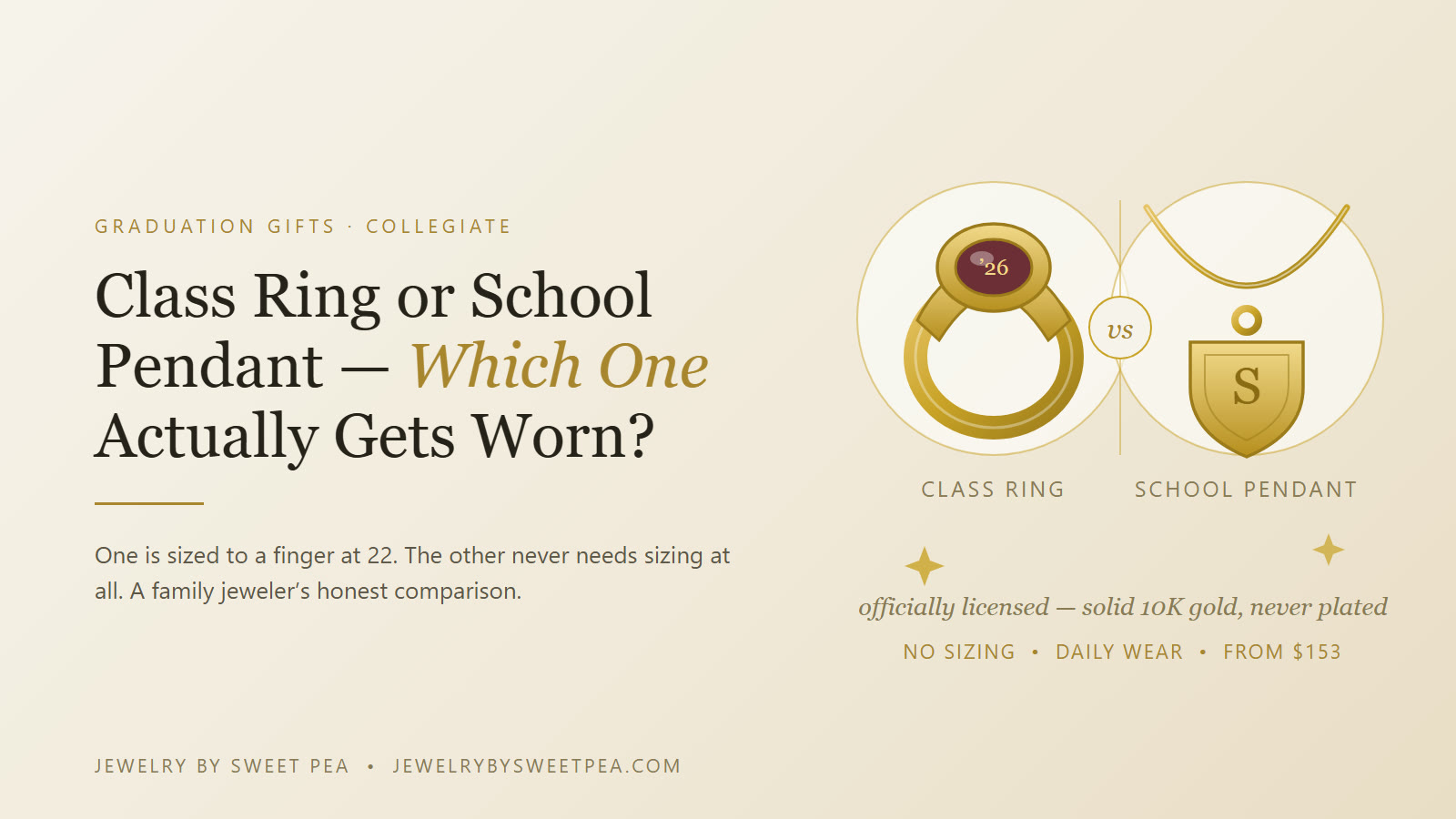
The short answer: the pendant. A class ring is sized to one finger at age 22 and reads as formal jewelry; a licensed collegiate pendant is size-free, layers with everything a graduate already owns, and works on a Tuesday commute. Rings win on ceremony and tradition. Pendants win on the thing that actually matters — days worn per year.
Both are good gifts. But parents ask us this question every spring and every December, and the honest answer isn't "whichever you like better." The two pieces fail and succeed for different, very predictable reasons. Here's how we talk it through with families at our counter.
Why do class rings so often end up in a drawer?
Nothing about a class ring is wrong. The problem is that it's the one piece of graduation jewelry that has to keep fitting.
- Fingers change. Ring size at 22 is rarely ring size at 32. Weight, pregnancy, medication, heat, cold, even the job someone takes — all of it moves finger size. A pendant has no size to outgrow.
- Class rings are physically large. A wide band with a raised stone catches on gloves, keyboards, gym equipment and scrubs. That's fine for a keepsake worn on occasions, and genuinely inconvenient for daily wear.
- They compete with the wedding ring. Somewhere in the late twenties, most people's ring hand gets spoken for. The class ring moves to the right hand for a while, then to the box.
- Resizing has limits. A plain band resizes easily. A class ring with a full sizing panel, engraved shanks and a set stone is a harder, costlier job — and some designs can only move a size or two before the artwork distorts.
None of that makes a class ring a bad purchase. It makes it a ceremonial purchase — something meant to be significant rather than constant. If that's what a family wants, it's the right choice, and we'll say so.
What exactly is a "licensed" collegiate pendant?
"Licensed" means the school's marks — the block letter, the mascot, the paw — are reproduced under a formal trademark license with the university, usually through a collegiate licensing agency (the largest is the Collegiate Licensing Company, which represents a large share of U.S. universities). The logo shape is approved by the school, not approximated by a factory.
That matters for two practical reasons. First, the artwork is correct — a Tiger Paw is the actual Tiger Paw, not a paw-ish shape. Second, licensed pieces are made by manufacturers held to the school's material standards, which is why the collegiate line we carry is genuinely solid 10K gold rather than gold-tone base metal.
Which one actually gets worn more?
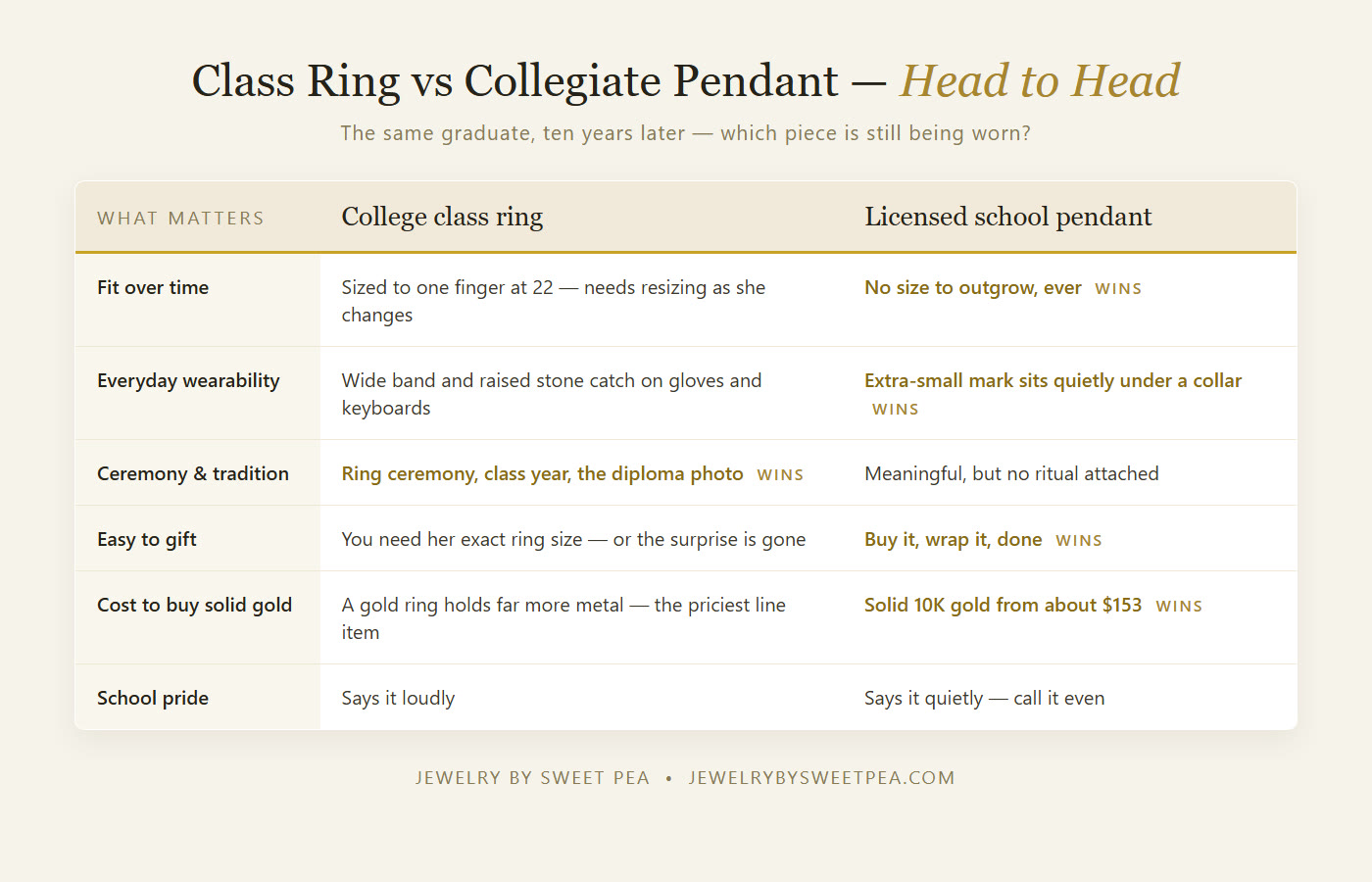
Set sentiment aside and compare the two the way you'd compare any two objects someone has to live with:
- Fit over time — Ring: must be resized as the wearer changes. Pendant: no fit, ever. Advantage: pendant.
- Wearable at work — Ring: depends entirely on the job. Pendant: an extra-small pendant sits under a collar and reads as a fine gold necklace. Advantage: pendant.
- Ceremonial weight — Ring: unmatched. The ring ceremony, the class year, the hand on the diploma photo. Advantage: ring.
- Gifting flexibility — Ring: you need her exact size, which means either asking (and ruining the surprise) or guessing. Pendant: buy it, wrap it, done. Advantage: pendant.
- Cost to enter solid gold — Ring: a gold class ring is usually the most expensive line item in a graduation package, because a ring simply contains more metal. Pendant: solid 10K collegiate pendants start around $153. Advantage: pendant.
- Game-day identity — Even. Both say the school out loud; the pendant just does it in a smaller voice.
Add it up and the pendant wins on five of six, and loses the one category that only matters on a single day. That's the whole answer — the ring is for the day, the pendant is for the decade after it.
What do solid gold collegiate pendants cost?
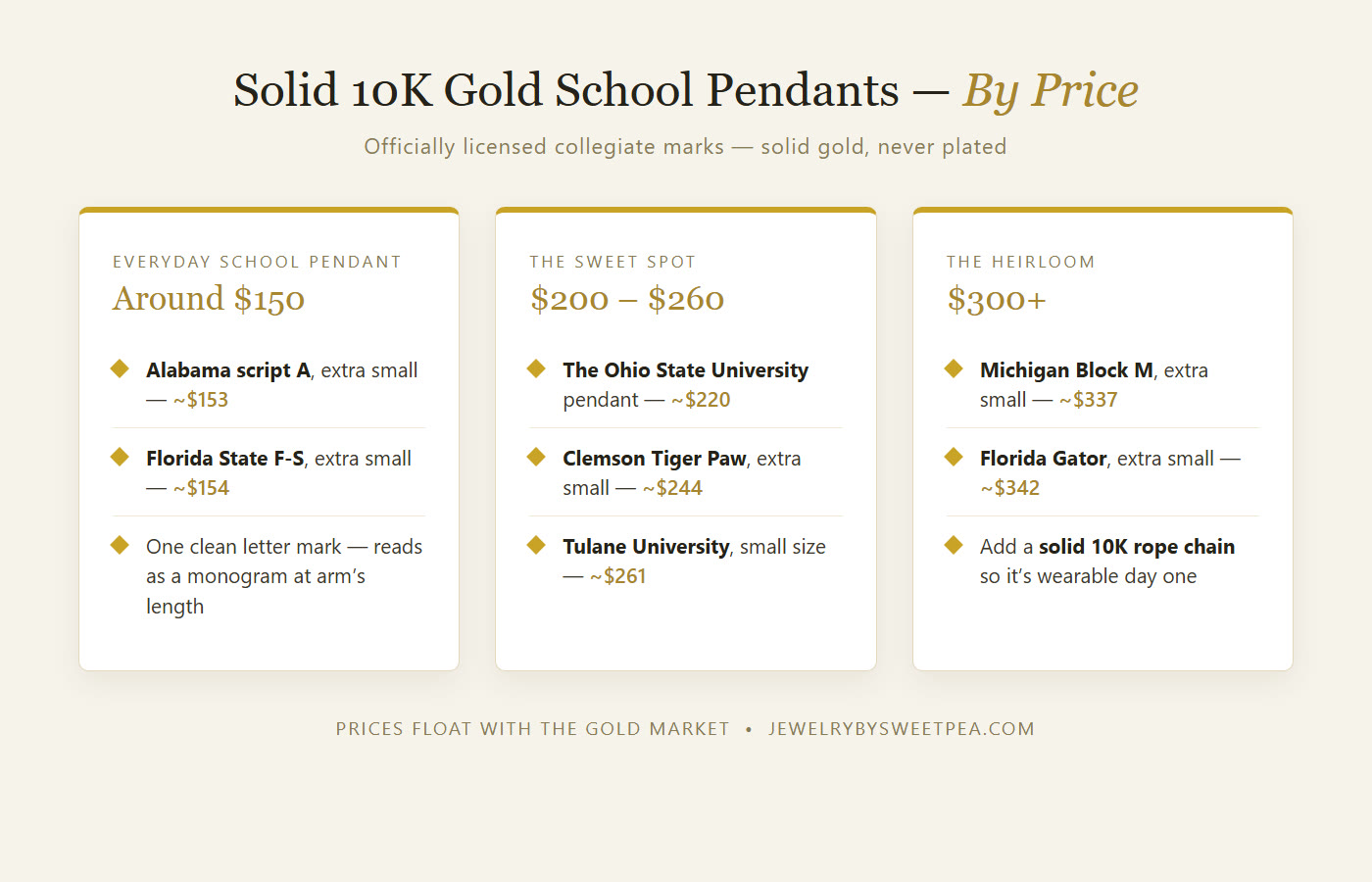
Every piece below is solid 10K yellow gold — officially licensed, stamped, and in stock as we write this.
Around $150 — the everyday school pendant
- 10K Gold University of Alabama Script A — about $153. The cleanest possible version of a school pendant: one letter, solid gold, nothing to date it.
- 10K Gold Florida State F-S Pendant — about $154. Interlocking letters read as a monogram at conversation distance.
$200–$260 — the sweet spot
- 10K Gold The Ohio State University Pendant — about $220.
- 10K Gold Clemson Tiger Paw Pendant — about $244. A mascot mark rather than letters, which tends to age better than a wordmark.
- 10K Gold Tulane University Pendant — about $261, in the larger "small" size.
$300+ — the heirloom tier
- 10K Gold University of Michigan Block M — about $337.
- 10K Gold University of Florida Gator — about $342. More gold weight and more detailed sculpting than the letter marks.
Prices are as of writing; solid gold moves with the gold market. More schools are in our Sports & Collegiate charms and the wider Pendants & Charms collection. If a school isn't listed, ask us — the licensed line is far deeper than what shows on any one page.
Don't gift the pendant without a chain
A pendant given alone gets set aside "until I find a chain" and sometimes stays there for years. Match the metal and karat, keep the chain narrower than the pendant's bail, and choose a lobster clasp for anything worn daily. Our 10K Yellow Gold 1.5mm Extra-Light Diamond-Cut Rope Chain (about $283, shown in 16″ with 18″–30″ also offered) carries an extra-small collegiate pendant well without overpowering it. More options are in the Necklaces collection.
One karat note: 10K gold is 41.7% pure and 14K is 58.3%. Both are real, solid gold and both are legally required to be described accurately — the FTC Jewelry Guides (16 CFR Part 23) govern how gold content may be stated. If a listing won't tell you the karat plainly, that silence is the answer.
When the class ring is genuinely the better buy
We'd steer a family toward the ring in three situations. When the graduate has already said they want one — wanting it is most of what makes it worn. When there's a family ring tradition and the ring is the point. And when the school has a real ring ceremony, because the object is inseparable from that memory.
Everywhere else — a surprise gift, an unknown ring size, a graduate heading into a hands-on career, or a budget that has to buy solid rather than plated — the pendant is the piece that gets worn.
Frequently asked questions
Do college graduates still wear class rings?
Some do, and they're often the graduates who chose the ring themselves rather than receiving it as a surprise. The pattern we see is that class rings get worn heavily for a year or two after commencement and then move to occasional wear, largely because ring size changes and the ring hand eventually gets claimed by a wedding band.
Is a licensed collegiate pendant too casual for work?
An extra-small pendant is roughly the size of a fingernail. Under a collar it reads as a fine gold necklace, and the school detail only reveals itself up close — which is exactly what you want in a professional wardrobe. Choose a letter or monogram mark over a large enameled logo if the workplace is conservative.
Can a college class ring be resized later?
Usually, but with limits. Engraved shanks, a set stone and a sizing panel make the job more involved than resizing a plain band, and heavily decorated designs can only move a size or two before the artwork distorts. Ask before you buy how many sizes the specific design tolerates.
Should I buy 10K or 14K gold for a school pendant?
10K is harder and more scratch-resistant, and it puts solid gold within reach at a lower price. 14K has a richer color. For a recent graduate wearing the piece through workouts, commutes and travel, 10K is the durable, budget-smart pick — not a compromise. Both are solid gold and both outlast the wearer with basic care.
What if I don't know which school pendant to buy?
Buy the school she actually talks about. Graduate school beats undergrad if that's the identity she claims; the undergrad campus wins if that's where the friendships are. If you truly can't tell, a plain solid gold chain plus a note saying "pick your pendant" is a graceful out — and the chain is the piece she'd have needed anyway.
Jewelry by Sweet Pea is a family-run fine jewelry store. Every piece we sell is solid 10K or 14K gold or sterling silver — never plated — sourced from U.S. wholesalers and shipped from the USA. Browse the collegiate collection or ask us anything before you buy.