
Dainty Jewelry vs Statement Jewelry Which Style Gets Worn More Often in Real Life
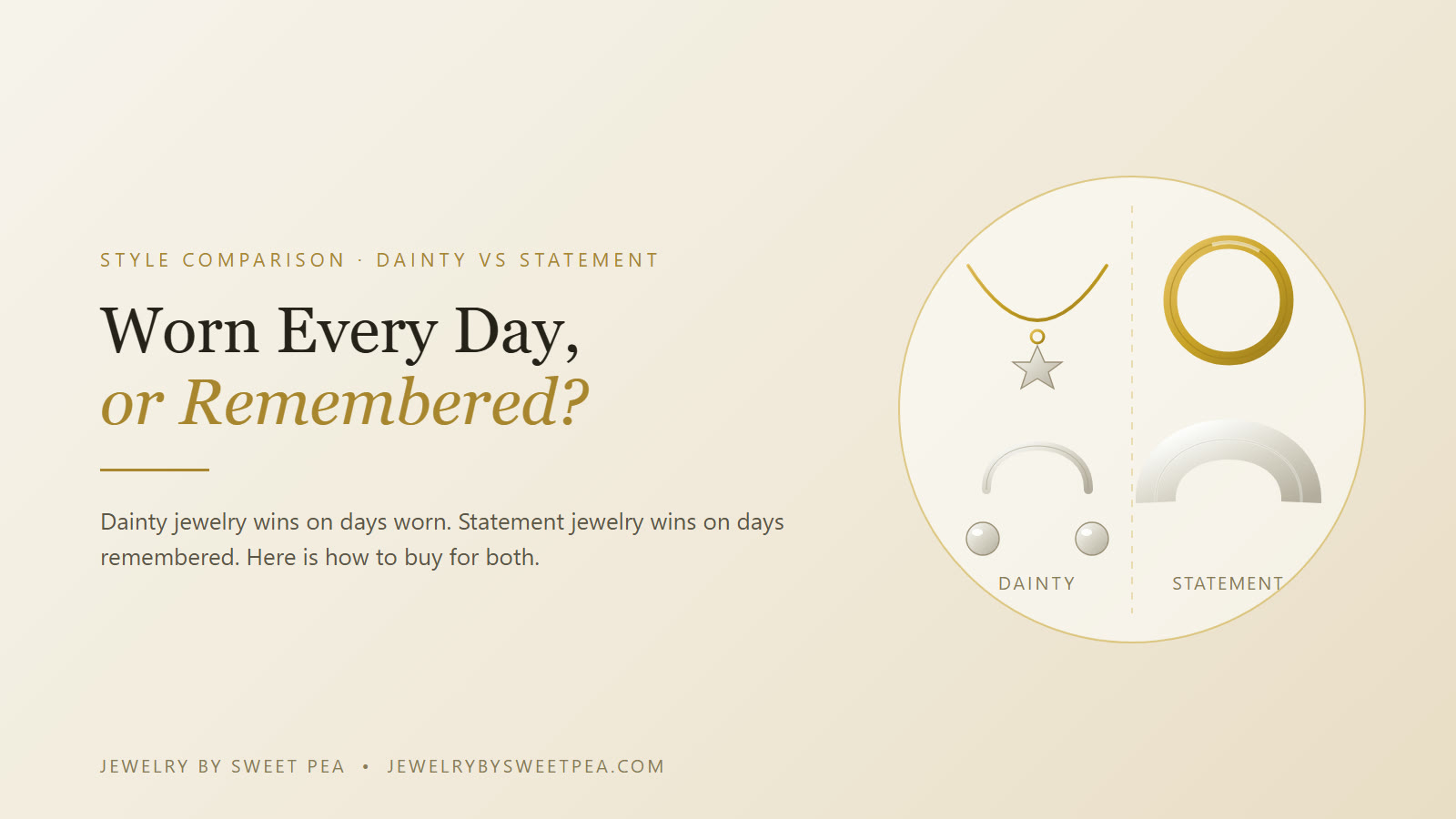
The short answer: Dainty jewelry gets worn far more often — most people wear a fine chain or small studs almost every day, while a statement piece comes out a handful of times a year. But statement jewelry earns its keep differently: it gets remembered. If you are buying one piece, buy dainty. If you are building a jewelry box, you need both.
We get this question in some form almost every week, usually from someone holding a gift receipt. She loved the big earrings, but has she worn them? He bought the delicate necklace, but is it too plain? Both worries are reasonable, and both come from measuring the wrong thing.
What actually counts as dainty, and what counts as statement?
There is no industry definition, so here is the working one we use on the sales floor:
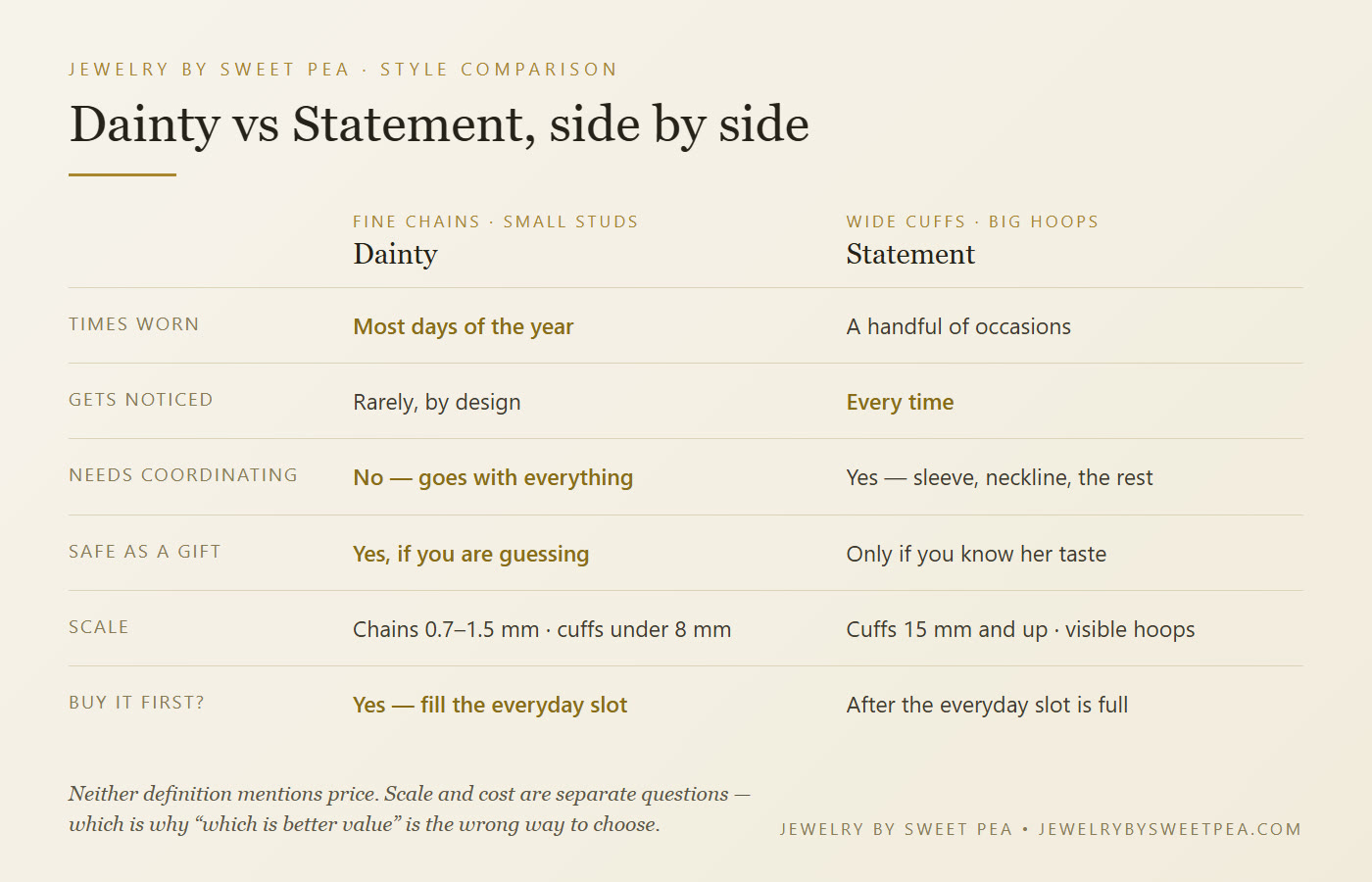
- Dainty — the piece reads as a detail, not an object. Chains around 0.7 mm to 1.5 mm. Pendants under about 15 mm. Studs you notice from three feet away, not thirty. Cuffs and bangles under about 8 mm wide.
- Statement — the piece is the outfit's main event. Hoops you can see across a room. Cuffs 15 mm wide and up. Anything with visible scale, texture, or movement.
Notice that neither definition mentions price. A quarter-carat lab-grown diamond stud is dainty and costs more than a wide silver cuff. Scale and price are separate questions, which is exactly why "which is better value" is the wrong frame.
Which one actually gets worn more often?
Dainty, and it is not close. We do not run a study, so we will not pretend to have a statistic — but we do read our own return notes, our repair bench, and what customers tell us when they come back. Three consistent patterns:
Dainty pieces get put on without a decision. A fine chain or a pair of small studs is the jewelry equivalent of a watch. It does not need to be coordinated with anything, so it never has to wait for the right occasion. That is the whole mechanism: the pieces that require no decision get worn the most.
Statement pieces wait for an invitation. A 20 mm cuff is spectacular and it is also a commitment. It has to agree with the sleeve, the neckline, and the rest of what you are wearing. That is not a flaw — but it means the piece is used a dozen times a year, not three hundred.
The wear gap shows up on the bench. The pieces that come to us with worn clasps, thinned links, and rubbed-off finishes are almost always the small everyday ones. Statement pieces come in looking new, because they have been in a box.
So why buy statement jewelry at all?
Because wear-count is not the only thing jewelry does. A dainty chain is the thing you forget you are wearing. A statement piece is the thing someone compliments, the thing in the photograph, the thing your daughter asks to borrow. Those are different jobs.
The honest version of the trade-off: dainty jewelry buys you days, statement jewelry buys you moments. If someone tells you a wide cuff is a bad buy because it only comes out six times a year, ask them what six memorable evenings are worth. That is a values question, not a jewelry question, and it is yours to answer.
If you can only buy one piece, which should it be?
Dainty — with one condition. Buy dainty in a metal that can take daily wear, which means solid gold or solid sterling silver, never plated base metal.
This matters more for dainty than for statement pieces, precisely because dainty pieces get worn constantly. A plated piece worn twice a year may look fine for a decade. The same plating worn daily against skin, soap, and a seatbelt will show brass at the edges within months. Everything below is solid 10K or 14K gold, or solid sterling silver. The U.S. FTC Jewelry Guides (16 CFR Part 23) govern how these terms must be used, which is why "gold-tone" and "10K gold" are not interchangeable words on any honest site.
One clarification we make often: several of our sterling pieces are described as rhodium-finished. That is a thin bright, tarnish-resistant layer applied over solid sterling silver. It is not the same thing as plating over brass — the metal underneath is still silver.
Dainty picks that hold up to daily wear
All prices below are current on our site at the time of writing and quoted as "about," because gold and silver prices move. Stock counts were read live when this article was built.
- Sterling Silver Cut-Out Star Pendant Necklace — about $53. A 10 mm star on a 17.5-inch cable chain, with an anti-tarnish finish and a spring ring clasp. This is the shape of piece that never comes off: small enough to sit under a collar, interesting enough to wear alone.
- 10K White Gold Polished CZ Stud Earrings — about $99. Baguette-cut CZ in solid 10K white gold, 3.24 mm across, post and push back. The everyday stud that does not need to be taken out at night.
- 14K White Gold 1/4 Carat Lab-Grown Diamond Solitaire Studs — about $173. The upgrade version of the same idea: 0.256 ctw of VS+ clarity, F+ color lab-grown diamond in a 3-prong martini setting. If the clarity and color grades are new to you, GIA's explanation of the 4Cs is the clearest free reference we know of.
More in necklaces and earrings.
Statement picks that earn their place in the box
- 10K Yellow Gold Polished and Satin Hoop Earrings — about $111. Roughly 18 mm, in solid 10K yellow gold, with a satin texture against a polished edge so they catch light without stones. These are the crossover piece — big enough to register, small enough to wear to work.
- Sterling Silver Polished Textured Cuff Bangle — about $123. A 7.15 mm slip-on cuff made in Italy. Wide enough to read as intentional, narrow enough to stack or wear with a watch.
- Sterling Silver 20mm Cuff Bangle Bracelet — about $283. The genuine statement piece: 20 mm wide, hollow and concave so it stays comfortable, polished, and engravable. This is a bare-wrist, three-quarter-sleeve bracelet, and it will be the thing people mention.
More in bracelets.
How to split a budget between the two
A rough allocation that has served our customers well:
- Under $150 total. Spend it all on dainty. One solid-metal chain or one pair of studs, worn daily, beats two pieces that split the difference. The star pendant at about $53 plus the 10K CZ studs at about $99 is a complete everyday set for roughly $152.
- $150 to $300. Buy one good dainty piece and one crossover piece. The lab-grown diamond studs at about $173 plus the textured cuff at about $123 covers both an everyday anchor and something with presence.
- $300 and up. Now a true statement piece makes sense, because the daily slots are already filled. The 20 mm cuff at about $283 is the piece that does the remembering.
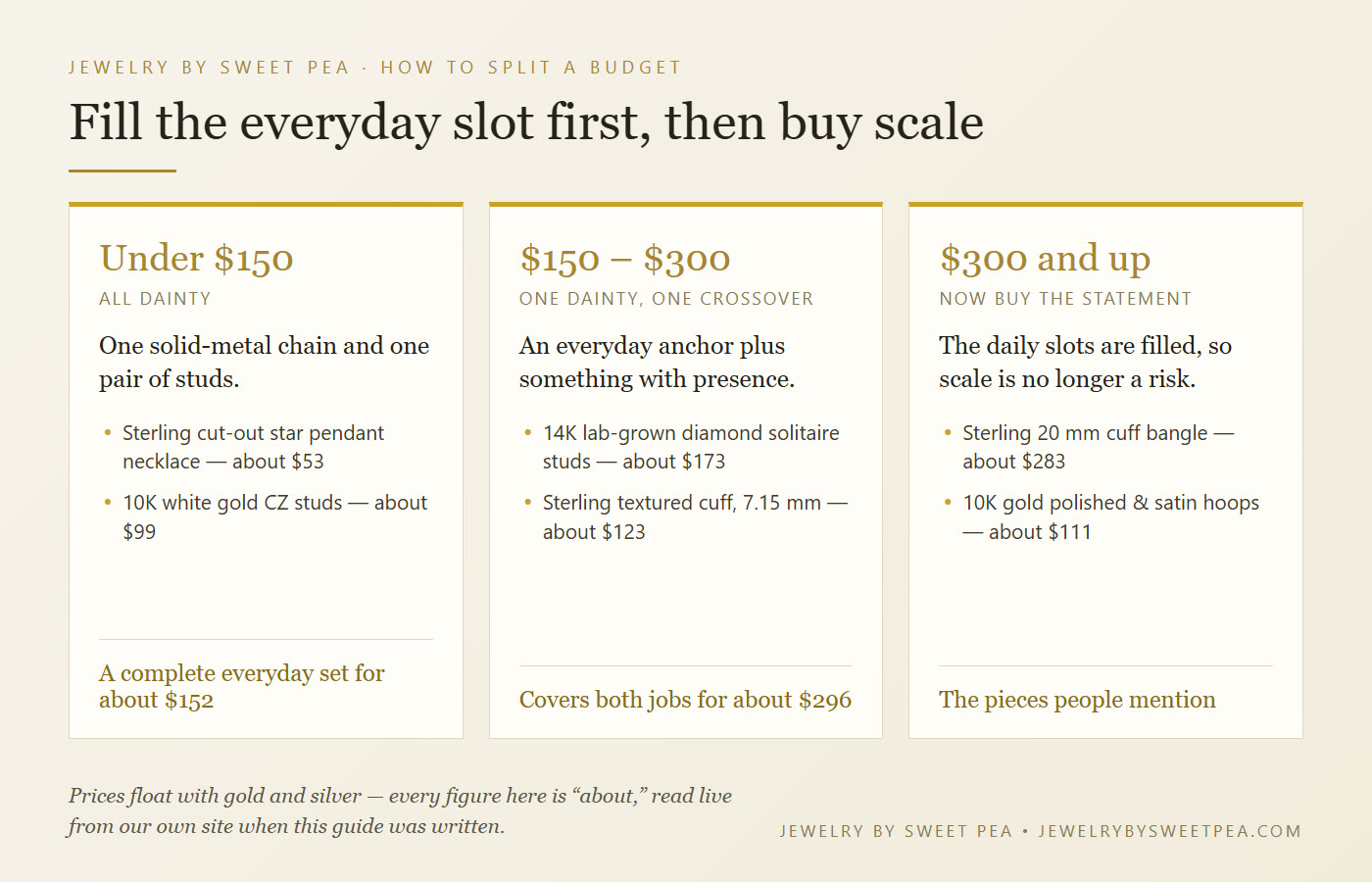
The order matters more than the amounts. Fill the everyday slot first — chain or studs — then buy scale. Buying scale first is the single most common reason a beautiful gift sits unworn in a drawer.
A note on layering, which changes the math
The trend of layering two or three fine chains at different lengths has quietly made dainty jewelry do statement work. Three delicate chains together have visual weight, but each one can still be worn alone on a plain Tuesday. If you like the look of scale but know your own habits favor the small stuff, that is the cheapest way to get both — and it is why we suggest a 16-to-18-inch piece as a first chain, since it layers cleanly under longer ones later.
Frequently asked questions
Is dainty jewelry more fragile than statement jewelry?
Not inherently, but a fine chain has less metal in it, so a snag does more proportional damage. The practical guidance is about the clasp and the chain type rather than the width: cable and box chains repair easily, and a spring ring or lobster clasp on a well-made solid chain is not a weak point. Rope and herringbone chains are the ones to treat carefully.
Can I wear a dainty necklace and statement earrings together?
Yes, and that is usually the better combination. The general rule we give: pick one area to be loud. Big hoops with a fine chain reads as deliberate. Big hoops with a wide cuff and a bold pendant reads as unfinished.
Does statement jewelry go out of style faster?
Sometimes, because scale is more tied to a given decade than a plain chain is. That is a real argument for buying statement pieces in classic forms — a plain wide cuff, a plain gold hoop — rather than in whatever shape is currently everywhere. Silhouettes with no ornament tend to survive.
Which is a safer gift if I do not know her taste?
Dainty, clearly. A small solid-gold or sterling piece is close to universally wearable, and it does not require you to have guessed her style correctly. Save statement pieces for when you have seen what she actually reaches for.
Is sterling silver good enough for everyday wear, or should I insist on gold?
Solid sterling silver is genuinely fine for daily wear. It will tarnish over time — that is oxidation, not damage — and a polishing cloth reverses it in a minute. Many of our sterling pieces carry an anti-tarnish finish that slows it considerably. Choose gold over silver for reasons of color, allergy, or budget, not durability.
The short version
Dainty jewelry wins on days worn. Statement jewelry wins on days remembered. If you are buying your first real piece, or buying for someone whose taste you are guessing at, buy dainty and buy it in solid metal. Once the everyday slots are full, a statement piece stops being a risk and starts being the fun part.
Questions about a specific piece, a chain length, or a cuff size? We are a small family-run shop and we answer our own email — just ask.