
Diamond Accents vs Plain Gold Which Makes Licensed Sports Jewelry Look More Refined
The short answer: plain gold wins, because in officially licensed team jewelry diamond accents barely exist. Across the roughly 18,000 licensed collegiate and pro pieces we carry, essentially none are set with diamonds. Refinement in this category comes from the metal, the scale, and the finish — not from stones.
This surprises people. Shoppers assume the “nice” version of their team pendant is the one with a row of little diamonds around the logo, the way an anniversary band steps up from plain to pavé. That upgrade path is real in most of fine jewelry, but it is not how licensed sports jewelry is built — and once you know why, choosing well gets simpler and usually cheaper than expected.
Does anyone actually make licensed team jewelry with diamonds?
Almost no one, at least not at the retail tier where most people shop. When we searched our own licensed catalog for diamond-set collegiate and pro pieces, the only hits were the Arizona Diamondbacks — the team name, not a gemstone.
There are practical reasons. A licensed logo has to be reproduced exactly as the school or league approved it, down to the proportions of a paw print or the serifs on a letter, and scattering melee diamonds across that shape fights the artwork instead of flattering it. Stones also add cost and fragility to a piece designed to be worn to tailgates and games, and every design change has to clear a licensing approval.
The category answered the question differently. Instead of adding stones, licensed jewelry steps up through metal: enameled sterling at the entry, solid sterling in the middle, then solid 10K and 14K gold at the top. That is the actual upgrade ladder, and it is where your money goes furthest.
If not diamonds, what actually makes a team piece look refined?
Three things, in this order.
1. Solid metal instead of plate. The single biggest visual difference, and it grows over time. A gold-plated logo looks convincing on day one and starts thinning at the high points — the edge of a letter, the top of a crest — within a year of regular wear. Solid 10K or 14K gold has no layer to lose, so it ages into a soft patina rather than wearing through to a different colored metal underneath. Everything we recommend below is solid sterling silver or solid gold, never gold-plated over a base metal.
2. Smaller scale. Counterintuitive, but reliable: the same logo reads dressier small. An extra-small or small pendant sits like a piece of jewelry that happens to be a team mark. A large one reads as fan gear. If you want something that works at the office and at the game, size down one step from what looks right on the screen.
3. A quiet finish. Polished yellow or white gold reflects light off the logo's own shape. Heavy enamel fill adds team color but also adds a costume-y flatness. Enamel has its place — it is what makes a $30 bead unmistakably yours — but at the top of the ladder, metal alone does more.
None of that is about stones. If you are shopping for diamonds in the ordinary sense, the relevant thing to understand is GIA's four quality factors, and you will be shopping our non-licensed collections, not the team lines.
What do the tiers actually cost?
Here is the honest ladder in the licensed category, using live prices from our own shelves. Gold prices float, so treat these as close approximations rather than quotes.
- About $30 – $60 | Enameled sterling silver. Beads and small charms. Real silver, team color from enamel. The right answer for a stocking stuffer or a bracelet add-on.
- About $100 – $140 | Solid sterling silver. Earrings and small pendants with the logo cut or struck in metal. Usually rhodium-plated, which is an anti-tarnish surface treatment on top of solid silver — not the same thing as gold plate over brass.
- About $140 – $300 | Solid 10K gold, extra-small to small. The value sweet spot. This is where a team piece stops looking like merchandise.
- About $450 – $900+ | Solid 10K/14K gold, larger sizes, earrings, and pieces sold on a chain. Heirloom territory.
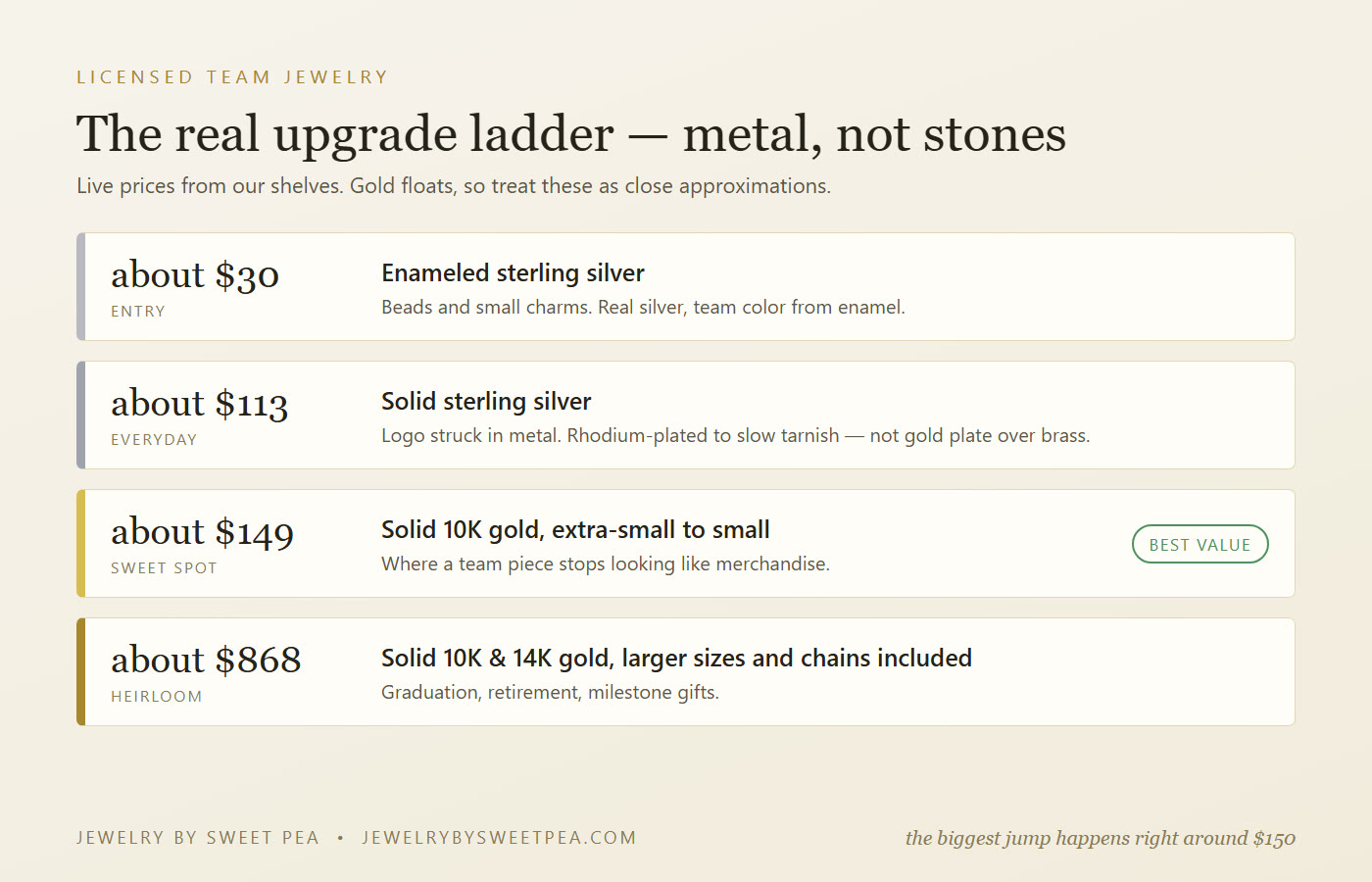
Notice that the entire ladder is under $900, and the biggest jump in perceived quality happens around $150 — the step from silver into solid gold. If you had budgeted for a diamond-accented piece, that budget buys you a considerably larger or heavier solid gold one instead.
Which licensed pieces are worth buying right now?
Six that are in stock as we write this, spanning the whole ladder.
- Sterling Silver Enameled LogoArt Arizona Cardinals NFL Bead — about $30. Solid sterling, fits standard add-a-bead bracelets. The cheapest honest entry point in the category.
- Sterling Silver Rhodium-Plated MLB LogoArt Detroit Tigers Letter D Small Post Earrings — about $113. Small posts are the most wearable licensed piece there is; these disappear into a normal outfit until someone looks closely.
- 10K Yellow Gold LogoArt University of Georgia Arch Small Pendant — about $149. Our pick for best value on the whole ladder. Solid 10K yellow gold at a price most people assume only buys plate.
- 10K White Gold LogoArt University of Tennessee Lady Volunteers Small Pendant — about $277. White gold keeps the logo crisp without the warmth of yellow competing with team colors.
- 10K Yellow Gold LogoArt University of Iowa Hawk Small Pendant 18 Inch Necklace — about $871. Arrives complete on an 18-inch chain, so it is ready to give as-is.
- 14K White Gold LogoArt University of South Carolina Crest Lapel Pin — about $868. A full crest in 14K white gold. This is the graduation or retirement gift end of the range.
More of both categories: Collegiate and Licensed Sports.
What does “pendant” mean versus “necklace” on these listings?
This one costs people money, so it is worth being blunt about. In LogoArt naming, “pendant” means the charm by itself, with no chain. “Necklace” means the chain is included.
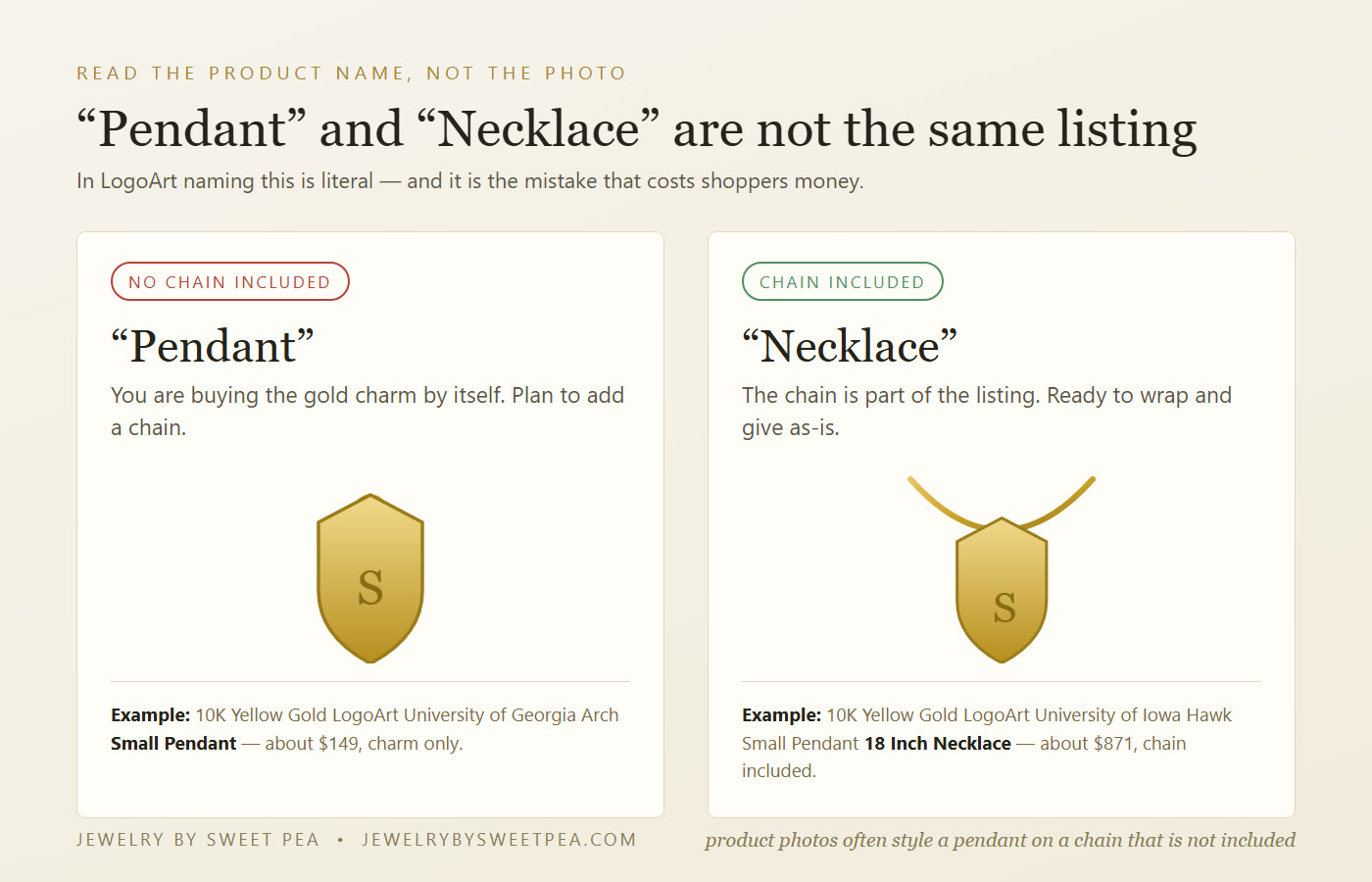
Compare two of the picks above. The Georgia Arch piece is a Small Pendant at about $149 — that is the gold charm alone, and you will want to add a chain. The Iowa Hawk piece is a Small Pendant 18 Inch Necklace at about $871 — the chain is part of it. Read the product name, not the photo, because product photography in this category often shows a pendant styled on a chain that is not included.
Does karat number change how refined it looks?
Less than people expect. 10K and 14K look nearly identical at the small sizes licensed logos are made in; 14K is slightly richer in yellow and slightly softer, 10K is more wear-resistant and less expensive. Both are legally gold and both are stamped accordingly — the FTC sets the rules for how gold content must be marked and described in 16 CFR § 23.5. For a piece that will be worn hard we usually steer people to 10K and put the savings toward a larger size or a better chain.
Frequently asked questions
Can I get diamonds added to a licensed team piece?
Not through the licensed manufacturers, and we would not recommend having a licensed piece altered by a third party — it can damage the logo detail and it steps outside the license. If you want stones with team meaning, a better route is a solid gold logo piece worn alongside a separate diamond piece you already own.
Is gold-plated licensed jewelry ever the right call?
For a one-season novelty or a young fan who will outgrow it, sure. For something meant to last, no. Plate wears through at the edges and cannot be restored the way solid metal can. That is why every piece we recommended above is solid sterling or solid gold.
Will sterling silver tarnish if it is worn to games?
Solid sterling tarnishes slowly with air exposure and cleans up easily with a polishing cloth. Most licensed sterling pieces are rhodium-plated, which slows tarnish considerably. Sweat and sunscreen accelerate it, so wipe a piece down after a hot game day.
What size pendant should I buy if I am not sure?
Small, in almost every case. Extra-small and small read as jewelry; medium and large read as fan gear. If it is a gift and you cannot ask, small is the safer miss.
Which single piece gives the biggest jump in quality for the money?
The step from sterling into solid 10K gold, which in this category happens right around $150. That is a bigger visible upgrade than anything else on the ladder, including size.
The bottom line
The question assumes a choice the category does not actually offer. Diamond accents are not a meaningful option in officially licensed sports jewelry, so the real decision is where you land on the metal ladder. Go solid rather than plated, go one size smaller than feels right, and spend the diamond budget on gold instead. That is what makes a team piece look like jewelry rather than merchandise.
Questions about a specific school or team? We are a small family-run shop and we answer our own email — just ask.