
Experts Answer How Long Gold-Plated Jewelry Really Lasts Compared to Solid Gold
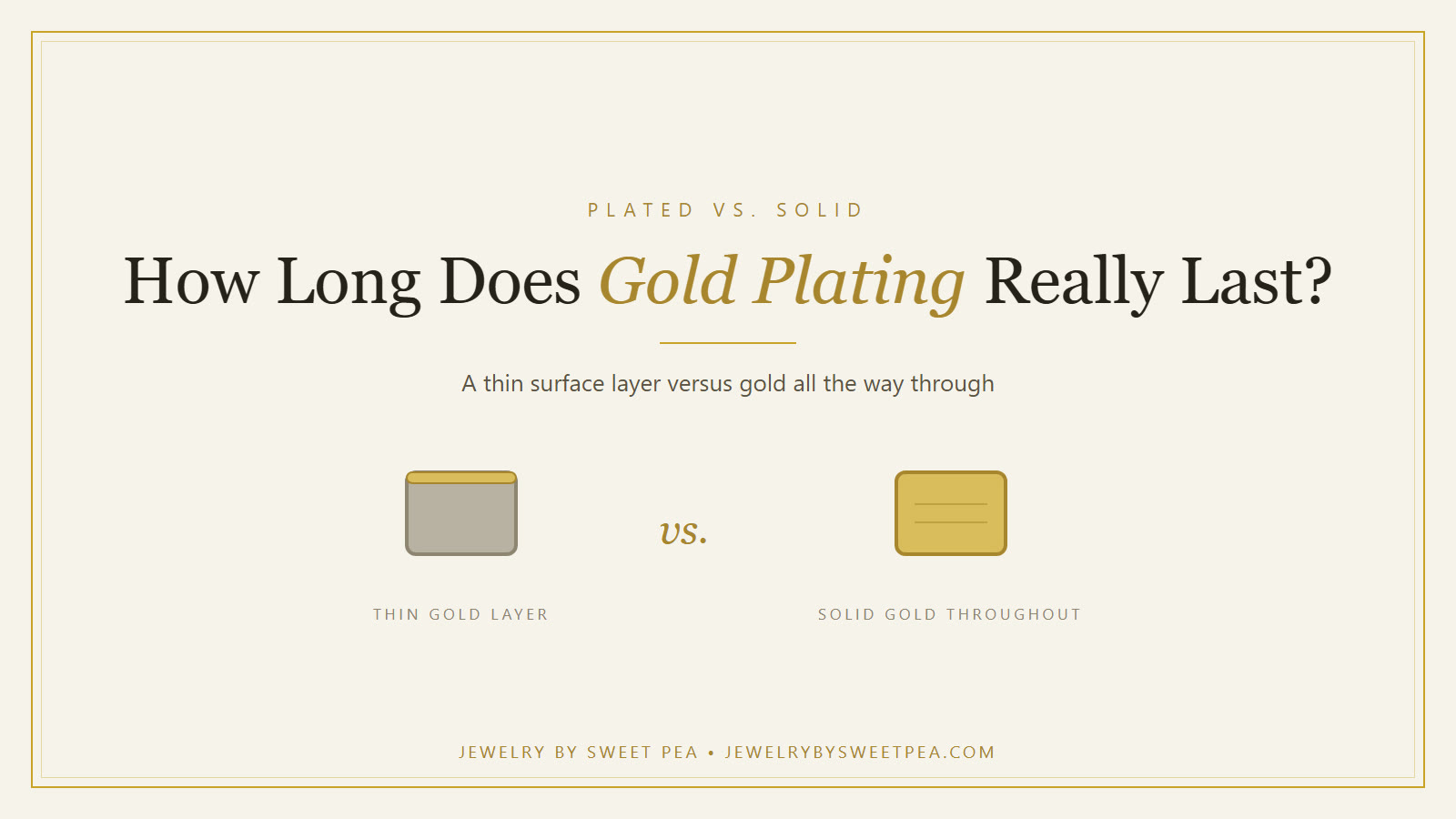
The short answer: Solid gold lasts for generations because the gold goes all the way through, so scratches and wear never reveal a different metal. Gold-plated jewelry has only a thin surface layer over base metal, and with daily wear that layer can thin out, often within months to a few years depending on the plating and how you wear it.
We're a small, family-run store, so we'll be upfront: we sell solid 10K and 14K gold and sterling silver, never plated, and that colors our view. To keep this fair, we've leaned on what the published rules and jewelry authorities say rather than inventing quotes. There's no single magic number for how long plating lasts, and anyone who gives you one is guessing.
What does the FTC say about gold plating?
The Federal Trade Commission publishes Guides for the Jewelry, Precious Metals and Pewter Industries (16 CFR Part 23). Reading them is a useful reality check:
- "Gold" on its own means more than you think. Calling something simply "gold" is misleading unless it is pure 24 karat gold throughout. An alloy has to be described with its karat, such as "10K gold."
- Plated pieces must say so. Gold plate and gold electroplate claims should be preceded by the karat of the plating, and the plating should be thick enough and cover enough of the surface that "reasonable durability" is assured.
- The Guides don't promise a lifespan. "Reasonable durability" isn't a number of years, which is exactly why two plated pieces can wear very differently.
The takeaway: a label can be legal and still describe a very thin coating. Solid gold has no coating to wear through.
How long does gold-plated jewelry actually last?
It depends on four things, none of which you can see from a photo:
- Plating thickness. Thicker layers last longer, but even a good layer is still a coating.
- The metal underneath. Plating over brass, copper or steel shows through when it wears. Plating over sterling silver (often called vermeil when it meets the FTC's requirements) holds up better, but it is still plating.
- Where it's worn. Rings and bracelets take the most friction. Earrings and pendants that sit still last longest.
- Your daily routine. Sweat, lotion, perfume, chlorine, hand washing and sleeping in it all speed up wear.
In our experience as a jewelry store, plated pieces worn every day, especially rings and bracelets, are the first to show a change in color. Pieces worn occasionally and stored dry can look good far longer. That's a general observation, not a guarantee.
Why does solid gold last so much longer?
Because there's nothing to wear off. A solid 10K or 14K gold piece is an alloy of gold and other metals all the way through. If it gets a scratch, the scratch is still gold. If it gets dull, a polish brings it back. It won't flake or peel, and it won't leave a green mark on your skin.
That also makes it repairable. A jeweler can solder a solid gold chain, polish a bangle, or re-tip a prong. Plating generally can only be redone by stripping and re-coating.
Is 10K or 14K gold better for everyday wear?
Both are solid gold and both last. 10K is a little harder and usually costs less. 14K has a slightly richer yellow color and more gold content. For everyday pieces that get bumped, like rings, bracelets and hoops, many families choose 10K for the price and toughness. For pieces that sit gently, like a pendant, 14K is a lovely choice.
What solid gold pieces are in stock right now?
Prices float with the gold market, so treat these as approximate. Every piece is solid 10K yellow gold:
- 10K yellow gold freshwater cultured pearl stud earrings, about $55, a classic everyday pair.
- 10K yellow gold scalloped textured hollow hoops, about $85, light and easy on the ears.
- 10K yellow gold September birthstone heart charm, about $56, a small gift that lasts.
- 10K yellow gold 1.5mm diamond-cut slip-on bangle, about $174, a no-clasp everyday bracelet.
- 10K yellow gold small hoop earrings, about $182, a sturdier everyday hoop.
- 10K yellow gold adjustable 1mm diamond-cut cable chain, about $233, a chain that carries a pendant for years.
Browse more in our necklaces and pendants and charms collections.
Is solid gold worth the higher price?
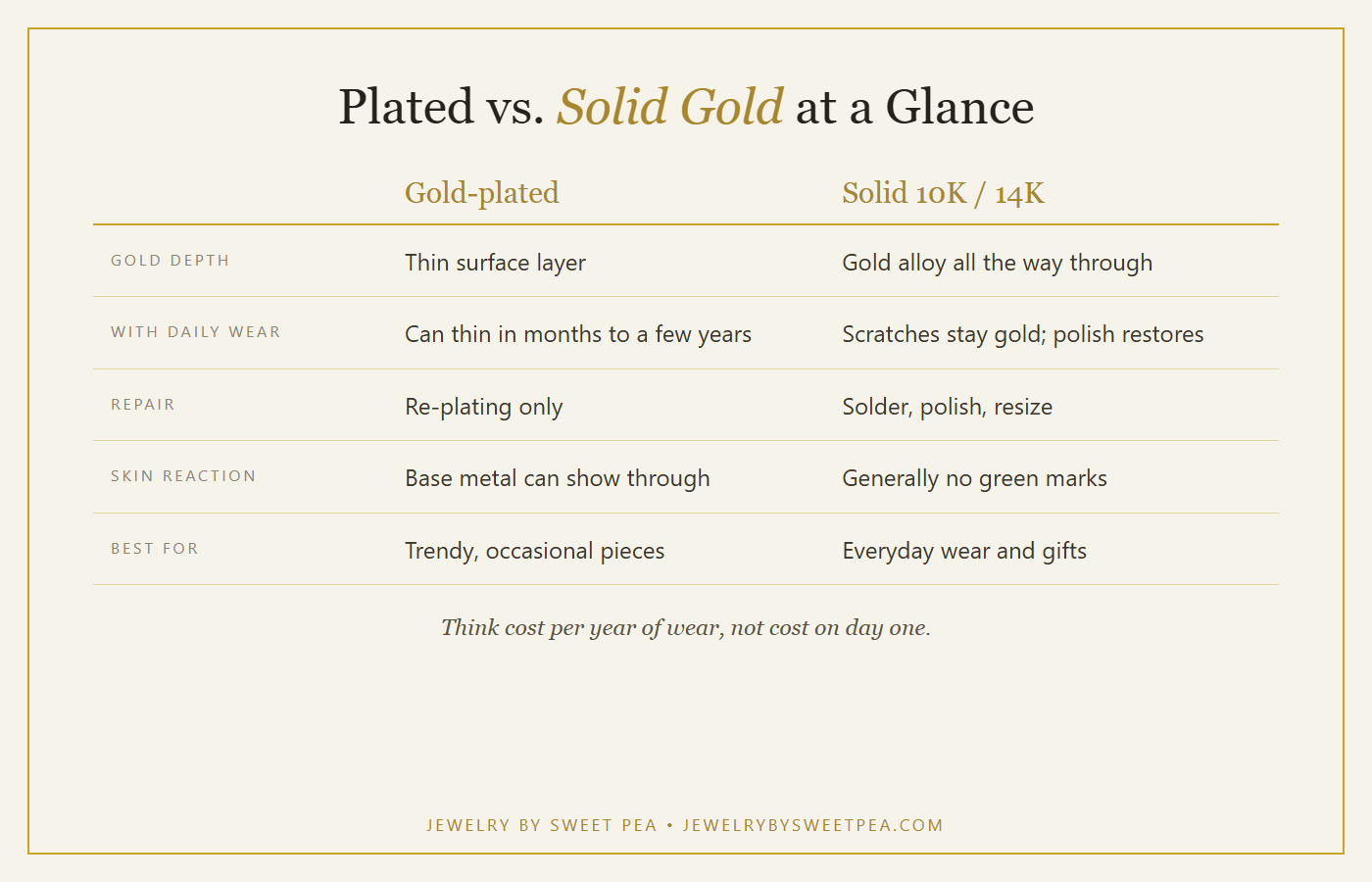
Think cost per year of wear, not cost on day one. A plated piece that is $20 and looks tired in a year costs more over a decade than a solid piece you wear for ten. Here is how we'd sort it:
- Trendy piece worn a few times: plated is a fun, low-commitment choice.
- Earrings worn daily: solid gold is worth it, and small studs start around $55.
- Ring or bracelet worn daily: solid gold, since this is where plating wears fastest.
- A gift meant to last: solid gold.
If solid gold is out of reach right now, sterling silver is a solid (not plated) middle step, though it can tarnish and needs occasional polishing. For a starter gold piece, a small charm or pearl studs is the lowest-cost way in. The GIA's pearl quality factors are a helpful read if you go the pearl route.
How do you care for gold-plated jewelry so it lasts longer?
If you own plated pieces and love them, these habits help: take them off before showering, swimming, working out and sleeping; put them on after lotion and perfume; wipe them with a soft, dry cloth after wearing; and store them separately in a dry pouch so they don't rub against each other. Skip abrasive cleaners, since they remove plating faster.
Frequently asked questions
How long does gold-plated jewelry last?
There's no fixed number. With daily wear, the plating can wear through in months to a few years depending on thickness, the base metal and how it's worn. Pieces worn occasionally can last longer.
Does solid gold ever wear out?
It can get scratched and dull, and it can bend if it's very thin, but the gold itself doesn't wear off. A jeweler can polish or repair it.
What's the difference between gold-plated and gold-filled?
Both put a layer of gold over base metal. Gold-filled uses a thicker, mechanically bonded layer, so it usually lasts longer than typical plating, but neither is solid gold throughout.
Will solid gold turn my skin green?
Solid 10K and 14K gold generally doesn't. Green marks usually come from base metals like copper showing through worn plating.
Is 10K gold real gold?
Yes. 10K is 10 parts gold out of 24, mixed with other metals for strength. It's solid gold, just a lower karat than 14K.