
Experts Answer Whether Gold Jewelry Is Still a Smart Purchase When Gold Prices Rise
The short answer: yes — if you shop by weight instead of by width. A rising gold price moves the metal inside a piece, not the labor that shaped it. On small earrings, where most of what you pay is the making, the price barely moves. On a heavy chain it moves a lot. Every one of our chain and earring listings prints an approximate metal weight in grams, and that number is the whole answer.
We get this question in waves, always the same way: someone has seen a headline about gold and wants to know whether to buy now, wait, or give up. Below is what the people who actually price this stuff will tell you — the federal rules on what may be called gold, the gold market's own published pricing, and the arithmetic off our listings.
What actually happens to jewelry prices when gold goes up?
Only part of the ticket moves.
The price of a finished piece is the gold it contains plus everything done to it — drawing the wire, braiding the links, soldering the clasp, polishing, packing, shipping. When gold rises, only the first part changes. Look up where it is trading on the World Gold Council's gold price page; we quote no figure here, because any number we print goes stale.
So the same headline hits a $75 pair of earrings and a $490 chain very differently. The earrings are mostly labor. The chain is mostly metal. If gold climbs, the chain follows closely and the earrings barely twitch.
How do I tell what I am paying for the gold and what I am paying for the making?
Divide the price by the grams. Our listings give you both.
Here is that exercise run across pieces on our site right now. Everything below is 10K yellow gold, and every gram figure is the approximate metal weight printed on that listing.
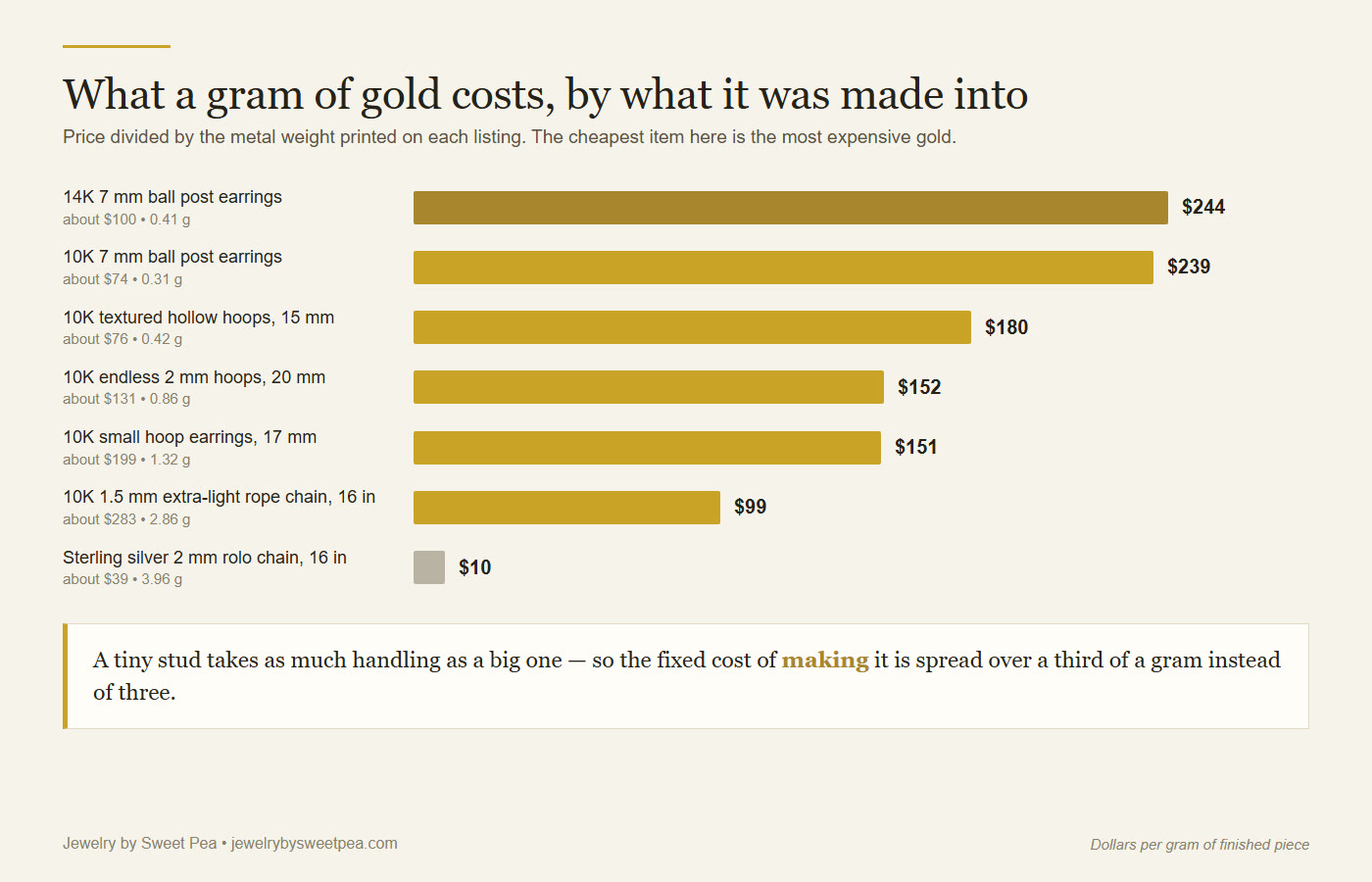
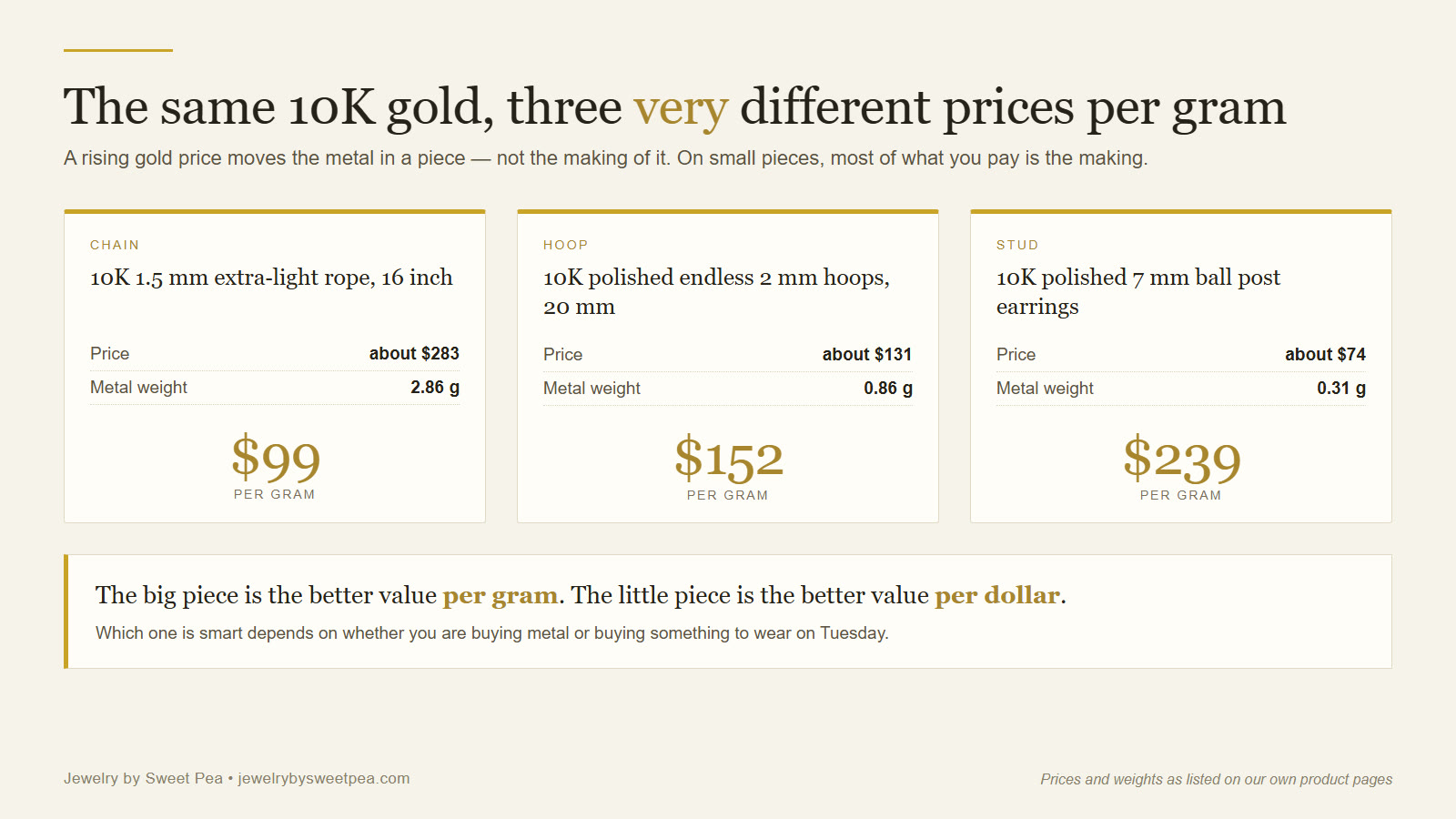
The 10K 1.5 mm extra-light diamond-cut rope chain in 16 inch is about $283 at a stated 2.86 grams — roughly $99 a gram. The 10K small hoop earrings at about $199 carry 1.32 grams, near $151 a gram. The 10K endless 2 mm hoops at about $131 carry 0.86 grams — about $152 a gram, nearly the same rate. The 10K 7 mm ball post earrings at about $74 carry 0.31 grams: near $239 a gram.
Read that spread again, because it is the useful part: the cheapest item on the list is the most expensive gold you can buy. A tiny stud takes as much handling as a big one, and that fixed labor is spread over a third of a gram instead of three.
The honest rule when gold is expensive is the opposite of what people assume: the big piece is the better value per gram, the little piece the better value per dollar. Which is smart depends on whether you are buying to own metal or buying something to wear on Tuesday.
Why do two chains the same width cost so differently?
Because width is a look and weight is a price, and they are not the same thing.
Our rope chains make this easy to see, because construction is written into the product name. Compare two 16 inch chains: the 2 mm semi-solid diamond-cut rope at about $229, and the 2 mm regular rope — solid, hand made — at about $491. Identical width, more than double the price. The second simply holds more gold. The same fork appears at 1.5 mm: extra-light about $283, the solid hand-made 1.50 mm regular rope chain about $415.
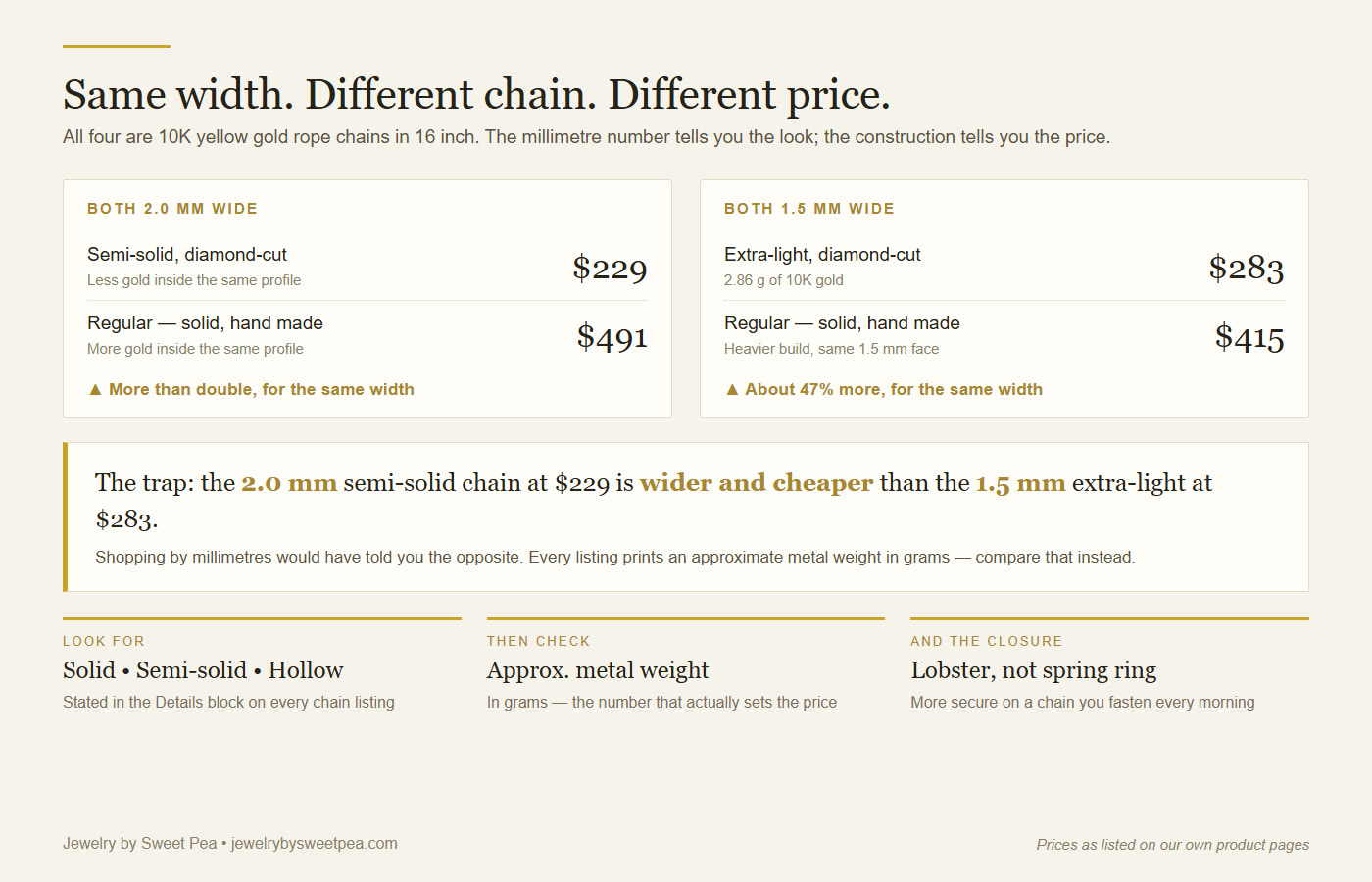
Now the part that surprises people: that 2 mm semi-solid chain at $229 is wider and cheaper than the 1.5 mm extra-light at $283. Shopping by the millimetre number, you would have concluded the opposite. Check the grams before you decide, and compare the rest of the chains collection the same way.
Does "hollow" or "semi-solid" mean it is not real gold?
No. It means less of it, not lesser quality.
A hollow or semi-solid piece is genuine 10K or 14K gold formed around a void, which is how a hoop can look substantial and still weigh under half a gram. What may legally be called gold, and how karat and construction must be disclosed, is set out in the FTC's Jewelry Guides at 16 CFR Part 23. Hollow gold is real gold. Plated is not gold at all — it is a microns-thin skin over base metal, and we do not sell it in any karat.
The tradeoff is durability: hollow walls dent and can crease if crushed, solid does not. The 10K textured hollow hoops at about $76 are a good buy for occasional wear at 0.42 grams; for a hoop worn daily, the heavier ones above are built for it. The rest of the earrings collection states construction the same way.
Is 10K or 14K the better buy in an expensive gold market?
Ten karat, if the number on the tag is what is stopping you.
Karat is a purity fraction: 10K is 10 parts gold in 24, and 14K is 14 in 24. Less gold per gram means less exposure to the gold price, which is exactly why 10K holds its price better when gold runs.
Our catalog offers a clean test, because we stock the same earring in both. The 10K polished 7 mm ball posts are about $74 at 0.31 grams; the 14K polished 7 mm ball posts are about $100 at 0.41 grams. Same size, shape and finish. About a third more money for about a third more metal at a higher purity — the pricing is doing exactly what it should.
Fourteen karat is warmer in color and a little harder-wearing at the post. Ten karat is the value play, and nobody has ever told them apart across a room.
Should I buy gold jewelry as an investment?
We are a family jewelry store, not financial advisors, and we will not tell you what to do with your savings. But how jewelry differs from metal is not opinion.
When you buy a finished piece you pay for the making as well as the gold, and the making is not something you can sell back. Bullion is priced off the metal alone; jewelry is not. Anyone calling a chain a way to hold gold is quietly ignoring the labor — and the numbers above are exactly the size of what they are ignoring.
Buy jewelry because you want to wear it, or because someone you love will. If your goal is exposure to the gold price itself, that is a question for a licensed financial advisor, not for us.
What if gold is simply out of reach right now?
Then buy sterling silver on purpose, not apologetically.
The sterling silver 2 mm rolo chain in 16 inch is about $39 and its listing states 3.96 grams — roughly $10 a gram, with a solid link, anti-tarnish coating and lobster clasp, made in Italy. That is more metal than the 10K rope chain above, at a seventh of the price.
Solid sterling is a real precious metal, and a well-made silver chain outlives a plated gold one by decades. Waiting out the gold market while wearing nothing is the one genuinely bad outcome. Browse the necklaces collection and buy something you will actually put on.
Frequently asked questions
Will this necklace cost more next month?
It can. Our prices track our cost from the manufacturer, and on gold that moves with the metal. Heavier pieces move more than light ones. If you have decided on something substantial, there is no advantage to waiting for a dip nobody can predict.
How do I find the gram weight before I buy?
In the Details block on the product page, listed as approximate metal weight. Chains, hoops and studs all carry it, and that line tells you more than the width in millimetres.
Is a heavier chain automatically better made?
No. Weight tells you how much gold you get, not how well it was assembled. Check the clasp too — a lobster clasp is more secure than a spring ring — and whether the listing says solid, semi-solid or hollow.
Does 10K gold tarnish or turn skin green?
Solid 10K does not tarnish the way plated jewelry does, because there is no base metal underneath to wear through. Some people react to the alloy metals in any karat gold; 14K, with less alloy, is usually more comfortable for them.
Can I trade in old gold against a new piece?
We do not run a buy-back program, so we will point you to a local buyer rather than pretend otherwise. Expect an offer based on scrap weight and karat, not on what the piece originally cost — the same lesson as above, running in reverse.
Stuck between two pieces? Email us both links and we will tell you which carries more gold — the least biased answer we can give.