
Experts Break Down Exactly What You Are Paying for in a Fine Jewelry Price Tag
The short answer: Most of a solid gold price tag is the metal itself — how many grams, and what karat — plus the work of turning that metal into a finished piece. Construction (solid or hollow), how much handwork each gram needs, and any stones do the rest. Divide the price by the gram weight and two tags suddenly make sense.
We are a small family store, not a panel of celebrity jewelers, so we are not going to put invented quotes in anyone’s mouth. What follows is what buyers, bench jewelers and people who price gold for a living broadly agree on — shown with real pieces from our own catalog, so you can check every number yourself.
What actually goes into a fine jewelry price?
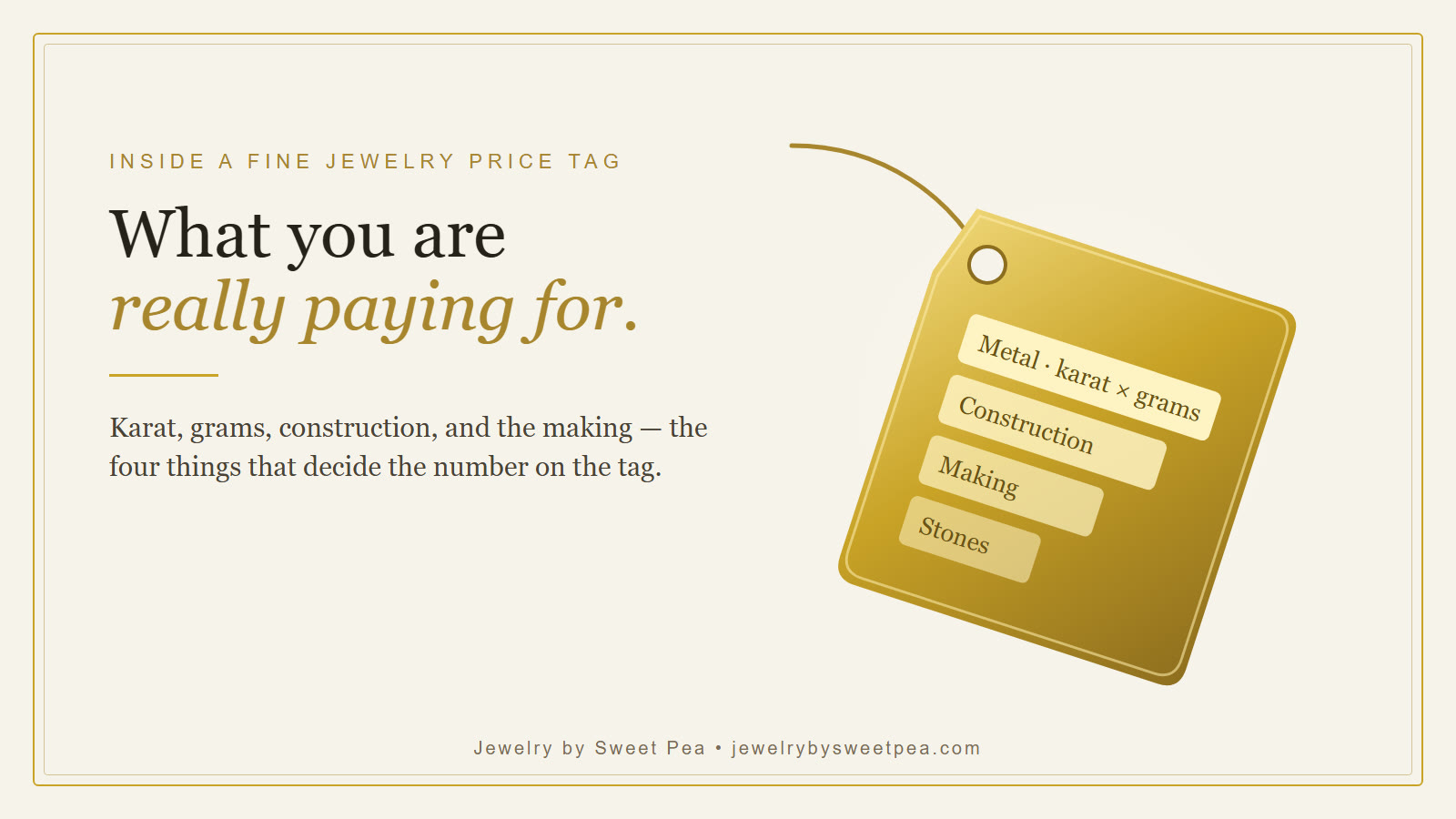
Think of the tag as four layers stacked on top of each other.
- The metal. Gold is priced by weight on the world market, and it moves every day. A piece’s karat tells you how much of its weight is pure gold; its gram weight tells you how much metal there is in total.
- Construction. The same outline can be cast solid, cast hollow, or formed from hollow tubing. Less metal means a lower price — and a lighter, more easily dented piece.
- The making. Casting, polishing, soldering a bail, fitting an earring post and clasp, and finishing a three-dimensional shape all take time that has to be paid for, however small the piece.
- Stones. Diamonds and gemstones are priced on their own scale and can outweigh everything else. This article sticks to plain gold so the other three layers are easy to see.
On top of that sits the cost of getting a piece to you — sourcing, photography, packaging, shipping and handling returns. That is true of every store. What should not be in the tag is a premium for words that sound valuable but are not regulated, which we come back to below.
How much does karat change the price?
Karat is simply parts of pure gold out of 24, a system explained well on Wikipedia’s fineness page. That makes 10K about 41.7% pure gold and 14K about 58.3%. The rest is other metals that add hardness and color.
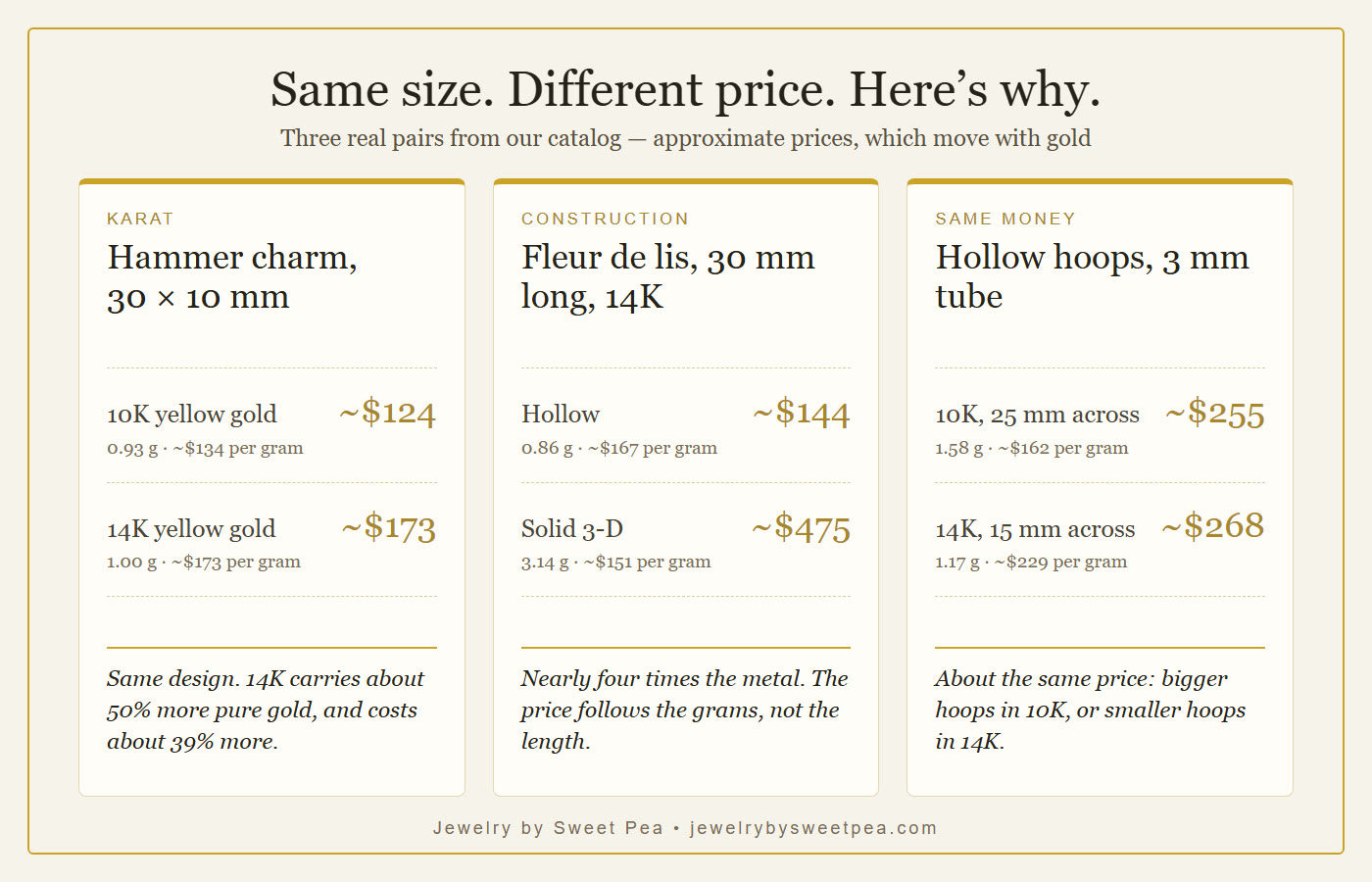
Here is how that plays out on one design. Our 10K Yellow Gold Hammer Charm is about $124 and weighs about 0.93 g. The 14K Yellow Gold Hammer Charm is the same 30 by 10 mm shape at about 1.00 g, and costs about $173. The 14K version holds roughly 50% more pure gold and costs about 39% more. You can see the same step on a hollow fleur de lis: about $94 in 10K and about $144 in 14K, at nearly identical weights.
Neither karat is the “right” one. 10K is a little harder and paler; 14K has a richer yellow. What you should expect is that the karat shows up in the price in a fairly predictable way.
Why can two pieces the same size cost so differently?
Because length and width are not metal. Grams are.
The 14K Yellow Gold Hollow Fleur De Lis Charm is 30 mm long, weighs about 0.86 g and costs about $144. The 14K Yellow Gold Solid Fleur De Lis 3-D Charm is also 30 mm long, but it is cast solid at about 3.14 g — nearly four times the metal — and costs about $475, a little over three times as much. Online, side by side, they look like the same charm at wildly different prices. In your hand, one is a feather and the other has real heft.
Hollow is not a trick. It makes a larger look affordable, and it is honest as long as it is disclosed. The FTC’s Jewelry Guides say a hollow gold item should be described that way, near the word “gold” — see 16 CFR § 23.3. That is why our listings say “hollow” and print an approximate metal weight in the details. If a listing gives you neither, ask.
Why do small pieces often cost more per gram?
This is the part that surprises people. The work of making a piece does not shrink in proportion to its weight. Casting, polishing and finishing a tiny three-dimensional charm takes nearly as long as a larger flat one, and a pair of earrings is two pieces plus tubing, posts and closures.
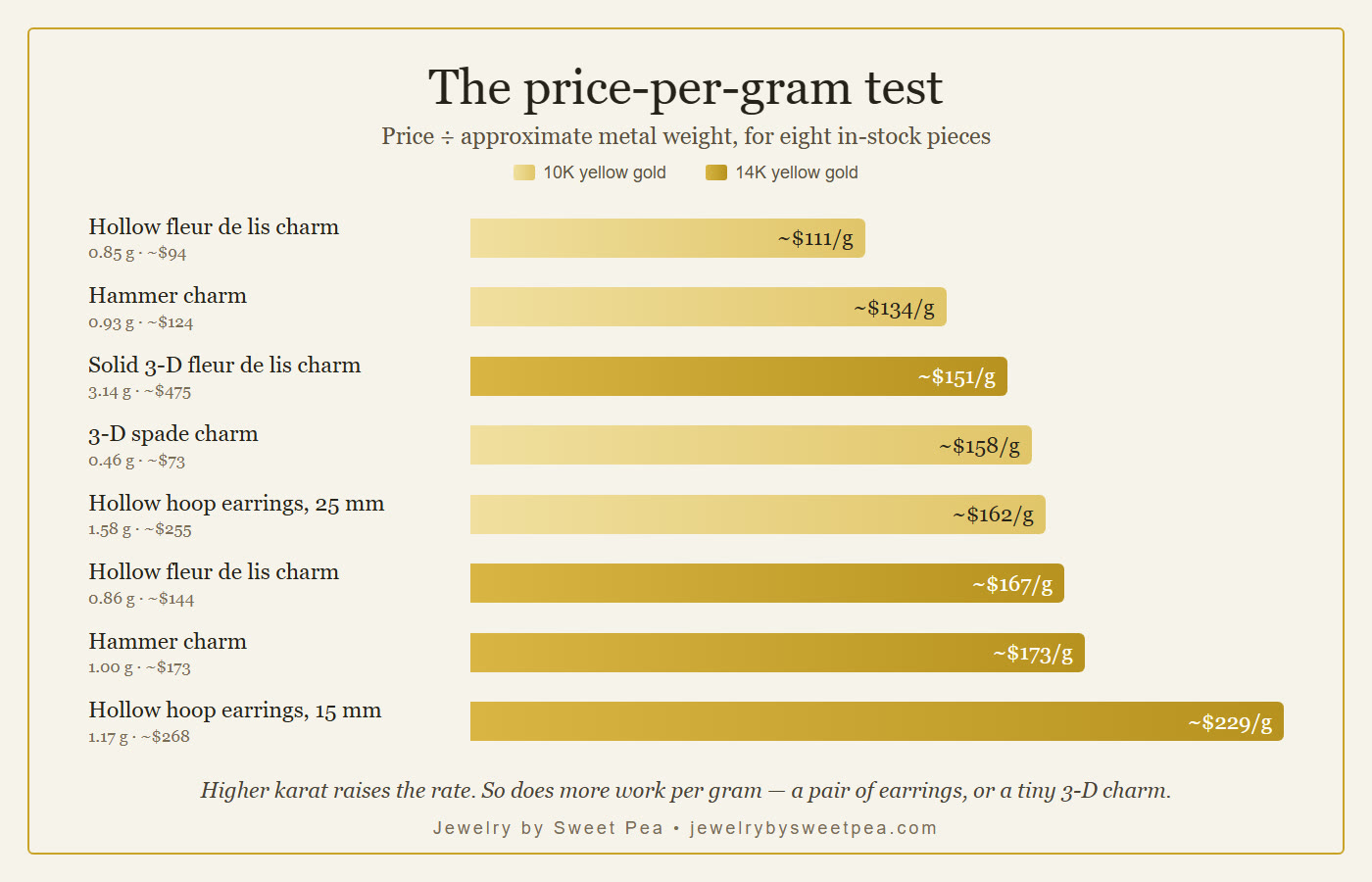
Divide price by weight and it shows. The 10K Yellow Gold 3-D Spade Charm is only about $73, but at 0.46 g it works out to roughly $158 per gram — more than the 10K hammer charm at about $134. The 10K Hollow Fleur De Lis Charm, a simpler shape, lands near $111 per gram. At the other end, the heavy solid 14K fleur de lis comes in lower per gram than any of the lighter 14K pieces.
None of that makes the small charm a bad buy. It is often exactly the right gift. It just means the cheapest tag is not always the cheapest gold.
What should you not be paying extra for?
- Plating dressed up as gold. Gold-plated, gold-filled and vermeil pieces have a thin layer of gold over another metal. They can be lovely, but they should not be priced like solid gold. Everything we sell as gold is solid 10K or 14K.
- Words without a definition. “Heirloom quality” and “luxury grade” have no legal meaning. Karat marks and “hollow” do.
- An investment story. We are jewelers, not financial advisors, so we will not tell you jewelry is a smart investment. You pay for the making, and nobody buys the making back. If you want today’s gold market price, the World Gold Council publishes it; for investment questions, talk to a licensed advisor.
How can you compare two price tags yourself?
- Match the karat. Compare 10K with 10K and 14K with 14K.
- Find the gram weight. On our product pages it is listed as “Approx. metal weight” in the details.
- Check solid or hollow. A hollow piece will always look like more gold than it is.
- Divide price by grams. Pieces of similar type and karat should land in a similar range; one far above it deserves a question.
- Then decide what you want. Sometimes the higher rate buys exactly the piece you love — that is a fine reason to pay it.
If you are working to a budget, here is how our eight examples fall. Under $100: the 10K spade charm (about $73) or the 10K hollow fleur de lis (about $94). $100 to $200: the 10K hammer (about $124), the 14K hollow fleur de lis (about $144) or the 14K hammer (about $173). $250 to $500: hollow hoops — the larger 25 mm 10K Polished Hoop Earrings (about $255) or the smaller 15 mm 14K Polished Hoop Earrings (about $268) — or the solid 14K fleur de lis at about $475. Most charms are sold without a chain, so allow for one; browse pendants and charms, earrings and chains. Prices move with gold, so treat every figure here as a ballpark.
Common questions
Why is 14K gold more expensive than 10K?
14K is about 58.3% pure gold and 10K about 41.7%, so a 14K piece of the same weight holds about 40% more gold. On a same-design pair in our catalog, the 14K version costs roughly 39% more.
Is hollow gold jewelry real gold?
Yes. Hollow pieces are made of real karat gold with less metal inside, which makes them lighter and less expensive but easier to dent. They should be clearly described as hollow.
How do I work out the price per gram of a piece of jewelry?
Divide the price by the approximate metal weight in grams. Compare only pieces of the same karat and a similar type, since earrings and small 3-D charms naturally carry more making cost per gram.
Why do small gold charms cost so much for their size?
The casting, polishing and finishing do not shrink with the weight. A tiny 3-D charm can take nearly as much work as a larger flat one, so its making cost is spread over fewer grams.
Is fine gold jewelry a good investment?
We are jewelers, not financial advisors, so we do not recommend jewelry as an investment. Part of every price is the making, which is not paid back if you sell. Buy a piece because you will love wearing it.
A note from our family to yours
If you are looking at two pieces and cannot tell why one costs more, send us both links. We will tell you plainly what the difference is — karat, grams, construction or work — and which one we would choose for the person you have in mind.