
Experts Reveal the Jewelry Trends That Always Come Back and the Ones That Never Do
The short answer: the pieces that come back are the plain ones — gold hoops, pearl studs, solid link chains, lockets, signet rings and a single diamond on a chain. They return because they are simple shapes in solid metal that do not reference any particular year. The ones that never come back are almost always plated, novelty-shaped, or tied to a specific moment in pop culture. Solid metal and simple geometry are the whole test.
Why do some jewelry trends keep returning?
Ask anyone who handles jewelry for a living — buyers, bench jewelers, estate appraisers, the people behind the counter at a family store like ours — and you get remarkably consistent answers about which pieces keep circling back. It is not mysterious, and it is not about taste. It comes down to three practical things.
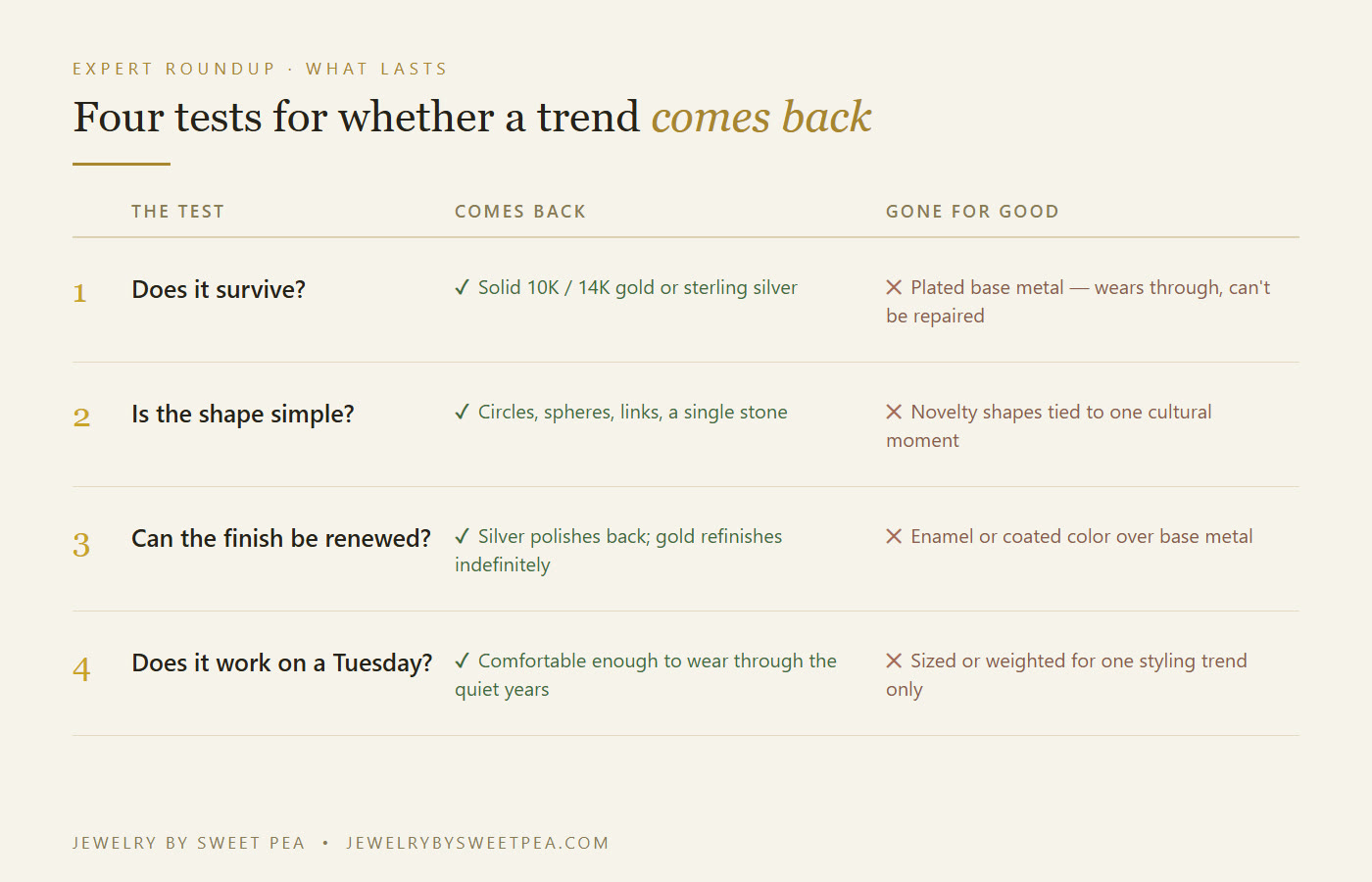
The piece survived. A trend can only come back if enough examples still physically exist. Solid gold and sterling silver last for generations, get repaired instead of thrown out, and end up in a drawer that someone opens twenty years later. Plated base metal wears through, corrodes and goes in the bin. Whole categories of jewelry never return simply because none of it made it to the next decade.
The shape does not date itself. A round hoop is a circle. A pearl stud is a sphere on a post. There is no year encoded in either one. The moment a design carries a specific reference — a logo, a slogan, a silhouette that only made sense during one particular season — it gets stamped with a date, and dated things do not come back; they get remembered.
It works on a Tuesday. Pieces that survive a rotation out of fashion are the ones people keep wearing during the unfashionable years, quietly, because they are comfortable and go with everything. That steady low-level wear is what keeps a category alive until the next generation rediscovers it.
Which pieces always come back?
Six categories account for nearly all of it.
Pearl studs — about $72. Pearls have been in and out of favor a dozen times and have never once failed to return. These are solid 14K yellow gold posts with 7–8mm white round freshwater cultured pearls. If you are comparing pearls anywhere, the things that actually determine quality are luster, surface, shape, size, color, nacre quality and how well a pair matches — the Gemological Institute of America breaks down all seven factors here. Size is the one people over-focus on; luster is the one that makes a pearl look expensive.
Gold hoops — about $196. Hoops go enormous, then tiny, then back again roughly every fifteen years, but the category itself never leaves. A small solid 10K yellow gold hoop is the version that stays wearable through every swing. Buy the size you would wear to work, not the size that is currently in a magazine.
A solid gold curb chain — about $67. Curb, cable and rope chains have been made continuously for well over a century. This one is 10K yellow gold at 0.5mm — a fine everyday weight that sits flat and disappears under a collar. A solid chain is also the one purchase that is never redundant: everyone who owns a pendant eventually needs another one.
A round locket — about $182. Lockets are the clearest example of the pattern. They go quiet for a decade, then a generation finds their grandmother's and the whole category comes roaring back. Solid 10K yellow gold, 16mm, polished and domed — large enough to hold photographs, small enough to wear without planning an outfit around it.
A single diamond on a chain — about $214. One stone, four or six prongs, nothing else. This is a 14K yellow gold setting with a 1/2 carat total weight round certified lab-grown diamond. The design has not meaningfully changed in a hundred years, which tells you most of what you need to know about whether it will still look right in 2046.
A signet ring — about $96. The oldest item on this list by several thousand years. Solid 10K yellow gold with a flat face. Signets drift between "heirloom" and "fashion" depending on the decade and are currently doing both at once.
Which trends never come back?
We are describing categories here, not naming and shaming any particular design — but the failure modes are consistent.
Anything plated. This is the biggest single reason a trend disappears permanently. Plated jewelry is base metal with a microscopically thin layer of gold on the outside; daily wear takes it off, usually first at the back of a chain where skin contact is constant. Once it wears through it cannot be repaired, so nothing survives to be rediscovered. The Federal Trade Commission's Jewelry Guides (16 CFR Part 23) govern what a seller may legally call "solid," "gold-filled," "gold-plated" or "gold tone," which is why reading the exact wording on a listing matters far more than looking at the photo. We only sell solid 10K or 14K gold and sterling silver — never plated base metal.
Novelty shapes tied to a moment. A charm shaped like a piece of technology that no longer exists, a slogan that stopped being funny, a character from one particular year. These are genuinely fun to own and terrible to buy as an investment. If a piece needs context to make sense, it will not survive losing that context.
Coatings and finishes that cannot be renewed. Colored enamel over base metal, anodized surfaces, anything with a printed or coated color layer. When the finish goes there is nothing underneath. Compare that with sterling silver, which tarnishes and then polishes right back to new, or solid gold, which can be refinished by a bench jeweler indefinitely.
Pieces sized for one specific styling trend. A chain cut to sit at exactly one length that only worked with one neckline, or earrings so heavy they can only be worn for an evening. Wearability is what keeps a piece in circulation during the fallow years.
How do the price tiers compare?
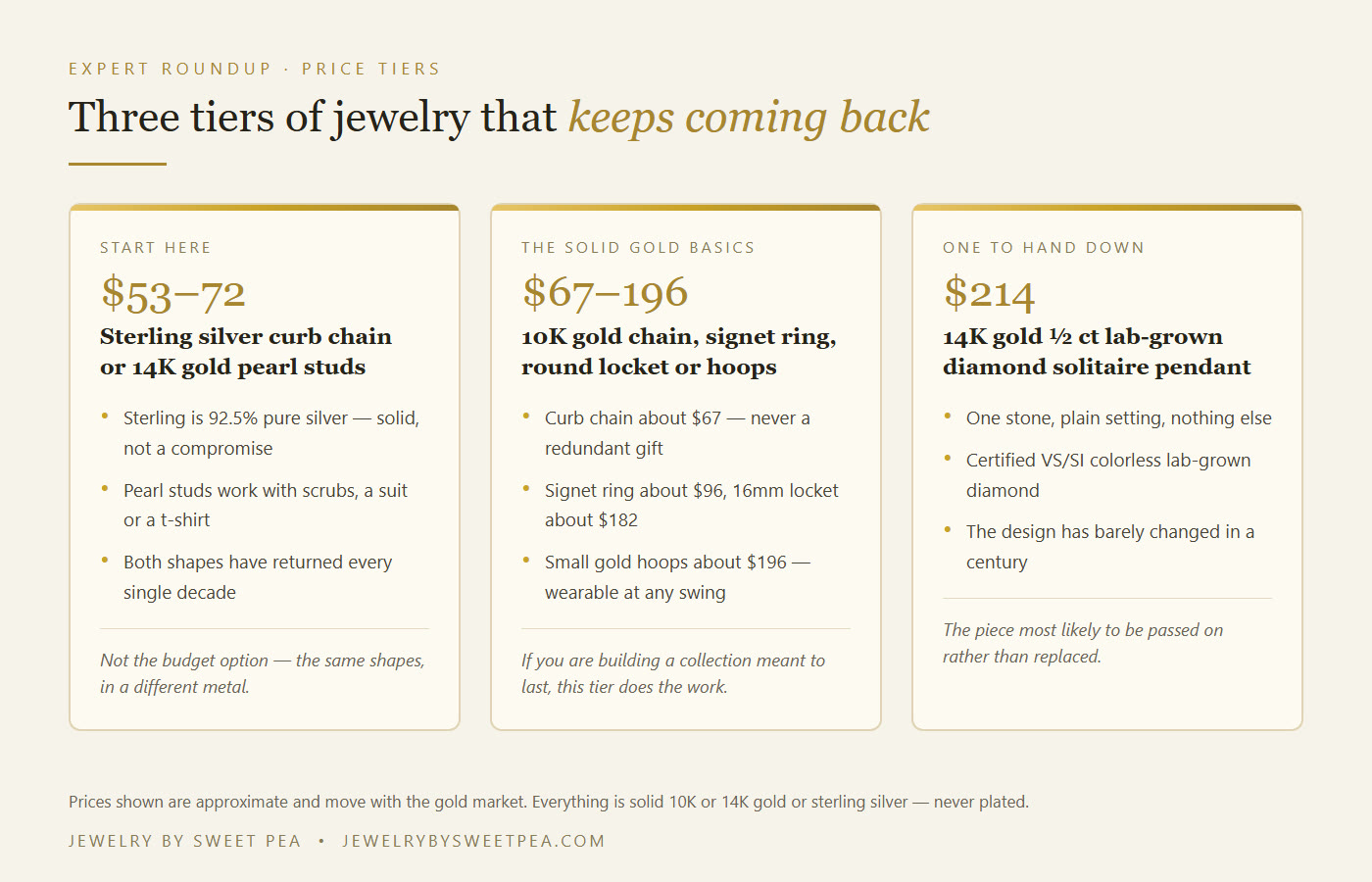
Under $75. A sterling silver 2mm curb chain at about $53 or the 14K gold pearl studs at about $72. Both are solid metal, both are the exact shapes that keep returning, and neither is a compromise — sterling silver is 92.5% pure silver all the way through, repairable and polishable the same way gold is.
$75 to $200. This is where the solid gold basics live: the curb chain at about $67, the signet ring at about $96, the locket at about $182, the hoops at about $196. If you are building a small collection that will still make sense in thirty years, this tier does most of the work.
$200 and up. The diamond solitaire pendant at about $214. One good stone in a plain setting is the most reliably timeless purchase in fine jewelry, and it is the piece most likely to be handed down rather than replaced.
Common questions
Is it worth buying into a trend at all?
Yes — just buy the solid-metal version of it. If oversized hoops are having a moment, buy solid gold hoops rather than plated ones. You end up owning the trend now and a permanently wearable piece afterward, at a price that usually is not much higher once you account for replacing the plated pair twice.
Does yellow versus white gold go in and out of fashion?
It does, on roughly a generational cycle, and it is one of the few style swings we would tell you to ignore completely. Both are solid gold, both hold value, and mixing metals stopped being a rule violation a long time ago. Buy the color she actually reaches for.
Is lab-grown diamond a trend that will date?
The stone is chemically and optically the same material as a mined diamond; the difference is origin, and it must be disclosed under the FTC Jewelry Guides. A plain solitaire setting is what makes a piece timeless, and that is unchanged either way.
How can I tell if something is solid or plated before I buy?
Read the metal description word for word. "10K gold" and "sterling silver" mean solid. "Gold-plated," "gold-filled," "gold tone," "gold over" and "vermeil" all mean a layer over something else. If a listing describes the color of a metal rather than naming the metal, assume it is plated.
What is the single safest thing to buy someone?
A solid gold chain. It commits the wearer to nothing, it works with whatever they already own, and it is the one piece of fine jewelry almost nobody has too many of.
Where to start
If you want one recommendation: buy a solid chain and a pair of pearl studs. That combination is roughly $140, has been continuously in style for a century, and gives you something to build on.
Browse the full range in earrings, necklaces, pendants and charms and bracelets. Everything is solid 10K or 14K gold or sterling silver, it ships in a gift box, and returns are free for thirty days.