
Experts Share How to Clean Gold Jewelry at Home Without Damaging the Finish
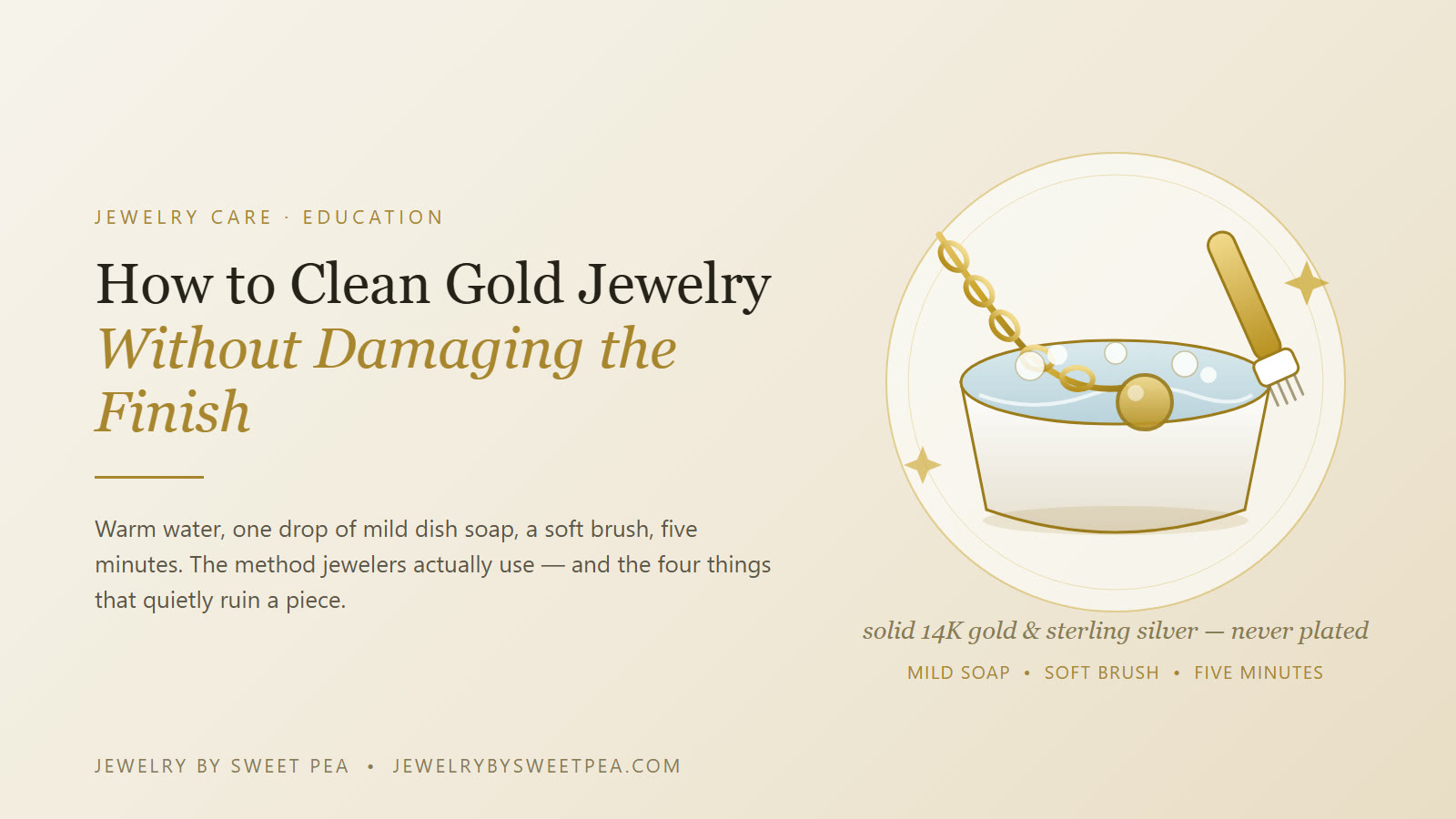
The short answer: warm water, one drop of mild dish soap, a soft toothbrush, five minutes of soaking, a gentle brush along the metal, a rinse, and a pat dry with a soft cloth. That is the method working jewelers use on the bench, and it is safe on solid 10K and 14K gold and on sterling silver. Almost every ruined finish we see came from something stronger.
Ask anyone who works on jewelry for a living what they use for routine cleaning and you will hear some version of that same boring answer. The advice online gets progressively more dramatic — baking soda, aluminum foil, vinegar, boiling water, toothpaste — and every one of those is a way to take metal off a piece you paid for.
Why do jewelers all recommend the same dull method?
Because gold does not get dirty in an interesting way. What dulls a gold chain is a film: skin oil, lotion, hairspray, soap scum, and the fine grit that sticks to all of it. That film sits on the metal — it does not bond to it, so a surfactant and a little agitation lift it.
Everything harsher works by abrasion or chemical attack instead. Toothpaste and baking soda are abrasives: they make a piece look bright by sanding away a microscopic layer of surface, which is tolerable on a plain polished band and destructive on any texture, satin finish, antiqued recess, or plating. Once a diamond-cut facet is rounded off, no polishing brings the sparkle back — the sparkle was the sharp edge. And chlorine, in bleach or heavily chlorinated pool water, attacks the copper and nickel alloyed into gold; repeated exposure can weaken solder joints until a chain fails at the clasp. That is why your jeweler says to take the chain off before the hot tub.
The five-minute method, step by step
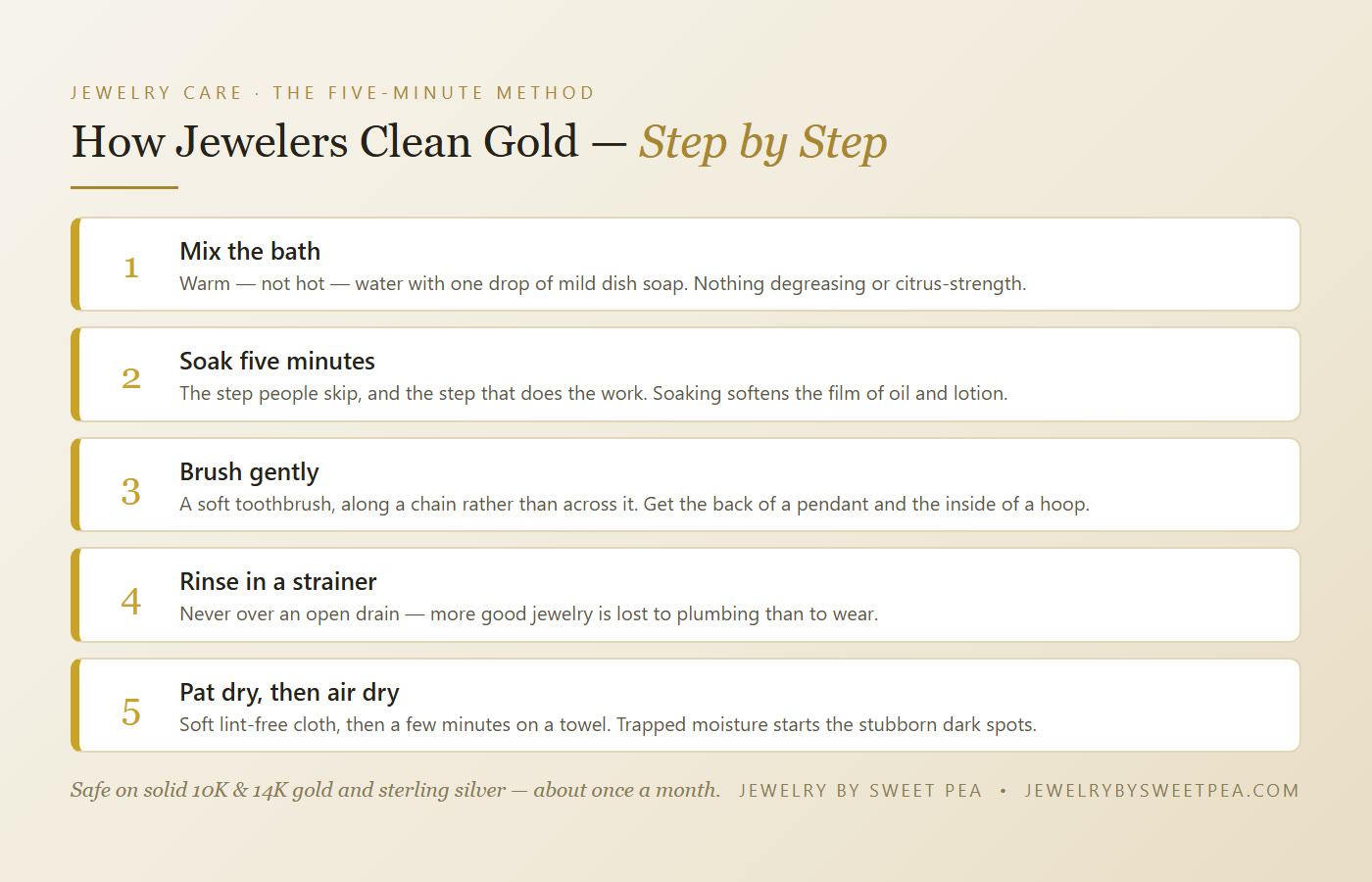
- Mix the bath. A small bowl of warm — not hot — water with a single drop of mild dish soap. Nothing labeled degreasing, antibacterial, or citrus-strength.
- Soak five minutes. The step people skip, and the step that does the work: soaking softens the film so the brush barely has to.
- Brush gently. A soft toothbrush kept just for this. Work along a chain rather than across it, and get into the back of a pendant and the inside of a hoop, where the film actually collects.
- Rinse in a strainer. Never over an open drain — more good jewelry is lost to plumbing than to wear.
- Pat dry, then air dry. A soft lint-free cloth, then a few minutes on a towel before the piece goes back in its box. Moisture trapped in a locket hinge or a hollow bead is what starts a stubborn dark spot.
Once a month is plenty for a piece worn daily. A chain worn under a collar, like our 14K Yellow Gold 18.5″ Add-A-Bead Cable Chain (about $231), has smooth open links and is the easiest thing in the box to clean well.
Does the finish change the method?
Yes — and this is the part the general advice leaves out. The metal is the same; the surface is not. Four cases cover almost everything you own.
High-polish gold is the forgiving one: soap, brush, rinse, dry, and a polishing cloth afterward is optional and safe.
Textured, diamond-cut, and satin finishes need the soap bath and nothing else — a polishing cloth run across a satin surface leaves shiny streaks only a jeweler can correct by refinishing the whole piece. Our 14K White Gold Textured 13mm Heart Locket (about $213) is exactly this category: brush it, rinse it, leave the texture alone.
Antiqued and oxidized pieces are the ones most often wrecked by good intentions. The dark tone down in the filigree is deliberate, and it is the first thing an abrasive or a silver dip removes, leaving a flat piece that has lost its depth. On something like the Sterling Silver Antiqued Filigree 23mm Locket (about $70), use soapy water and a soft brush only — never a tarnish-removing dip.
Rhodium-plated white gold and silver get soap and water, full stop. Rhodium is a thin bright layer over the metal and abrasives thin it. It wears naturally — a daily-wear ring may want re-plating every few years, a pendant like the Sterling Silver Rhodium-Plated Guardian Angel Heart Locket (about $23) may go a decade — and scrubbing only brings that day forward.
Worth knowing which you actually have: the FTC Jewelry Guides (16 CFR Part 23) govern how terms like karat gold, gold-filled, and gold plate may be used in the United States. Everything we sell is solid 10K or 14K gold or sterling silver, which is why every method here is safe on it. Gold-plated costume jewelry is a different problem — the plating is what you are cleaning.
What should you never use on gold jewelry?
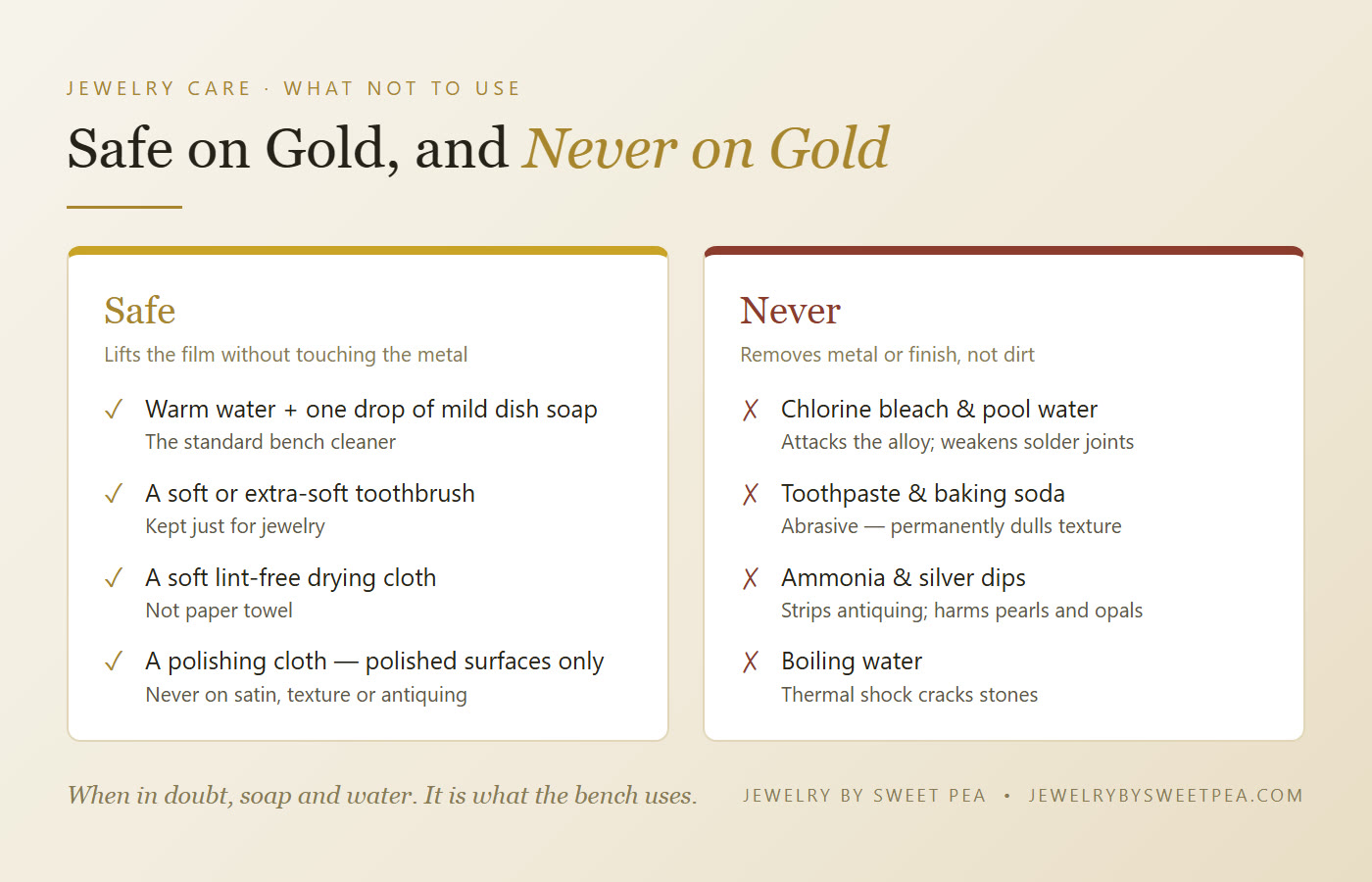
- Chlorine bleach — attacks the alloy metals in gold and can weaken solder joints. Nothing here is worse.
- Toothpaste and baking soda — abrasives. They remove metal, not dirt, and permanently destroy textured and antiqued finishes.
- Ammonia on anything delicate — a real risk to pearls, opals, emeralds, turquoise, and anything glued rather than set.
- Silver dips — they strip tarnish indiscriminately, which means intentional antiquing too, and leave a chalky residue in filigree.
- Boiling water — thermal shock cracks stones and can soften the adhesive under a fabric or enamel inlay.
- Paper towels — wood fiber is harder than you think. Use a soft cloth.
Chains, hoops, and lockets — the shapes that hide dirt
Flat pieces clean themselves in the bath. Complex ones need one extra thought.
Rope and multi-strand chains hold film between every twist, so they want the full soak and a brush drawn slowly along the strand rather than scrubbed at one spot. A piece like our 14K Yellow Gold Four Layer Rope Chain Necklace (about $729) rewards the patience — then lay it flat to dry so the layers separate instead of nesting wet.
Hoop earrings collect more film than anything else people own, on the inner curve and around the hinge or post where it is out of sight. Our 14K Yellow Gold Hoop Earrings (about $208) take thirty seconds with a soft brush along the inside. Dry the closure fully before wearing.
Lockets need any photograph or keepsake removed before the piece goes near water, and the hinge dried carefully — leave the locket open until it is completely dry.
More in our Necklaces, Earrings, and Pendants & Charms collections. Prices are as of writing; solid gold moves with the gold market.
Are home ultrasonic cleaners safe?
On plain solid gold with no stones, a home ultrasonic is generally fine and does a good job on chain. The same machine is hazardous to a long list of other things: pearls, opals, emeralds, tanzanite, turquoise, coral, amber, treated or fracture-filled stones, anything glued rather than prong-set, enamel, and antiqued finishes.
Pearls are the clearest case. A pearl is nacre — the layered organic material a mollusk deposits and, as GIA's guide to pearl quality factors explains, the source of a pearl's luster. Ultrasonic vibration, ammonia, and detergent all work on nacre, and the damage is not reversible.
Our honest position: with one machine and a mixed jewelry box, the soap bath is the better default. Save the ultrasonic for plain gold chain.
When should you stop and call a jeweler?
Cleaning is maintenance, not repair. Four things should never meet a toothbrush at home:
- A stone that moves, clicks, or rattles when you tap the piece near your ear — a loose setting can drop the stone in the sink.
- A clasp that has started catching, or a link that looks stretched or thinned.
- A pearl or bead strand where the thread has gone slack or grey — that is a restringing job.
- Dark spots that do not come off with soap, which usually means a proper polish or, on white gold, re-plating.
None of these are expensive to fix, and all of them get more expensive after something falls off.
Frequently asked questions
How often should I clean gold jewelry?
About once a month for anything worn daily, and after exposure to lotion, sunscreen, hairspray, chlorinated water, or salt water. Occasional pieces can go far longer — clean those when they look dull. A wipe with a soft cloth at day's end is the highest-value habit, because it removes skin oils before they build into a film.
Can I use dish soap on solid 14K gold?
Yes. Warm water with one drop of mild, non-degreasing dish soap is the standard safe cleaner for solid 10K and 14K gold and for sterling silver, with or without ordinary stones like diamonds and sapphires. Avoid heavy-duty, degreasing, antibacterial, or citrus-based soaps, and never put jewelry in a dishwasher.
Does toothpaste really clean gold jewelry?
It brightens gold by abrading the surface, which is not the same as cleaning it. On a plain polished piece the harm is slow; on diamond-cut, satin, textured, antiqued, or plated finishes it is immediate and permanent, because it removes the surface detail you paid for. Jewelers do not use it.
Will cleaning remove the antiqued finish on my silver pendant?
Soap and water will not. Abrasives and tarnish-removing dips will, and that cannot be undone without a jeweler re-oxidizing the piece. If your pendant has intentional dark tone down in the detail, use warm soapy water and a soft brush only, and keep polishing cloths off the recessed areas.
Why did my white gold turn slightly yellow or grey?
Usually it has not changed at all — the rhodium plating over it has worn thin, letting the naturally warmer color of the white gold alloy show through. That is normal wear, not a defect. Re-plating is a routine, inexpensive jeweler's service, and gentle cleaning makes it last longer between visits.
Jewelry by Sweet Pea is a family-run fine jewelry store. Every piece we sell is solid 10K or 14K gold or sterling silver — never plated base metal — sourced from U.S. wholesalers and shipped from the USA. Browse Necklaces and Pendants & Charms, or ask us anything about a piece you already own.