
Gold Bracelets vs Gold Bangles Which Style Holds Up Better With Daily Use
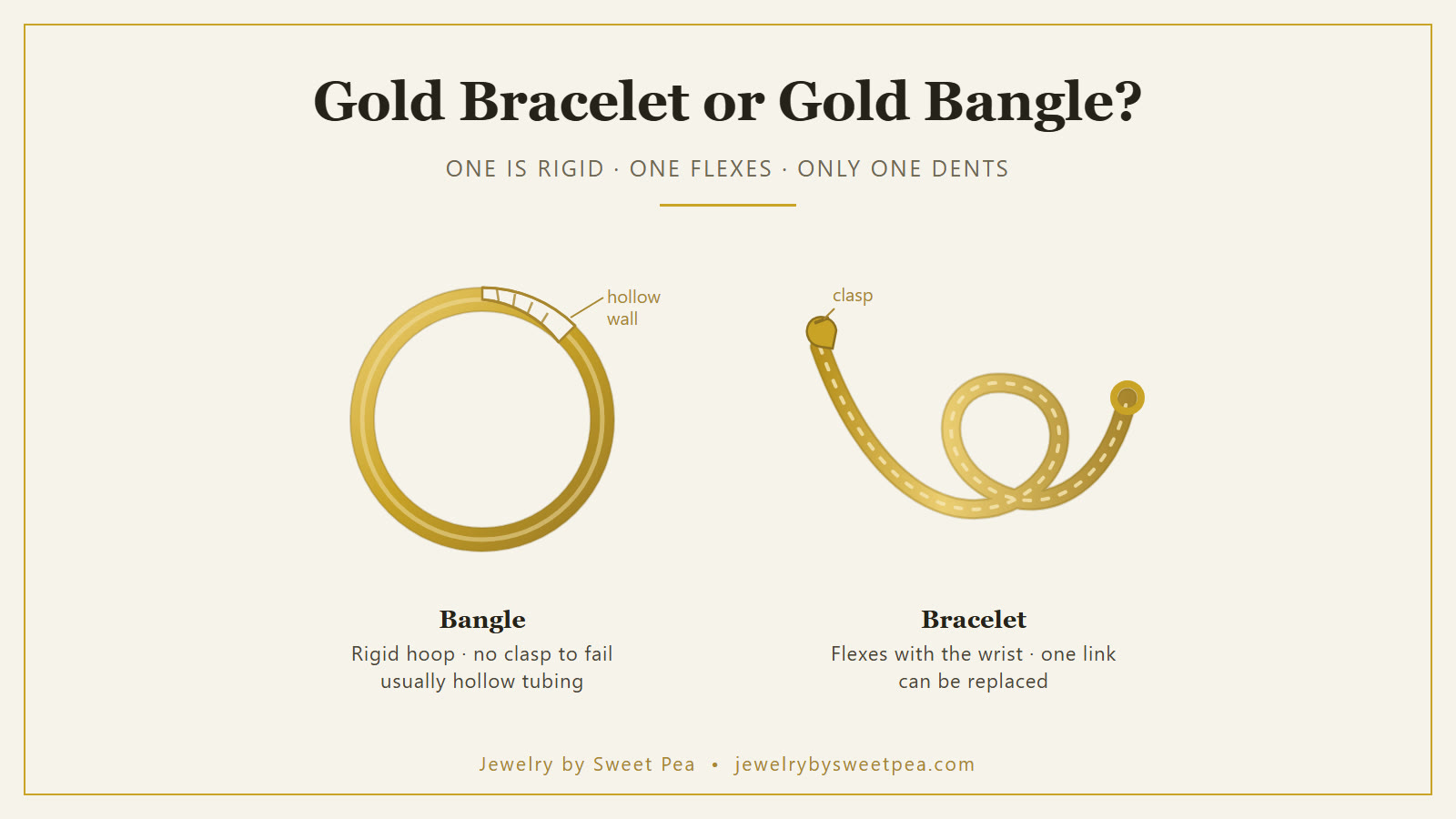
The short answer: for everyday wear, a link bracelet holds up better. A bangle is a rigid hoop, and at this price nearly every one is hollow or semi-solid tubing, so a hard knock leaves a permanent dent. A link bracelet flexes with the wrist and a jeweler can repair one link. Bangles win on price and on having no clasp to fail.
What is the actual difference between a bracelet and a bangle?
A bangle is a rigid ring that keeps its shape whether or not it is on you — set it on a dresser and it stays a circle. A bracelet is flexible: a chain of links or a rope that collapses into a puddle when you take it off, and takes the shape of the wrist when you put it on.
That one structural difference drives everything else: how they are sized, what they cost, and how they fail. There is also a middle case — a hinged bangle opens and closes with a box catch, so it goes on over the wrist bone instead of over the hand. It is still rigid, so it behaves like a bangle in every way that matters here; it just adds a clasp.
Which one actually survives daily wear?
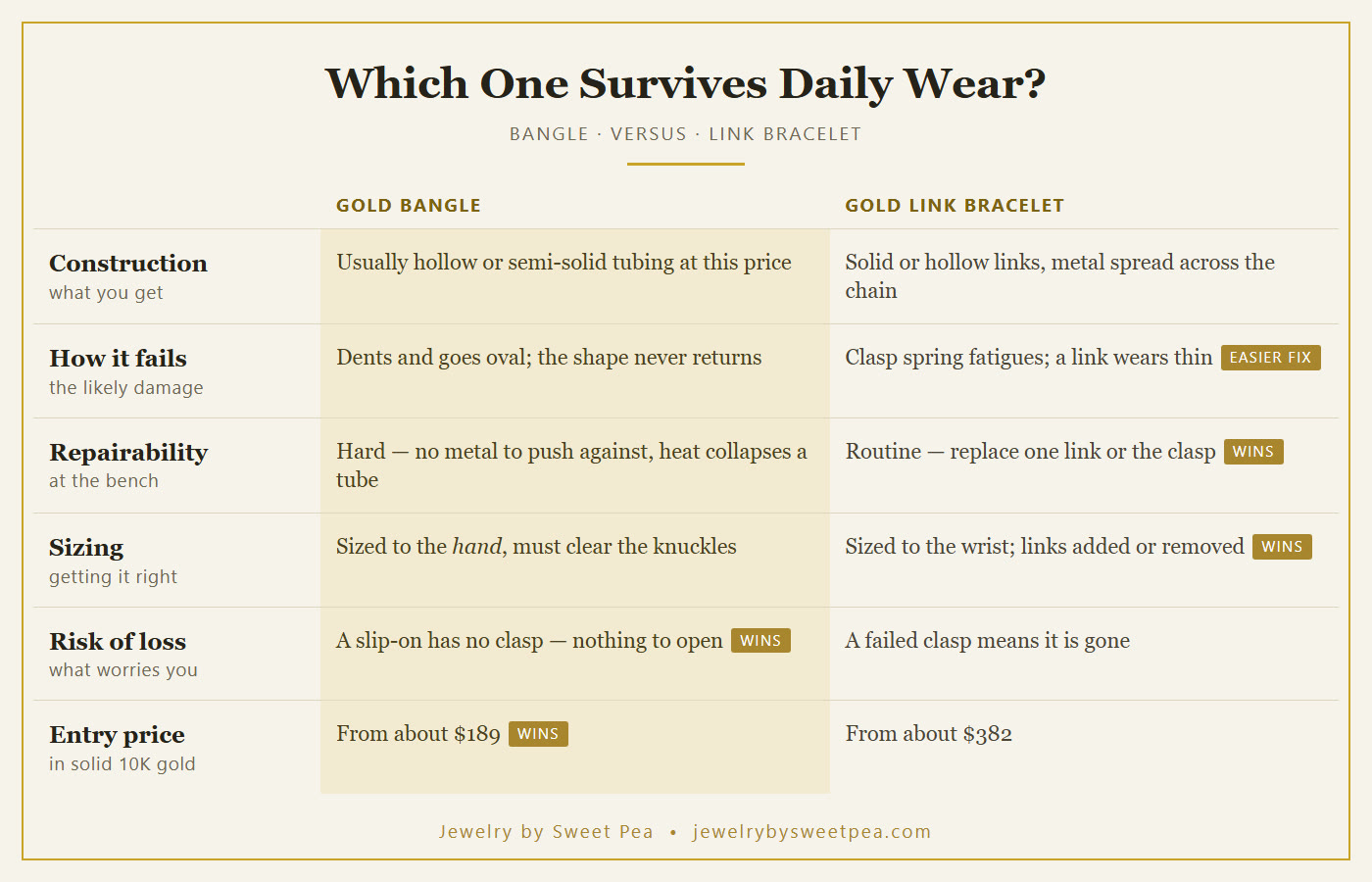
Here is the thing almost nobody mentions, even though the listing says it plainly if you read the specs: most gold bangles are hollow. Not fake, not plated — genuinely 10K or 14K gold, but formed as a thin-walled tube rather than a solid rod, because a solid gold hoop that size would cost thousands. Our own pages use the words "hollow tubing" and "semi-solid construction," and one lists the weight outright: a 10K yellow gold hinged bangle at about $388 carries roughly 2.57 grams of gold.
This matters because hollow tubing dents. A wrist rests on desks, car doors and kitchen counters all day, and a rigid tube takes that impact in one spot instead of distributing it. Once dented, a hollow bangle is genuinely hard to repair — there is no metal to push against from the inside, and heat can collapse the tube. Many jewelers decline the job.
A link bracelet spreads the same abuse across dozens of small pieces that move independently, and when one link eventually wears thin, replacing it is routine bench work. That is the real durability argument for anyone who never takes jewelry off.
The hollow question is regulated, incidentally. The Federal Trade Commission's jewelry guides on gold content require a hollow center to be disclosed near the gold description, precisely because shoppers assume solid.
Why is a bangle so much cheaper?
Gold sells by weight, so price is mostly a question of grams. A thin hollow hoop uses very little; a solid chain uses a great deal. That is the whole explanation, and it shows up cleanly in what these cost:
- 10K yellow gold 1.5 mm diamond-cut slip-on bangle — about $189. Eight inches around, 1.5 mm wide, semi-solid, no clasp at all. This is the least expensive way into real gold on a wrist.
- 10K yellow gold 2 mm diamond-cut tube slip-on bangle — about $281. Semi-solid tubing, 8.25 inches, still no clasp.
- 10K yellow gold 2.5 mm twisted slip-on bangle — about $302. Hollow tubing, and the twist hides small scuffs better than a polished surface.
- 10K yellow gold polished and textured hinged bangle — about $546. Wide at 18.5 mm, hinged with a safety clasp, made in Italy — a statement piece rather than a stacker.
- 14K yellow gold twisted hinged bangle — about $722. Hollow tubing, box catch with a safety clasp, 3 mm wide.
Now the flexible side, where the same money buys a different distribution of metal:
- Sterling silver antiqued rope bracelet — about $78. Eight inches, 3 mm, lobster clasp, made in Italy. Solid sterling, not plate.
- 10K yellow gold 3 mm double strand rope bracelet — about $382, described on its page as solid construction. Note what that means next to the hinged bangle above: nearly the same price, but the gold is in the chain, not in a tube wall.
- 14K yellow gold 3 mm double strand rope bracelet — about $472, in a 6-inch length for a small wrist or a child.
- 14K yellow gold oval ID Figaro bracelet — about $484. Eight inches, 3.5 mm chain, with an engravable plate measuring 25 mm by 11.2 mm. Made in the United States.
- 10K yellow gold flat curb link bracelet — about $572. Seven inches and a substantial 8 mm wide, though the page notes hollow curb construction, so it wears bigger than its weight.
Prices move with the gold market, so treat every figure here as "about" and let the product page be the authority on the day you buy. The full ranges live in bangles and bracelets.
Where does each one actually fail?
Bangles fail by deformation. A slip-on has no clasp, no spring, no hinge — nothing mechanical to break, which is a real advantage. What it does have is a shape it must keep. Catch it in a car door and it goes slightly oval, and once it is oval it never sits right again.
Bracelets fail at the clasp. A lobster clasp has a tiny spring, and springs fatigue — though a clasp is a replaceable part costing far less than the bracelet, and a failing one usually stiffens before it lets go. The real difference is the failure mode: a bangle that deforms is still on your wrist, while a bracelet that opens is on a sidewalk somewhere. If that is the risk that worries you, a slip-on answers it completely.
How do you get the size right?
This is where bangles are genuinely harder. A bangle is not sized to the wrist; it is sized to the hand, because it has to clear the knuckles. Measure around the widest part of the hand with the thumb tucked in, and pick a bangle at least that measurement. Too small will not go on; too large slides down to the fingers.
A hinged bangle sidesteps this by opening, which is the strongest argument for paying more for one: it sits at wrist size rather than hand size, so it stays put instead of sliding onto the back of the hand while you type.
Bracelets are far more forgiving. Measure the wrist, add about half an inch of ease, buy the nearest length — and if it is wrong, links can be removed or added at a bench for a modest fee. That adjustability is not a small thing when you are buying for someone else.
So which should you buy?
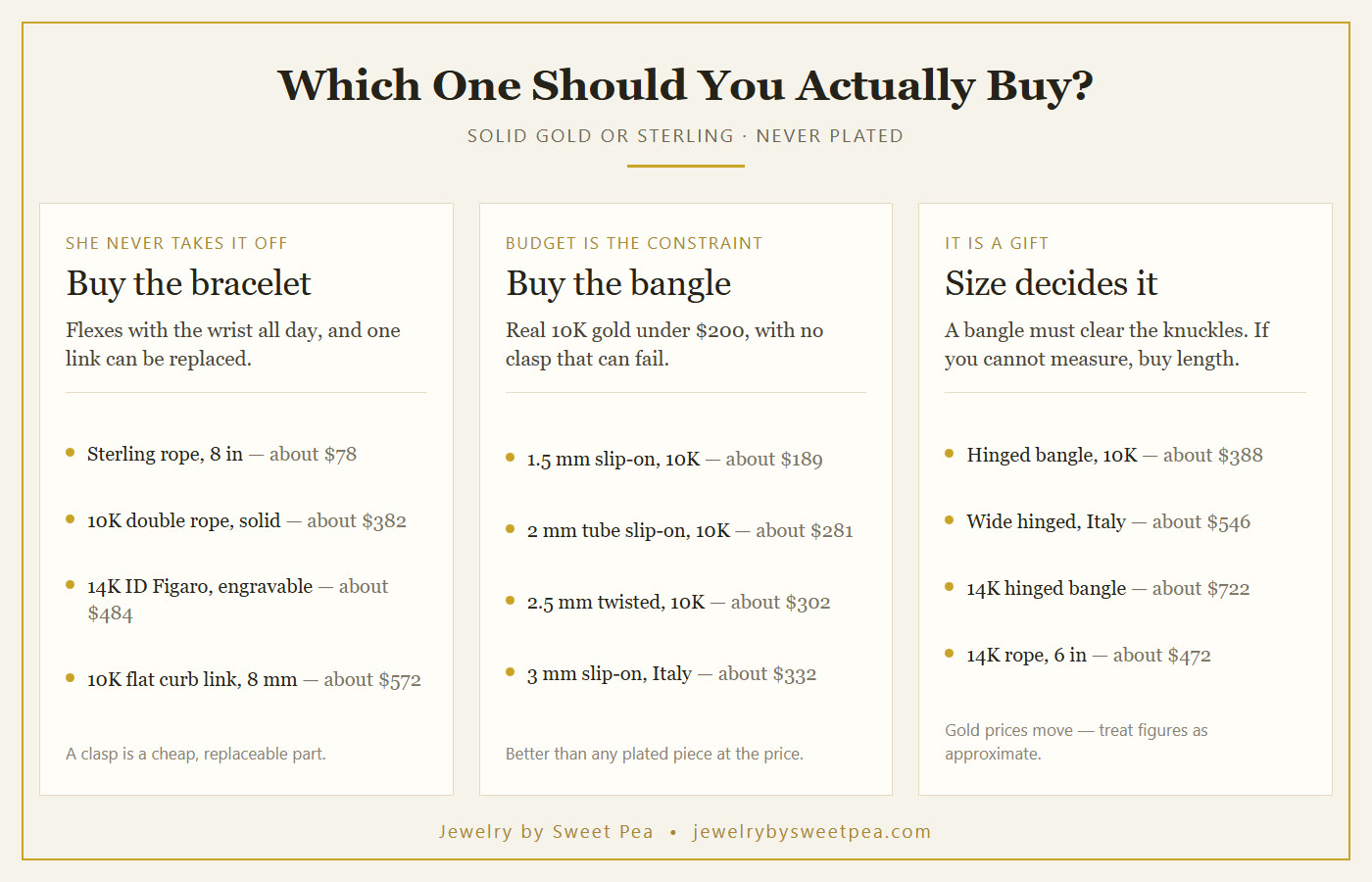
If she never takes jewelry off, buy the link bracelet. Sleeping and typing in a rigid hollow hoop is the recipe for a dented bangle, and rope styles handle constant wear about as well as gold does anything.
If the budget is the constraint, buy the slip-on bangle. Under $200 gets real 10K gold with no clasp to fail, and that beats any plated bracelet at the same price. We do not sell plated pieces, and this is why: a coating wears through and cannot be repaired.
If it is a gift and you cannot measure the hand, buy the bracelet. Length is easier to guess and easier to adjust afterwards, and one that arrives an inch long still goes on.
If you want one piece that looks like a decision, the wide hinged bangle does that better than any chain — just accept it is jewelry you take off before the gym.
Common questions
Can a dented gold bangle be fixed?
Sometimes, but not reliably, and hollow ones are hardest. There is no solid metal to work against and heat can collapse a thin tube. Ask a bench jeweler rather than assuming, and expect some to decline.
Is a hollow gold bangle real gold?
Yes. Hollow describes the construction, not the metal — a 10K hollow bangle is 10K gold throughout its walls. That is completely different from plating, a thin gold layer over a cheaper base metal.
Can bangles and bracelets be worn together?
Yes, and stacking is the most common way bangles are worn. A rigid bangle rubbing a chain will polish fine scratches into both over time, so matching the karat and color keeps the wear even.
Which is better for a child?
A bracelet with a lobster clasp, sized short. Children's hands change fast, so a bangle that clears the knuckles this year slides off next year, while a chain can be shortened or lengthened as they grow.
Does 14K last longer than 10K?
Not necessarily. 10K has more alloy and is harder, so it resists scratching slightly better; 14K holds richer color and more metal value. For daily wear, solid versus hollow matters far more than the karat number.
Still deciding? Both the bracelet collection and the bangle range are in stock as written. If a price has moved since your last visit, that is gold behaving like the traded commodity it is — the USGS gold statistics page tracks it.