
Heirloom Quality Jewelry vs Fashion Jewelry How to Tell the Difference Before You Buy
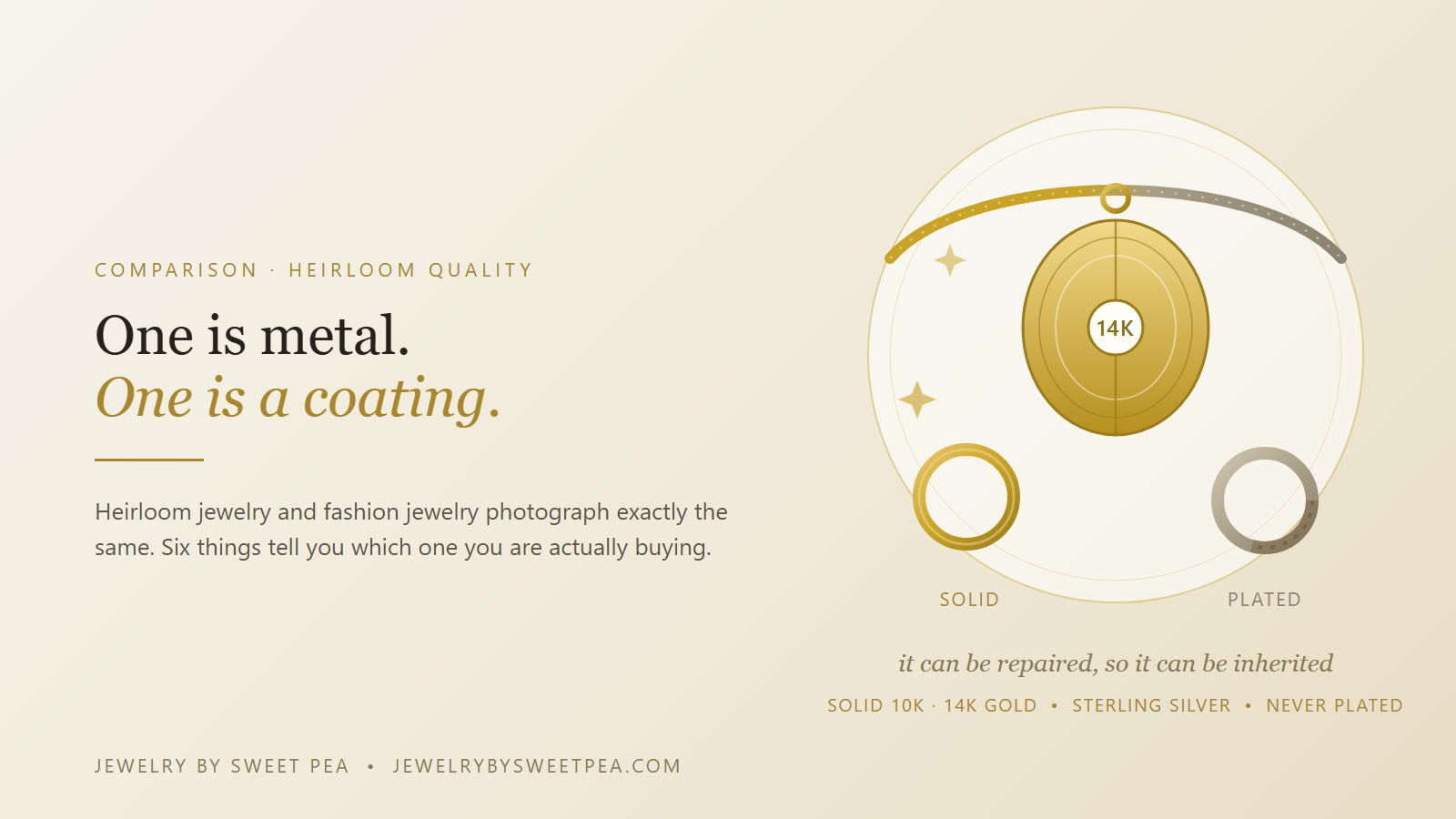
The short answer: heirloom-quality jewelry is made of solid precious metal all the way through — 10K or 14K gold, or sterling silver — so it can be polished, repaired, resized and handed down. Fashion jewelry is base metal under a thin decorative coating. It is built to be worn for a season, not repaired, and it cannot be passed on.
The hard part is that the two look identical in a photograph. A plated brass chain and a solid 14K chain get shot on the same white background, in the same light. One costs $19 and one costs $250, and nothing in the picture explains why. So here is what to read instead of the picture.
What actually makes a piece "heirloom quality"?
Not age, and not price. A piece earns the label when it can still be repaired and worn thirty years from now. Three things decide that.
- The metal goes all the way through. Solid 14K gold is 58.3% gold by weight, 10K is 41.7%, and sterling silver is 92.5% silver. Wear the surface down and what is underneath is the same material. Wear down a plated piece and you reach brass or steel, and the piece is finished.
- A jeweler can work on it. Solid gold and sterling can be soldered, re-tipped, resized and re-polished. Plated pieces usually cannot — the heat that makes a repair possible also destroys the coating, and glued components come apart under it.
- The construction is not disposable. Soldered jump rings rather than open ones. A real clasp rather than a folded tab. Stones held in prongs or bezels rather than dropped into a cup of adhesive.
Everything we sell is solid 10K or 14K gold or sterling silver, never plated base metal — which is the entire reason our prices sit where they do next to a mall kiosk.
How can I tell the difference in a product photo?
You mostly cannot. But the listing around the photo will tell you, if you know which six things to read.
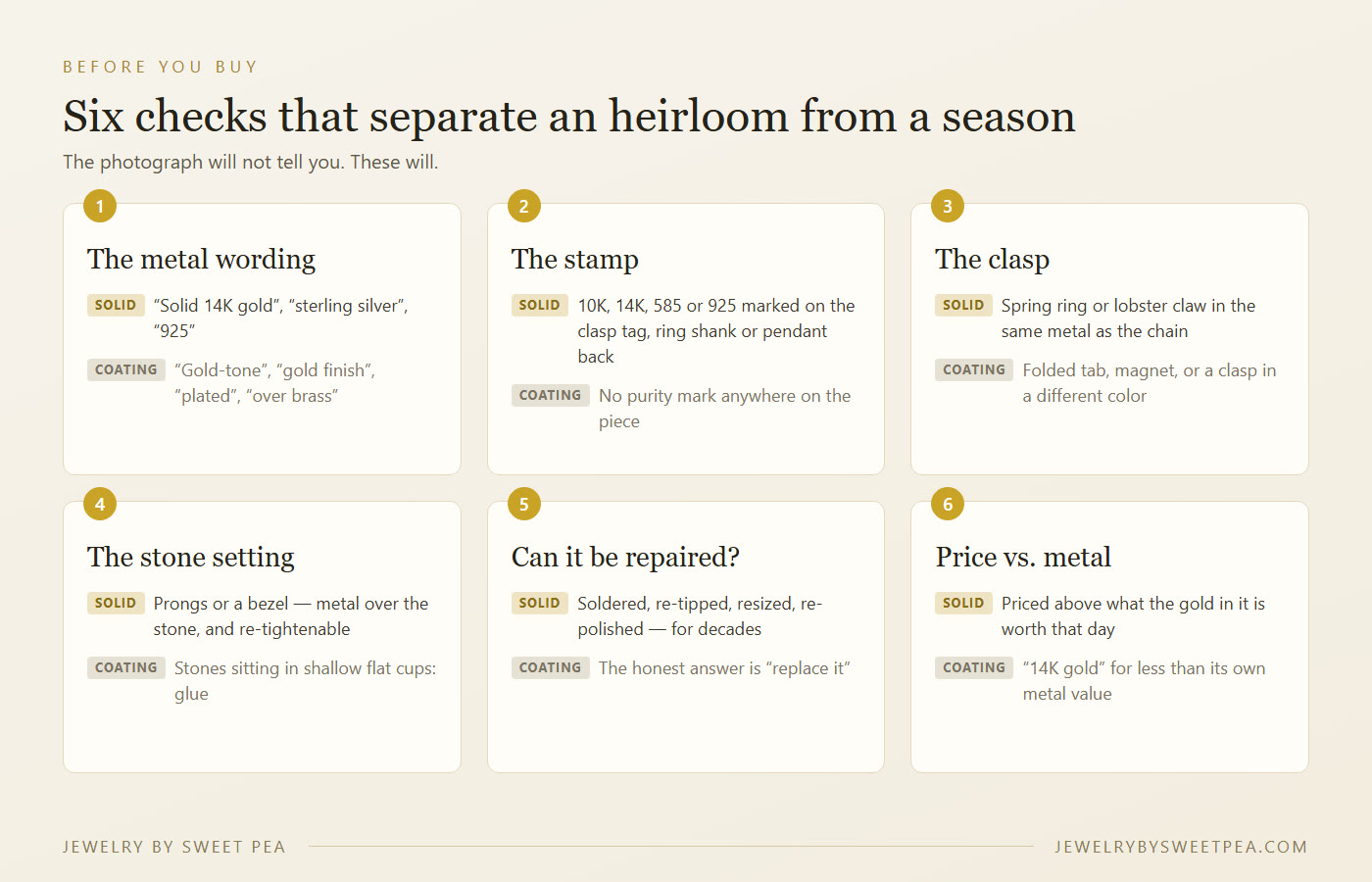
- Read the metal wording literally. "Solid 14K gold" and "sterling silver" are claims about the whole object. "Gold-tone," "gold finish," "14K gold plated" and "over brass" are claims about a coating. The Federal Trade Commission's Jewelry Guides govern how those terms may be used, which is why careful sellers word them precisely — and why vague wording is itself a signal.
- Look for a karat or purity stamp. 10K, 14K, 585, 925. Fine jewelry is stamped, usually on a clasp tag, inside a ring shank, or on the back of a pendant. Fashion jewelry generally is not.
- Study the clasp. The clasp fails first on nearly every necklace ever made. A spring ring or lobster claw in the same metal as the chain is a good sign. A painted tab, a magnet, or a clasp in a visibly different color is not.
- Check how the stones are held. Prongs and bezels are mechanical, and a jeweler can re-tighten them. Glue cannot be re-tightened. If small stones sit in shallow flat cups with no metal over their edges, assume adhesive.
- Ask whether it can be repaired. This is the fastest test of all, and you can ask us directly before you buy. If the honest answer is "replace it," it is fashion jewelry, whatever it cost.
- Weigh the price against the metal. Gold trades at a public daily price. A chain described as 14K gold but priced below what its metal alone would cost is not 14K gold. This one check catches most of what gets misrepresented online.
Is gold-filled or gold-plated ever worth buying?
Gold-filled and gold-plated are not the same thing. Plated jewelry carries a coating that can be measured in millionths of an inch. Gold-filled carries a bonded layer of real karat gold that is a meaningful share of the item's total weight — enough to survive years of gentle wear rather than months. The FTC guides linked above draw that line explicitly, with different rules for what may be called each.
Our honest position: gold-filled is a legitimate middle tier, we stock it, and it is not an heirloom. It cannot be resized or re-soldered the way solid gold can, and the layer, while real, is finite. Buy gold-filled when you want the look of gold on a modest budget and you understand the trade. Buy solid when the piece is meant to outlive you. Plated base metal has its place as well — a costume piece for one event — just do not pay keepsake money for it.
Which pieces are actually worth buying to keep?
These are in stock as we write this, chosen because they are repairable, classic in shape, and unlikely to look dated. Gold prices move daily, so treat these as close approximations rather than quotes.
- Gold-filled 14/20 satin and polished two-frame heart locket — about $95. The honest middle tier: a real bonded layer of karat gold, two photo frames, a fraction of the solid-gold price. A sensible first locket for a child who will grow into a solid one.
- 14K yellow gold 6–7mm white freshwater cultured pearl necklace — about $131. The classic strand, finished with a solid 14K clasp rather than a plated one. Pearls are the traditional inherited piece; GIA's guide to pearl quality factors explains what separates one strand from another.
- Sterling silver 26mm oval locket bangle — about $148. Solid sterling, rigid, no clasp to fail, and it polishes back to new indefinitely.
- 10K yellow gold 8.0 x 7.0mm closed-back signet ring — about $161. The original heirloom form: engravable with initials now, re-engravable for the next person decades from now.
- 10K yellow gold domed floral heart locket — about $171. Solid gold, hinged, made to be opened for decades. A locket is the piece most likely to actually get handed down, because the sentiment lives on the inside.
- 14K yellow gold hoop earrings — about $310. Plain gold hoops have been in style for roughly three thousand years, which seems a reasonable bet on the next thirty.
There is a great deal more in the full necklaces, pendants and charms, earrings, bracelets and rings categories. Remember that most pendants are sold without a chain.
What should I spend to get heirloom quality?
Less than most people assume. The entry point for solid precious metal sits far below the entry point for a diamond, because the metal is doing the work.
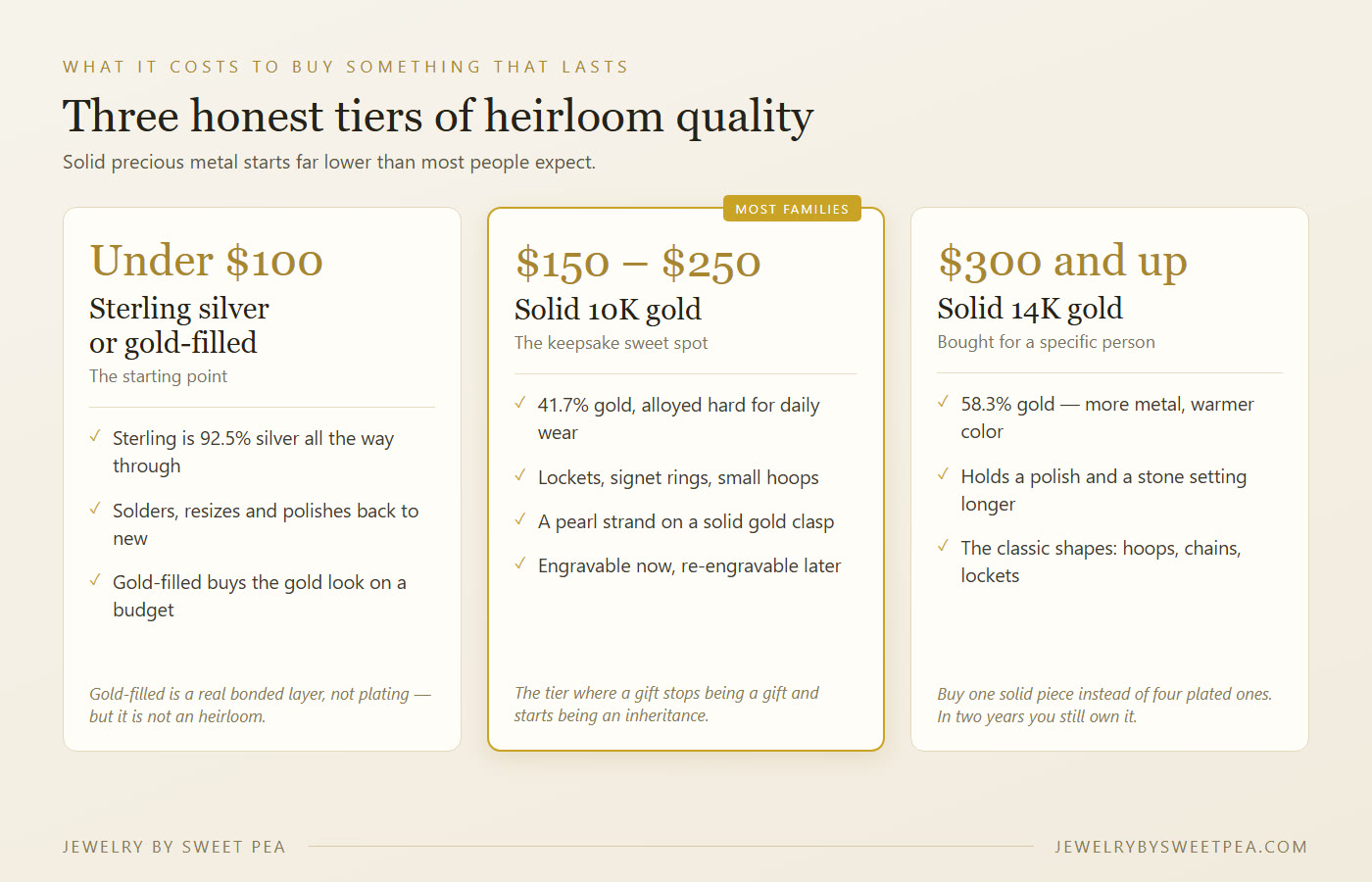
- Under $100 — sterling silver, or gold-filled. Solid sterling at this price is genuinely heirloom-grade; it simply needs an occasional polish. Gold-filled buys the look of gold, with the caveats above.
- $150 to $250 — solid 10K gold. The sweet spot for a keepsake most families can justify: lockets, signet rings, small hoops, a pearl strand on a gold clasp.
- $300 and up — solid 14K gold. More gold by weight, a warmer color, and the tier to choose when the piece is being bought with a specific person in mind to inherit it.
The advice we give constantly: buy one solid piece instead of four plated ones. Four fashion necklaces at $40 each cost about what one 10K locket costs, and two years later you own the locket or you own nothing.
Common questions
Is 10K gold real gold?
Yes. 10K is 41.7% gold alloyed with other metals for hardness, and it is solid gold jewelry in both the legal and the practical sense. It is harder-wearing than higher karats precisely because of the alloy, which makes it a sensible choice for a piece worn every day.
Does sterling silver count as heirloom quality?
Yes. Sterling is 92.5% silver throughout, can be soldered and repaired, and polishes back to new. It tarnishes, which is a surface reaction rather than damage — a polishing cloth reverses it. Families have been handing down sterling for centuries.
How can I tell whether jewelry I already own is solid or plated?
Look for a karat or purity stamp first: inside a ring shank, on a clasp tag, on the back of a pendant. Then look at the wear points — the edge of a ring, the back of a clasp. Plated pieces show a different color of metal peeking through where they rub. Any local jeweler can test a piece in a minute if you are unsure.
Do gemstones make something an heirloom?
Not on their own. A well-set stone in a solid gold mounting is heirloom quality; the same stone glued into plated brass is not. The setting and the metal decide whether a piece survives, not the stone.
What is the best first heirloom piece to buy?
A locket, for sentiment, or plain gold hoops, for wear. Both are timeless shapes, both are solid metal, and both get used rather than stored — and being worn is what actually turns a piece into an heirloom.
The short version
Fashion jewelry is priced for a season and built for one. Heirloom-quality jewelry is priced for a lifetime and built to be repaired along the way. If a listing will not tell you plainly what the metal is, that is your answer — and if you want a second opinion before you buy, from us or from anyone else, just ask.