
How Do You Choose Gold Jewelry That Looks Professional at Work but Still Feels Personal
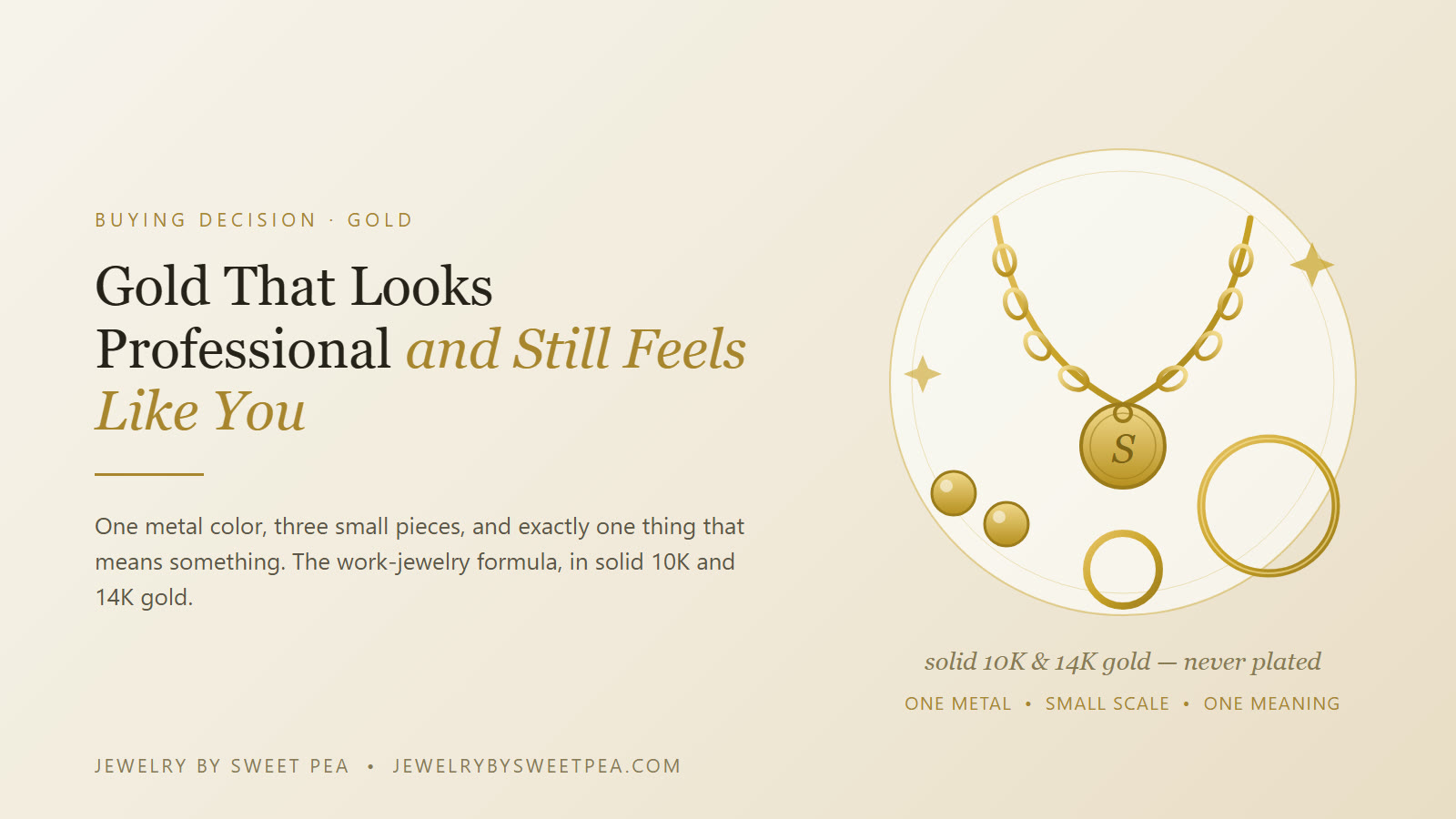
The short answer: commit to one metal color, keep every piece small and smooth enough to live under a sleeve or over a collar, and let exactly one item carry the personal meaning — an initial, a birthstone, a locket. Solid gold at a small scale reads as polished. What reads as “too much” at work is almost never the gold; it is volume, movement, and noise.
The question reaches our inbox constantly, usually phrased as an apology: I don’t want to look boring, but I don’t want to look like I’m trying either. Those two goals stop competing once you separate the pieces doing the professional work from the one piece doing the personal work.
What actually makes jewelry read as professional?
Three things, and none of them is price.
Scale. A piece is office-appropriate when it stays inside its own outline: studs that don’t reach past the earlobe, a pendant above the neckline, a bracelet that doesn’t slide over the heel of your hand.
Sound. The one nobody warns you about. Charm bracelets and stacks of thin bangles announce themselves in a quiet room and on every video call, because a laptop microphone sits about eight inches from your wrists. One rigid bracelet is silent; three loose ones are not.
Consistency. Mixing yellow and white gold can look wonderful, but it reads as intentional only when repeated. One yellow chain, one white ring, and one rose bracelet reads as three separate mornings. Pick a color and wear it as a set.
What is the three-piece formula?
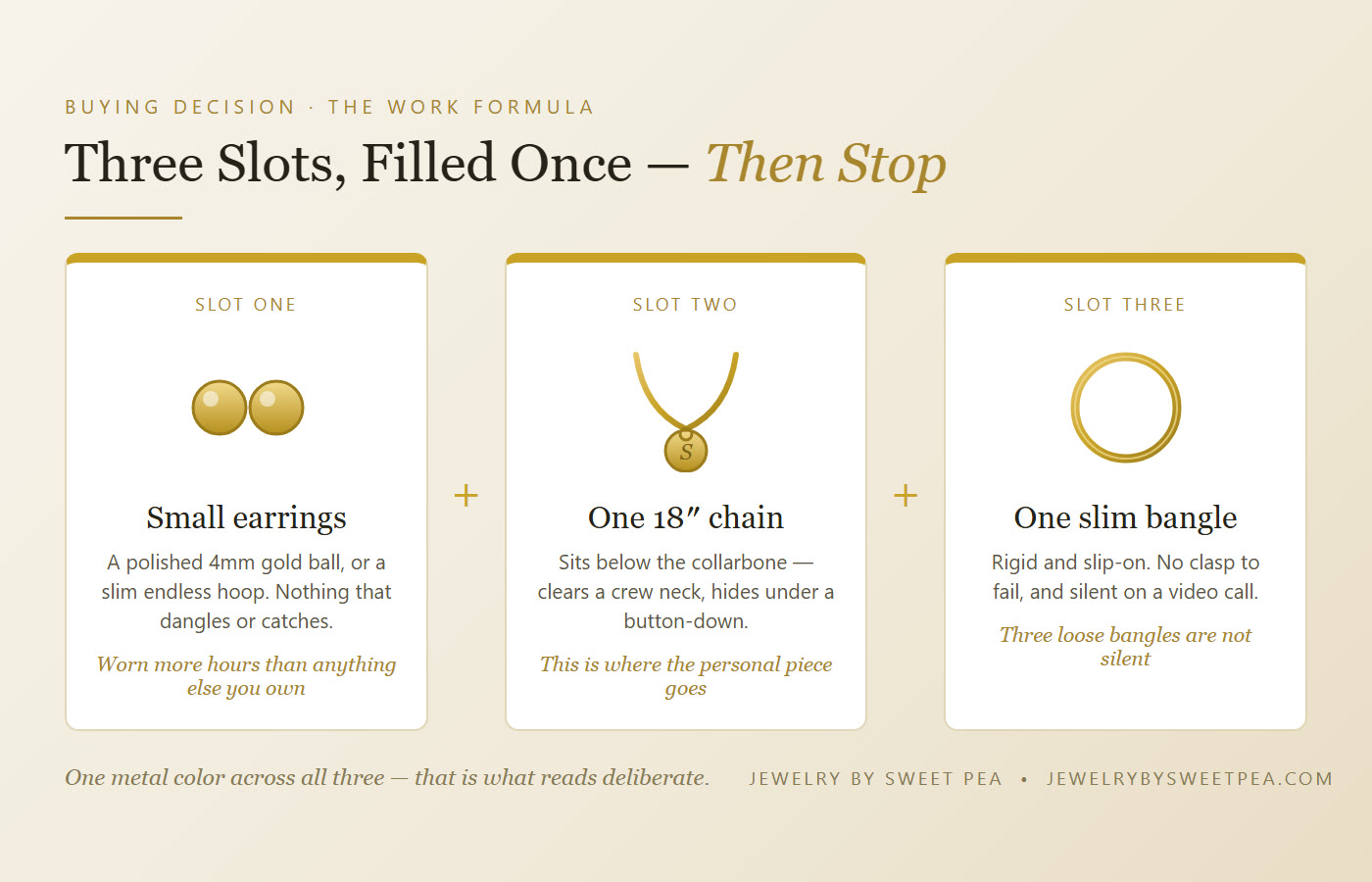
Nearly every polished-looking work wardrobe we see comes down to the same three slots. Fill each once and stop.
1. Earrings you never think about. A polished gold ball is the most forgiving version there is — it catches light without throwing sparkle across a conference table. Our 14K Yellow Gold Polished 4mm Ball Post Earrings (about $60) are the pair we recommend most often, and 4mm is the sweet spot: visible from across a desk, invisible under a headset.
For a little more presence, a slim endless hoop is still firmly professional as long as the diameter stays modest. The 10K Yellow Gold Polished Round Endless 2mm Hoops (about $128) have no clasp, no dangle, and nothing to catch on a collar.
2. One chain, worn daily. A thin cable chain around 18 inches lands just below the collarbone — the length that works with a crew neck, a button-down, and a blazer without fighting any of them. Our 14K Yellow Gold 18.5″ Add-A-Bead Cable Chain (about $233) accepts pendants and beads, which matters for the next section: it is the chain you change the meaning of rather than replace.
3. One bracelet that stays put. Rigid, slim, and slip-on beats anything with a clasp for daily wear — nothing to fail, nothing to jingle. The 10K Yellow Gold 1.5mm Diamond-Cut Slip-On Bangle (about $184) is deliberately narrow; the diamond-cut surface gives it light without width.
Three pieces, one metal color, and you are not choosing jewelry in the morning anymore.
Where does the personal part go?
Into the pendant, and only the pendant. When the earrings and bracelet are neutral, the one thing at the center of your collarbone gets to mean something, and nobody reads it as excessive because everything around it is quiet.
An initial is the most-asked-for version, and genuinely subtle at a small scale — most people register it as a shape before a letter. Our 10K Yellow Gold Polished Etched Initial Pendant (about $118, and we stock the alphabet) works because the etching gives it texture instead of size. It need not be your own initial: a child’s, a parent’s, a person you lost.
Same idea, other forms: a birthstone, a locket with a photograph in it, a charm from a place that matters. If you would rather the personal piece sat in your ears, a lab-grown solitaire like the 14K White Gold 1/4 Carat Lab Grown Diamond Solitaire Studs (about $154) is the classic milestone purchase and completely at home in a boardroom.
Pearl studs are the other traditional office answer. A pearl is nacre, the layered material a mollusk deposits, and as GIA’s guide to pearl quality factors explains, that layering is where luster comes from — which is also why perfume, hairspray, and hand sanitizer all attack it. Pearls go on last and come off first.
Does your workplace dress code change the answer?
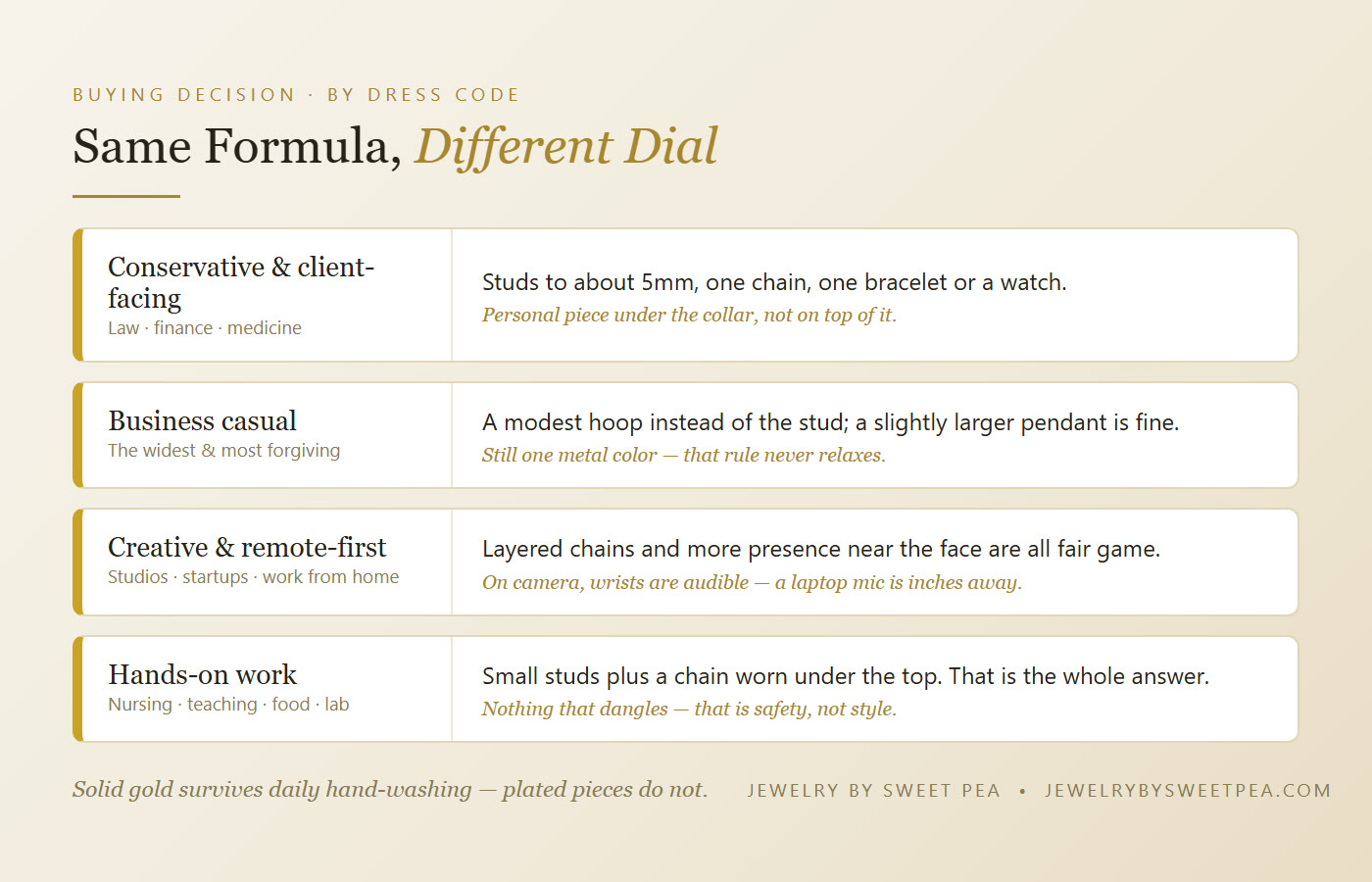
It changes the dial, not the formula.
Conservative and client-facing — law, finance, medicine. Studs no larger than about 5mm, one chain, one bracelet or a watch, nothing that moves. The personal piece belongs under the collar rather than on top of it, which is exactly what a small pendant on an 18-inch chain does.
Business casual — the widest and most forgiving category. Here a modest hoop replaces the stud, a second short chain can layer with the first, and a slightly larger pendant is fine. Still one metal color.
Creative, relaxed, or remote-first — more room, with one caveat that has nothing to do with taste: on camera, jewelry near your face is amplified and jewelry near your hands is audible. Bright hoops and stacked bangles behave differently on a video call than in a room.
Hands-on work — nursing, teaching, food service, lab. Rings and bracelets are often restricted, and dangling earrings are a safety issue rather than a style one. Small studs plus a chain under a scrub top is the whole answer, and solid gold survives constant hand-washing in a way plated pieces do not.
What should you actually spend?
A complete solid-gold work set does not require a large budget, because everything in it is deliberately small. Three tiers:
- About $60–$130 — start with the earrings. A pair of 14K ball studs at about $60 gets worn more hours per year than anything else here. Add the initial pendant at about $118 and both halves of the formula come in under $200.
- About $180–$250 — add the anchors. The slim bangle (about $184) and the 18.5″ cable chain (about $233) are the pieces you will still be wearing in fifteen years — the argument for buying solid gold once instead of replacing plated versions repeatedly.
- About $150–$400 — the milestone piece. Lab-grown diamond solitaire studs from about $154, or a diamond pendant. This is the tier people buy for themselves after something goes right, and the one worth waiting for.
Treat every figure here as approximate: we quote solid 10K and 14K, and gold moves with the market. That is also why a plated piece costs a fraction as much — there is almost no gold in it. The FTC Jewelry Guides (16 CFR Part 23) set the rules for how karat gold, gold-filled, and gold plate may be described in the United States, and the distinction is worth understanding before comparing two listings that look identical in a photo.
What quietly makes work jewelry look cheap?
Not the price. Four specific things, all avoidable:
- Plating worn through. A gold-plated chain looks perfect for a few months, then goes patchy at exactly the spots people see. Solid gold has no layer to lose.
- Green or grey skin marks. A base-metal alloy reacting with skin, not gold. Solid 10K and 14K do not do this.
- Competing focal points. Statement earrings plus a statement necklace means neither is a statement.
- A film of skin oil and lotion. Dull gold reads as fake gold. Warm water, a drop of mild dish soap, a soft brush, five minutes, once a month.
Browse the pieces in this article in Earrings, Necklaces, and Pendants & Charms. Prices are as of writing; solid gold moves with the gold market.
Frequently asked questions
Can you wear gold hoop earrings to a professional job?
Yes, in most workplaces, as long as the diameter is modest and the hoop is smooth and endless rather than dangling. From a few feet away a small polished hoop reads the same as a stud. In strictly client-facing roles a stud is still the safer default, and in hands-on work anything that hangs is a safety question rather than a style one.
Is it unprofessional to mix gold and silver jewelry?
No, but it looks deliberate only when it is repeated rather than happening once. Mixing works best when a single piece contains both colors, or when you wear at least two pieces in each. Building a work set from scratch, one color is simpler and harder to get wrong.
What length necklace works best under a work shirt or blazer?
Around 18 inches for most people, which sits just below the collarbone — low enough to clear a crew neckline, high enough to stay under a button-down without showing at the gap. Under 16 inches can sit on the collar itself; past 20 inches tends to swing forward when you lean over a desk.
Is 10K or 14K gold better for jewelry worn every day?
Both are solid gold and both are fine for daily wear. 10K holds more alloy, making it slightly harder and less expensive; 14K has a richer color and is the more common choice for fine jewelry in the United States. Either outlasts any plated alternative by decades, so choose on color and budget rather than durability.
How do I make one jewelry set feel personal without changing it?
Keep the earrings and bracelet fixed and change only what hangs on the chain. An add-a-bead or cable chain accepts different pendants, so an initial, a birthstone, a locket, or a travel charm can rotate on one necklace. The set stays consistent while the meaningful piece changes with the day.
Jewelry by Sweet Pea is a family-run fine jewelry store. Every piece we sell is solid 10K or 14K gold or sterling silver — never plated base metal — sourced from U.S. wholesalers and shipped from the USA. Browse Earrings and Necklaces, or ask us anything.