How Do You Pick a Gold Pendant That Will Still Look Stylish in Twenty Years
The short answer: buy a shape rather than a trend. Solitaires, crosses, lockets and hearts have been made continuously for over a century, so none of them can go out of style. Then check three things: that the gold is solid rather than plated, that the pendant measures roughly 10–30 mm, and that the bail is wide enough to take a replacement chain later.
People ask us this in a roundabout way. They hold up a pendant and say “is this too much?” What they mean is: will I be embarrassed by this in ten years. It is a fair worry, and the answer has less to do with taste than most people expect.
What actually dates a pendant?
Not simplicity. Plain pieces are not what look old in a photograph — the pieces that look old are the ones that referenced a particular year.
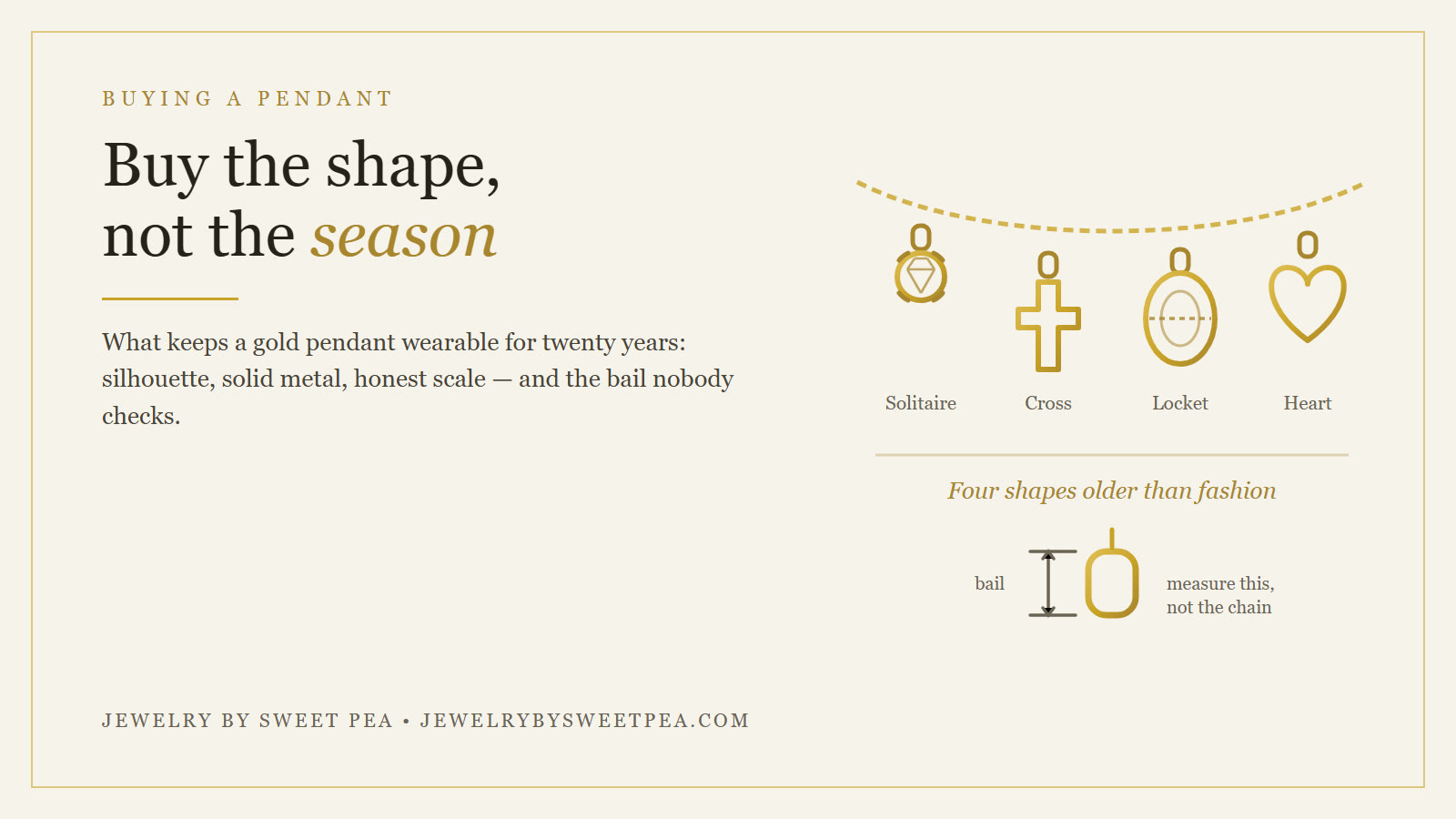
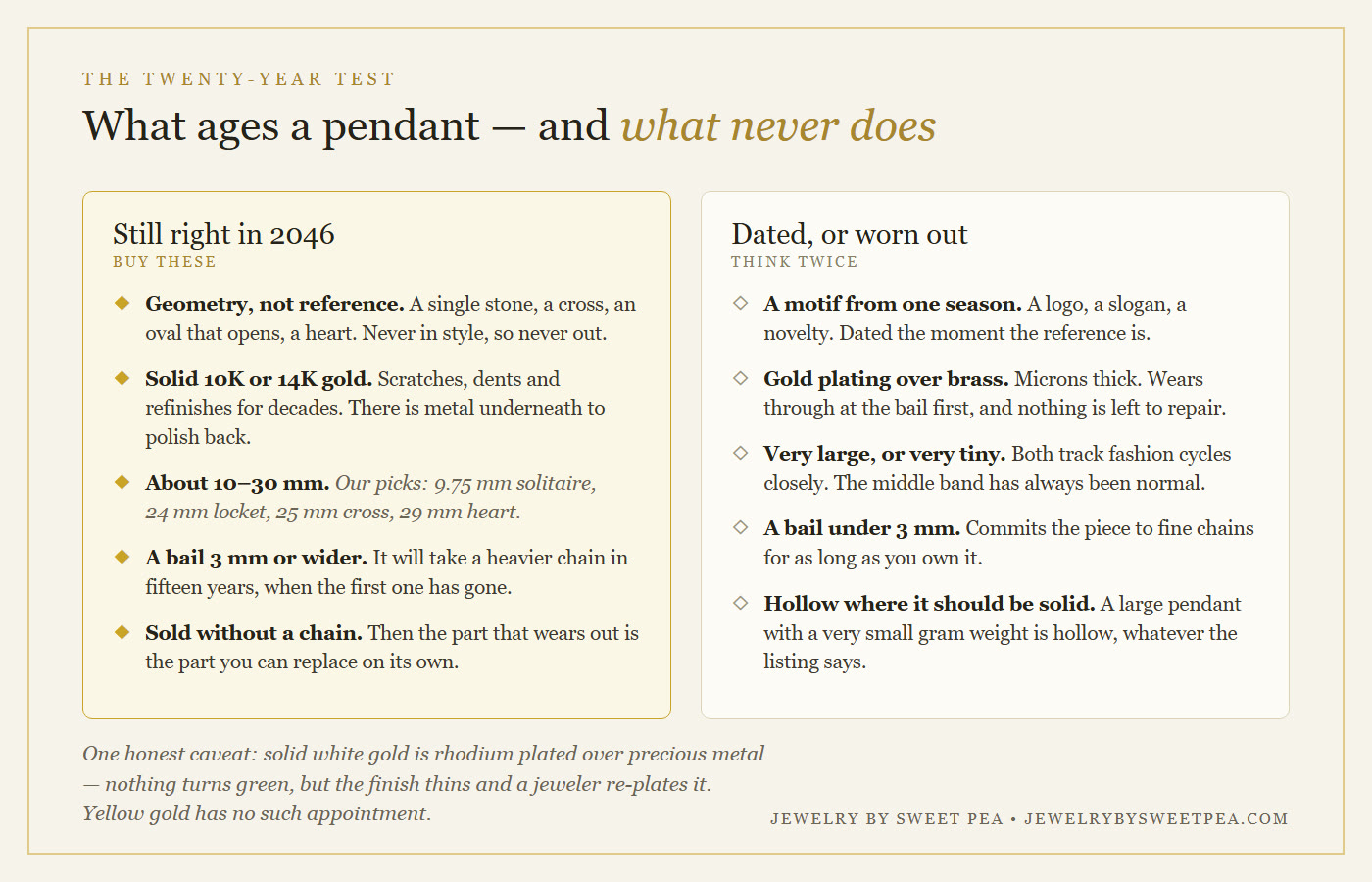
Pendant designs fall into two groups. The first is geometry: a single stone, a cross, an oval that opens, a heart. These shapes predate fashion entirely — they were never in style, so they cannot fall out of it. The second is reference: a logo, a slogan, a motif that belongs to one season. Those are fun, and sometimes exactly the right gift, but they are dated the moment the reference is.
The clearest example of the first group is the four-prong solitaire, which is the same construction the trade has used for generations: one round stone, four claws, nothing else. Our 14K yellow gold 1/4 carat lab grown diamond solitaire pendant (about $173) is 9.75 mm long and holds a 0.25 ct round stone in a four-prong head. There is no design decision in it that can age, because there is barely a design decision in it at all.
Does the metal matter more than the design?
Over twenty years, yes — considerably more.
The difference that matters is solid versus plated. Solid gold is gold all the way through: 10K is ten parts gold out of twenty-four, 14K is fourteen. What may legally be described as “gold” rather than gold-plated or gold-filled is set out in the FTC's Jewelry Guides at 16 CFR Part 23. Plating is a layer microns thick over brass or steel. On a pendant it wears through first at the bail, where the chain rubs, and once it does there is nothing underneath to polish back. A solid piece can be scratched, dented and refinished for decades. That is the whole reason we sell solid 10K and 14K gold and sterling silver and nothing plated.
White gold deserves an honest footnote, because nobody mentions it at the counter. Solid white gold is usually finished with rhodium, a bright white plating over the precious metal underneath. Our 14K white gold 1/3 carat solitaire pendant (about $188, 0.37 ct total weight) is described exactly that way: 14K white gold, rhodium plated, polished. That plating sits over solid gold, not over brass, so nothing turns green — but it thins with wear, and after a few years the piece drifts slightly warmer in color. A jeweler re-plates it for a modest fee. It is a maintenance appointment you are quietly signing up for; yellow gold has none.
How big should a pendant be if you want to wear it in 2046?
Between about 10 mm and 30 mm, which sounds like a dodge until you look at what falls outside it. Very large statement pendants track fashion cycles closely; very tiny ones read as a specific recent taste. The middle band has been continuously normal for as long as anyone has been photographing jewelry. Real numbers from pieces on our shelves right now:
- The 1/4 carat solitaire — 9.75 × 4.8 mm, 0.42 g of gold. Small enough to disappear under a collar.
- The 10K yellow gold polished oval locket — 24 × 14 mm (about $155), holding two oval photos.
- The 10K yellow gold cross pendant — 25 × 12 mm, 0.62 g, solid and cast.
- The 14K white gold heart pendant — 29 mm overall including the bail, 19 mm of that the heart itself, 0.89 g.
One thing worth knowing before buying a locket for a child: a locket is die-struck and hollow by necessity, because it has to open and hold photographs — the oval above takes two at 11 × 15.3 mm. That is not a defect, it is what makes a locket a locket. But it dents where a solid cast cross would not, and a dented lid is a real repair. For a nine-year-old, the cross is the sturdier gift.
Why the bail decides how long you keep it
This is the part almost nobody checks, and it is the part that ends up mattering. Twenty years is longer than a chain lasts. Chains stretch, links fatigue, clasps get replaced, and sooner or later one goes missing altogether. The pendant almost always outlives the chain it arrived on — so the bail, the loop the chain passes through, is what determines whether the piece can be rescued or has to be retired.
A generous bail takes a heavier chain later, when tastes or necks change. The 14K white gold heart has a bail 3 mm wide and 10 mm long, which is roomy; the oval locket is 4 mm wide and 5.75 mm long, wide but short. A bail under about 3 mm across commits you to fine chains for the life of the piece. Measure the bail, not the chain.
It is also why every pendant here is sold without a chain — deliberate, not stingy. Buying them separately means you replace the part that wears out and keep the part that does not. Browse chains after you have chosen the pendant, not before.
What should you spend?
Less than people assume. Prices below float with the gold market and were accurate on the day this was written.
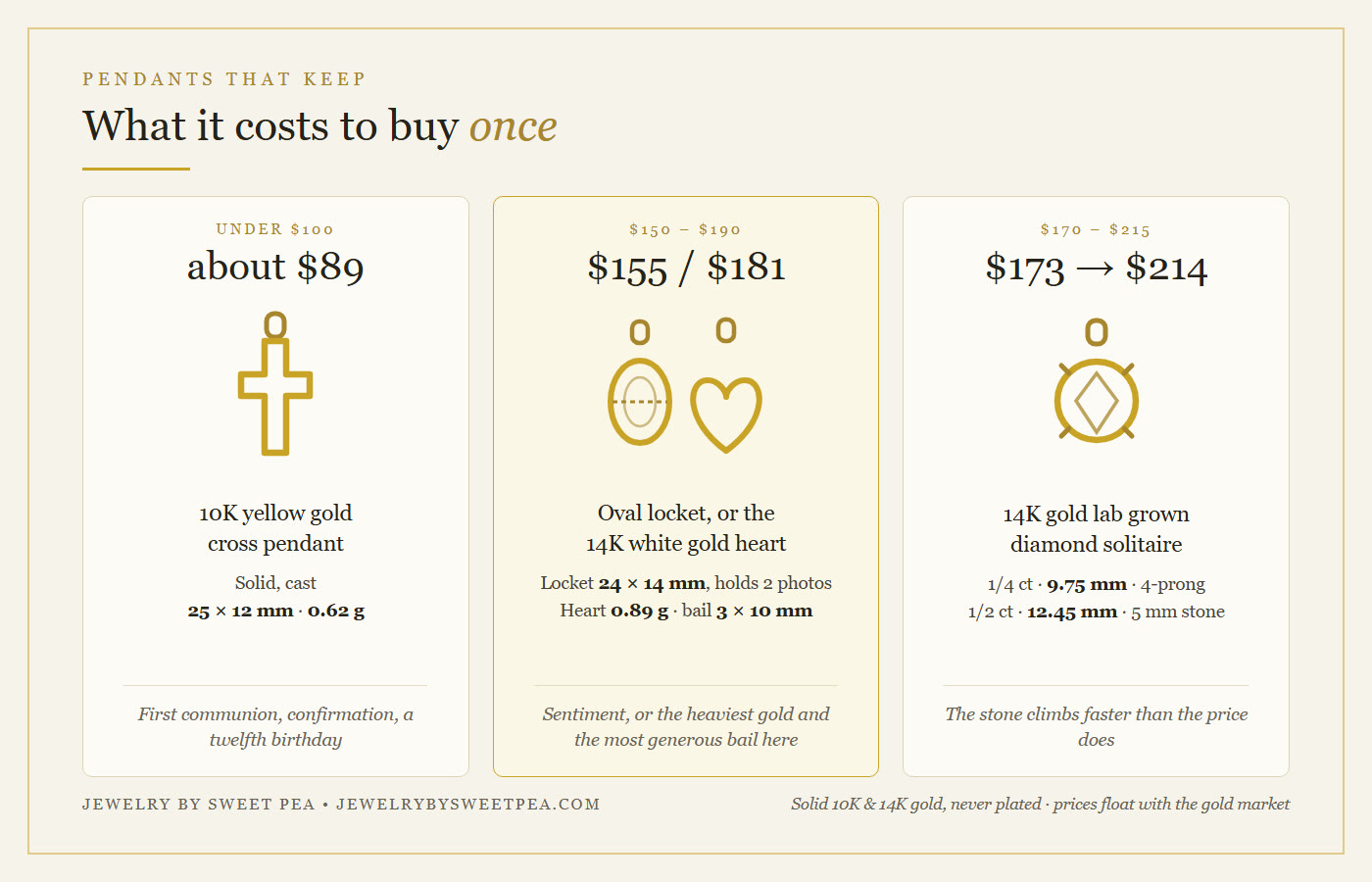
Under $100. The 10K yellow gold cross at about $89 is solid gold, cast, 25 mm long, with a textured face and polished finish. Nothing on it can look like 2026 in 2046. For a first communion, a confirmation or a twelfth birthday, it is the piece we hand people most often.
$150 to $190. The middle tier buys either sentiment or a stone. The oval locket at about $155 holds two photographs and gets more meaningful with age rather than less — the only category of jewelry that reliably does. The 14K white gold heart at about $181 is the heaviest piece in this article at 0.89 g, solid cast, with the most generous bail.
$170 to $215. Solitaires, where the stone climbs faster than the price does. The 1/4 carat is about $173; the 1/2 carat, twice the stone at a 5 mm diameter, is about $214. If a solitaire is the plan, the jump is usually worth taking.
More options across pendants and charms and necklaces.
Common questions
Is 10K or 14K better for a pendant you will wear for decades?
10K is marginally harder, because it contains more alloy metal, so it resists scratching slightly better. 14K is richer in color. For a pendant — which does not take the constant knocks a ring does — the difference over twenty years is small enough that we would let color and budget decide it. Both are solid gold and both are repairable.
Will a lab grown diamond pendant still look right in twenty years?
It will look identical, because a lab grown diamond is chemically the same material as a mined one and is graded on the same clarity, color and cut scales — GIA's explanation of the 4Cs applies to both. What we will not tell you is that it is an investment. Jewelry rarely is. Buy it to wear.
Does white gold really need to be re-plated?
Eventually, yes, if you want it to stay bright white. Rhodium is a surface finish and it thins with wear, faster on a ring than on a pendant. On something worn against clothing rather than against everything, it can go many years. Yellow gold sidesteps the question entirely.
How can I tell whether a pendant is solid or hollow?
Check the listing for the manufacturing process and the metal weight, and ask if neither is stated. Cast pieces are usually solid; die-struck pieces are often hollow, which is why lockets are die-struck. Weight tells the same story: a large pendant with a very small gram weight is hollow whatever else it says.
Should I buy the pendant and chain at the same time?
Buy them together if you want it to arrive ready to wear, but choose the pendant first and let its bail set the chain width. Buying a chain you love and then hunting for a pendant that fits it is how people end up with a piece they settled for.
Not sure which of two pieces suits the person you have in mind? Send us a note — we would rather help you pick once than process a return.