
How Jewelers Evaluate Quality and Craftsmanship Before Recommending a Piece to Customers
The short answer: before we recommend anything, we run the same short checklist — is the metal solid (not plated) and clearly karat-stamped, are the stones set securely with clean prongs, is the finish smooth with no casting pits, and is the clasp built to survive daily wear? A piece that passes all four is worth owning. Here is exactly how to check each one yourself.
We are a small, family-run store, and we handle every piece before it ships. Over the years the questions customers ask us most are versions of the same one: "How do I know this is actually good?" Below is the honest, jeweler's-eye answer — the things we look at first, why they matter, and real pieces from our own shelves that show what "well made" looks like.
Is the metal solid, and how can you tell?
This is the very first thing we check, because it decides whether a piece is an heirloom or a disappointment. Solid gold is gold all the way through. Plated ("gold-filled," "gold over sterling," "vermeil") is a microscopically thin gold layer over a cheaper base metal — it looks identical in a photo and wears through in months to a few years, exposing the metal underneath.
How to tell: look for a karat stamp — 10K, 14K, 18K, or 925 for sterling silver — usually on the bail of a pendant, the inside of a ring, or the clasp tag of a chain. A reputable listing states the karat plainly in the title. If a description leans on words like "gold tone," "gold finish," or "plated" and never gives a karat number, that is your answer. United States sellers are bound by the FTC Jewelry Guides (16 CFR Part 23) on how gold content may be described, so the language on the page is meaningful. Every piece we sell is solid 10K or 14K gold or sterling silver — never plated.
What does a jeweler check on the stone setting?
A loose stone is the most common reason a nice piece ends up in a drawer. When we evaluate a gemstone or diamond piece, we look at the prongs (the little metal claws holding the stone): are there enough of them, do they sit flat against the stone, and are the tips smooth rather than snagged or bent? We also check that the stone sits level and that the gallery underneath is clean, not filled with polishing compound.
A good example of tidy setting work is the 14K White Gold Oval Sapphire & Diamond Pendant (about $268): an AA-grade oval sapphire held in secure prongs with accent diamonds seated flush — the kind of setting that keeps stones safe through everyday wear. For a more playful, all-metal example of clean detail work, the 14K Yellow Gold Baseball Diamond Pendant (about $248) shows crisp seam stitching cast into solid gold with a diamond accent.
How do you judge a pearl?
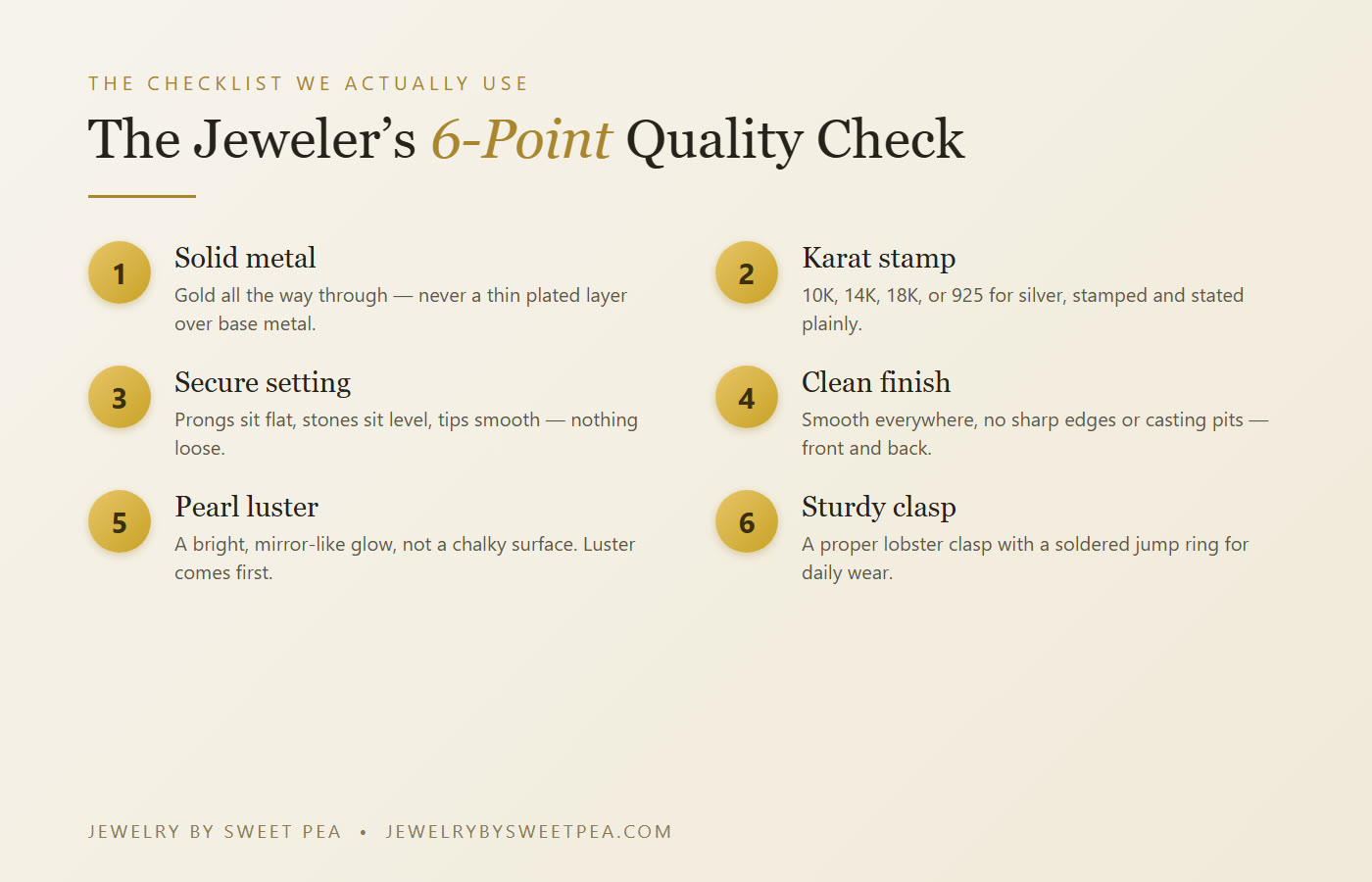
Pearls have their own quick test. We hold them to the light and look for luster — a bright, almost mirror-like glow rather than a chalky, matte surface. Luster is the single biggest quality signal in a pearl; the Gemological Institute of America lists it first among the seven pearl value factors. Then we check the surface for smoothness and the shape for roundness, and on a pair we make sure the two match.
Two nicely-lustered, well-matched picks from our case: the 14K Yellow Gold 7mm Freshwater Cultured Pearl & Diamond Pendant (about $184) pairs a round AA pearl with a diamond accent in warm yellow gold, and the 14K White Gold 5.5mm Freshwater Cultured Pearl & Diamond Pendant (about $219) is the classic white-gold version. Both are solid gold, so the pearl is set on metal that will outlast it.
What separates a well-made chain from a cheap one?
Chains fail more often than any other jewelry, so we look closely. The three markers: it should be solid (or clearly labeled semi-solid) rather than hollow and crushable; the links should be even and fully soldered closed, not open and prone to pulling apart; and the clasp should be a proper lobster clasp for daily wear, spring-back crisp, with a soldered jump ring.
A chain we recommend constantly is the 14K Yellow Gold Adjustable Diamond-Cut Rope Chain (about $697): solid 14K, an adjustable length so it works with almost any pendant, and diamond-cut faceting that catches light — a genuine buy-it-once chain. If you want the same construction quality at an entry price, the 10K White Gold 1.5mm Diamond-Cut Rope Chain (about $237) is a solid-gold chain that carries a light-to-medium pendant beautifully. Browse more in our Necklaces collection.
The finish: the detail most people miss
Run a fingertip over a piece. A well-finished item feels smooth everywhere — no sharp edges on a bail, no rough spots on the back, no tiny pinholes ("casting porosity") in the metal. Turn it over: on quality work, the back is finished as carefully as the front, because a good maker assumes someone will look. A rushed piece hides its flaws where you are not supposed to look. We turn every piece over.
Quality by budget: what "good" looks like at each price
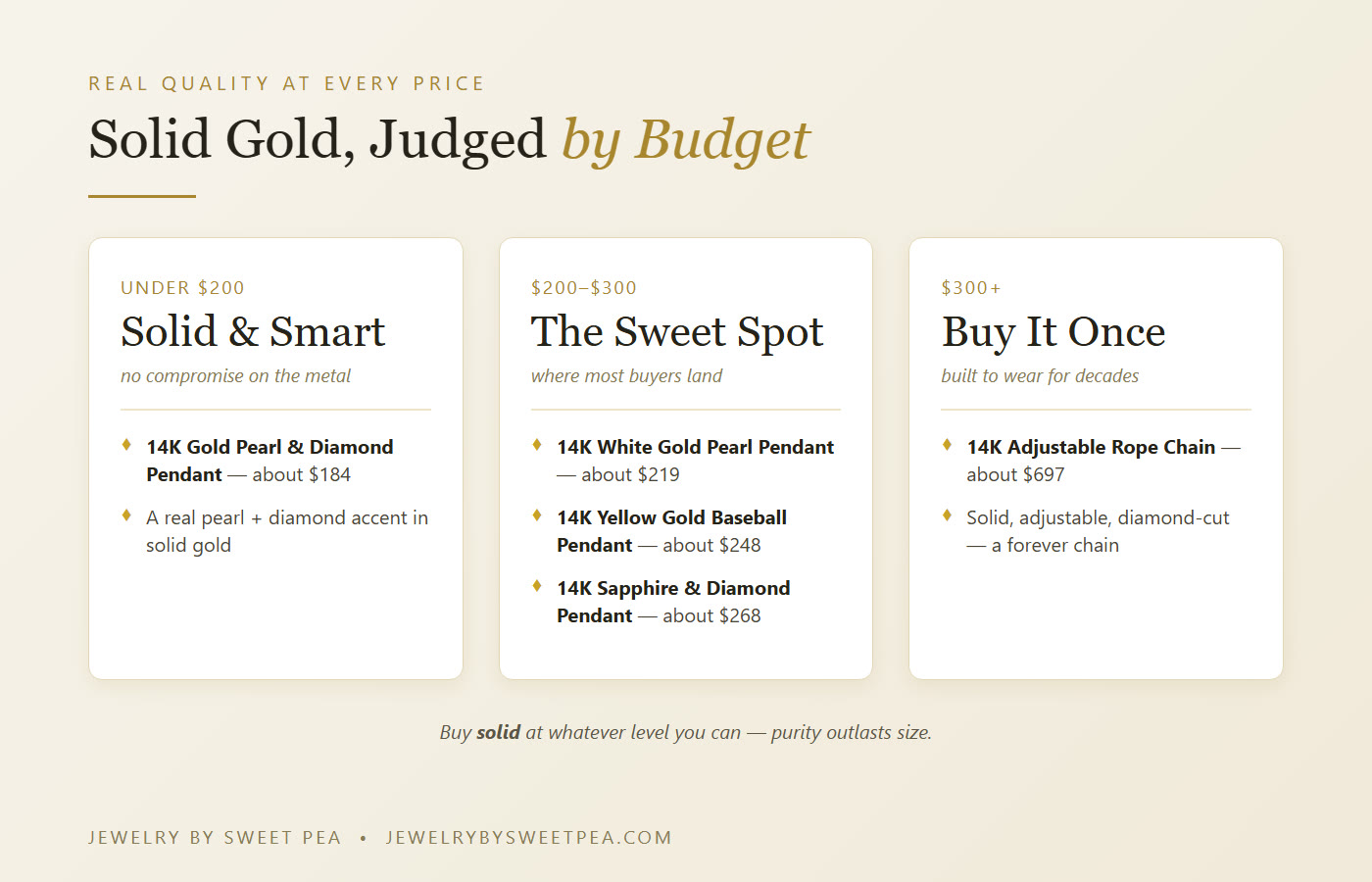
Good craftsmanship exists at every price — the trick is buying solid at whatever level you can, rather than a larger plated piece.
Under $200 — solid and smart
- 14K Yellow Gold Pearl & Diamond Pendant — about $184. A real pearl and a diamond accent in solid gold; proof you do not need a big budget for genuine quality.
$200–$300 — the sweet spot
- 14K White Gold Pearl & Diamond Pendant — about $219.
- 14K Yellow Gold Baseball Diamond Pendant — about $248.
- 14K White Gold Sapphire & Diamond Pendant — about $268.
$300+ — the buy-it-once piece
- 14K Yellow Gold Adjustable Diamond-Cut Rope Chain — about $697. Solid, adjustable, and built to be worn for decades.
Prices shown are at the time of writing; solid gold pieces move with the gold market. See more in Pendants & Charms.
10K, 14K, or 18K — does higher karat mean higher quality?
Not exactly — the karat is about purity, not workmanship. 14K is 58.3% pure gold (richer color, the U.S. standard for fine jewelry), 10K is 41.7% pure (paler, harder, more affordable, and excellent for daily wear), and 18K is 75% pure (deepest color, softer). A beautifully-made 10K piece will outlast a carelessly-made 18K one. Whichever karat you choose, buy from a seller who states it plainly — U.S. sellers are bound by the same FTC Jewelry Guides on describing gold content. Our take: choose the karat for the color and durability you want, then judge the craftsmanship using the checklist above.
Frequently asked questions
How can I tell if gold jewelry is real before I buy it?
Look for a karat stamp (10K, 14K, 18K) or 925 for sterling silver, and read the listing for a plainly-stated karat. Vague terms like "gold tone," "gold finish," or "plated" signal that the piece is not solid gold. A trustworthy seller states the metal clearly and stamps every piece.
What is the most important sign of a quality piece of jewelry?
That it is solid metal, correctly stamped, with securely-set stones and a smooth, complete finish front and back. Solid construction is what lets a piece last generations; a plated or hollow item can look identical in a photo but will not survive daily wear.
Is plated or gold-filled jewelry ever worth buying?
For costume or trend pieces you will wear briefly, plated jewelry is fine. For a gift, a milestone, or anything you want to keep, buy solid gold or sterling silver — it holds intrinsic value and does not wear through. We only sell solid pieces for exactly this reason.
How do I judge pearl quality quickly?
Hold the pearl to the light and look for luster — a bright, mirror-like glow rather than a chalky surface. Strong luster is the top quality signal. Then check the surface for smoothness and, on a pair, that the two pearls match in size and color.
Does a higher karat number mean better jewelry?
No — karat measures gold purity, not craftsmanship. 14K is the U.S. fine-jewelry standard; 10K is harder and more affordable; 18K is richer and softer. A well-made 10K piece beats a poorly-made 18K one. Judge the making, then pick the karat for the look and durability you want.
Jewelry by Sweet Pea is a family-run fine jewelry store. Every piece is solid 10K or 14K gold or sterling silver — never plated — sourced from U.S. wholesalers and shipped from the USA. Browse our Pendants & Charms and Necklaces, or ask us anything before you buy.