
Is 10K or 14K Gold Better for Someone Who Wants Durable Jewelry for Everyday Wear?
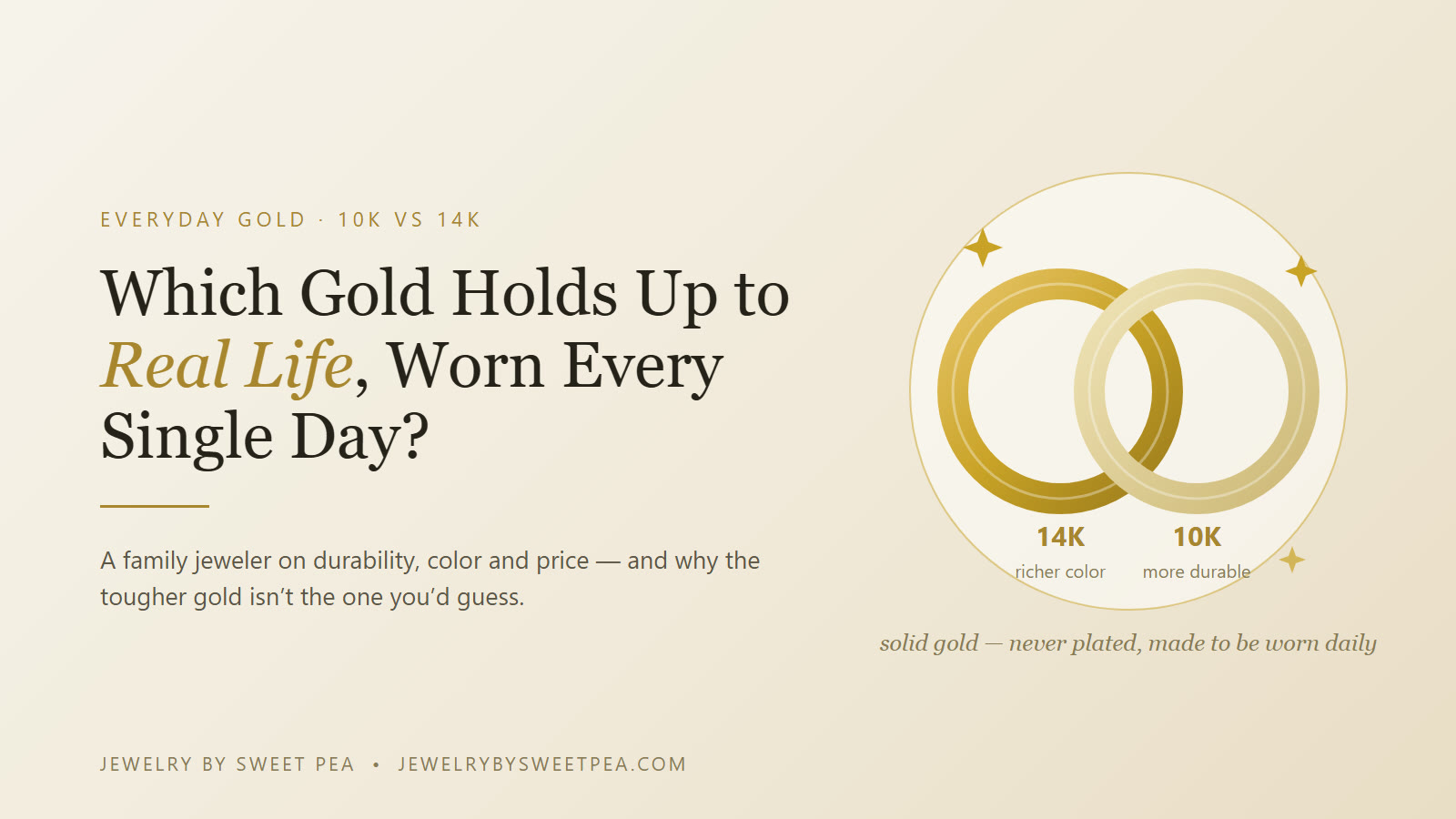
The short answer: for jewelry you'll wear every single day — through dishes, workouts, car doors and toddlers — 10K gold is the more durable, harder-wearing choice, and it costs noticeably less. Choose 14K when you want a richer gold color or have sensitive skin. Both are real, solid gold and both last for generations.
It feels backwards, doesn't it? You'd expect the higher karat to be tougher. But pure gold is one of the softest metals there is — so the piece with less pure gold is actually harder. Here's exactly how that works, where each karat wins, and which solid-gold pieces we'd hand someone who never takes their jewelry off.
What does the karat number actually mean?
Karat (K) measures purity, not quality. Pure gold is 24K. The number tells you how much of the metal is gold and how much is a stronger alloy mixed in for durability:
- 14K gold = 58.3% pure gold (14 parts of 24). The U.S. standard for fine jewelry — a warm, rich yellow.
- 10K gold = 41.7% pure gold (10 parts of 24). The minimum that can legally be called "gold" in the United States — slightly paler, and the toughest of the common karats.
That alloy — copper, zinc, silver, and a touch of nickel or palladium depending on the color — is what gives gold its backbone. More alloy means a harder, more scratch-resistant piece. If you want to go deeper on how purity and color are determined, the Gemological Institute of America keeps a clear, no-sales-pitch gold education page.
Which is more durable for everyday wear — 10K or 14K?
10K wins on hardness. Because it has more of the strengthening alloy and less soft pure gold, 10K resists scratches, dings, and bending better than 14K. For a ring you wear typing all day, a chain that lives under your collar, or hoops you sleep in, that extra hardness is a real, practical advantage — not a marketing line.
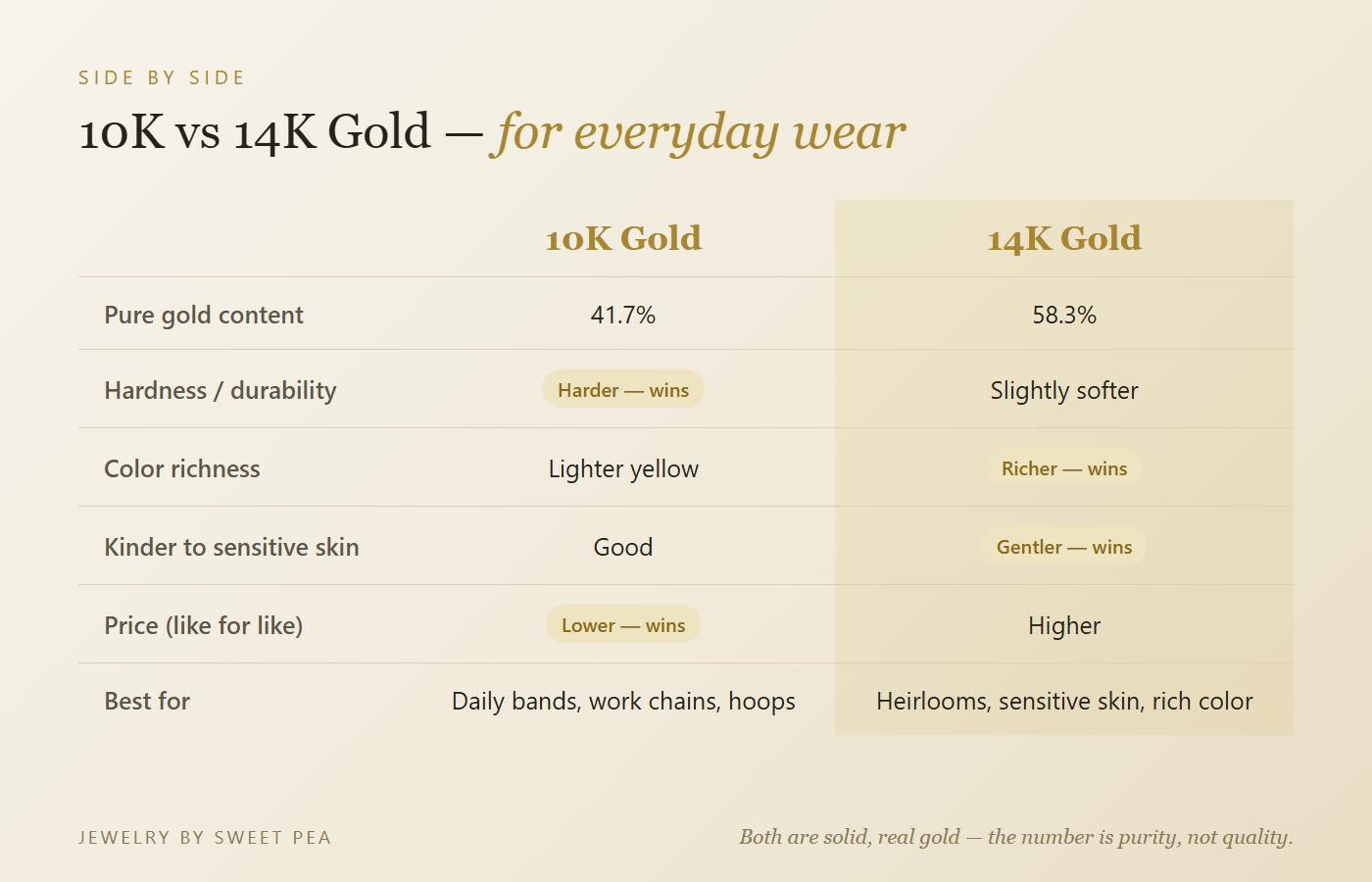
The trade-off is small and honest: 10K's color is a touch lighter and less saturated than 14K, and because it contains more non-gold metal, very sensitive skin is slightly more likely to react to it (more on that below). For most people wearing a piece daily, neither is a dealbreaker — and the durability and price savings are immediately useful.
One myth worth retiring: 10K is not "fake" or "low quality" gold. It is solid, stamped, real gold held to federal standards. U.S. sellers are bound by the FTC Jewelry Guides (16 CFR Part 23) on how karat and gold content must be described. A listing that won't state the karat plainly is the thing to worry about — not the karat itself.
Where 14K is the better pick
14K isn't the "fancier" version of 10K so much as a different balance of the same trade-offs. Reach for it when:
- Color matters most to you. 14K's higher gold content gives a warmer, richer yellow that many people simply prefer up close — especially in a piece that frames the face.
- You have sensitive skin. More pure gold means less alloy (including less nickel, a common irritant), so 14K is a touch friendlier to reactive skin. If you've had green marks or irritation from costume jewelry, 14K is the safer everyday bet.
- You're buying a once-in-a-lifetime piece. For a wedding band or a milestone gift, the slightly higher gold content and richer hue can feel worth the premium.
Our go-to everyday 14K piece is the 14K Yellow Gold Adjustable 1.2mm Diamond-Cut Rope Chain (about $767): the adjustable slider lets you wear it at 16, 18, or 20 inches under a collar or over a tee, and the diamond-cut facets catch light beautifully in that richer 14K color.
The best everyday pieces in 10K gold
If your goal is "real gold I never have to baby," 10K is where your dollar and your durability line up. A few solid-gold pieces we'd happily put on heavy-rotation duty:
Stackable bands you can actually live in
- 10K Yellow Gold 2mm Half-Round Band — about $165. A slim, comfortable everyday band; the half-round profile sits smoothly against the finger and resists nicks.
- 10K Yellow Gold 4mm Half-Round Band — about $284. More presence and heft for a primary band you'll wear for decades.
Chains that disappear into your routine
- 10K Yellow Gold 2.5mm Semi-Solid Rope Chain — about $269. A classic 18-inch rope with the diamond-cut sparkle of a heavier chain at a daily-wear weight.
- 10K Yellow Gold Delicate Curb Chain — about $56. The budget hero: a fine, barely-there curb chain in solid gold, perfect alone or under a pendant.
Earrings you can put in and forget
- 10K Yellow Gold Small Hoop Earrings — about $181. The everyday hoop: small enough for work and sleep, solid gold so they won't tarnish or turn your ears green.
Prices shown are at the time of writing; solid gold moves with the gold market. Browse the full Chains collection, Necklaces, and Earrings for more everyday options.
10K vs 14K at a glance: which should you buy?
Use this simple rule of thumb:
- Buy 10K if the piece will be worn hard and constantly, your budget is the deciding factor, or you just want the most durable real gold for the money. Think daily bands, work chains, gym-and-shower hoops.
- Buy 14K if richer color is a priority, your skin is sensitive, or it's a heirloom-level milestone piece where the small premium feels right.
And here's the freeing part: you don't have to match karats across your jewelry box. A 10K everyday chain and a 14K wedding band live together perfectly — both are solid gold, and at arm's length almost no one can tell the difference.
How to make either karat last for generations
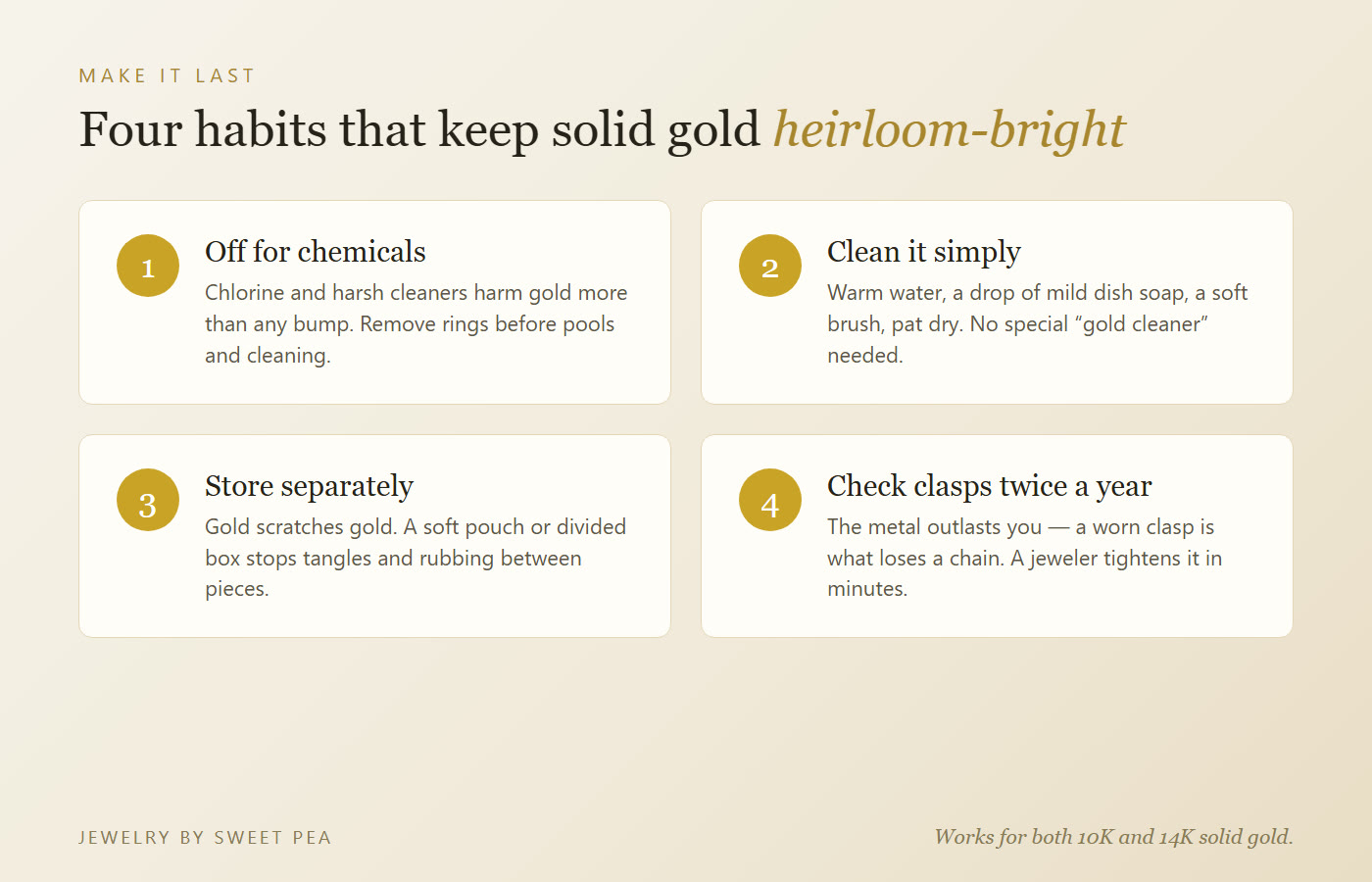
Solid gold is forgiving, but a few habits keep it bright for the next generation:
- Take it off for chemicals. Chlorine, bleach, and harsh cleaners are gold's real enemy — far more than everyday bumps. Slip rings off before pools and cleaning.
- Clean it simply. Warm water, a drop of mild dish soap, a soft brush, then pat dry. No special "gold cleaner" needed.
- Store pieces separately. Gold scratches gold. A soft pouch or a divided box keeps chains from tangling and bands from rubbing.
- Check clasps and prongs twice a year. The metal will outlast you; a worn spring-ring clasp is what loses a chain. A jeweler can tighten or replace it in minutes.
Frequently asked questions
Is 10K or 14K gold more durable for everyday wear?
10K gold is more durable. It contains more strengthening alloy (and less soft pure gold) than 14K, which makes it harder and more scratch- and bend-resistant — ideal for pieces worn daily like bands, chains, and hoops. 14K is slightly softer but richer in color.
Is 10K gold real gold, or is it fake?
10K is 100% real, solid gold — 41.7% pure gold mixed with stronger alloy metals. It's the minimum purity that can legally be sold as "gold" in the United States. It is stamped, hallmarked, and held to FTC standards. It is not plated or "fake."
Will 10K gold turn my skin green or tarnish?
Solid 10K gold does not tarnish. Because it has a bit more alloy (including small amounts of copper and sometimes nickel), very sensitive skin can occasionally react, but for most people 10K is worn daily with no issue. If you have known metal allergies, 14K — with more pure gold and less alloy — is the gentler choice.
Is the price difference between 10K and 14K big?
Meaningfully, yes. Because 14K contains about 40% more pure gold than 10K, comparable pieces in 14K typically cost noticeably more — often the difference between a piece that fits your budget and one that doesn't. For the same look in daily wear, 10K stretches your dollar further.
Can I mix 10K and 14K gold jewelry?
Absolutely. Wearing a 10K chain with a 14K band or pendant is completely fine — both are solid gold, both wear well, and the slight color difference is hard to notice in normal light. Buy each piece in the karat that fits its job and your budget.
Jewelry by Sweet Pea is a family-run fine jewelry store. Every piece is solid 10K or 14K gold or sterling silver — never plated — sourced from U.S. wholesalers and shipped from the USA. Browse our everyday gold chains or ask us anything before you buy.