Jewelers Explain How Team Logo Jewelry Is Licensed Through Universities and Pro Leagues
The short answer: universities and pro leagues own their names and logos as trademarks, so a jewelry maker has to get permission, called a license, before putting those marks on a pendant or a pair of cuff links. The maker applies, has its designs approved, and typically pays the school or league a royalty on what it sells. Retailers like us then buy finished, licensed pieces from that maker.
We are a family-run jewelry store, and we get this question a lot, usually from a parent who wants to know why an "official" Florida State pendant costs more than a lookalike online. The details differ from school to school and league to league, and we don't see every contract, so this is how it works in general and what it means when you shop.
Why does team jewelry need a license at all?
A team's name, mascot and logo are trademarks, the same kind of protection a brand name gets. The U.S. Patent and Trademark Office explains the basics in its guide to what a trademark is. A school or league decides who may put its marks on merchandise, and a license is how it says yes.
For the school or league, licensing does two jobs. It keeps the logo looking the way it should, and it brings in royalty income. For you, it is the difference between a piece the team stands behind and a copy nobody approved.
How does a jewelry maker get licensed to make team logo jewelry?
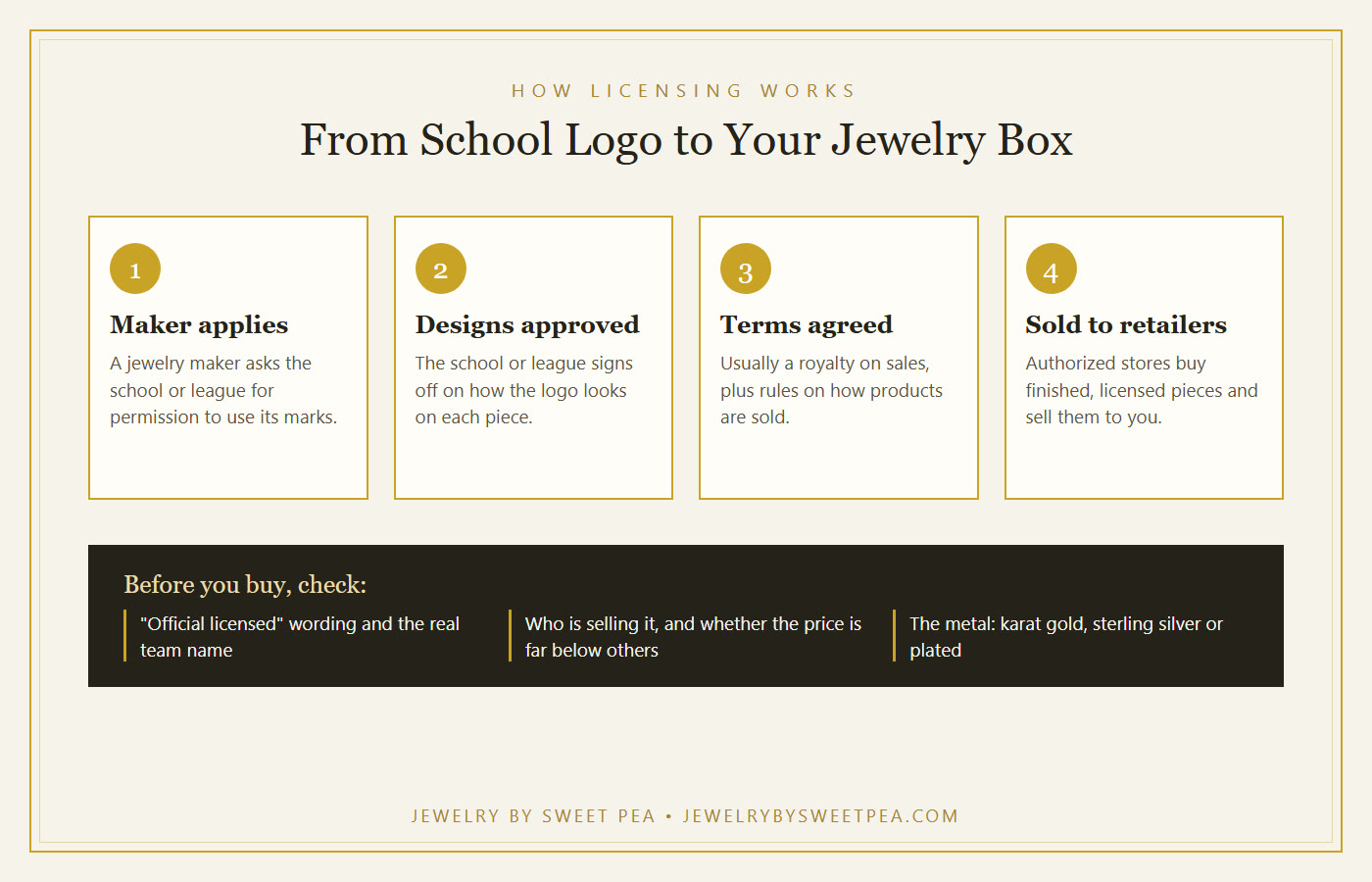
The exact steps vary, but the path usually looks like this:
- The maker applies. Many universities and leagues run a licensing program, sometimes through a licensing agency that handles many schools at once. A jewelry manufacturer applies for the categories it wants to make.
- The designs get approved. The maker submits artwork or samples, and the school or league signs off on how the logo appears. That is why licensed pieces look consistent from one seller to the next.
- The maker agrees to terms. Terms typically include a royalty on sales and rules on where and how the products may be sold.
- The product goes to market. The licensed maker sells to authorized retailers, who sell to you.
We do not make team logos ourselves. The licensed collegiate, Greek and pro-team pieces in our collegiate collection and Greek collection come from a licensed manufacturer, LogoArt, and we pass its official designs along.
Do universities and pro leagues license the same way?
Broadly yes, but each has its own rules. A university may license through its own office or an agency, and it may limit certain marks, such as an older logo, to particular products. Pro leagues such as the NHL and NBA have licensing programs that cover their teams. Because of that, one maker might offer a Dallas Stars pendant but not every team's version of the same style. If a piece you want isn't available, it often just isn't in that maker's licensed line.
What does licensing mean for price and quality?
Licensed jewelry usually costs more than a generic lookalike for a few reasons: the royalty, the approval process, and the fact that the manufacturer has to follow the school's rules. Licensed makers also often set a minimum advertised price, so you will see similar prices at authorized sellers rather than big swings.
Licensed does not mean solid gold. A licensed pendant can be 10K gold, sterling silver, or gold-plated or rhodium-plated sterling silver. The license only covers the logo, so you still need to read the metal on the product page. The Federal Trade Commission's Guides for the Jewelry, Precious Metals, and Pewter Industries set the rules for how karat gold and plated metal must be described, so look for a clear karat or plating description.
Which licensed pieces would we pick?
Gold prices float, so treat these as "about" and check the product page for today's price.
- Orlando Magic women's NBA charm watch, about $69. A low-cost way to show team colors every day (other NBA teams are available).
- Dallas Stars gold-plated sterling silver dog tag pendant, about $127. A pro-league piece in gold-plated sterling silver, not solid gold.
- Florida State University 10K yellow gold arrow pendant, extra small, about $129. Real gold with the school mark, in a size that works for a graduation gift.
- FSU Seminoles rhodium-plated sterling silver cuff links, about $144. A classic gift for a grad or an alum going into a first job.
- University of Florida 10K yellow gold Gator pendant, small, about $562. The splurge pick: solid gold, school-approved, and made to last.
How do the options compare?
| Budget | Piece | Metal |
|---|---|---|
| About $69 | NBA charm watch | Watch (not jewelry metal) |
| About $127 | NHL dog tag pendant | Gold-plated sterling silver |
| About $129 | FSU arrow pendant | 10K yellow gold |
| About $144 | FSU cuff links | Rhodium-plated sterling silver |
| About $562 | Florida Gator pendant | 10K yellow gold |
For more ideas, see our gifts collection.
How can you tell if team jewelry is really licensed?
- Look for "official licensed" wording and the actual team or school name on the product page, not just similar colors or a "fan style" description.
- Check who is selling it. A licensed maker sells through authorized retailers. A price far below everyone else's is a reason to look closer.
- Read the metal. Look for a clear karat (10K, 14K) or "sterling silver, gold-plated" in the description.
- Ask us. If a listing doesn't say what it is made of, we are happy to look it up for you.
Frequently asked questions
What does "officially licensed" mean on team jewelry?
It means the maker has permission from the school or league to use its name and logo, and the design has gone through that organization's approval process.
Why is licensed team jewelry more expensive than lookalikes?
The maker pays for the license, usually as a royalty on sales, and follows the school's or league's design rules. Those costs show up in the price, along with the metal itself.
Is licensed team jewelry solid gold?
Not always. The license covers the logo, not the metal. Licensed pieces come in 10K or 14K gold, sterling silver, and plated sterling silver, so check the product description.
Do jewelers need their own license to sell team jewelry?
Retailers generally buy finished, licensed pieces from an authorized manufacturer. The manufacturer holds the license for making the product, which is how we buy ours.
Can I get a team logo engraved or custom-made?
Custom use of a team's logo is up to that school or league, so we offer the licensed designs as they are made. For a personal touch on other jewelry, ask us what is available.
The simplest rule: buy from a seller who can tell you what the piece is made of and who made it. If you have a question about a specific team piece, we're a family business and glad to help.