
Jewelers Explain How to Store Gold Jewelry So It Never Tangles or Tarnishes
The short answer: store each chain fastened and hanging or laid flat in its own pouch, never loose in a shared drawer. Tangles are caused by light chains with open links and catchy spring-ring clasps, not by your jewelry box. Solid 10K and 14K gold does not tarnish at all — only sterling silver does, and silver needs a sealed bag instead.
We get asked this constantly, usually by someone holding a knot of three necklaces. So we pulled the numbers off our own chain listings, and the answer has little to do with storage furniture.
Why does gold jewelry tangle in the first place?
Two things decide whether a chain knots: how much it weighs, and what its links do when they touch each other.
A heavy chain has the mass to fall straight and stay there. A light one coils on itself the moment you set it down, and a coiled chain feeds its own clasp back through its own loops every time the drawer opens. Our catalog makes the gap plain: a 10K yellow gold 0.6mm cable chain carries about 0.56 grams of metal, while a 10K yellow gold 1.15mm rope chain carries about 2.38 grams — more than four times as much, for a chain only twice as wide.
Link shape does the rest. A cable chain is a row of open round links, and an open link is a hinge that swings every direction, so one chain's link passes straight through another's. A box link is a closed square that pivots one way. A wheat, or spiga, chain is woven from four strands at once, so it behaves more like a cord than a row of loops. That is why the drawer that ruins a cable chain leaves a box chain sitting quietly beside it.
Then there is the clasp, which nobody thinks about. A spring ring's small sprung lever opens inward, so when it brushes another chain it catches a link and holds it. A lobster clasp has a heavier, enclosed gate that does not snag as readily. Notice which chains get which: our 0.5mm box chain ships with a spring ring, the heavier 0.7mm box chain with a lobster. Fine chains tend to get the catchy clasp — the wrong pairing for a drawer.
Which chains tangle least?
Ranked by how they behave in storage rather than how they look on:
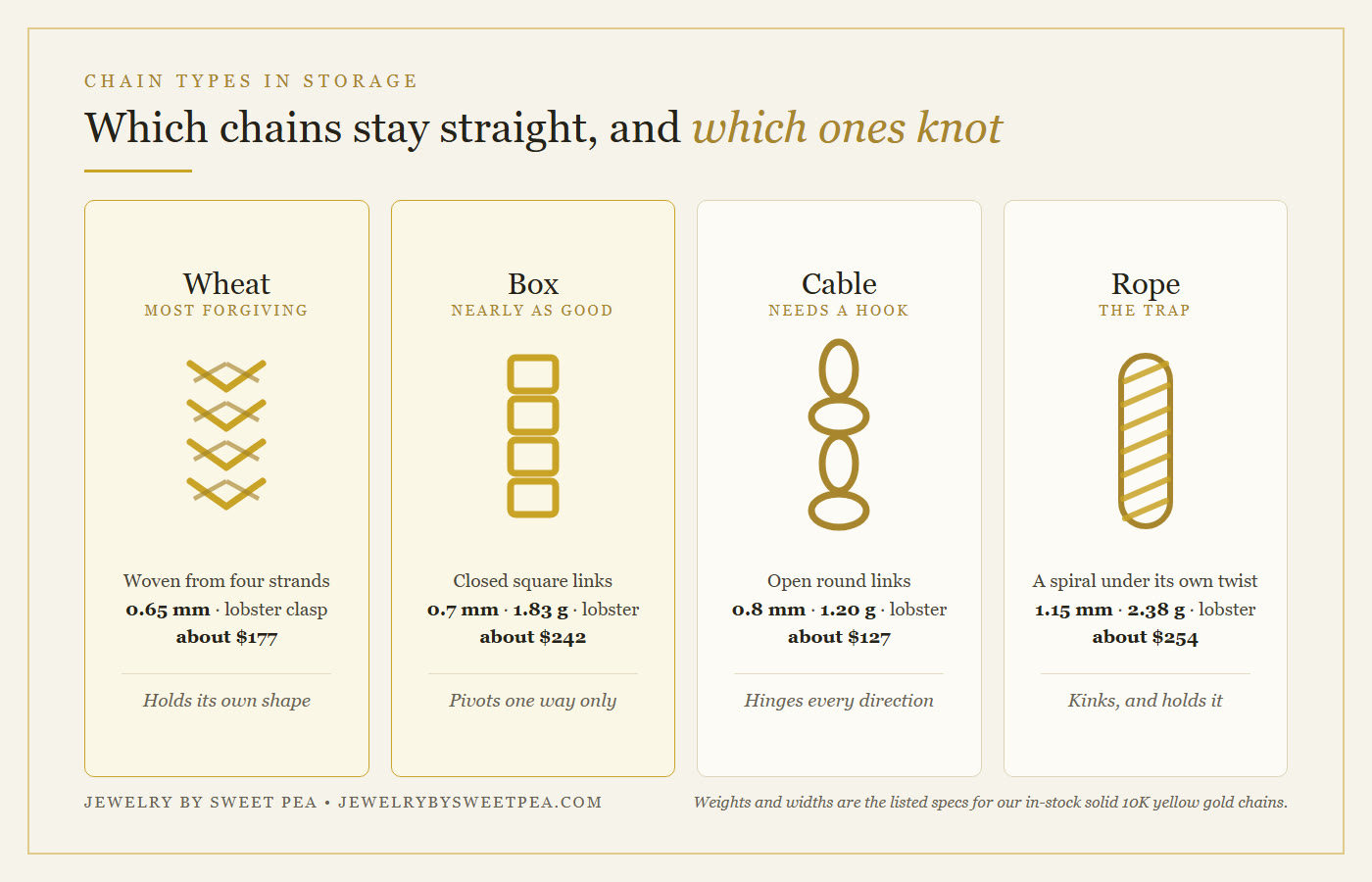
- Wheat (spiga) — the most forgiving. Our 10K yellow gold 0.65mm diamond-cut wheat chain (about $177, lobster clasp, solid 10K) is two thirds of a millimeter wide and still resists kinking, because the weave holds its own shape.
- Box — nearly as good. The 0.7mm Italian box chain (about $242, 1.83 g, lobster) is what we hand people who admit their necklaces live in a bowl.
- Cable — fine on the neck, needy in the drawer. The 0.8mm diamond-cut cable chain (about $127, 1.2 g, lobster) has the weight to hang straight if you actually hang it.
- Rope — the trap. A rope chain is a spiral under its own twist, so it wants to kink, and it holds a kink once it has one. The 1.15mm rope chain above is worth owning; it just needs its own hook.
The uncomfortable pattern: the chains most likely to knot are the least expensive, and they are inexpensive for the same reason they knot — less metal.
Does solid gold actually tarnish?
No. Gold does not oxidize, which is why gold coins come out of shipwrecks bright. Most anti-tarnish advice online is written about silver and then applied to gold, where it is simply not needed.
What happens to a 10K piece is different. Karat is parts out of twenty-four, a definition set out in the FTC's Jewelry Guides at 16 CFR Part 23, which also governs when a piece may be called gold rather than gold-plated. So 10K is a little under half pure gold, the balance copper, silver and zinc; 14K is a bit more. That alloy fraction can pick up a dull grey film — but nine times out of ten you are looking at lotion, hairspray or sunscreen in the links, not corrosion. Warm water, dish soap and a soft toothbrush takes it off.
Plated jewelry is the real exception, and it is not a storage problem. Plating is a microns-thin gold layer over brass or steel; when it wears through at the clasp and the back of the neck, the base metal goes green and no storage method stops it. That is why we sell solid gold and sterling rather than plated.
How should sterling silver be stored differently?
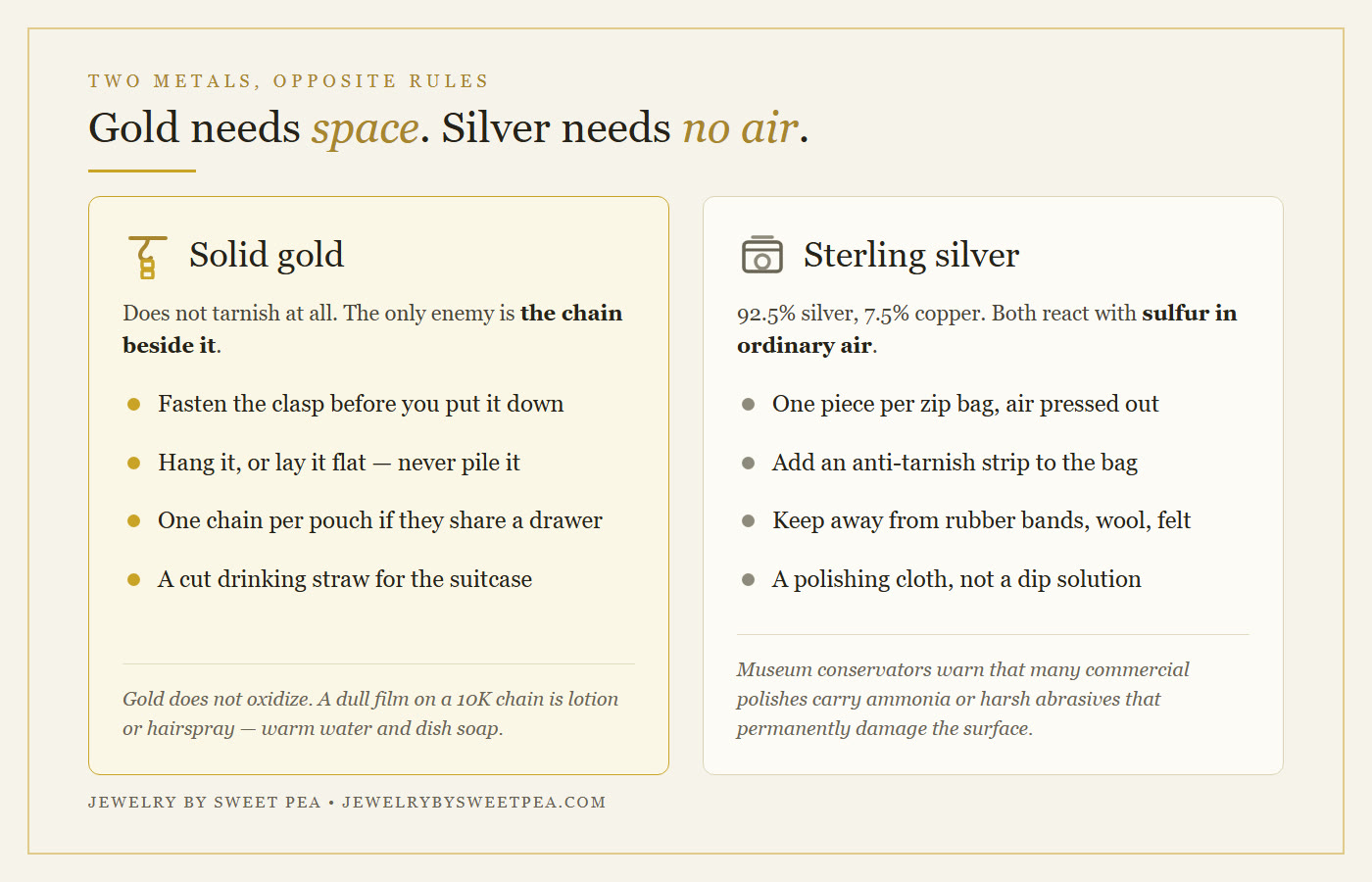
Sterling is 92.5% silver and 7.5% copper, and both react with sulfur compounds in ordinary household air. That is real tarnish — a chemical reaction, not dirt. A sterling silver 1.75mm Singapore chain (about $30, 1.84 g, lobster clasp) will darken in an open dish within months; a gold chain in the same dish will not.
So silver wants the opposite of gold's storage. Gold needs separation; silver needs as little air as possible. Put each piece in a small zip bag with the air pressed out, add an anti-tarnish strip if you have one, and put the bag in the drawer. Keep silver away from rubber bands, wool and untreated felt — all three give off sulfur and darken it faster than open air does.
One warning worth taking from the professionals: the National Park Service's guidance on caring for silver and copper alloy objects advises against commercial polishes, noting that many contain corrosive chemicals such as ammonia or harsh abrasives that permanently damage delicate surfaces. Dip solutions strip metal every time. A polishing cloth used occasionally is gentler, and on a chain you actually wear it is usually all you need.
What is the right way to store a gold chain?
- Fasten the clasp first. A closed chain is a loop and cannot thread itself through anything. This one habit prevents most tangles and costs nothing.
- Hang it, or lay it flat — do not pile it. Small hooks inside a cabinet door work as well as anything sold as an organizer.
- One chain per pouch. If everything must share a drawer, give each chain its own pouch or zip bag. Chains only tangle with each other.
- For travel, use a drinking straw. Thread the chain through a cut straw, then fasten the clasp. It sounds like a party trick; it is the best thing we know for a suitcase.
- Keep it out of the bathroom. Steam, hairspray and humidity swings are hard on findings, and this is where sterling darkens fastest.
- Take it off before the pool. Chlorine attacks the alloy metals in gold and can make a solder joint brittle — a genuine cause of chains breaking at the clasp.
What should you spend on this?
Almost nothing, honestly. Anti-tarnish zip bags and a strip of adhesive hooks cost a few dollars and outperform a lined box that lets four chains touch. If you would rather put the money into the jewelry, buy a chain that behaves: a 0.5mm box chain at about $102 is our least expensive solid gold chain with a tangle-resistant link — though it carries a spring ring, so give it its own pouch. Browse chains and necklaces, or pendants and charms.
Frequently asked questions
How do you untangle a gold chain without damaging it?
Lay it on a flat, light-colored surface and put a drop of baby oil or olive oil on the knot. Use two straight pins to tease the loops apart from the outside in, and never pull the two ends. Pulling is what breaks links and stretches a fine chain permanently. Wash the oil off with warm soapy water afterward.
Should I store gold jewelry in the original box?
It is fine for one piece, and good for a piece with stones that could scratch something else. It stops helping the moment you put two chains in the same box. The box does not cause tangles; sharing does.
Does 10K gold tarnish faster than 14K?
Slightly, in the sense that 10K has more alloy metal in it, so it is marginally more reactive. In practice neither one tarnishes the way silver does. If your 10K chain looks dull, wash it before you assume it has corroded.
Do anti-tarnish strips work on gold?
They work, but there is nothing for them to do. Save them for sterling silver, where they genuinely slow the reaction down. Putting one in with a solid gold chain is harmless and pointless.
Is it bad to store jewelry in the bathroom?
Yes, and it is the most common mistake we see. Constant humidity swings, hairspray and cleaning-product fumes all accelerate tarnish on silver and can leave a film on gold alloys. It is also where earring backs go down the drain. Store it in the bedroom and only bring it to the bathroom to put it on.
Have a chain that has been knotted since last winter? Send us a note — we would rather talk you through saving it than sell you a replacement.