
Jewelers Reveal the Most Common Reasons Fine Jewelry Gets Returned After Gifting
The short answer: Most gifted fine jewelry comes back for fit, not quality. The usual reasons are a ring in the wrong size, a metal color that doesn't match what the person already wears, a chain that sits at the wrong length, a piece that looks smaller or bigger than expected, and earring backs that don't suit the wearer. Nearly all of them are preventable with a little detective work before you buy.
We're a small, family-run jewelry store, and every return that crosses our bench tells us something about how gifts get chosen. Very few come back because something was wrong with the piece. Far more come back because it was a lovely piece for someone else. Here's what we see most often, in roughly the order we see it, and what we'd do differently if we were the one buying.
Why is the wrong ring size the number one reason gifted jewelry comes back?
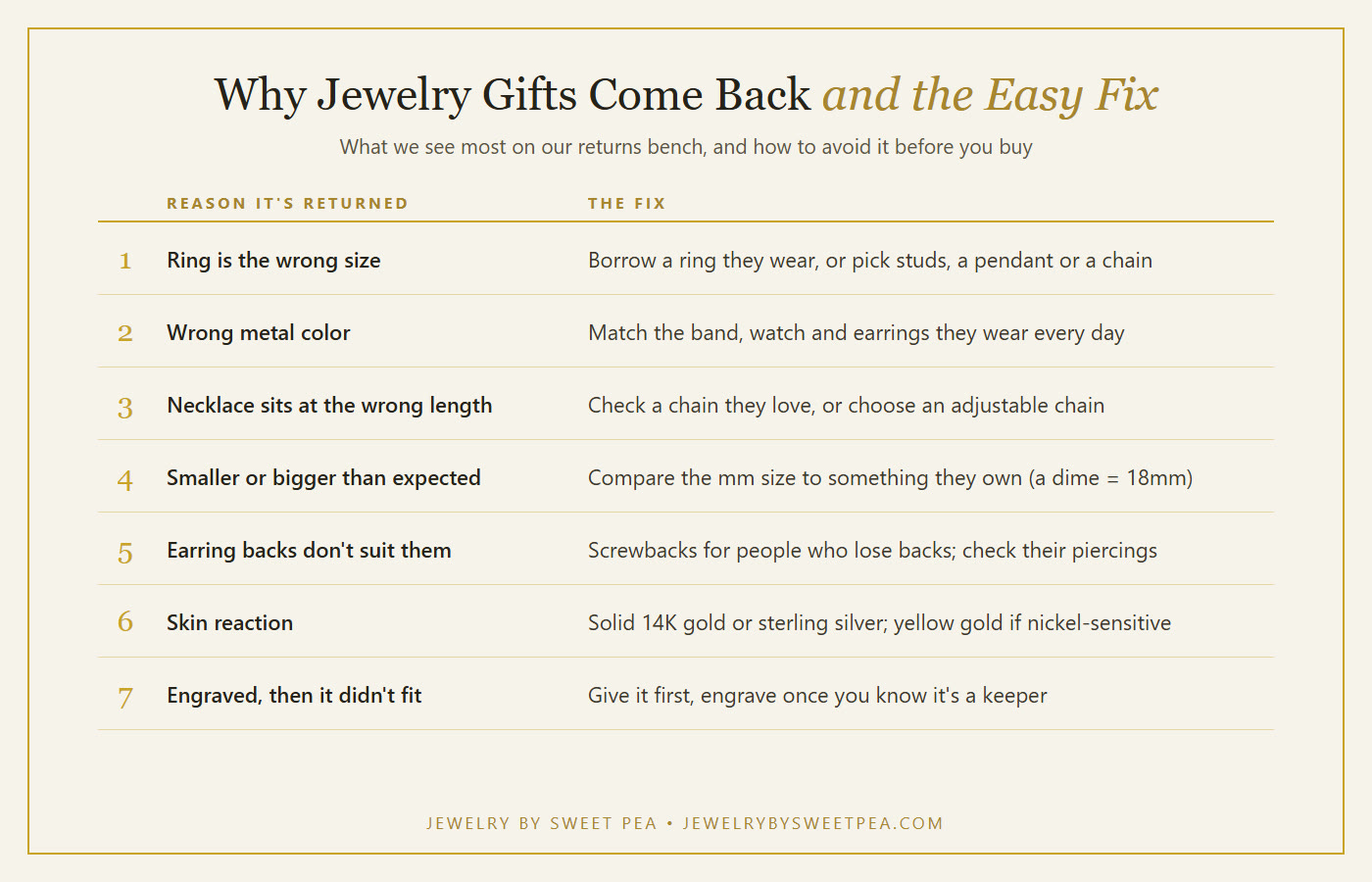
Rings are the hardest gift to get right because they have to fit a specific finger to the quarter size. A surprise ring is bought on a guess, and the guess is usually off by a size or more. Fingers also change with the seasons, time of day and which hand the ring is meant for, so even a size the person told you last year may not be right today.
What we'd do instead:
- Borrow a ring they already wear on that finger and have it measured, or trace the inside of it on paper. Note which finger it's from.
- Ask a friend or family member who knows their size. It's often written down somewhere from a past purchase.
- Choose a piece that doesn't need a size, like a pendant, stud earrings or a chain, when you truly can't find out.
- Know the resizing policy before you buy. Our return policy includes one complimentary resizing on eligible rings within the first year, which takes a lot of pressure off a ring gift. Not every store offers that, so check.
Why does metal color matter so much?
People are loyal to their metal. Someone who wears a white gold wedding band and silver earrings every day will often feel a yellow gold necklace "doesn't go with anything," even if they love the design. The reverse is just as common. It's one of the most frequent reasons a beautiful, well-made piece gets exchanged.
The fix is free: look at what they wear every day. Their watch, their wedding band, their everyday earrings. Match that. If they mix metals freely, you have more room, but when in doubt, match the ring on their hand.
Why do necklaces come back for the wrong length?
A pendant on a 16-inch chain sits near the collarbone. The same pendant on a 20-inch chain sits well below it. Neither is wrong, but the person receiving it usually has a strong preference, often without realizing it, and a chain that sits in the "wrong" spot never feels right.
Two easy ways around it: check the length of a necklace they already wear and love, or buy an adjustable chain with built-in sliding or extra rings so it can be worn at more than one length. Adjustable styles like the 14K yellow gold Singapore chain with 1-inch + 1-inch adjustment (about $334) take most of the guesswork out.
Why does a piece look "smaller than I expected"?
Product photos are taken up close so you can see the detail, which can make a 3mm stud or a 15mm pendant look larger on screen than it does in person. Some returns are the opposite: the piece is bolder than the recipient would wear every day.
Read the dimensions in millimeters and compare them to something real. A US dime is about 18mm across, so a 3mm stud is roughly one-sixth of a dime's width and a 15mm pendant is a little smaller than the whole coin. If you have a piece of theirs at home, measure it with a ruler and use it as your yardstick. When the recipient's style is understated, stay at or a little under what they already wear.
What other reasons do jewelers see?
Earring backs and piercing details
Some people can't wear push backs because they lose them, some find screwbacks fiddly, and some have only one piercing per ear or a piercing that has partly closed. Children's earrings bring their own preferences. If you know the person loses backs, a screwback stud is a thoughtful upgrade.
Skin sensitivity
Itchy or discolored skin is usually a reaction to base metals under plating or to certain alloys. Solid 14K gold and sterling silver are the safest gifts for most people. Some white gold alloys contain nickel, so if the person knows they're nickel-sensitive, yellow gold is the safer choice. The FTC's Jewelry Guides explain how "solid gold," karat and "plated" must be described, which is a good way to read a listing before you buy anywhere. We sell solid gold and sterling silver only, never plated.
Style that belongs to the giver
This one is gentle but real: sometimes the gift reflects what the giver loves rather than what the wearer wears. A bold statement piece for someone who wears one pair of studs daily rarely gets worn. Classic, simple designs are the safest when you're unsure.
A duplicate
Diamond studs, a cross pendant or a first initial charm are popular precisely because so many people want them, which also means some people already own one. A quick question to a spouse, parent or close friend saves a trip to the post office.
Engraving on the wrong piece
Engraved and personalized jewelry generally can't be returned anywhere, because no one else can wear it. If you're unsure of the size, color or style, give the piece first and add engraving afterward once you know it's a keeper.
Which gifts almost never come back?
Gifts that don't depend on a size and lean classic are the safest bets. These are pieces we'd pick ourselves, all in stock, all solid gold or sterling silver. Prices move with the gold market, so treat them as approximate.
- 14K yellow gold 1/5 ct lab-grown diamond screwback studs, about $166. Screwbacks are secure, studs suit any outfit, and there's no size to guess.
- 14K yellow gold 1/4 ct natural diamond studs, about $285, for a natural-diamond classic. If you're comparing diamonds, GIA's guide to the 4Cs of diamond quality is a clear, neutral explainer.
- 14K yellow gold 1.1mm cable chain, adjustable to 18 inches, about $293. Solves the length problem on its own.
- 14K Singapore adjustable chain, about $334, a little more sparkle with the same flexibility.
- 14K white gold polished cross pendant, about $93, for someone who wears white metal.
- 14K yellow gold initial charm (letter R shown, other letters available), about $52, paired with a chain like the 14K 0.8mm diamond-cut Forzantine chain from about $141.
- 14K yellow gold 15mm heart hoops, about $86, a small, sweet hoop that's easy to wear.
- Sterling silver 3mm round CZ studs, about $20, a tiny stocking stuffer or a sensible add-on.
You can browse more styles in earrings, necklaces and pendants and charms.
Safe gift picks by budget
- Under $100: a solid gold initial or cross charm, sterling silver studs, or small 14K hoops. Low risk, easy to love.
- $100 to $300: lab-grown or natural diamond studs, or a solid gold chain with a charm. The sweet spot for a gift that feels significant without a size to worry about.
- $300 and up: an adjustable solid gold chain on its own or with a pendant, larger studs, or a ring once you've confirmed the size. If you go with a ring, use the borrowed-ring trick and check the resizing policy first.
A five-minute checklist before you buy
- What metal do they wear every day? Match it.
- Does the piece need a size? If yes, confirm it or choose something that doesn't.
- For necklaces, what length do they already wear? Consider an adjustable chain.
- Check the millimeter dimensions against something they own.
- Do they already own this exact style? Ask someone close.
- Hold off on engraving until it's a keeper.
- Read the return and resizing policy, and tuck a gift receipt or the order number in the card.
And if a gift from us does miss the mark, it isn't the end of the world. Our policy gives you 30 days from delivery for a return with a free prepaid label, as long as the piece comes back new and unworn. We'd still rather help you get it right the first time.
Frequently asked questions
What is the most common reason jewelry gifts are returned?
The wrong ring size. Rings are bought on a guess more often than any other piece, and a guess is easily a size off. Borrowing a ring they already wear, or choosing a piece that doesn't need a size, prevents most of these returns.
Can you return jewelry that was a gift?
Usually yes, as long as it's within the store's return window and the piece is new and unworn. Engraved, personalized, resized and custom pieces are typically final sale. Keep the order number or a gift receipt so the return goes smoothly.
How do I find out someone's ring size secretly?
Borrow a ring they wear on the same finger and have it measured, or trace the inside circle on paper. A close friend or family member may also know their size from a past purchase. If none of that works, a pendant or earrings is a safer surprise.
Is yellow gold or white gold the safer gift?
Whichever one they already wear. Look at their wedding band, watch and everyday earrings and match it. If they're nickel-sensitive, yellow gold is generally the safer choice because some white gold alloys contain nickel.
What jewelry gift is least likely to be returned?
Classic stud earrings and a simple solid gold pendant on an adjustable chain. Neither needs a size, both suit nearly any wardrobe, and an adjustable chain lets the wearer choose the length that feels right.