
Jewelry Experts Answer: What Makes a Gift Still Memorable Twenty Years Later?
The short answer: a gift is still remembered in twenty years when it survives physically, belongs to one specific person, and gets worn instead of stored. In practice that points to solid gold or sterling silver jewelry — a locket, a birthstone pendant, an engravable piece — given with a story attached. Almost everything else is used up, replaced, or forgotten.
We run a family jewelry store, so we get asked a version of this question constantly: what should I give that she'll actually still have in twenty years? So we put the question to the people who handle fine jewelry every day — our bench jeweler, our longtime gold buyer, and the folks who pack and engrave the pieces that go out the door. Their answers were strikingly consistent. Here's what makes a gift last.
Why most gifts are forgotten within a year
Think back to a birthday twenty years ago. You almost certainly can't list what you received — and that's the whole problem. Most gifts fall into one of three forgettable categories: consumable (it gets eaten, spent, or used up), replaceable (electronics and gadgets get upgraded every few years), or generic (a nice-but-anonymous item that could have gone to anyone).
A memorable gift fails all three tests on purpose. It doesn't get consumed, it doesn't get replaced, and it could only have been for one person. Fine jewelry is one of the very few everyday gifts that checks every box — which is exactly why our jewelers kept circling back to it.
What our jewelers say makes a gift last: the four-part test
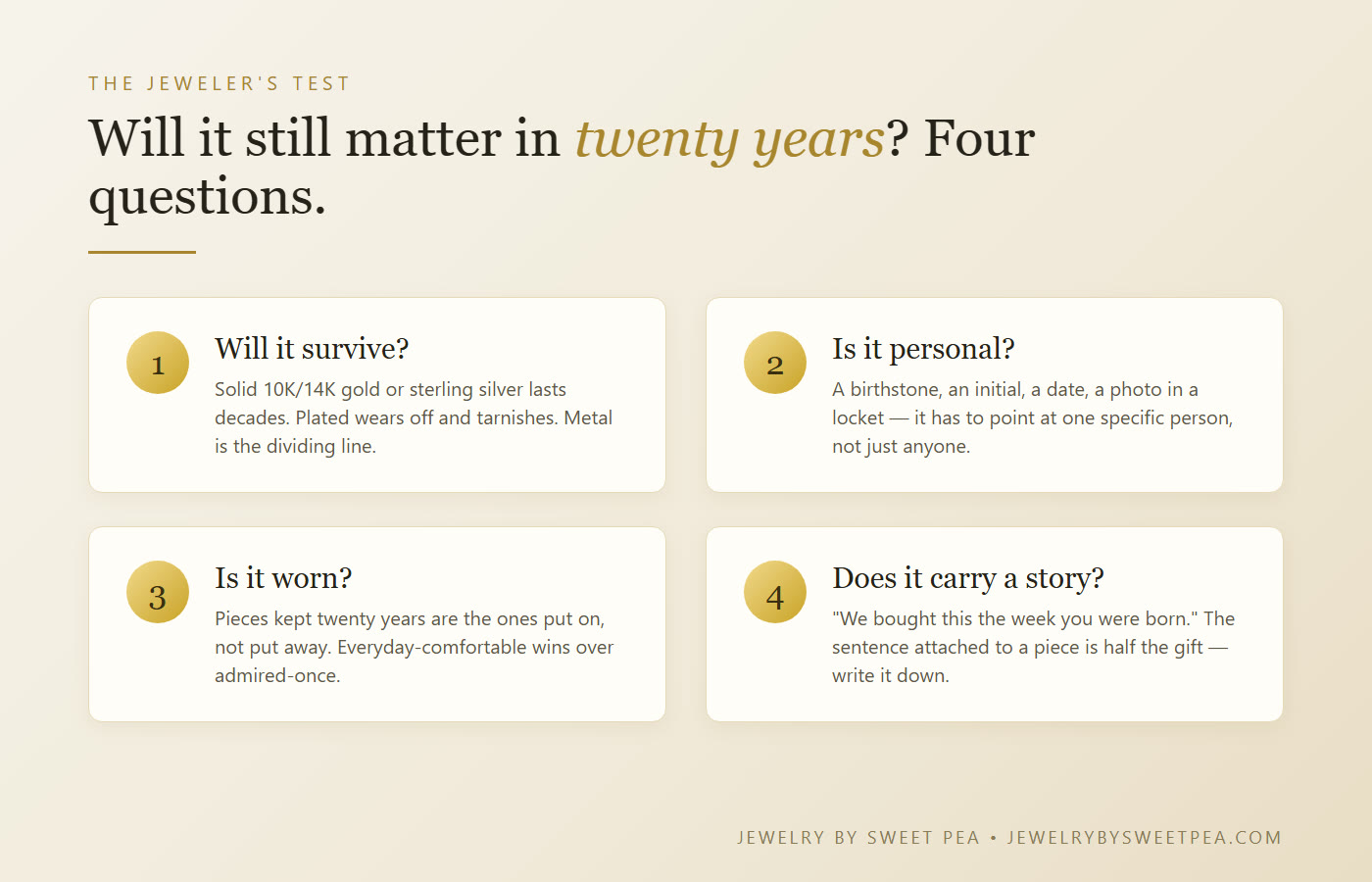
1. It has to physically survive — so the metal matters most
"The first thing I ask is whether it will even exist in twenty years," our bench jeweler told us. Plated jewelry won't — the thin gold layer wears off, the base metal underneath tarnishes green, and it ends up in a drawer. Solid 10K or 14K gold and genuine sterling silver are the materials that go the distance. They can be polished, repaired, and re-strung for decades. This is the single biggest dividing line between a keepsake and a throwaway, and it's why we don't sell plated "looks-like-gold" pieces at all. (If you want to understand how gold purity actually works, the Gemological Institute of America keeps an excellent gold education page.)
2. It has to belong to one specific person
A memorable piece carries a fingerprint of the person it was for — a birthstone, an initial, an engraved date, a photo inside a locket. Our gold buyer put it plainly: "Generic gets forgotten. The second a piece points at her — her birth month, her child's photo, the date — it stops being jewelry and starts being hers." That's the difference between "a gold necklace" and "the necklace Mom gave me when the baby was born."
3. It has to be worn, not stored
"The pieces people still have in twenty years are the ones they put on, not the ones they put away," said the jeweler who handles our repairs. A gift admired once and then shut in a box doesn't build memories. Wearable, everyday-comfortable pieces — an 18-inch pendant, a locket on a sturdy chain — get woven into ordinary days, and that daily contact is what makes them unforgettable.
4. It has to carry a story
Every long-remembered piece has a sentence attached to it: this was your grandmother's, we bought this the week you were born, I wore this at the wedding. The story is half the gift. A piece given with a note explaining why outlives one given silently, every single time.
The pieces that pass the twenty-year test
Here are the styles our team reaches for when someone says "I want this to still matter in twenty years." Every one is solid metal — never plated — and chosen because it scores on personal, wearable, and lasting all at once.
A locket — the literal memory keeper
Nothing makes the "twenty years later" case better than a locket: it physically holds a photo, so the memory travels with the metal. For an everyday piece that won't intimidate, the Sterling Silver Scroll Oval Locket (about $84) is a classic that wears with anything. Want the heirloom version? The 10K White Gold Polished Oval Locket (about $170) is solid gold — the kind of piece that genuinely gets handed down. For a little more detail, the Sterling Silver Diamond-Accent Filigree Oval Locket (about $79) adds a touch of sparkle without the gold-price jump.
A birthstone pendant — instantly personal
A birthstone is the easiest way to make a gift point at one person. The 14K Yellow Gold Diamond & Blue Topaz Birthstone Pendant (about $79) pairs a real diamond accent with a birth-month stone in solid gold — available across the twelve months, so you can match hers exactly. Twenty years on, it still says this was made for me.
A classic gold heart — the timeless shape
Some shapes never date. A simple 14K White Gold Heart Pendant (about $180) is the kind of piece that looked right in 1995, looks right now, and will look right in 2045. Trend-proof is its own kind of memorable — she'll never outgrow it.
Prices shown are at the time of writing; solid gold pieces move with the gold market. Browse more in our Lockets and Pendants & Charms collections.
How much should you spend on a gift meant to last?
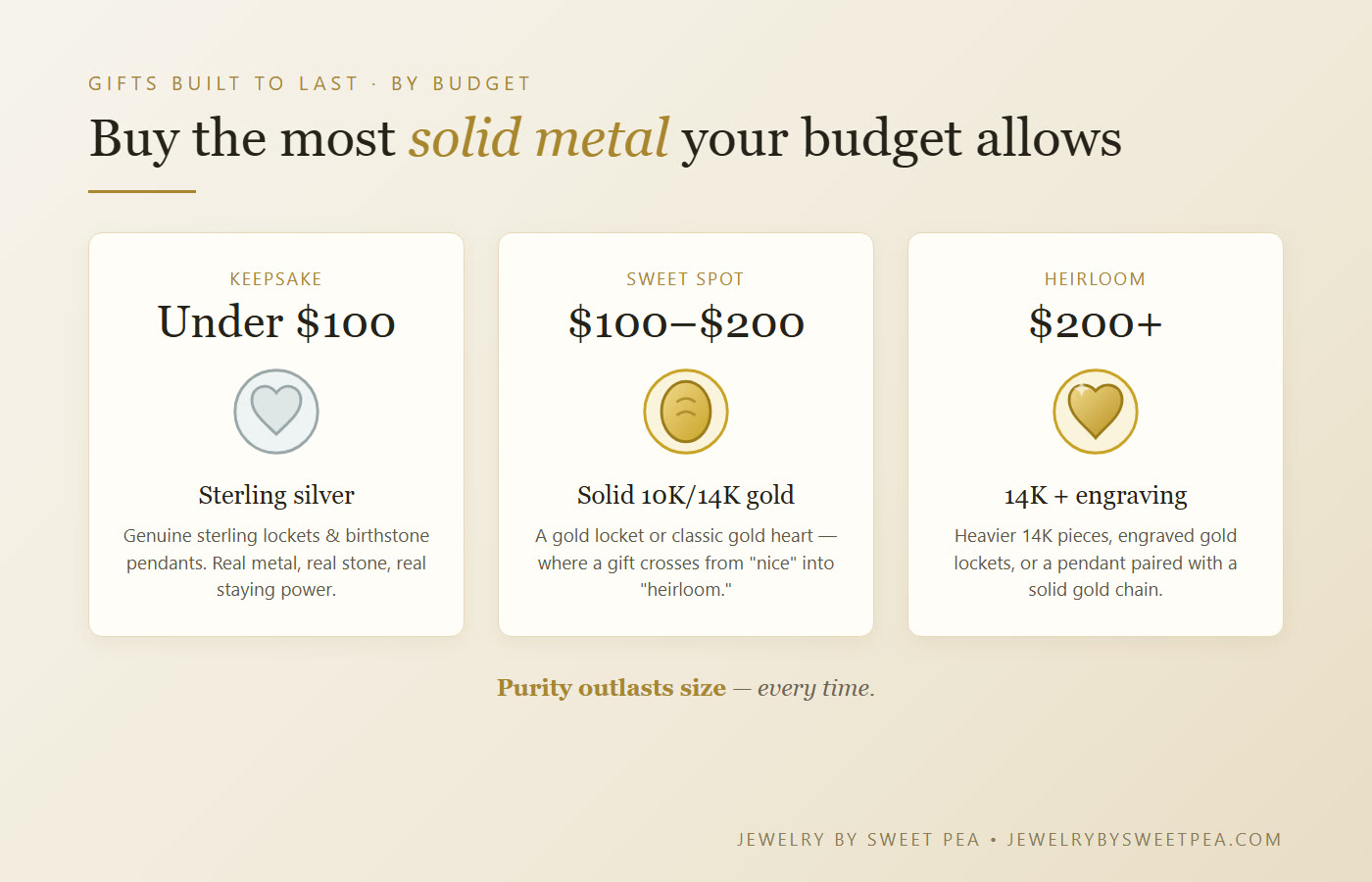
Our jewelers were unanimous on one point: buy the most solid metal your budget allows, not the biggest piece. Purity and craftsmanship outlast size every time. Here's how the tiers shake out:
- Under $100 — the sterling keepsake. Genuine sterling silver lockets and pendants like the Scroll Oval Locket (about $84) or a birthstone pendant (from about $79). Real metal, real stone, real staying power.
- $100–$200 — the solid-gold piece. A 10K White Gold Locket (about $170) or a 14K Gold Heart (about $180) — this is the sweet spot where a gift crosses from "nice" into "heirloom."
- $200+ — the family heirloom. Heavier 14K pieces, gold lockets with engraving, or a pendant paired with a solid gold chain so it's wearable the moment it's opened.
Buy from someone who states the metal plainly
A gift can only last twenty years if it's what the label says it is. U.S. sellers are bound by the FTC Jewelry Guides (16 CFR Part 23), which govern exactly how gold and silver content may be described. The practical takeaway: a listing that dodges the karat or won't say "solid" versus "plated" is telling you something. Every piece we sell is stamped, solid 10K or 14K gold or genuine sterling silver — the materials built to still be here in 2046.
Give it so the memory actually sticks
The piece is only half of it. Our team's advice for making a gift unforgettable:
- Write the story down. A few sentences about why you chose it — the moment, the meaning — tucked in the box. People keep the note with the jewelry forever.
- Put a photo in the locket before you wrap it. Don't hand over an empty locket "to fill later." Fill it. That's the whole gift.
- Give it in a quiet moment. A piece handed over privately, with a few words, lands harder than one opened in a crowd.
- Tell her the metal is solid on purpose. "I chose real gold because that's how long I want this to last" is a sentence she'll remember.
Frequently asked questions
What kind of gift is most likely to be remembered in twenty years?
A piece of solid gold or sterling silver jewelry that's personal to the recipient — a locket with a photo, a birthstone pendant, an engraved piece. It survives physically, it points at one specific person, and it gets worn day to day. Those three traits, together, are what make a gift outlast almost everything else.
Why does jewelry outlast other gifts?
Because it isn't consumed, replaced, or generic. Solid gold and sterling silver can be polished and repaired for decades, a birthstone or engraving ties the piece to one person, and a wearable design becomes part of daily life. Gadgets get upgraded and consumables get used up; a stamped gold pendant just keeps going.
Is sterling silver good enough to last, or do I need gold?
Genuine sterling silver lasts generations with basic care — it can tarnish, but tarnish polishes off and the metal underneath is unchanged. Solid gold needs even less maintenance and carries more intrinsic value. Both are real, lasting metals; the dividing line that matters is solid versus plated, not silver versus gold.
Why is a locket such a classic "memorable" gift?
A locket is the only common piece of jewelry that physically holds a memory — a photo of a child, a parent, a wedding day — against the wearer's chest. The metal carries the picture forward through the years, which is why lockets get handed down more than almost any other piece.
How do I make sure the jewelry I'm buying will actually last?
Buy solid 10K or 14K gold or genuine sterling silver, never plated, from a seller who states the metal and karat plainly (as required by the FTC Jewelry Guides). Choose a wearable everyday style, and care for it simply — occasional polishing and a yearly clasp check. Solid metal, honestly described and actually worn, is what reaches the twenty-year mark.
Jewelry by Sweet Pea is a family-run fine jewelry store. Every piece is solid 10K or 14K gold or sterling silver — never plated — sourced from U.S. wholesalers and shipped from the USA. Browse our Lockets and Necklaces collections, or ask us anything before you buy.