Jewelry Experts Share Their Honest Advice on Choosing Graduation Gifts That Truly Last
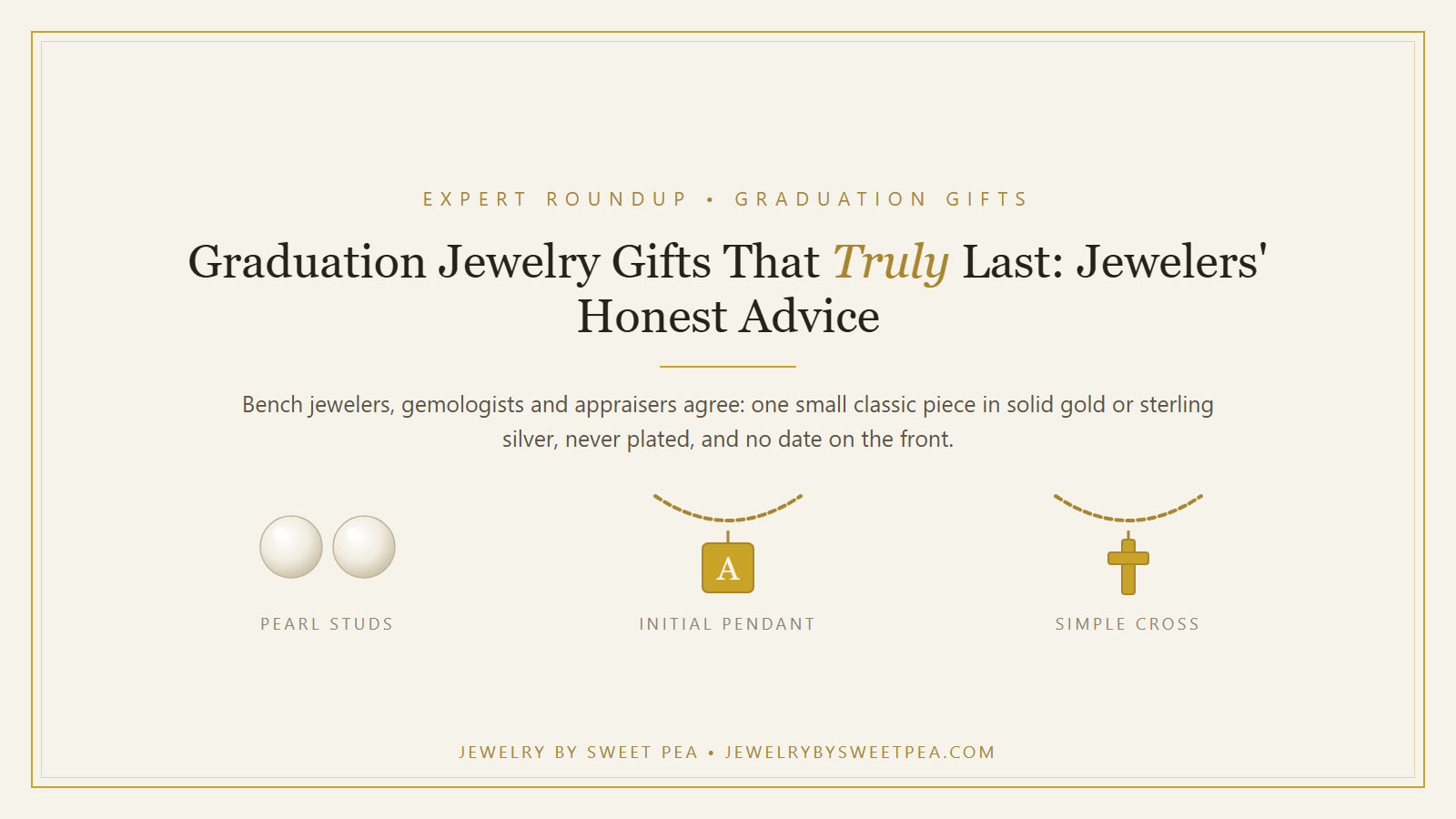
The short answer: the jewelers, gemologists and appraisers we talk with give the same advice about graduation gifts. Buy one small, classic piece in a real metal: solid 10K or 14K gold or sterling silver, never plated. Choose a shape she would pick for herself, such as pearl studs, ball studs, an initial pendant or a simple cross, and skip anything that says "Class of" on the front. Pieces like these start at about $20 in sterling and about $40 in solid gold, and they are the ones still being worn at the ten-year reunion.
We are a family-run jewelry store, and every spring and again every December we hear the same question from parents, grandparents and godparents: "What can I give that she will still have in twenty years?" Over the years we have asked that question back to the people who see jewelry at every stage of its life, from the bench jeweler who repairs it to the gemologist who grades it to the estate appraiser who values it decades later. Their answers line up remarkably well. Here is what they say, in plain language, with in-stock examples from our store.
What do bench jewelers say wears out first?
Ask anyone who repairs jewelry for a living what comes across the bench most often, and the answer is plating. Gold-plated and "gold-tone" pieces have a layer of gold so thin it is measured in microns, and it wears through at the exact spots a graduation gift gets handled: the clasp, the back of a pendant, the post of an earring. Once the base metal shows, the piece is finished, because there is nothing to polish back.
Solid gold is gold all the way through. A bench jeweler can polish it, re-tip it, solder a broken link, replace a lost earring back and resize a ring for as long as the piece exists. That is the practical meaning of "lasts." The Federal Trade Commission's Jewelry Guides in 16 CFR Part 23 spell out the difference between "gold," "gold filled" and "gold plated" as marketing claims, and the difference shows up on a wrist within a year of daily wear.
The second thing bench jewelers mention is hollow or very light construction on pieces meant for daily wear. A hollow hoop dents; a very thin chain kinks and breaks. For a gift that will be worn to class, to work and to the gym, they recommend solid earring posts, a chain of at least 0.4mm or so for a light pendant, and clasps that close positively rather than snapping.
What do gemologists say about the stones?
Gemologists tend to steer gift buyers toward one of two paths for a graduation piece: a pearl, or a small cubic zirconia or diamond accent. Both have a reason.
Pearls are the classic graduation gift, and gemologists like them for a young woman because quality is easy to see without instruments. The Gemological Institute of America's guide to pearl quality factors lists luster, surface, shape, color, size, nacre and matching. For a stud earring, luster is what matters: a pearl with a sharp, bright reflection looks expensive at any size. A freshwater cultured pearl in the 5mm to 7mm range gives that look at a price that lets you put the rest of the budget into solid gold posts.
Small CZ or diamond accents are the other recommendation, because a tiny stone in a bezel or four-prong setting is protected by the metal around it and rarely gets lost. What gemologists warn against is large glass or crystal "stones" glued into fashion settings. Glue fails, crystal chips, and the piece is then unwearable. If a graduation gift has sparkle, make it a small stone that is set, not glued.
What do appraisers say still has value years later?
Estate appraisers look at the jewelry a family has kept for thirty or forty years, and their list of what survives is short. Solid precious metal with real weight. Classic shapes that did not belong to one season. Pieces that were small enough to be worn often, because jewelry that lives in a drawer gets lost, not kept. Appraisers are also the first to say that a piece does not need to be expensive to last; it needs to be real. A $45 pair of 10K ball studs worn for twenty years has done its job better than a $200 plated statement necklace worn twice.
The one graduation-specific caution appraisers raise is engraving. A year or a "Class of" on the front of a pendant dates it to one moment. An initial, or a short message on the back, stays personal and keeps the front plain enough to wear with anything.
Which graduation jewelry gifts do the experts actually recommend?
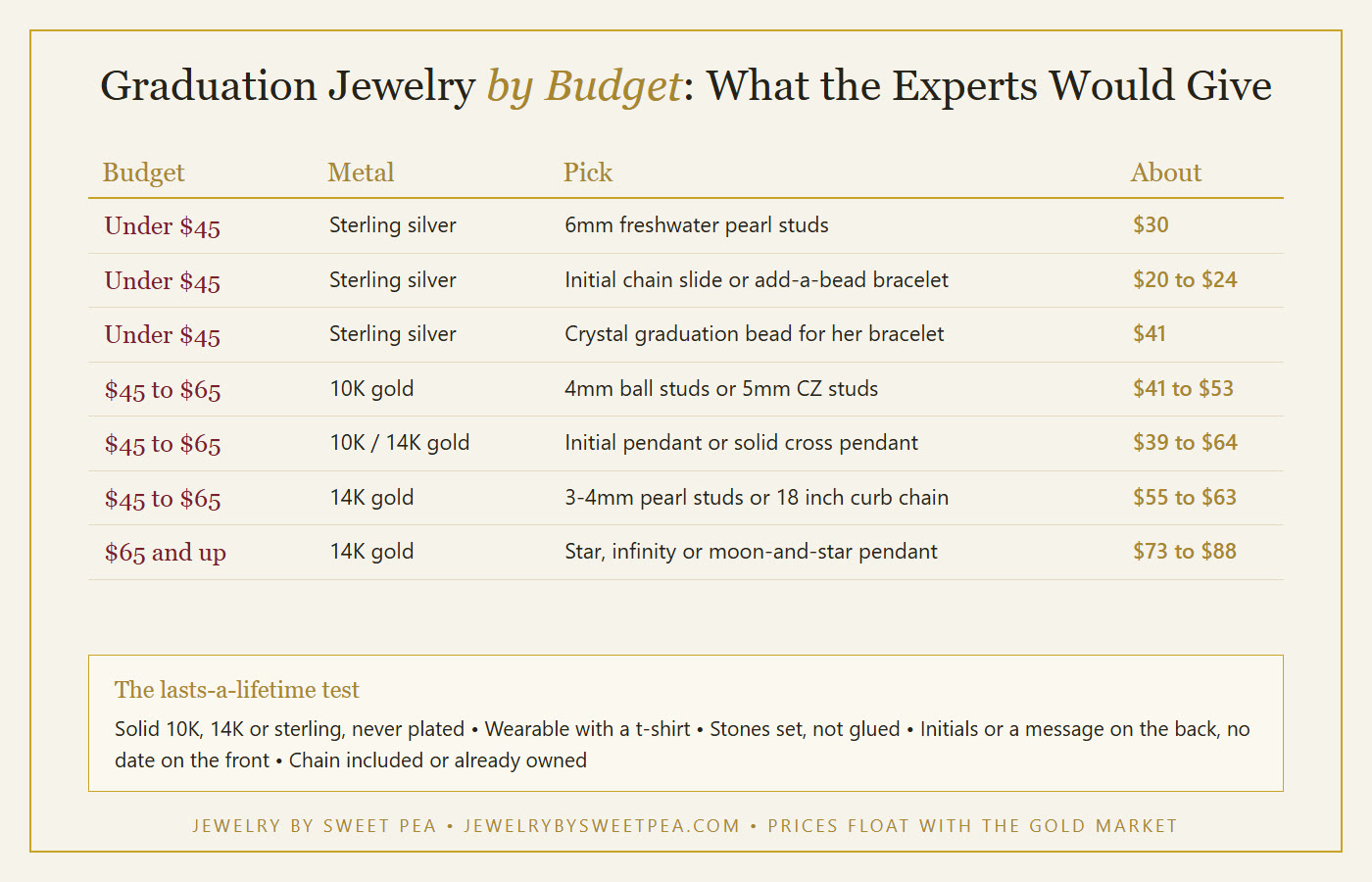
Put the three sets of advice together and a clear shortlist appears. These are the categories that come up again and again, with in-stock examples from our store. Prices are approximate and move with the gold market, so check the product page for today's number.
Under $45: sterling silver
- Sterling silver 6mm freshwater cultured pearl stud earrings, about $30. The graduation classic in its most affordable real-metal form, and the pair we would choose for a high school graduate.
- Sterling silver letter initial chain slide, about $20. Slides onto a chain she already wears; stock varies by letter, so check early.
- Sterling silver add-a-bead cable chain bracelet, about $24. A starter bracelet that takes a bead for each milestone to come.
- Sterling silver crystal graduation bead, about $41. The one "graduation" item on this list that passes the test, because it is a charm on a bracelet rather than a message on a pendant, and it joins the other beads she will collect.
- Sterling silver beaded adjustable bracelet, about $25. No sizing needed, and it stacks with a watch.
$45 to $65: entry solid gold
- 10K yellow gold 4mm ball stud earrings, about $41. Real gold at the lowest price in the store, and the earring bench jewelers describe as nearly impossible to wear out.
- 10K yellow gold small block initial pendant, about $39. A personal gift without a date on it; chain sold separately.
- 10K yellow gold 5mm round CZ stud earrings, about $53. Reads as a diamond stud from across the room, with the stone held by prongs, not glue.
- 14K yellow gold 3mm puffed ball stud earrings, about $53. The quietest pick here, for a graduate who wears very little jewelry.
- 14K yellow gold polished solid cross pendant, about $53. Solid, not hollow, at under 15mm tall; chain sold separately.
- 14K yellow gold 3-4mm white freshwater cultured pearl stud earrings, about $55. The pearl stud with 14K posts and backs, for a graduate who already wears gold.
- 10K yellow gold 14mm endless tube hoop earrings, about $60. The everyday hoop, light enough to forget she has it on.
- 10K yellow gold cross pendant, about $64. A traditional graduation gift in a durable 10K alloy; chain sold separately.
- 14K yellow gold 18 inch curb chain, about $63. The chain to pair with any of the pendants above, so the gift is complete when she opens it.
$65 and up: 14K pieces with a little more presence
- 14K yellow gold mother of pearl star pendant, about $73. A "reach for the stars" gift that does not say so out loud.
- 14K yellow gold CZ infinity pendant, about $76. The pendant parents choose most often for a daughter leaving for college.
- 10K yellow gold 5-6mm freshwater cultured pearl endless hoop earrings, about $82. Pearls and hoops in one pair, for the graduate who already owns the studs.
- 14K yellow gold CZ moon and star pendant, about $88. Small, set stones and a shape that has been in jewelry cases for a century.
Browse more in earrings, pearls, necklaces, chains, bracelets and gifts.
Should you choose 10K, 14K or sterling for a graduate?
All three are real metals that a jeweler can repair and an appraiser will recognize decades from now. The choice is about budget and the graduate's habits, not about which one "lasts," because they all do.
- Sterling silver is the right call for a graduate who already wears silver, or when the budget is under $45. It tarnishes slowly in a drawer but stays bright when worn, and a polishing cloth fixes the rest.
- 10K gold is the hardest-wearing karat sold in the US and the least expensive way to give real gold. Its color is a touch paler than 14K. For ball studs, hoops and small pendants that will be worn daily, many bench jewelers prefer it.
- 14K gold has the warmer color most people picture as "gold" and is the standard for fine jewelry. Small 14K earrings and pendants run about $50 to $90 at our store, and prices move with the gold market.
Five questions the experts would ask before you buy
- Is it solid 10K, 14K or sterling? Not "gold tone," "gold filled" or "plated." If the listing does not say, assume it is not.
- Would she wear it with a t-shirt? If it only works with a dress, it will live in a drawer.
- Are any stones set, not glued? Prongs and bezels hold; adhesive fails.
- Is the message on the back, or is there no message? Initials yes, "Class of 2027" on the front no.
- Is the chain included? Most pendants are sold alone. Add a chain or confirm she has one, so the gift is wearable the day she opens it.
Frequently asked questions
What is the most traditional graduation jewelry gift?
Pearl earrings, followed by a simple gold pendant on a chain. Pearls have marked graduations for generations because they suit every age and every outfit, and a 5mm to 7mm freshwater cultured pearl stud in sterling or solid gold is still the pick most jewelers make first.
How much should I spend on a graduation jewelry gift?
Most of our customers spend between $30 and $90. A solid sterling or 10K piece at $30 will outlast a plated piece at $150, so put the budget into the metal rather than the size. Grandparents and godparents giving a college graduation gift often step up to a 14K pendant and chain together, around $115 to $150.
Is 10K gold good enough for a gift meant to last?
Yes. 10K is the most durable karat gold because it has the highest share of harder alloy metals, which is why bench jewelers often recommend it for daily-wear earrings and pendants. It is slightly paler than 14K and costs less. Both are solid gold and both can be repaired for a lifetime.
Should a graduation gift be engraved with the year?
Jewelers and appraisers generally advise against putting a date or "Class of" on the front of a piece meant to be worn for years. An initial, or a short message engraved on the back of a pendant, stays personal without dating the piece. Our charms and pendants with a flat back take a few engraved characters well.
What graduation jewelry works if she does not wear earrings?
A small pendant on a chain, or an adjustable or add-a-bead bracelet. Neither needs sizing. A sterling add-a-bead bracelet with a graduation bead is a good start, because each later milestone can add a bead instead of a whole new piece.
Still deciding? Email us with the graduate's usual style, the metal she wears and your budget, and we will send a short list from what is in stock today. We would rather help you pick one right piece than sell you three that end up in a drawer.