
Jewelry Experts Share the Etiquette Rules of Gifting Fine Jewelry in Every Relationship
The short answer: Jewelry is only "too personal" when it outruns the relationship. The etiquette jewelers actually follow is simple: match the intimacy of the piece to the intimacy of the friendship, keep the price where the other person could comfortably reciprocate, never buy a ring for a romantic partner unless you mean what a ring means, and always leave the gift receipt in the box so it can be exchanged without an awkward conversation.
We get some version of this question in the shop every week, usually from someone holding their phone with a pendant already in the cart. "Is this too much?" "Is a necklace weird if we've only been dating four months?" Jewelry sits closer to the body and closer to the heart than almost anything else you can wrap, and people feel that even when they cannot say why.
Why is jewelry treated differently from every other gift?
Three reasons, and they explain every rule that follows. Jewelry is worn — it has to be put on a body, in public, and someone wearing your gift is saying something about you to everyone who sees them. Jewelry is legible: most people can read the approximate price at a glance, so the number is part of the message whether you want it to be or not. And jewelry is coded — a ring on the fourth finger means one thing, a locket means another, a heart means a third. You are speaking an old language, and the person opening the box will translate it whether or not you intended the translation.
What are the etiquette rules for gifting jewelry to a romantic partner?
This is where people get most anxious, and the anxiety is usually about pace. The working principle: the piece should reflect where you are, not where you hope to be in a year.
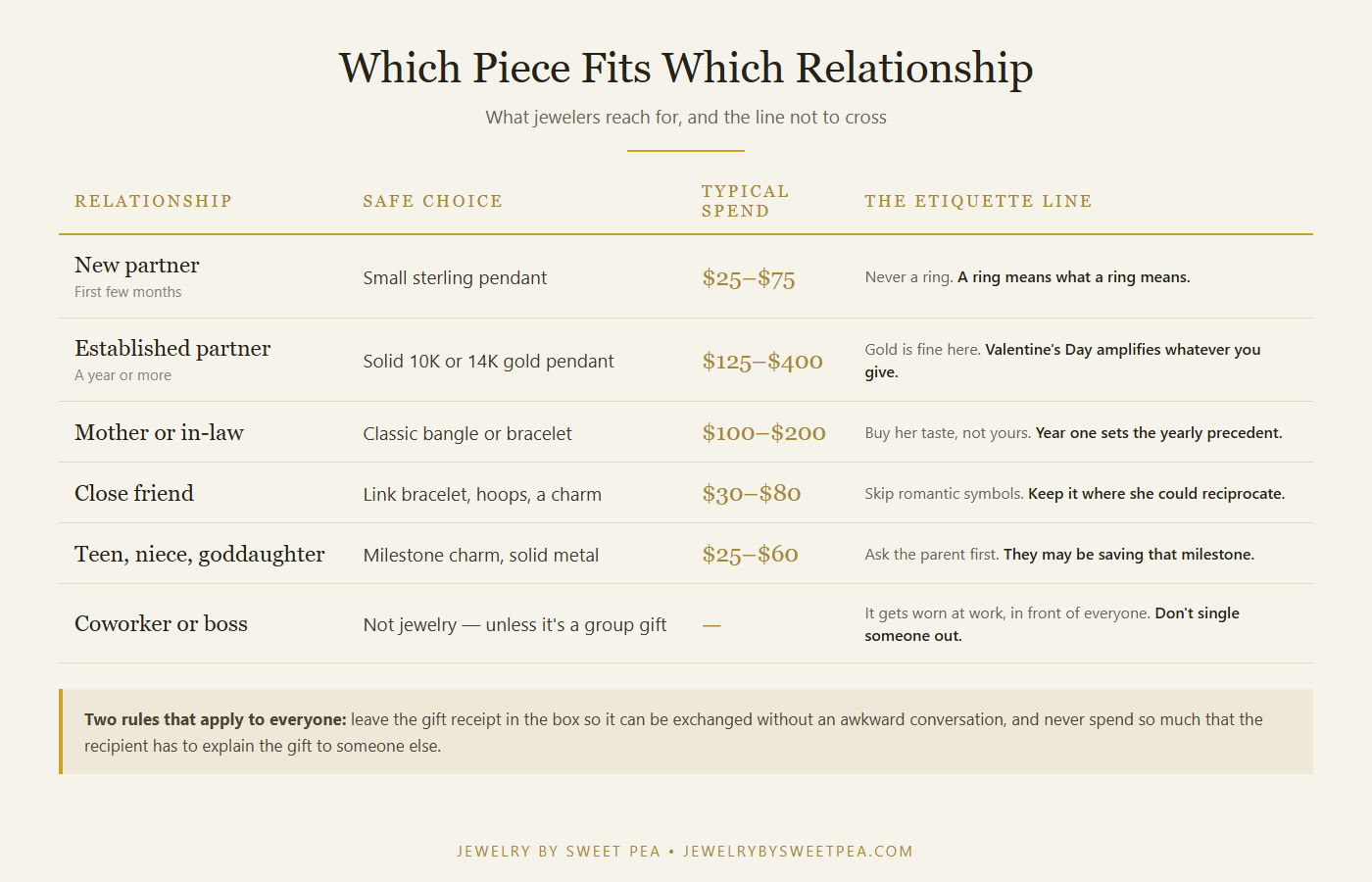
In the first few months, stay lovely and low-pressure — a small pendant, a simple bracelet, earrings, roughly $25 to $75 in sterling silver, given without a speech attached. The gift says I was thinking about you, which is exactly right for that stage. Our Sterling Silver Heart Pendant (about $29) is the piece we hand people most often here: solid sterling, small, sweet, and it asks nothing of the person receiving it.
Once a relationship is established — a year in, living together, families met — gold becomes appropriate and so does a higher price. A solid 14K yellow gold pendant (about $147) is the classic step up: real gold, chain sold separately so you can pick the length she actually wears, and nothing about it presumes an engagement.
The one hard rule: do not give a ring you do not mean. "It's just a fashion ring" is a sentence you will have to say out loud in a moment you would rather not have. Give a ring as an engagement ring, or give something else.
For a partner who does not wear traditional jewelry, change the material rather than the idea. Something like this black titanium and sterling silver necklace (about $385) reads as design rather than romance, which is often the register a person wants.
Can you give jewelry to a parent or in-law without it being strange?
Yes — this is the easiest category of all, and people worry about it far more than they need to. The etiquette here is not about intimacy, it is about taste: buy something she would have picked, not something you would have picked for yourself.
In practice that means classic and substantial. A sterling silver heart bangle bracelet (about $143) works because it does not chase a trend — it is the same bracelet in five years that it is today. Bangles also sidestep sizing, which matters when asking feels awkward.
Two courtesies that matter with an in-law: give it in front of the family, so it reads as warmth toward the household rather than a bid for favor, and if you are newly married in, keep the first gift modest. A $400 precedent in year one commits you to a $400 gift every year after, and everyone in the room is quietly doing that math.
Is jewelry an appropriate gift for a friend?
Between close friends, absolutely — with one adjustment. Steer away from the romantic vocabulary. Hearts, infinity symbols and anything engraved "forever" can read as a declaration even when both people know better, and the awkwardness lands on the recipient, not on you.
Friendship jewelry works best as simply a nice thing: a textured link bracelet, a pair of hoops, a charm with a private joke behind it. Our sterling silver heart link bracelet (about $76) manages both sides — the hearts are part of the chain pattern rather than a statement pendant, so it reads as a pretty bracelet, not a confession.
On price, the guideline that keeps friendships comfortable is reciprocity. If your friend could not comfortably spend something in the same neighborhood on you, a large gift creates a quiet debt, and quiet debts are corrosive. Somewhere in the $30 to $80 range keeps almost every friendship on even footing.
What about gifting jewelry to a teenager, niece or goddaughter?
Here the etiquette involves a third party: ask the parent first. Not for permission to be generous, but because parents are often running a plan you cannot see — saving a first real gold piece for a sixteenth birthday, holding a grandmother's ring for a graduation, keeping a younger sibling's gifts in line with an older one's. A thirty-second text prevents a genuinely painful collision.
Once you have the go-ahead, milestone charms are the most reliably welcome thing you can give a young person, because they are markers rather than accessories. A sterling silver Sweet 16 heart charm (about $31) is small, dated to a moment, and can join a bracelet she adds to for a decade.
One practical note: buy solid sterling silver or solid gold rather than plated pieces. Plating wears through in months on someone who genuinely wears it every day, and a green wrist teaches a young person that jewelry is disposable. Everything we sell is solid metal for exactly that reason.
Is it ever appropriate to give jewelry to a coworker or a boss?
The default here leans no — not because jewelry is scandalous at the office, but because of the wearing problem. Workplace gifts get worn to work, in front of the people you both work with, and that visibility can create an impression neither of you intended.
The exceptions are narrow and real: a group gift from a team, where the intimacy is diluted; a retirement or decades-of-service milestone, where the occasion carries the meaning rather than the giver; or a colleague who has genuinely become a personal friend outside work. What does not work is an individual gift of jewelry between a manager and a direct report, in either direction — upward it looks like currying favor, downward like singling someone out, and either way the recipient has to decide whether to wear it.
How much should you spend, and how do you handle the price question?
No etiquette rule assigns a dollar figure to a relationship, and anyone who says otherwise has something to sell. What there is, is the reciprocity test above plus one addition: never spend so much that the recipient has to explain the gift to someone else. If she will have to justify it to a spouse, a parent or a friend, it is too big for where you are.
- Leave the gift receipt in. This is not unromantic — it is the kindest thing you can do. It turns "I have to wear this" into "I get to choose," and removes any need for a difficult conversation about size or taste.
- Never disclose the price, and don't let the box do it for you — and don't ask, either. The right response to a gift is a specific compliment, not a question about value.
- Know what you are buying. Terms like "gold," "solid gold" and "gold-filled" are legally defined in the United States; the FTC's Jewelry Guides at 16 CFR Part 23 spell out what a seller may call a piece. If a listing is vague about karat or about whether the metal is solid, that vagueness is the answer.
Does the occasion change the rules?
Quite a lot, and mostly in your favor. A gift that would read as forward on an ordinary Tuesday is perfectly appropriate at a graduation, a christening, a milestone birthday or a wedding, because the occasion supplies the justification. That is why pearls have survived as the standard graduation and wedding gift for a century — the tradition does the explaining. If you go that route, the GIA's pearl quality factors are worth ten minutes first, because pearl quality varies more than almost any other gem material and price alone will not tell you what you have.
Valentine's Day works the other way: it intensifies whatever you give. A pendant that would be sweet in March is a statement on February 14th.
Gift picks by relationship, at a glance
- New relationship: Sterling Silver Heart Pendant — about $29
- Teen, niece or goddaughter: Sterling Silver Sweet 16 Heart Charm — about $31
- Close friend: Sterling Silver Heart Link Bracelet — about $76
- Mother, grandmother or mother-in-law: Sterling Silver Heart Bangle Bracelet — about $143
- Established partner: 14K Yellow Gold Pendant — about $147 (chain sold separately)
- Partner who skips traditional jewelry: Black Titanium & Sterling Silver Necklace — about $385
Prices move with the gold and silver markets, so treat these as close rather than exact. You can browse the full ranges in Pendants & Charms, Bracelets and Necklaces.
Frequently asked questions
Is giving jewelry too personal for a second or third date?
Generally yes. Early on, jewelry asks the other person to make a public statement about a private situation that is not settled yet. Flowers, a book or something tied to a shared interest carries the same thoughtfulness with none of the weight. Save jewelry for the point where you would comfortably introduce the person to a friend.
Should I ask for her ring size before buying a ring as a gift?
If you are proposing, get the size discreetly — borrow a ring she already wears and have it measured. For any other kind of ring, buy a bracelet, a bangle or a pendant instead. Sizing conversations spoil surprises, and a ring that does not fit sits in a drawer.
Is it rude to exchange or return jewelry you were given?
No, and a thoughtful giver expects it. Wear-it-or-hurt-them is a false choice nobody wins. Exchange it and tell the giver plainly and warmly: "I loved it so much I wanted one I'd wear every day, so I swapped the chain length." Most people are relieved.
Can I give jewelry that belonged to a family member as a gift?
Heirloom jewelry is one of the most meaningful gifts there is, with two conditions. Be sure the rest of the family agrees the piece is yours to give — resentment over a redistributed heirloom lasts decades. And have it cleaned and checked by a jeweler first, because old settings loosen and a lost stone in week one undoes the gesture.
What is the etiquette on engraving a gift?
Engraving turns a gift into a commitment, because an engraved piece cannot be exchanged or passed along easily. Engrave for milestones you are certain of — a graduation year, a birth date, a wedding date — and skip it for a new relationship or when you are unsure of taste. Initials and dates age well; sentiments and nicknames often do not.
If you are stuck between two pieces, or want a second opinion on whether something fits the relationship, send us a note — we answer these questions all day and we are happy to talk you out of a mistake.