Jewelry Gifts vs Experience Gifts Which Creates a Longer Lasting Emotional Connection
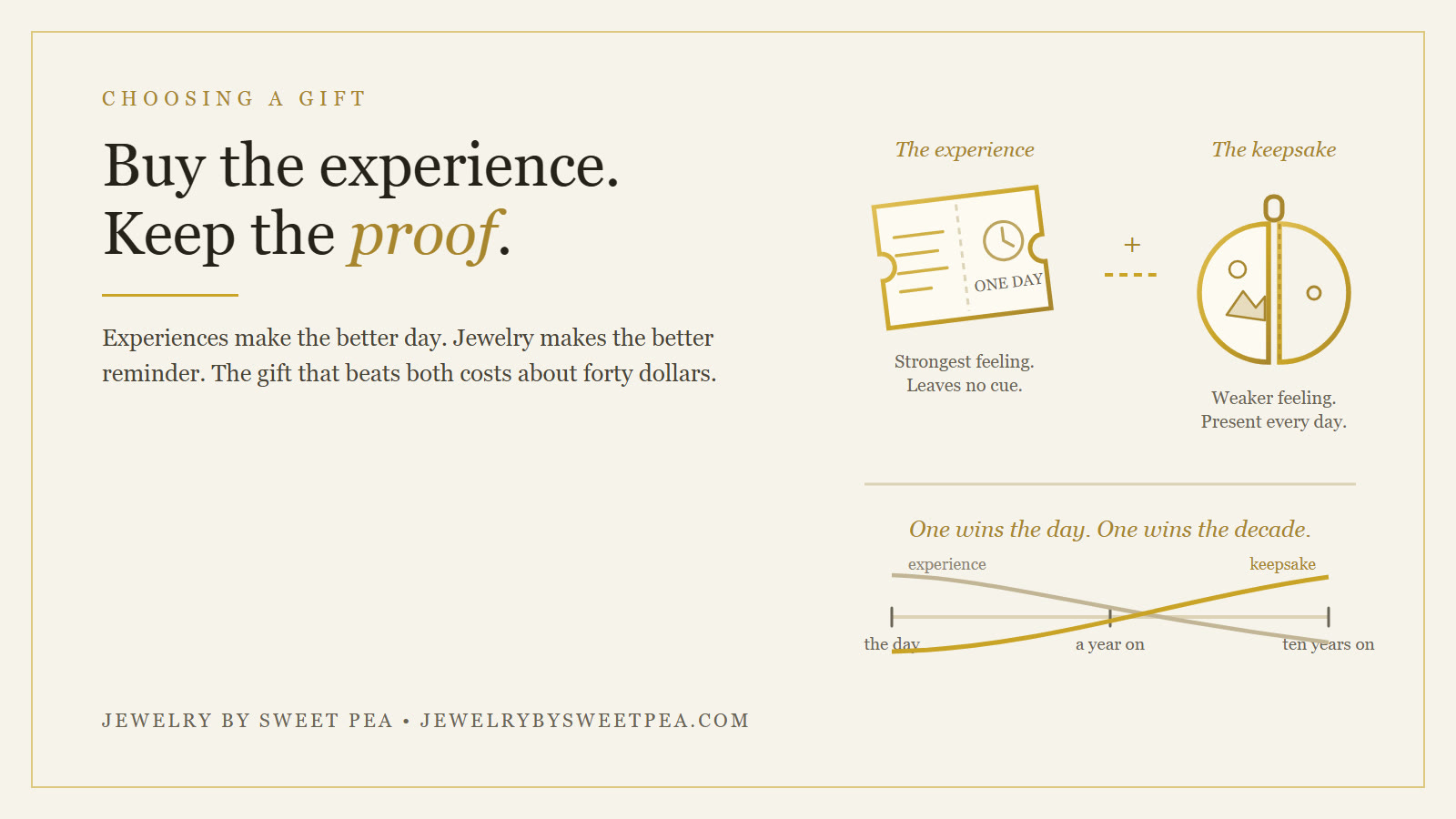
The short answer: an experience usually wins the day, and jewelry usually wins the decade. Experiences produce the stronger feeling at the time; jewelry produces the stronger reminder afterward, because it is physically present on an ordinary Tuesday five years later. The gift that beats both is a small piece bought to mark the experience.
This question comes up at our counter more than any other, usually phrased as an apology. Somebody says “I was going to get her a necklace, but I read that experiences make people happier.” It is a fair thing to have read, and it is mostly true. It is also not the whole comparison.
Why do experience gifts feel better in the moment?
Because they are shared, and because they do not sit still long enough to be judged.
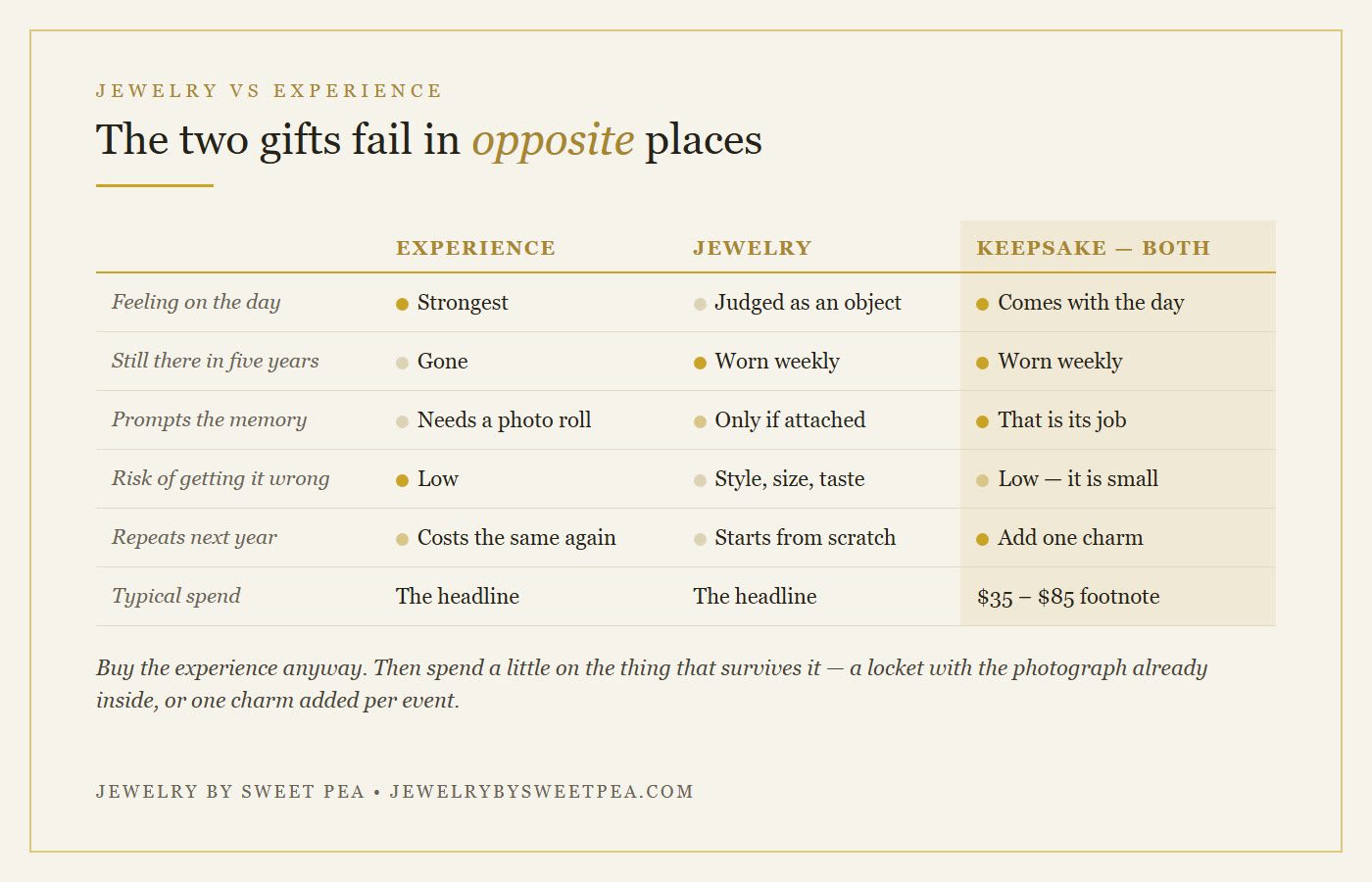
A concert, a weekend away, a cooking class — these arrive as time spent with someone rather than an object handed over. Nobody compares a dinner out to the dinner out somebody else got. An object invites that comparison immediately, and it invites a second, worse one: the recipient wonders whether you understood them. A gift you unwrap is a small test. A gift you turn up to is not.
There is a practical reason too. Experiences are consumed and gone, so they never become clutter, never need dusting, never sit in a drawer generating guilt. That is a real advantage and we are not going to argue with it.
Why does jewelry outlast the memory of the experience?
Because memory needs a cue, and an experience does not leave one behind.
Six months after a trip, the trip lives in photographs on a phone that nobody scrolls back through. Six months after a pendant, the pendant is around a neck. It is not that the object is more meaningful — it almost never is. It is that the object keeps presenting itself. It gets touched at a red light, adjusted before a meeting, noticed in a bathroom mirror. Each of those is a tiny return to whoever gave it.
That only works if the piece survives being worn every day, which is where most of the disappointment in jewelry gifting actually happens. A plated piece looks identical to a solid one in the box and stops looking like anything within a year. Plating is a layer microns thick over brass or steel; when it wears through at the bail or the clasp, there is nothing underneath to polish back. What may legally be called “gold” rather than gold-plated or gold-filled is set out in the FTC's Jewelry Guides at 16 CFR Part 23, and it is worth two minutes of anybody's time before buying. We sell solid 10K and 14K gold and sterling silver and nothing plated, for exactly this reason: a gift meant to be a reminder has to still be there to do the reminding.
Is there a way to get both?
Yes, and it is the answer we give most often: buy the experience, then spend a small amount on something that carries it.
This is not a compromise. It is a better gift than either half, because it fixes the weakness in each. The experience gets a cue that survives it. The object gets a meaning that was not assigned by the price tag.
A locket is the most literal version. Our sterling silver compass locket (about $68) is 26.5 mm long and opens to hold two round photographs up to 17 × 17.4 mm — small, but large enough for two faces. It is a compass, so it reads as travel without saying so. Give it after the trip, with a photograph from the trip already inside, and you have handed somebody the weekend rather than a necklace.
One caution nobody mentions: a photograph sealed against metal in a warm room does not last indefinitely. The Library of Congress's guidance on the care and storage of photographs is the short version — heat and humidity are what degrade prints. It is not a reason to avoid lockets. It is a reason to keep the digital original, and to reprint the photograph in ten years rather than assume the one in the locket is the archive.
What kind of jewelry actually holds a memory?
Three kinds, in rough order of how well they do it.
Things that open. A locket is the only category of jewelry that literally stores something. The 10K yellow gold polished oval locket (about $155) is 24 × 14 mm and takes two oval photos at 11 × 15.3 mm. Worth knowing before you buy one for a child: a locket is die-struck and hollow by necessity, because it has to open. That is not a flaw, it is what makes it a locket — but it dents where a solid cast pendant would not.
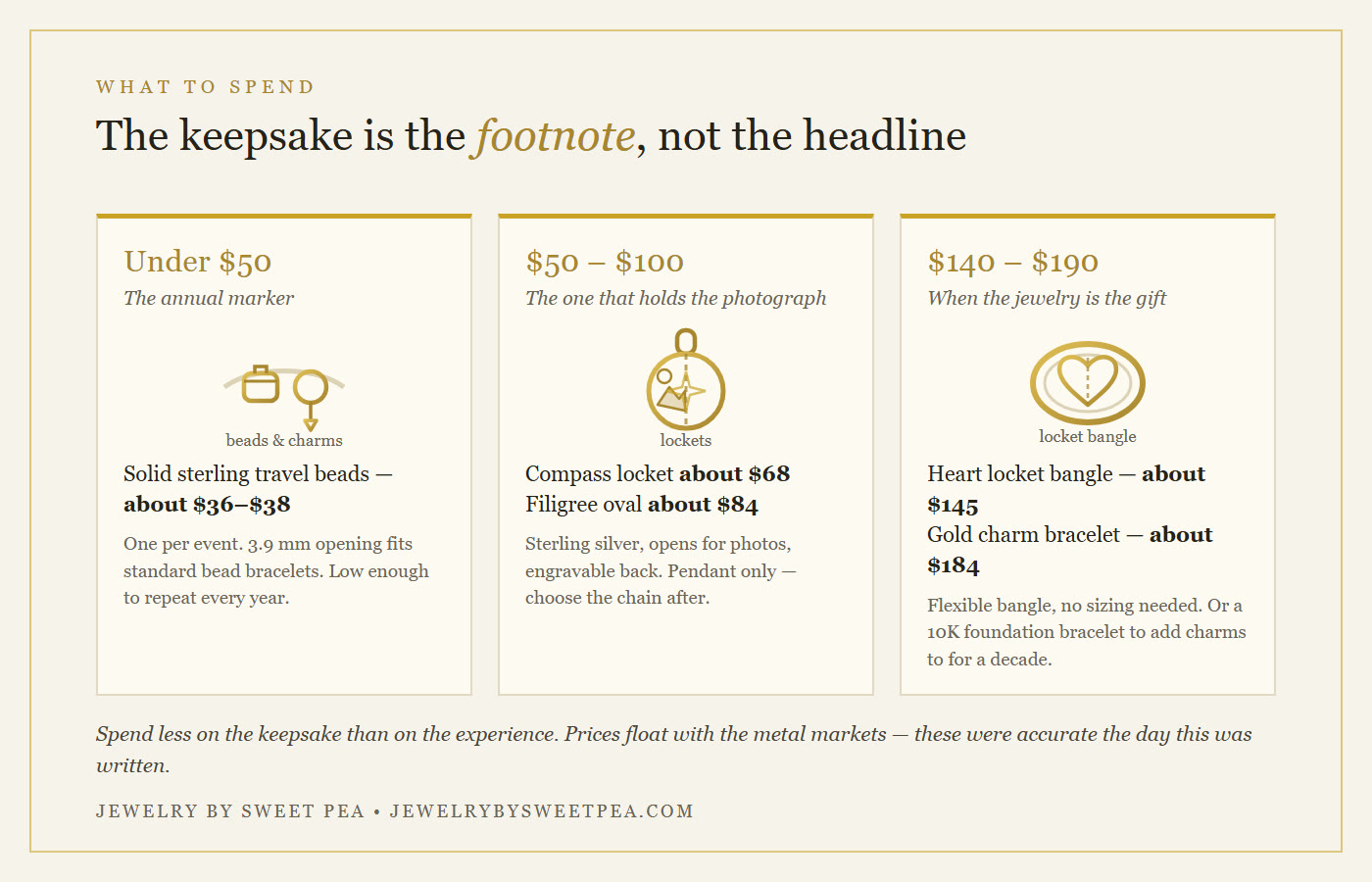
Things that accumulate. A charm bracelet is a gift you only have to choose once; every year after that, the decision is made for you. Start with a foundation piece — our 10K yellow gold hollow double link charm bracelet (about $184) is 8 inches, 4 mm wide, hollow so it stays light on the wrist. Then add one thing per event. A sterling silver suitcase bead at about $38 after the first trip abroad; a travel dangle bead at about $36 after the next. Both are solid cast sterling with a 3.9 mm opening, so they fit standard bead bracelets. The bracelet becomes a record of a decade, assembled at $40 a year.
Things that can be engraved. A date on the back of a piece does most of the work of a locket at a fraction of the fuss. The sterling silver filigree oval locket (about $84) does both — it opens for one photo and it is engravable on the back. It carries a single natural white diamond accent, measures 29 × 15 mm, and weighs about 4 g.
What should you spend?
Less than the experience, almost always. The keepsake is the footnote, not the headline. Prices float with the metal markets and were accurate the day this was written.
Under $50 — the annual marker. A single bead added to a bracelet that already exists. The travel dangle bead at about $36 is 25.27 mm long and solid sterling. This is the tier to be in if you are giving something every year, because a gift that repeats has to be sustainable.
$50–$100 — the one that holds the photograph. The compass locket at about $68 or the filigree oval at about $84. Both are pendants only — chain sold separately, deliberately, so the part that wears out can be replaced without replacing the part that does not. Choose the pendant first and let its bail width decide the chain.
$140–$190 — the piece that is the gift. When there is no experience to attach it to and the jewelry has to stand alone, go heavier. The sterling silver heart locket bangle (about $145) is 7.75 inches with a 47 × 23.1 mm heart that opens for two photos, about 11.4 g of silver, on a flexible bangle with a hook clasp — no sizing needed, which matters when you are buying for someone whose wrist you have never measured.
When is the experience simply the better gift?
Often, and we would rather say so than sell you something.
If the person does not wear jewelry, no amount of thoughtfulness in the choosing fixes that — you are buying an object for a drawer. If they are in a season of getting rid of things rather than acquiring them, an object is a burden with a bow on it. If the relationship is new enough that jewelry would read as a bigger statement than you mean, the dinner is the correct gift and the necklace is a mistake you will both be polite about.
And if the budget only stretches to one of the two, take the experience. A modest weekend beats a modest pendant, because the pendant has to compete with every other pendant and the weekend competes with nothing.
The keepsake approach is for the case where you were going to do the experience anyway. Then $40 turns a memory into something with a physical address.
Common questions
Does a gift have to be expensive to be kept? No, and the correlation runs weaker than people fear. What gets kept is what gets worn, and what gets worn is what is comfortable, sturdy and connected to something. A $38 bead attached to a trip outlives a $400 piece attached to nothing.
Should I put the photograph in the locket before giving it? Yes. An empty locket is a task you have handed someone. A filled one is the gift finished.
What if I choose the wrong style? Choose a shape rather than a trend — a heart, an oval, a round locket — and the risk mostly disappears. These forms have been made continuously for over a century, so none of them can go out of fashion.
If you are still deciding, browse pendants and charms or start with a bracelet you can add to later. And if you would rather talk it through, we are a small family shop and we answer our own email.