
Jewelry Professionals Explain How to Measure Necklace Length Before Ordering Online
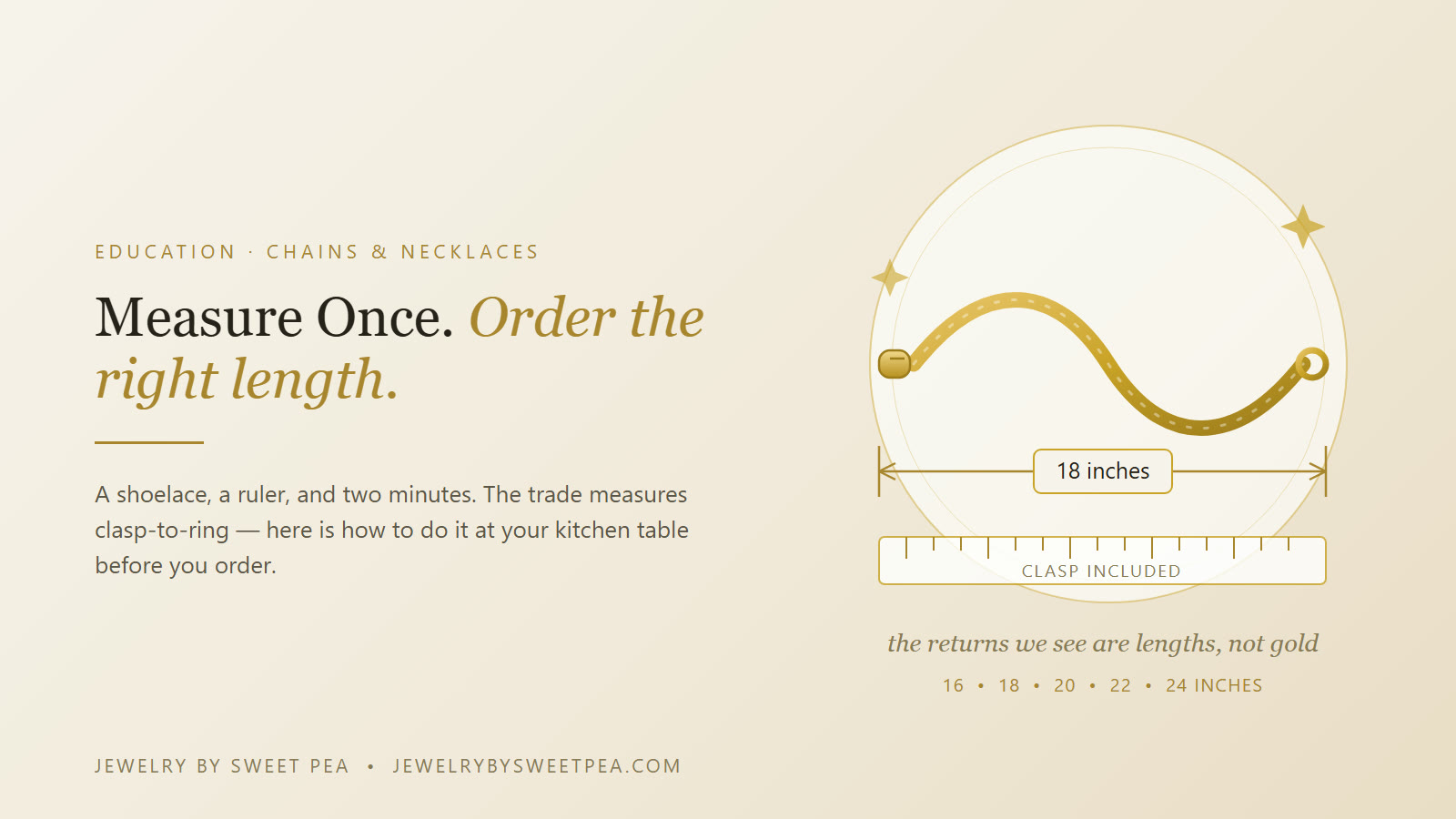
The short answer: wrap a piece of string around your neck and let it fall where you want the necklace to sit, mark it, then lay it flat against a ruler. That measurement in inches is your chain length — clasp included, the way manufacturers state it. Most adult women land on 18 inches, and you add about two inches if a pendant is going on it.
Necklace length is the single most common reason a chain comes back to us for an exchange, and it is completely avoidable. Nobody returns a chain because the gold was wrong. They return it because it sat two inches higher than they pictured, or because it disappeared under a collar. Five minutes with a shoelace prevents all of it.
What is the fastest way to measure at home?
You do not need a jeweler's tools. Anything flexible works — a soft sewing tape, a shoelace, a phone charging cable, a strip of ribbon.
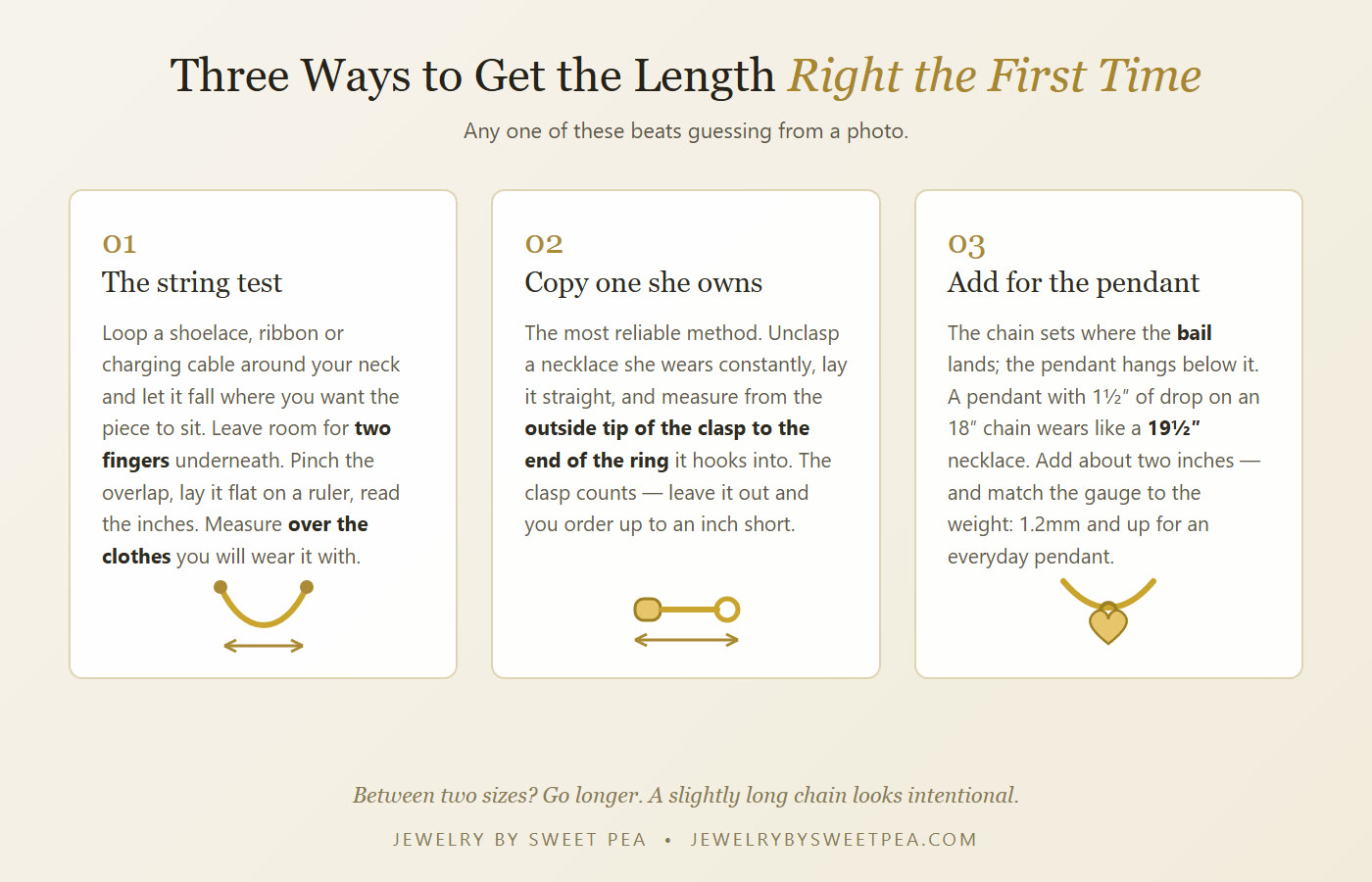
- Put it around your neck the way the necklace will sit. Not pulled tight against the throat — a chain rests on you, it does not grip. Leave enough room to slide two fingers underneath.
- Let it hang where you actually want the piece to land. Look in a mirror and move it up and down until the low point of the loop is at the spot you have in mind. That low point is what the eye reads as "the length."
- Pinch the overlap, take it off, lay it flat against a ruler or tape measure and read the inches.
- Measure over the clothes you will wear it with. A chain measured on bare skin and then worn over a turtleneck sits noticeably higher.
Round to the nearest even inch, because that is how chains are sold: 16, 18, 20, 22, 24. If you land between two, go longer — a slightly long chain looks intentional, a slightly short one looks like it belongs to someone else.
How do I measure a necklace I already own?
This is the method people in the trade trust most, because it removes all the guesswork: the piece she already reaches for every morning is the answer.
Unclasp it, lay it in a straight line on a flat surface, and measure from the outside tip of the clasp to the end of the ring it hooks into. The clasp is part of the length. That is the industry convention and it is how every chain on our site is stated, so if you measure the chain only and skip the clasp, you will order roughly half an inch to a full inch short.
If you would rather not undo the clasp, leave it fastened, lay the loop flat, pull it into a long oval, measure that oval from end to end and double the number.
What do the standard lengths actually look like when worn?
The classic length names — choker, princess, matinee, opera — come from pearl strands, and the GIA's guide to pearl quality factors is where that vocabulary is still used most precisely. For everyday gold chains, plain inches are clearer. Here is the ladder, described for an average adult neck of about 13 to 14 inches:
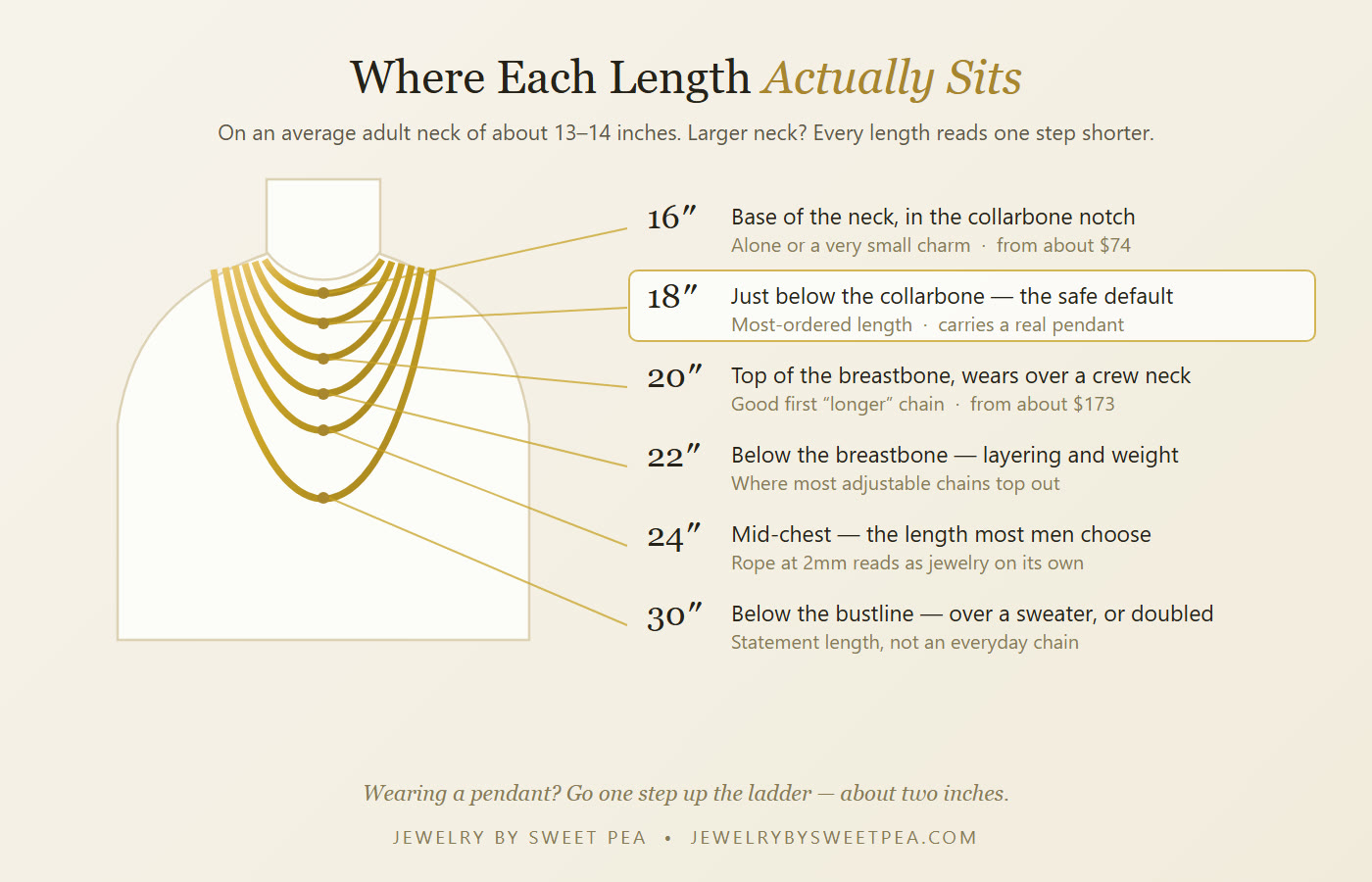
- 16 inches — sits at the base of the neck, right in the collarbone notch. Close to the throat, best on its own or with a very small pendant. The 10K Yellow Gold 0.6mm Diamond-Cut Cable Chain (about $74) is our lightest 16-inch, and an honest first solid-gold chain for a teenager.
- 18 inches — just below the collarbone. This is the one people order most, and the safest default when you are not certain. The 10K Yellow Gold 1.4mm Round Open Link Cable Chain (about $258) is the everyday version: substantial enough to hang a real pendant on, and it also comes in 16, 20, 22, 24 and 30 inches if your measurement says otherwise.
- 20 inches — a couple of inches lower, at the top of the breastbone. Wears well over a crew neck. See the 10K Yellow Gold 1.2mm Cable Chain (about $173).
- 22 inches — below the breastbone. Good for layering under a shorter chain, and for pendants with real weight to them.
- 24 inches — mid-chest, and the length most men choose. The 10K Yellow Gold 2mm Diamond-Cut Rope Chain (about $229) is our workhorse here — 2mm rope reads as a piece of jewelry on its own, not just a pendant carrier.
- 30 inches and longer — below the bustline, meant to be seen over a sweater or doubled.
One adjustment worth making: those descriptions assume an average neck. On a larger neck, every length effectively reads one step shorter — a 20-inch chain will sit where the pictures show 18. That is exactly why the string test beats a chart.
Does a pendant change the length I need?
Yes, and this is the step most people skip. The chain length puts the bail at a certain point on your chest. The pendant then hangs below that. A pendant with an inch and a half of drop on an 18-inch chain wears like a 19.5-inch necklace.
Two rules we give at the counter:
- Add roughly two inches — one size up the ladder — when the chain is carrying a pendant of any real size, unless you specifically want it high on the chest.
- Match the gauge to the weight. A 0.6mm chain is beautiful and it is not built to swing a heavy charm around all day. For an everyday pendant, look at 1.2mm and up; for something substantial, 1.4mm or heavier. A chain that snaps is almost always a chain that was too fine for what was hanging on it.
What if it is a gift and you cannot measure her neck?
Three ways out, in order of reliability. Measure a necklace she already owns while she is out. Default to 18 inches, which fits the largest share of adult women. Or take the decision off the table entirely and buy adjustable.
An adjustable chain has a sliding bead or a clasp that can grab anywhere along the last few inches, so one chain covers several lengths and she sets it herself:
- 10K Yellow Gold Adjustable 1mm Diamond-Cut Cable Chain (about $241) — adjusts up to 22 inches, so it covers everything from collarbone to mid-chest.
- 14K Yellow Gold Adjustable 1.2mm Flat Cable Chain (about $388) — the same idea in solid 14K, made in Italy, with a flat cable link that lies smoothly under a collar.
Every chain above is solid 10K or 14K gold, never plated. The FTC Jewelry Guides set the rules for how sellers are allowed to use words like "solid," "karat" and "gold-filled," and we state ours plainly on every listing so you can compare like with like.
Do men's and children's lengths work differently?
Men generally wear 20 to 24 inches, with 22 the common middle, and in wider gauges — a 1mm chain that looks delicate on a woman tends to disappear on a man's neck. For children, 13 to 14 inches suits a toddler and 15 to 16 inches a school-age child, and an adjustable chain is genuinely useful there because they grow out of a fixed length in a year or two.
What should you spend on the chain itself?
- Under $100 — fine and delicate: a light 16-inch 10K cable. Real gold, real chain, best worn alone or with a tiny charm.
- $150 to $275 — the everyday workhorse: 10K at 1.2mm to 2mm in 18 to 24 inches. This is where most of our chain orders sit, and it is the range that survives daily wear with a pendant.
- $275 and up — 14K and adjustable: a heavier karat, a hallmarked Italian chain, or the flexibility of an adjustable length for a gift.
You can browse the full range in our chains and necklaces collections, where every listing states the length and width up front.
Frequently asked questions
Is necklace length measured with the clasp included?
Yes. The stated length runs from the outside tip of the clasp to the end of the ring it fastens into, and that is the standard sellers use. If you measure only the chain and leave the clasp out, you will order about half an inch to an inch short.
What is the most common necklace length for women?
Eighteen inches. It sits just below the collarbone on an average adult neck and works with almost any neckline, which is why it is the safest default when you cannot measure.
How much length should I add for a pendant?
About two inches — one step up the ladder. The chain sets where the bail sits, and the pendant hangs below that, so a pendant with an inch and a half of drop on an 18-inch chain wears like a 19.5-inch necklace.
Can a chain be shortened or lengthened after I order it?
We do not alter chains, and altering a solid gold chain at a bench is rarely worth what it costs. Choose an adjustable style if you are unsure, or exchange it — every order ships with free 30-day returns, so getting the length right on the second try costs you nothing.
What length should I choose for layering two chains?
Leave at least two inches between them so each one reads separately — 16 with 18, or 18 with 20 or 22. Vary the width as well as the length; two chains of identical gauge tend to tangle and look like one thick chain that went wrong.