Lab-Grown Diamonds vs Natural Diamonds — Which Is Better for a Graduation Gift?
The short answer: for most graduation gifts, a lab-grown diamond is the smarter buy — it is a real diamond, in the same solid 14K gold settings, at roughly a third to a fifth of the natural-diamond price for the same size stone. Choose a natural diamond when the point of the gift is tradition and rarity — a stone made by the earth for a once-in-a-lifetime milestone. Neither choice is wrong; they simply say slightly different things.
We sell both in the store, side by side, often in the exact same mounting — which makes this one of the few comparisons we can show you with real prices instead of theory. Here’s how we walk parents and grandparents through it at the counter.
First things first: is a lab-grown diamond a real diamond?
Yes. A lab-grown diamond is carbon crystallized into diamond — the same material, the same hardness (a 10 on the Mohs scale, the hardest gem there is), the same brilliance and fire as a mined stone. It is not a look-alike the way cubic zirconia or moissanite are. A jeweler’s loupe can’t separate a lab-grown diamond from a natural one; it takes specialized lab equipment to tell them apart.
Because they really are diamonds, U.S. rules require honesty about origin: under the FTC Jewelry Guides (16 CFR Part 23), a man-made stone must be clearly described as lab-grown (or similar wording) so nobody mistakes it for a mined diamond. That’s why every lab-grown piece below says so right in the product name — and why a "diamond" deal that’s vague about origin deserves a second look. If you want the deeper science, this overview of how lab-grown diamonds are made covers the HPHT and CVD processes well.
The comparison nobody else will show you: the same earring, two stones
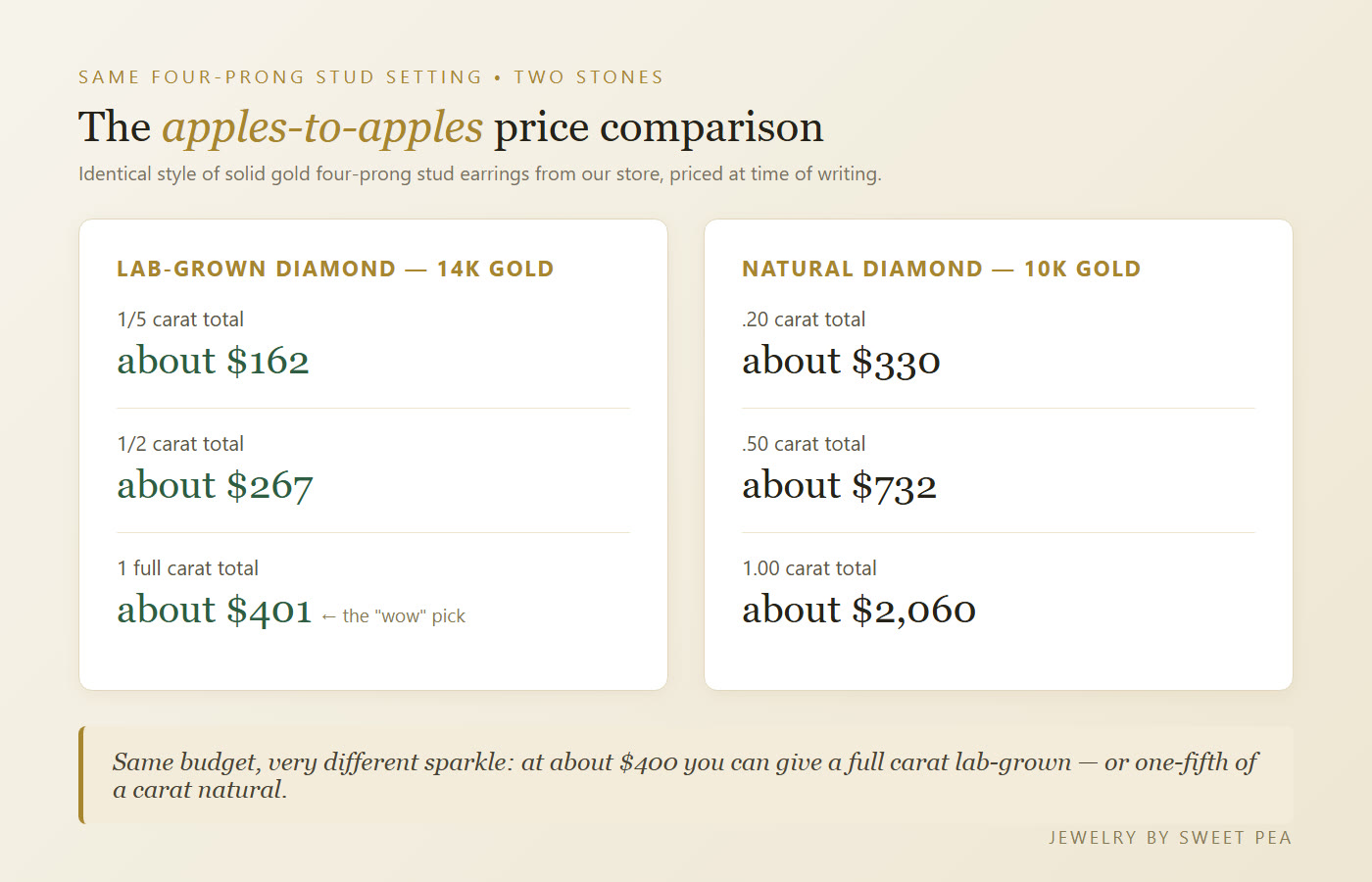
Our classic four-prong heavyweight stud earring comes in both versions, so the price difference is as clean as it gets:
- 1/5 carat total: the 14K White Gold 1/5 Carat Lab-Grown Diamond Studs run about $162 — while the .20 Carat Natural Diamond Studs in the same four-prong style are about $330. Same look on the ear, roughly half the price.
- A full carat: the 14K White Gold 1 Carat Lab-Grown Diamond Studs are about $401 — the 1.00 Carat Natural Diamond Studs are about $2,060. That’s a five-fold difference for the same carat weight.
Put another way: at a graduation-gift budget of about $400, you can give a full carat of lab-grown diamonds, or about a fifth of a carat of natural. Our lab-grown line is also consistently good quality — VS/SI clarity and near-colorless (G or better) — because labs grow clean stones on purpose, while nature makes no promises. Prices on solid gold pieces move a little with the metal market; the figures here are accurate at the time of writing.
So why would anyone choose the natural diamond?
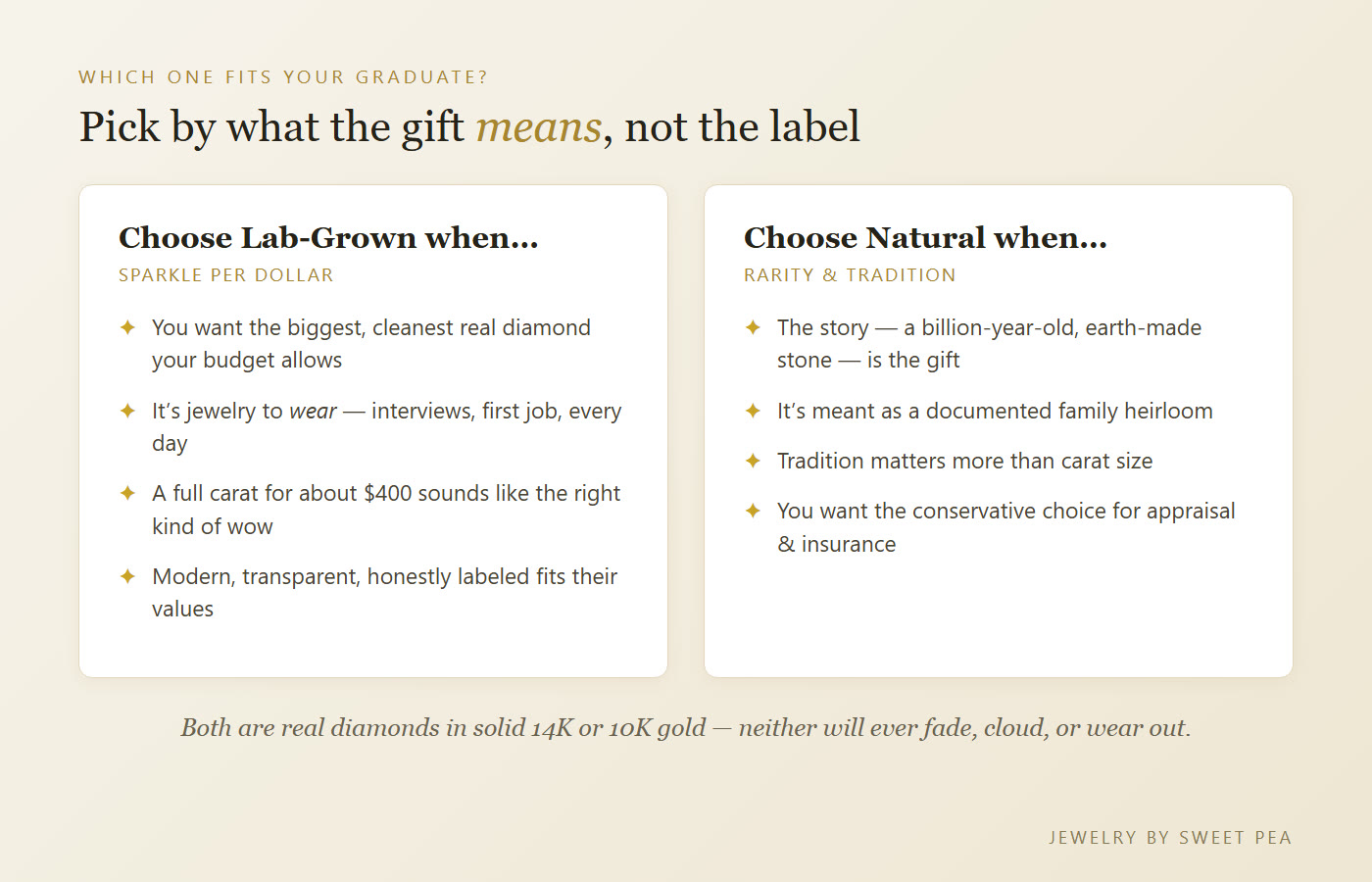
Because a gift is more than a spec sheet — and we’d be doing you a disservice if we pretended lab-grown wins on everything. The honest trade-offs:
- Rarity and story. A natural diamond formed over a billion years underground. For some families, "the earth made one and we chose it for you" is the gift. Lab-grown stones are made to order; they can’t carry that particular story.
- Long-term value expectations. Lab-grown prices have fallen steadily as growing technology improves, and they'll likely keep drifting down. Buy lab-grown for the beauty and the milestone — not as a store of value. (To be fair: ordinary retail natural diamonds aren’t investments either, but their prices have historically been steadier.)
- Tradition. For an heirloom meant to be appraised, insured, and handed down with papers, natural is still the conservative choice.
What does not differ: durability and care. Both are true diamonds — they wear the same, clean the same, and neither will fade, cloud, or "wear out." A lab-grown diamond bought for a 2026 graduation will look exactly the same at a 2066 reunion.
Our in-stock lab-grown picks for a graduate, by budget
Every piece below is a genuine lab-grown diamond in solid 14K gold — never plated, and the diamond quality (VS/SI clarity, G+ color) is stated right on the listing:
- 14K Yellow Gold Lab-Grown Diamond Fancy Pendant — about $111. A delicate 1/10-carat pendant and the gentlest way into real diamonds.
- 14K White Gold 1/4 Carat Lab-Grown Diamond Cross Pendant — about $133. A meaningful pick for a graduate of faith.
- 14K White Gold 1/5 Carat Lab-Grown Diamond Studs — about $162. The everyday classic; the pair she’ll wear to every interview.
- 14K White Gold 1/2 Carat Lab-Grown Diamond Studs — about $267. Noticeably bigger sparkle, still a mid-range budget.
- 14K White Gold 1 Carat Lab-Grown Diamond Studs — about $401. A full carat for a milestone moment — our "wow for the money" pick.
- Prefer natural after all? The 10K White Gold .20 Carat Natural Diamond Studs — about $330 — are the classic earth-made starting point.
A pendant needs a chain to wear — if your graduate doesn’t have one, add a simple solid gold chain from the Necklaces collection (chains are sold separately). You can also browse everything diamond in our Earrings and Pendants & Charms collections, or the Special Occasions collection for milestone gifts.
The bottom line for a graduation gift
Ask one question: is this gift about the moment or about the object’s pedigree? If it’s about the moment — she did it, she’s launching, and you want real diamonds on her ears to prove it — lab-grown gives you the most beautiful stone your budget can reach, honestly labeled and identical to wear. If the family story calls for an earth-made stone with papers to pass down, natural is worth its premium. Either way, insist on two things: solid gold settings (never plated) and a seller who tells you plainly which diamond you’re buying.
Not sure which fits your graduate? Tell us a little about them and your budget — we’ll give you a straight answer, even if it’s "save the difference and take her to dinner."
Frequently asked questions
Are lab-grown diamonds real diamonds?
Yes. Lab-grown diamonds are crystallized carbon with the same chemical composition, hardness (10 on the Mohs scale), and brilliance as mined diamonds. They are not imitations like cubic zirconia. U.S. FTC rules require sellers to clearly disclose that a stone is lab-grown so buyers always know the origin.
Which is better for a graduation gift — lab-grown or natural?
For most graduates, lab-grown: you get a larger, cleaner real diamond for the same budget, in the same solid gold settings. Choose natural when rarity and tradition are the point of the gift — an earth-made stone intended as a documented heirloom. Both wear identically for a lifetime.
How much cheaper are lab-grown diamonds than natural?
In our store, the same four-prong stud setting runs about $162 with 1/5 carat of lab-grown diamonds versus about $330 with .20 carat natural — and about $401 for a full lab-grown carat versus about $2,060 natural. Roughly, expect a lab-grown stone to cost a third to a fifth of a comparable natural one, with the gap widening as carat weight goes up.
Will a lab-grown diamond fade, cloud, or wear out?
No. A lab-grown diamond is a true diamond — the hardest gemstone there is — and it will not fade, yellow, cloud, or lose sparkle with age or wear. It cleans and cares exactly like a mined diamond: warm soapy water and a soft brush.
Can anyone tell a lab-grown diamond from a natural one?
Not by looking. Even a jeweler with a loupe cannot separate them; it takes specialized laboratory instruments. That is exactly why disclosure rules exist — the listing must say lab-grown. On the ear or the neckline, the two are indistinguishable.
Jewelry by Sweet Pea is a family-run fine jewelry store. Every piece is solid 10K or 14K gold or sterling silver — never plated — sourced from U.S. wholesalers and shipped from the USA. Browse the Earrings collection or tell us about your graduate and we’ll help you pick the right diamond — honestly.