
Licensed College Jewelry vs. Generic Fan Merchandise: Which Is Actually Worth Buying
The short answer: officially licensed college jewelry is worth buying when it is made of real precious metal — solid 10K or 14K gold, or genuine sterling silver. It carries an accurate, trademark-approved logo, supports the school through licensing, and lasts for years. Generic fan merch is cheaper up front but is usually plated or base metal that tarnishes and is gone in a season.
We are a small, family-run fine jewelry store, and every fall we hear the same question from parents, students, and lifelong fans: "There's a $12 version and a $130 version of basically the same team pendant — is the real one actually worth it?" Here is the honest, jeweler's-eye answer — what "officially licensed" really means, how licensed fine jewelry differs from generic merchandise, how to tell them apart, and real in-stock picks at every budget.
What does "officially licensed" college jewelry actually mean?
A university's name, logo, mascot, and colors are trademarks the school owns. "Officially licensed" means the maker has a license to use them — the design is reviewed and approved, and a royalty on every piece goes back to the university, often funding scholarships and programs. Most major schools license through a central program such as the Collegiate Licensing Company. A generic, unlicensed piece skips all of that: no approval, no accuracy standard, and nothing supporting the school.
The licensed fine-jewelry version of your team's logo — the kind we carry — is made by LogoArt, an official licensee, in solid gold and genuine sterling silver. That combination, a real precious metal plus an officially approved design, is what separates a keepsake from a souvenir.
Licensed fine jewelry vs. generic fan merch: what is the real difference?
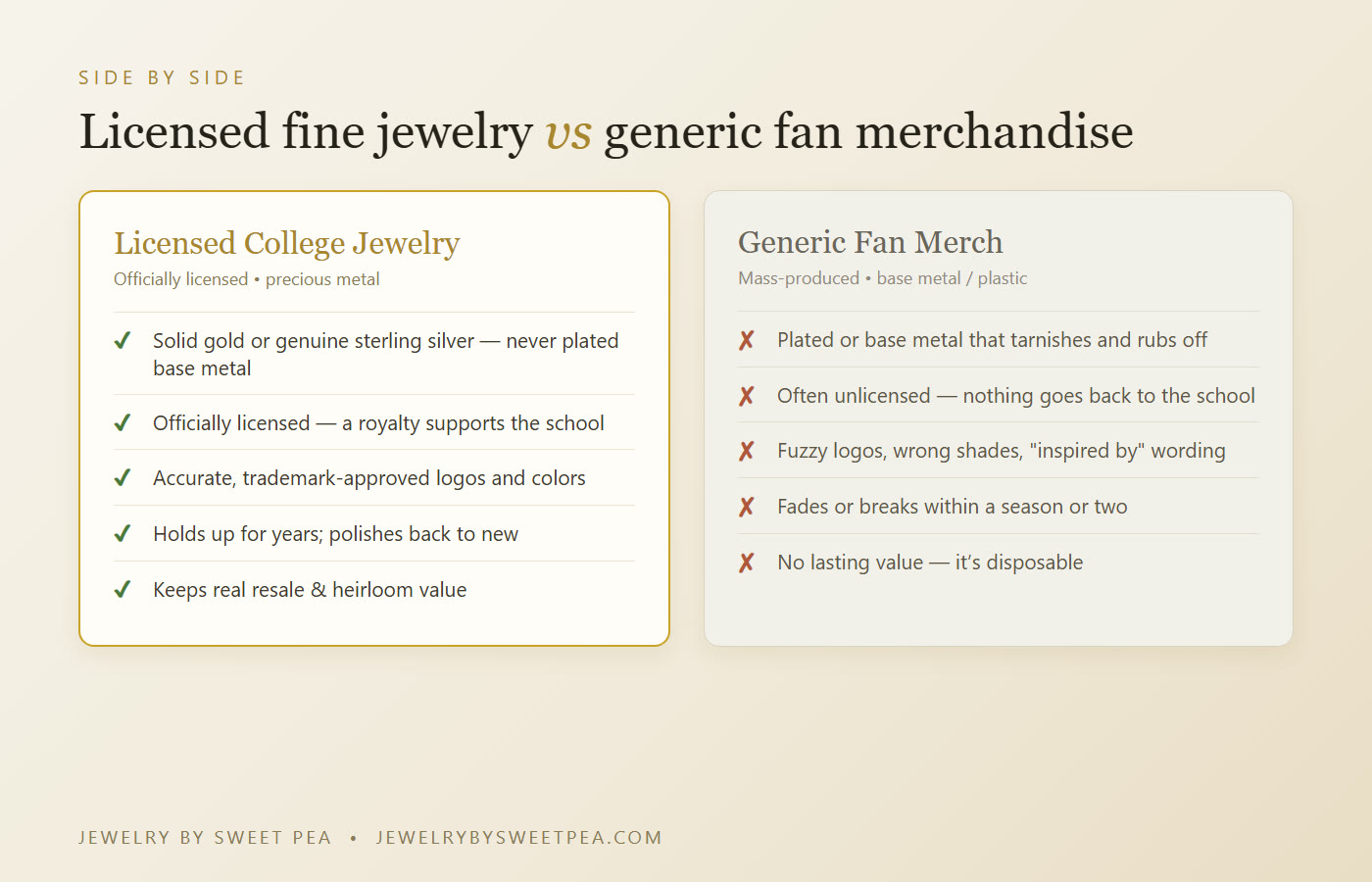
The gap comes down to four things:
1. The metal. This matters most. Licensed fine jewelry is solid gold or genuine sterling silver — precious metal all the way through, so a scratch just polishes out. Generic merch is typically a microscopically thin plating over a cheap base metal, or base metal alone. With daily wear the plating rubs off at the edges within months, the base metal underneath discolors, and there is nothing to restore. In the U.S., sellers are bound by the FTC Jewelry Guides (16 CFR Part 23) on how metal content is described, so a listing that never names a karat or "sterling" and leans on "gold tone" or "plated" is telling you exactly what it is. Every piece we sell is solid 10K or 14K gold or sterling silver — never plated.
2. The license. Licensed pieces are approved and pay a royalty to the school. Generic merch often is not licensed at all — you are buying an imitation, and none of your money reaches the university you are trying to support.
3. The accuracy. Approved designs get the logo shape and the exact team colors right. Generic pieces frequently use a fuzzy approximation, an off shade, or a vague "inspired by" motif that a real fan spots instantly.
4. The lifespan. A solid gold or sterling piece can be worn for decades and handed down. Generic merch is designed to be disposable — fun for a game, gone by next season.
How can you tell real licensed jewelry from generic merch?
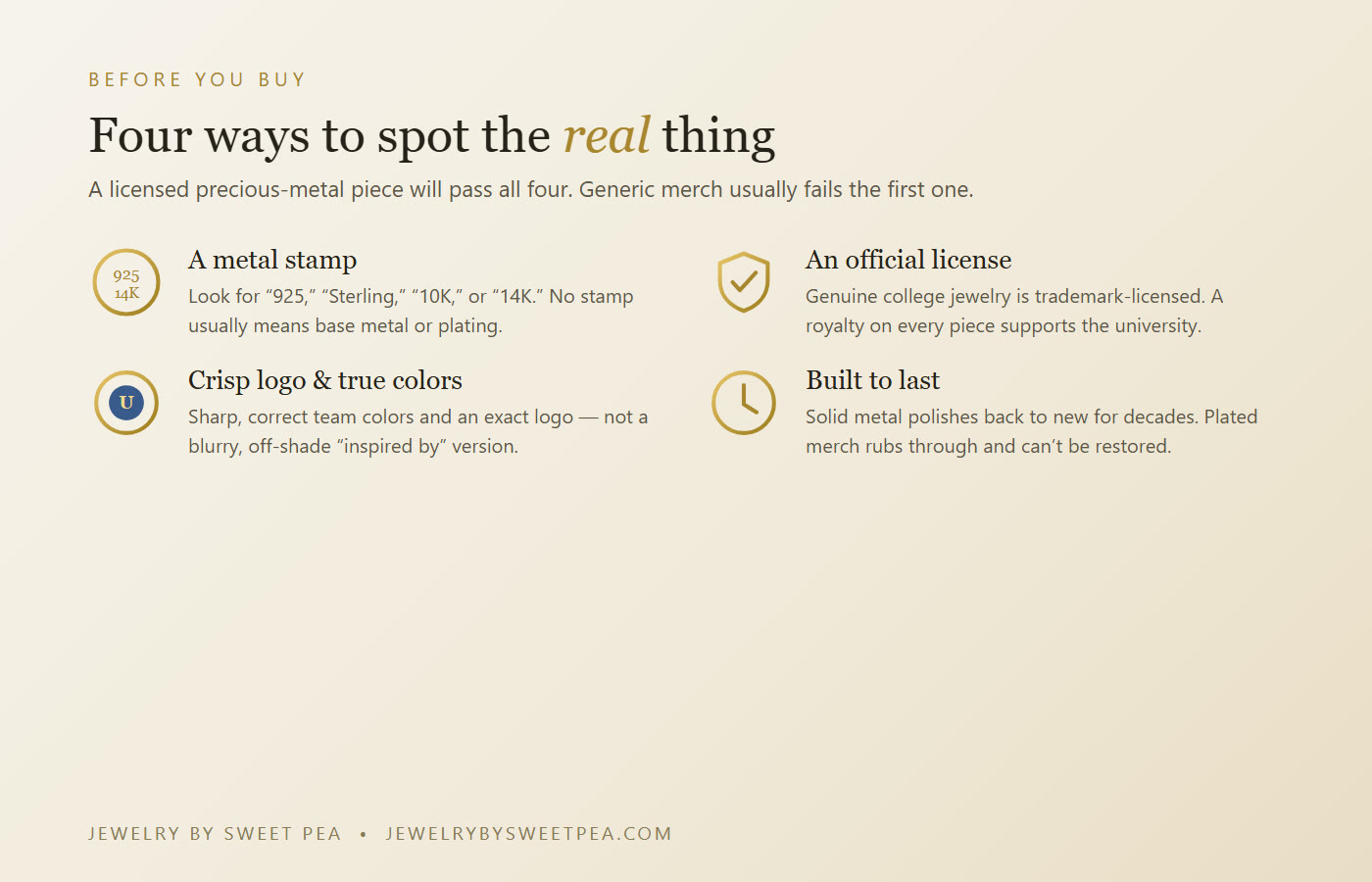
Before you buy — especially from an unfamiliar seller — run through four quick checks:
- Look for a metal stamp. Genuine pieces are stamped "925" or "Sterling" for silver, or "10K"/"14K" for gold. No stamp usually means base metal or plating.
- Confirm it is officially licensed. Real college jewelry says so plainly and names the licensee. If the listing avoids the word "licensed," be skeptical.
- Check the logo and colors. Sharp lines and correct team shades signal an approved design; blurry logos and "team colors" that are slightly off signal a knockoff.
- Consider the price and the promise. Solid gold and sterling cost what the metal costs. A "gold" team pendant for a few dollars is not gold.
Best value: licensed solid-gold college pendants under $300
You do not need to spend a fortune to own real solid gold. A small 10K pendant is the sweet spot — genuine gold, an officially licensed logo, and a price close to what people happily pay for a nice piece of merch.
Our 10K Yellow Gold Georgia Southern University Eagle Pendant (about $130) is a perfect example: solid 10K gold, an officially licensed Eagle, and a size that layers beautifully on a favorite chain. For a bigger program, the 10K Yellow Gold Michigan State University Spartan Pendant (about $164) puts the licensed Spartan in real gold. Prefer a cooler look? The 10K White Gold Michigan State “S” Pendant (about $276) is a slightly larger solid white-gold piece. Add a chain from our Necklaces collection and you have a gift that outlasts four years of school by decades.
Heirloom tier: solid 14K gold, for the fan who has everything
When it is a milestone — a graduation, a lifelong alum, a family that bleeds one school's colors — solid 14K gold is the buy-it-once, keep-it-forever choice. 14K is the U.S. standard for fine jewelry: a rich color and real durability.
Our licensed 14K collegiate earrings are made to be worn for a lifetime, with a wide range of schools. Favorites in stock include the 14K Yellow Gold University of Alabama “A” Dangle Earrings (about $452), the 14K Yellow Gold Ohio State University Dangle Earrings (about $683), and the 14K Yellow Gold Clemson Tiger Paw Dangle Earrings (about $760). These are genuine 14K gold with officially licensed logos — the kind of piece that gets handed down with a story attached.
For sorority and Greek life: genuine sterling silver
College pride is not only about the team — Greek-letter jewelry is one of the most meaningful gifts for a big/little, a bid day, or graduation. Our licensed sorority pieces are made of genuine sterling silver with hand-applied enamel for color (the color is enamel, not plating), so they hold up beautifully.
The Sterling Silver Delta Zeta Enameled Bead with Turtle Dangle (about $97) and the Sterling Silver Chi Omega Enameled Bead (about $89) are officially licensed, fit popular add-a-bead bracelets, and cost about what an unofficial trinket does — except these are real silver she can keep.
Licensed college jewelry by budget
There is a genuine, on-brand precious-metal option at every level — the trick is buying real metal at whatever tier you can, rather than a bigger fake that will not last.
Under $100 — genuine sterling silver
- Sterling Silver Chi Omega Enameled Bead — about $89. Real silver, officially licensed, fits add-a-bead bracelets.
- Sterling Silver Delta Zeta Bead with Turtle Dangle — about $97. A sweet, personal Greek-life gift.
$100–$300 — solid 10K gold
- 10K Yellow Gold Georgia Southern Eagle Pendant — about $130. Real solid gold at a merch-adjacent price.
- 10K Yellow Gold Michigan State Spartan Pendant — about $164.
- 10K White Gold Michigan State “S” Pendant — about $276.
$400+ — the heirloom 14K piece
- 14K Yellow Gold University of Alabama Dangle Earrings — about $452.
- 14K Yellow Gold Ohio State Dangle Earrings — about $683.
Prices shown are at the time of writing; solid gold pieces move with the gold market. Browse many more schools in our Collegiate collection.
So, which is actually worth buying?
For a game-day novelty you will wear a handful of times, generic merch is fine — just know it will not last. But if you want something to give, to keep, or to hand down — a graduation gift, an alum's everyday piece, a sorority keepsake — officially licensed precious-metal jewelry is the one that is genuinely worth it. It supports the school, it is accurate, and it will still look beautiful long after the plated version has worn away. That is the whole point of buying real.
Frequently asked questions
Is officially licensed college jewelry worth the extra cost?
For a piece you want to keep or give, yes. Licensed fine jewelry is made of solid gold or genuine sterling silver, uses an approved and accurate logo, and returns a royalty to the school. It lasts for years and holds real value, while generic plated merch wears out in a season. For a one-time game-day novelty, inexpensive merch is fine — just know it is not built to last.
How can I tell if college jewelry is officially licensed?
A genuine piece states that it is officially licensed and names the licensee (for our collegiate line, that is LogoArt). It also carries a metal stamp such as "925," "Sterling," "10K," or "14K," and shows a sharp, correctly colored logo. Listings that avoid the word "licensed," skip the metal, or use "team colors" that are slightly off are usually generic.
Is sterling silver or gold better for college jewelry?
Both are excellent because both are solid precious metal. Sterling silver is the most affordable way to own a real, licensed piece — ideal for sorority beads and everyday wear. Solid 10K gold is a durable step up at a still-reasonable price, and 14K gold is the heirloom choice for graduations and lifelong fans. The key in every case is buying solid metal, not plating.
Does buying licensed college jewelry support the school?
Yes. Officially licensed products pay the university a royalty on each sale, which commonly supports scholarships and campus programs. Generic, unlicensed merchandise pays the school nothing — so buying licensed is a small way to give back to the program you are cheering for.
Will plated "gold" team jewelry last?
No. Plated jewelry is a thin gold-colored skin over a base metal; with regular wear it rubs through at the edges within months to a couple of years, and once it is gone there is nothing to restore. Solid 10K or 14K gold and genuine sterling silver do not have that problem — a scratch simply polishes out, and the piece keeps its beauty for a lifetime.
Jewelry by Sweet Pea is a family-run fine jewelry store. Our collegiate pieces are officially licensed LogoArt, made of solid 10K or 14K gold or genuine sterling silver — never plated. Browse our Collegiate collection and Necklaces, or ask us anything — including whether we can get your school — before you buy.