
Matte Finish vs Polished Finish Gold Jewelry: Which Hides Scratches and Wear Better
The short answer: A matte finish — the trade calls it satin or brushed — hides everyday scratches better, because the surface is already a field of fine lines and a new scratch blends right in. A polished finish shows every swirl, but a jeweler can bring it back to mirror in minutes. Matte wins on daily looks; polished wins on refreshability.
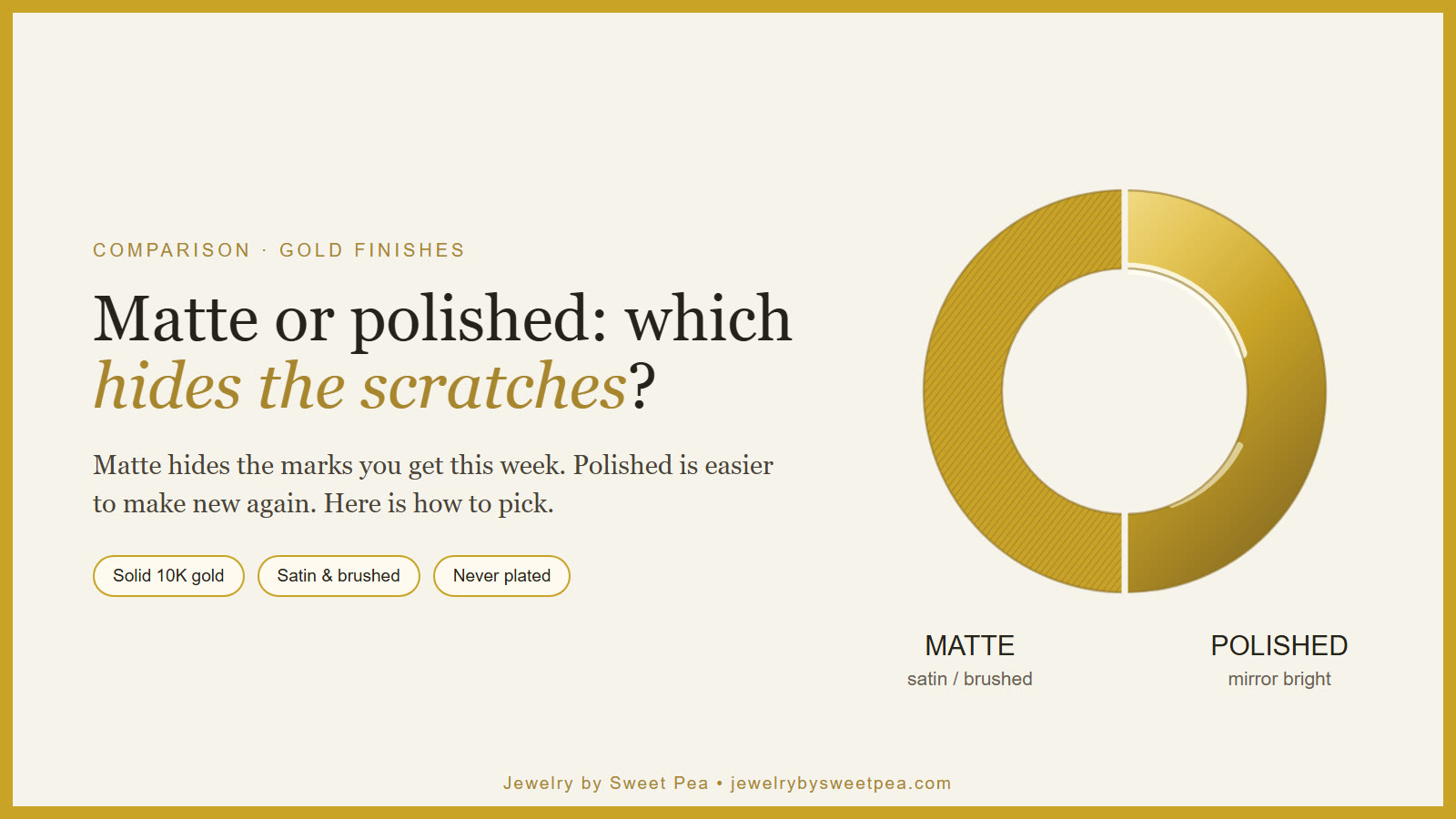
What is a “matte” finish actually called on a gold jewelry label?
The first thing that trips people up: you will almost never see the word matte on a solid gold tag. Search our own gold catalog for “matte” and you get essentially nothing; search satin or brushed and you get hundreds of pieces. Those are the manufacturers’ words, along with Florentine and sandblasted for heavier textures.
They all mean the same thing: the surface has been worked with a wire brush, a fine abrasive, or a bead blaster so it scatters light instead of reflecting it, giving a soft, low-glare glow. Polished (sometimes high polish) is the opposite — buffed smooth enough to act like a mirror. Plenty of well-made pieces are deliberately both, and that is a practical choice as much as a styling one.
What a finish never changes is what the metal is. These are surface treatments on the same solid gold underneath, and karat content and its marking are governed by the FTC’s Jewelry Guides, published as 16 CFR Part 23. Everything here is solid 10K gold — we do not sell plated jewelry, and no finish rescues a plated piece once the plating wears through.
Which finish hides scratches better day to day?
Matte, and it is not especially close.
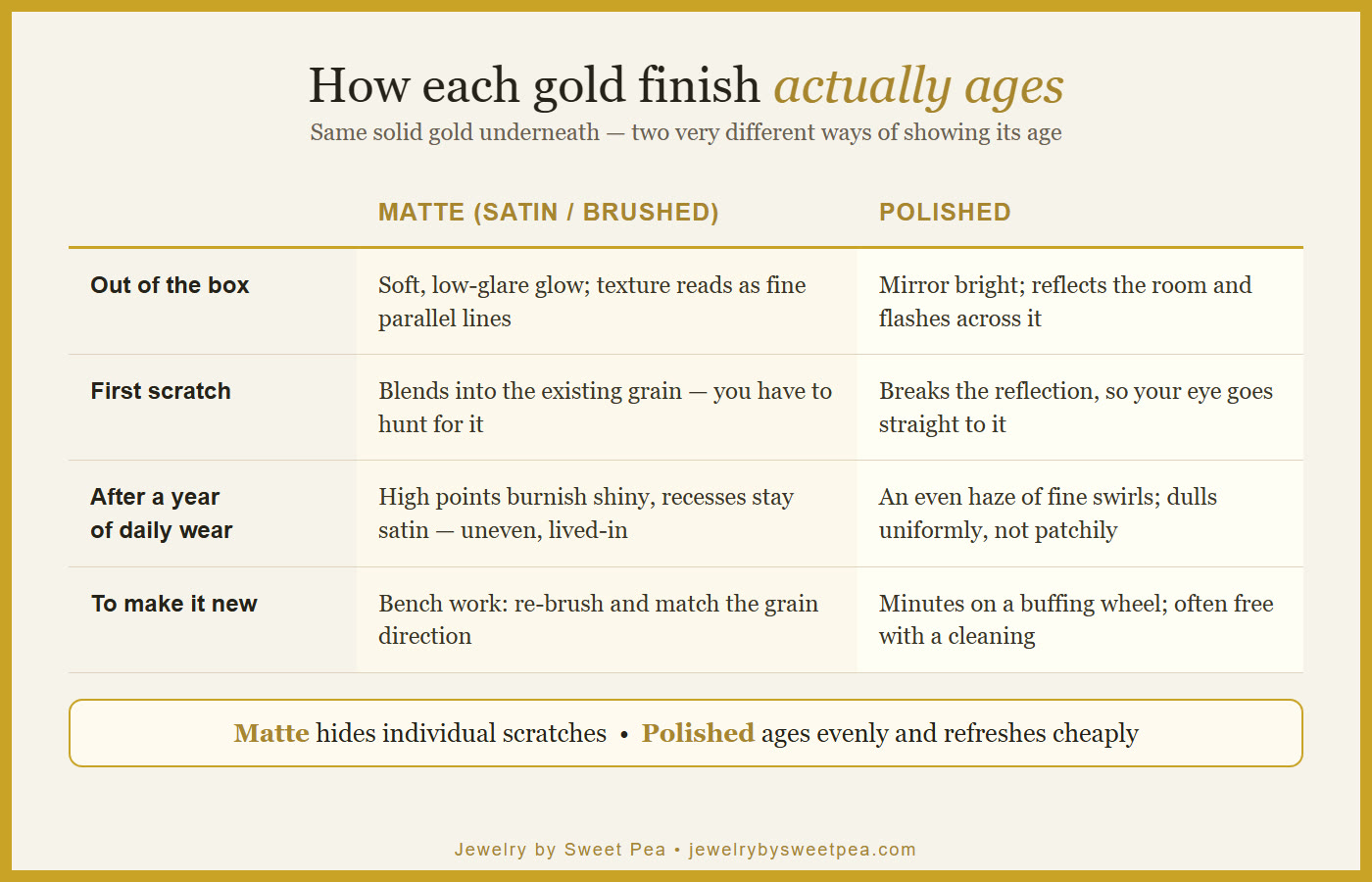
The reason is optical, not chemical. A polished surface works like a mirror, so your eye reads it as one continuous reflection, and a single scratch interrupts that reflection — the same way one crack stands out on an otherwise clean window. A satin or brushed surface is already made of thousands of fine parallel lines, so a new scratch of similar depth is just one more line in a field of lines. It is still physically there; it simply stops announcing itself.
It is worth being honest about the metal underneath, too. Gold is a soft, highly malleable metal in its pure form, which is why jewelry gold is alloyed. Because 10K contains more alloy metal than 14K, it ends up slightly harder and marginally more scratch-resistant, with a slightly paler yellow. No karat of gold is scratch-proof, and any jeweler who says otherwise is selling something.
So what actually happens to a matte finish after a year?
This is the part most comparison articles skip, and it is why we would not tell every customer to buy matte.
A matte finish does not stay evenly matte on a piece you wear hard. The same friction that would scratch polished gold instead burnishes matte gold: the raised texture gets flattened by contact, and flattened texture starts to shine. After a year on a band-style ring, you often see polished high points where it meets other fingers, desks and steering wheels, with the original satin surviving in the recesses. Some people love that lived-in look; others see a finish gone patchy.
Polished gold ages the opposite way, collecting an even haze of fine swirls rather than a few obvious marks — which is why a decades-old polished band usually reads as softer and warmer rather than damaged.
The honest summary: matte hides individual scratches, polished ages more evenly, and both eventually want a refresh.
Which one is easier and cheaper to refresh?
Polished, clearly. Any jeweler with a buffing wheel can take a scuffed polished piece back to mirror in minutes, often as part of a free cleaning and check. Re-creating a satin or brushed finish takes the right abrasive plus the discipline to match the original grain direction — ordinary bench work, but skilled, so expect longer turnaround and sometimes a small charge.
Two cautions worth more than they sound:
- Every polish removes a thin layer of metal. Once or twice a decade is nothing. Polishing an engraved or finely detailed piece every year will soften the detail over time.
- Never use a polishing cloth on a matte piece. This is the most common way people accidentally ruin a satin finish at home — the cloth does exactly what it says and starts shining the high points. For matte gold, warm water, mild dish soap, a soft brush and a soft towel is the whole routine.
Which pieces should be matte, and which should be polished?
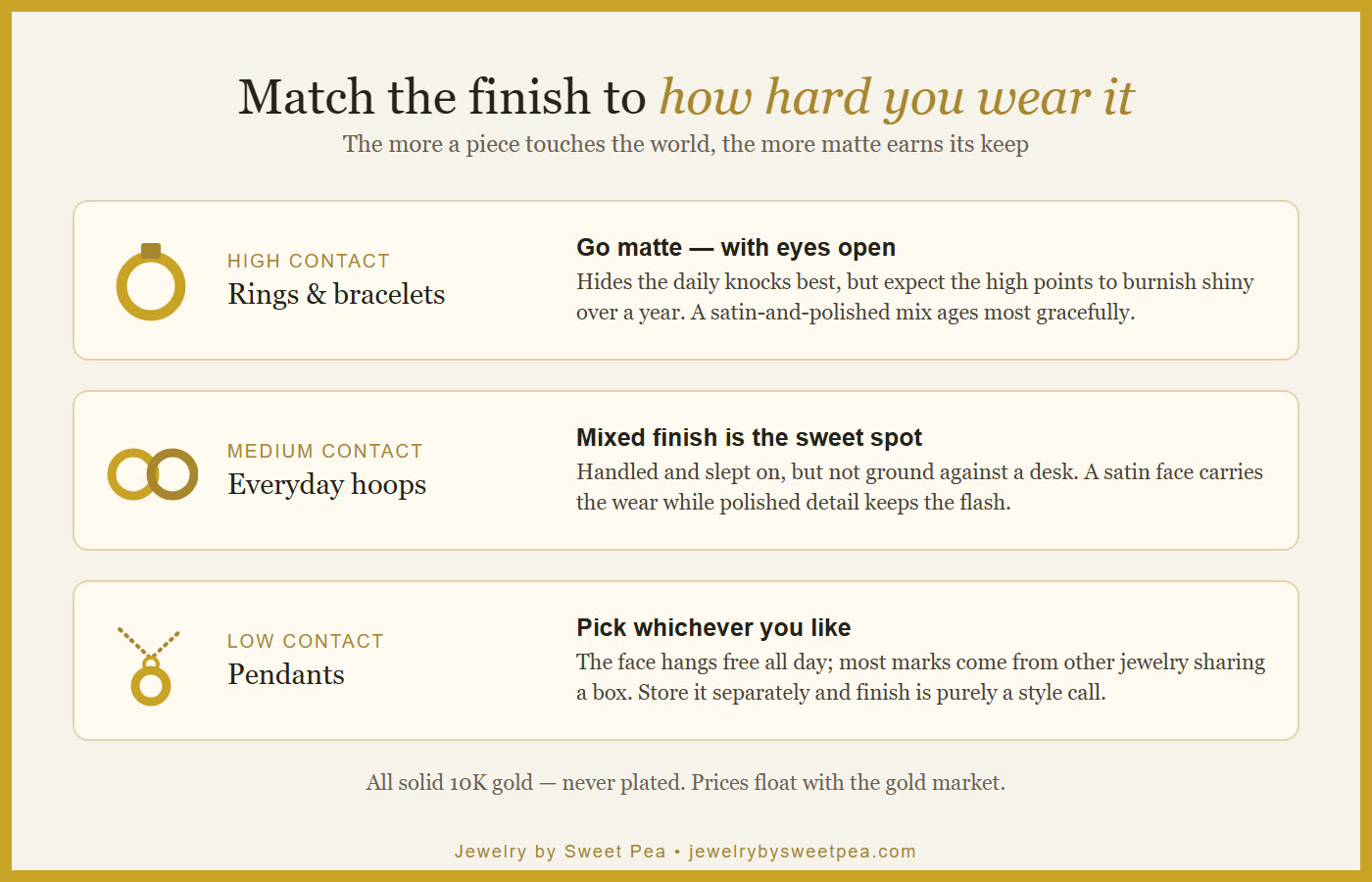
The most useful way we know to decide is by how much the piece touches the world.
High contact: rings and bracelets
These take the most abuse, so matte earns its keep — as long as you accept that it will burnish at the high points. The 10K Yellow Gold Satin Open Back Filigree Signet Ring (about $222) is a good example: a satin oval top about 8.5 mm by 7.5 mm on a 10 mm band, solid 10K gold, where the texture keeps desk scuffs quiet.
For the wrist, the 10K Yellow Gold Polished and Brushed Hinged Bangle (about $652) splits the difference: brushed panels absorb daily contact, polished sections keep the shine. One honest note — it is built from hollow tubing, which is what keeps a 7-inch bangle light, but hollow gold dents more easily than solid, so it is not the piece for heavy manual work. More in rings and bracelets.
Medium contact: earrings you actually wear every day
Hoops get handled, slept on, and knocked by hair and collars, but they are not grinding against a desk, so a mixed finish is the sweet spot. The 10K Yellow Gold Polished and Satin Hoop Earrings (about $111) run roughly 18 mm by 16 mm, with the satin face carrying the wear and the polished detail keeping the flash. If you want the classic shine and do not mind a buff every few years, the 10K Yellow Gold Polished Round 2mm Endless Hoops (about $95, 16 mm outside diameter) are the honest all-polished pick. Browse the rest in hoop earrings.
Low contact: pendants
A pendant face hangs free most of the day, and most scratches it collects come from other jewelry sharing a box rather than from wear — so finish here is almost purely a style choice. The 10K Yellow Gold Solid Satin and Polished St. Christopher Pendant (about $85, 15 mm by 6 mm) is solid gold at an entry price and pairs naturally with a plain polished chain such as the 10K Yellow Gold 0.95mm Cable Rope Chain (about $116). More in pendants and charms and chains.
What does each finish cost here?
Finish rarely moves the price — metal weight and karat do. Prices float with the gold market, so treat these as ballparks and check the product page for today’s number.
- Under $100 — satin and polished St. Christopher pendant, about $85; polished 2mm endless hoops, about $95.
- $100 to $150 — polished and satin hoops, about $111; 0.95mm polished cable rope chain, about $116.
- $200 to $250 — satin filigree signet ring, about $222.
- $600 and up — polished and brushed hinged bangle, about $652.
Common questions
Does a matte gold finish wear off?
Not in the sense of coming off — there is no coating to lose, because the texture is cut into the solid gold itself. What happens instead is that contact points burnish smooth and start to shine, so the finish becomes uneven rather than disappearing. A jeweler can re-satin it.
Can a polished ring be changed to matte, or a matte ring to polished?
Yes, both directions. Polishing a matte piece is quick. Going the other way takes a bench jeweler who can match the grain direction. If you are unsure which you prefer long-term, a polished piece is the lower-commitment starting point, since it can be brushed later.
Is 10K or 14K better at resisting scratches?
10K holds up slightly better, because it contains more alloy metal and less pure gold, which makes it a bit harder. The trade-off is a slightly paler yellow than 14K. For a ring worn daily by someone tough on jewelry, that is a reasonable reason to choose 10K.
Will a matte finish make gold look less expensive?
No, but it does look different. Matte reads quieter and more modern; polished reads brighter and more traditional. The metal, weight, and craftsmanship are identical — a satin 10K ring and a polished 10K ring of the same weight are the same amount of gold.
How do I clean matte gold at home without shining it?
Warm water, a drop of mild dish soap, a soft toothbrush worked along the grain, then rinse and pat dry with a soft towel. Skip polishing cloths and abrasive pastes entirely on matte pieces — those are for polished gold.
Still not sure?
Tell us how the piece will be worn and we will tell you honestly which finish we would choose. We are a small family jewelry business, and we would rather point you at the $85 pendant that suits your life than the $652 bangle that does not. Send us a note — a real person reads it.