
Necklace Extenders vs Custom Chain Lengths Which Solves the Fit Problem Better
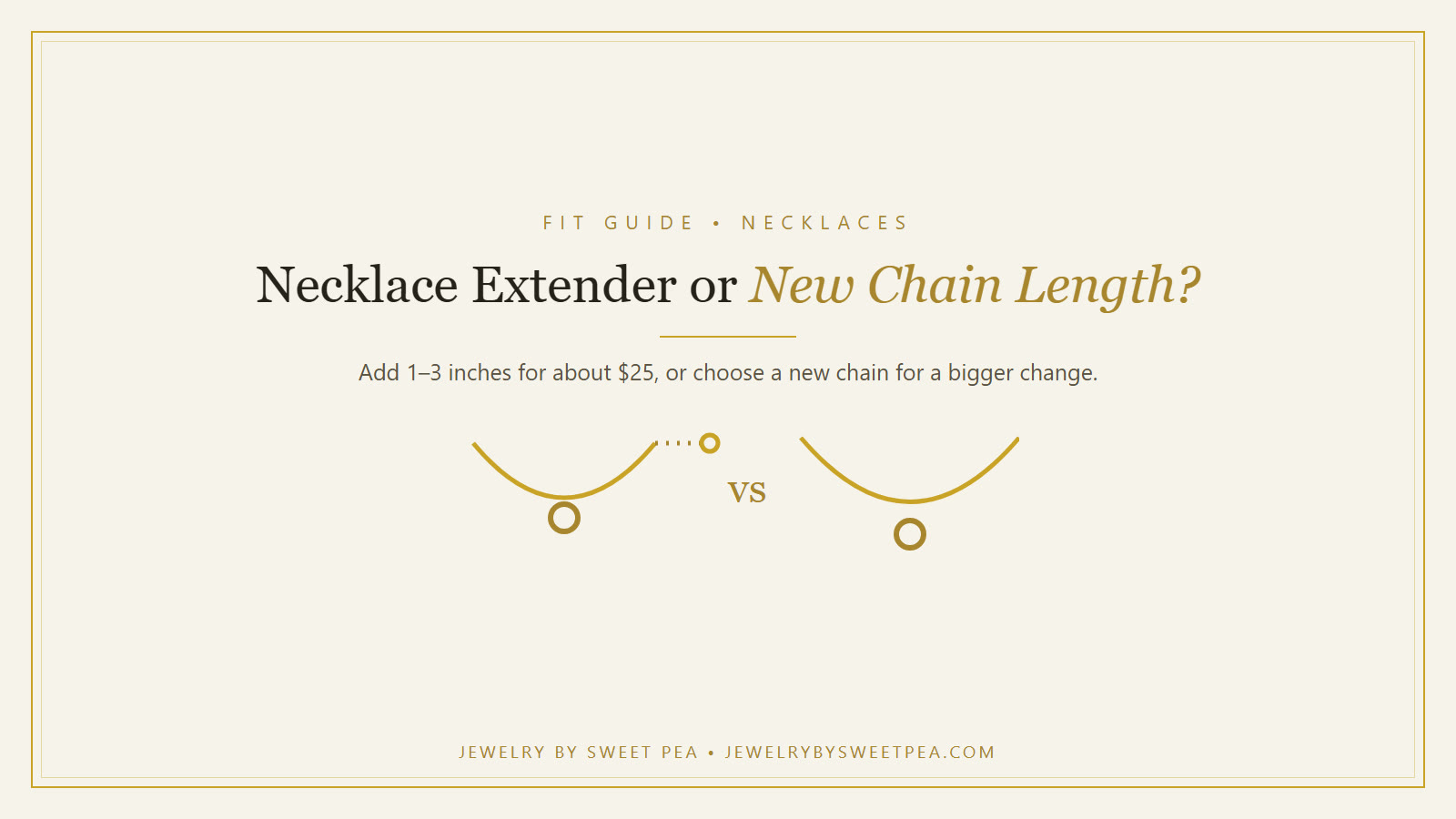
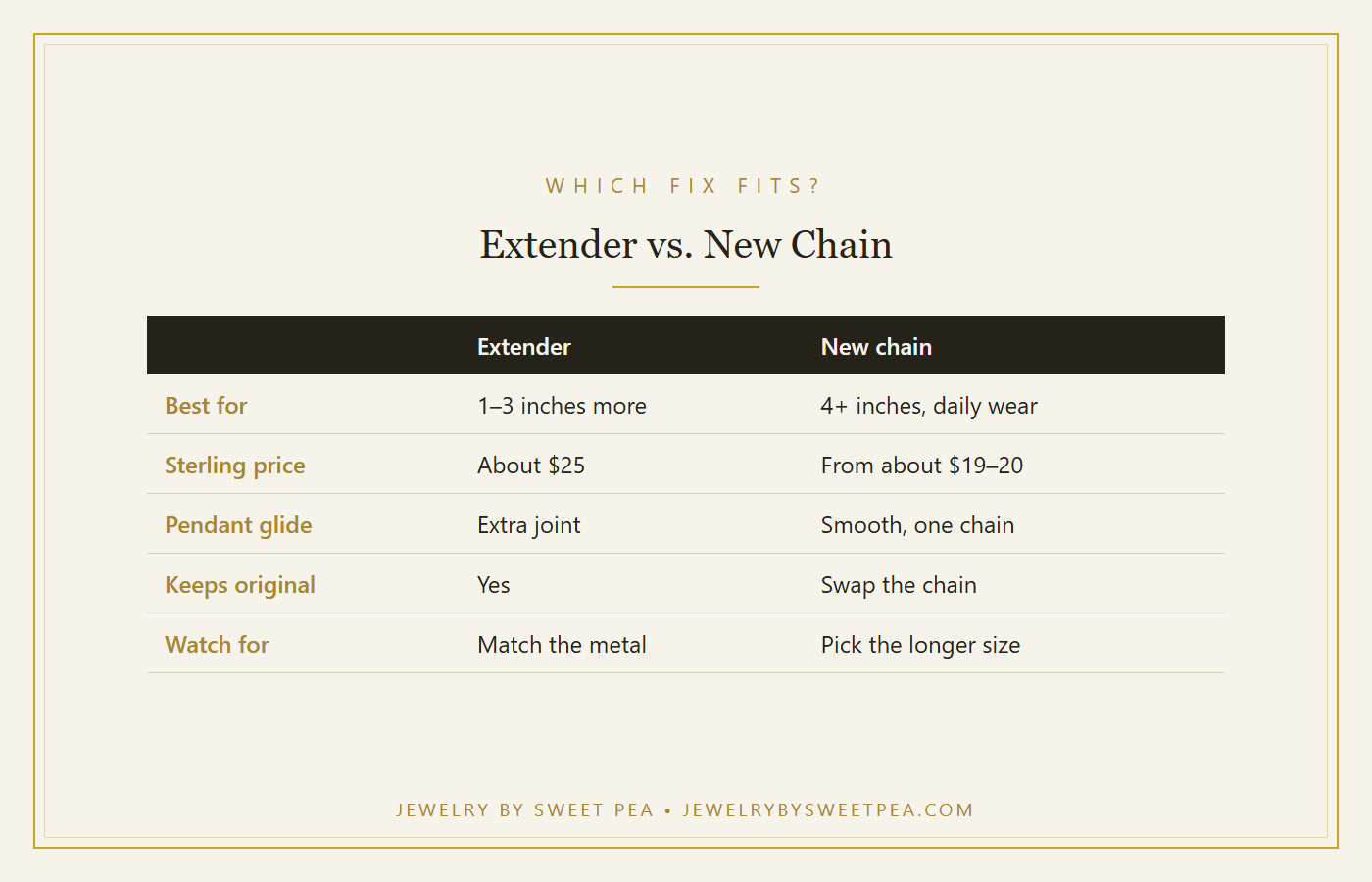
The short answer: a necklace extender is the better fix when a chain you already love is only one to three inches too short, and a sterling silver one costs about $25. A new chain in the right length is the better fix when you want to move the pendant by more than about four inches, when you wear the same necklace every day, or when the clasp is worn out. Many people end up owning both.
We hear the fit question every week: "My necklace sits too tight. Do I buy a longer chain, or just add something to it?" Both answers are right for different necklaces. As a family-run jewelry store, here is how we walk people through the choice, with real prices from our shelves.
What is a necklace extender, and what does it actually do?
An extender is a short length of chain, usually 2 to 3 inches, with a clasp or ring on each end. It hooks onto the end of your necklace, and your clasp attaches to its far end. Some necklaces already have a built-in extender, which is why you will see listings like "18 inch with 2 inch extender": the chain can be worn at 18, 19 or 20 inches.
Two extenders in stock as we write this:
- The sterling silver 2.5 inch chain extender is about $25.
- The sterling silver heart 3 inch chain extender is about $38. The small heart hangs at the back of your neck, so it doubles as a little detail.
Prices are about what each product page showed today and can change.
When is an extender the better fix?
- The shortfall is small. If the necklace is one to three inches too short, an extender solves it completely.
- You love the necklace as it is. A sentimental or one-of-a-kind chain, such as a gift or a family piece, stays original.
- You want flexibility. One extender gives you two lengths from one necklace, so the same pendant can sit high with a crew neck and lower with a V-neck.
- You are traveling or layering. A short extender fits in a corner of your jewelry roll and rescues a necklace that is too snug over a collared shirt.
- Budget. It is usually the lowest-cost fix.
One caution: the extender and the necklace should match in metal and, ideally, in finish. A sterling extender on a yellow gold chain will look like a different piece. If your necklace is gold, look for a gold extender, or choose a new chain instead.
When is a new chain in a different length the better fix?
- You need a bigger change. If you want a pendant to move from the collarbone to mid-chest, you are changing the length by four inches or more. An extender that long adds a visible second section and a second clasp.
- The pendant needs to hang straight. A single continuous chain lets a pendant slide smoothly and lie flat. An extender adds a joint the pendant can catch on.
- You wear it every day. More connections mean more places for wear. One chain with one clasp has fewer parts to inspect.
- The chain is very fine. Thin chains plus an extender can tangle at the joint. A single new chain avoids that.
- The clasp is tired. If the clasp is loose or the chain has stretched, replace the chain rather than add to it.
A good place to start is our chains collection, or browse all necklaces to see how different lengths sit on a pendant.
What does a new chain cost compared with an extender?
For sterling silver, a replacement chain costs about the same as an extender:
- The sterling silver 0.95mm Forzantine cable chain starts at about $20 and comes in lengths such as 16, 18 and 20 inches.
- The sterling silver 1mm cable chain starts at about $19 and is a classic everyday pendant chain.
So for sterling the price difference is small, and the deciding factor is fit and wear rather than cost. With gold, matching the extender to the chain matters more, so check the metal first.
What about necklaces that come with a built-in extender?
This is often the neatest answer, because the fit adjustment is part of the design:
- The Ohio State stainless steel pendant on an 18 inch chain with a 2 inch extender is about $31, and other school versions follow the same pattern.
- The 14K yellow gold polished twisted omega necklace, 18 inches plus a 2 inch extender is about $1,337. It wears at 18 inches or at 20 inches without adding a part.
If you are buying a gift and do not know the recipient's preferred length, a necklace with a built-in extender is the safest choice. It gives a range of fits without anyone having to shop again.
How do you know which length you need?
These are the standard necklace lengths jewelers use, measured along the chain:
- 14 to 16 inches (choker): sits at the base of the neck.
- 17 to 19 inches (princess): rests at or just below the collarbone. This is the most popular length for pendants.
- 20 to 24 inches (matinee): falls between the collarbone and the bust.
- 28 to 36 inches (opera): long enough to wear doubled.
To find your own, lay a piece of string around your neck where you want the pendant to land, mark it, and measure it flat. Add about an inch if you wear thicker tops. If the number lands between two sizes, pick the longer one: a long chain can be worn up with a high neckline, but a short one cannot be stretched.
Pearl strands follow the same lengths. GIA's pearl quality factors page explains how pearl size and shape change the look, which also changes how a strand sits at a given length.
Is the metal on an extender the same as on the chain?
Not always, so check. The FTC's Guides for the Jewelry, Precious Metals, and Pewter Industries set the rules for how metals like sterling silver and 10K or 14K gold may be marked and described. Look for a 925, 10K or 14K stamp or a clear listing on both parts, and make sure the extender is the same metal as your chain.
A quick way to decide
- Measure how much longer you want the necklace.
- One to three inches: buy an extender in the same metal.
- More than about four inches, or an everyday pendant: buy a new chain.
- Unsure, or buying a gift: choose a necklace with a built-in extender.
Frequently asked questions
Do necklace extenders look obvious?
Not when the metal matches. At 2 to 3 inches, an extender looks like part of the chain, and a plain one sits at the back of your neck where hair or a collar hides it.
Can any extender attach to any necklace?
Usually, as long as the clasp types are compatible. A standard extender is made to hook onto common lobster and spring ring clasps. Check the product page if your necklace has an unusual clasp.
How much longer will an extender make my necklace?
Plan on a little less than the stated length, since a small amount is used where the clasps overlap. A 2.5 inch extender adds roughly 2 to 2.5 inches.
Will an extender damage a delicate chain?
It adds a little weight and one more connection. On very fine chains we prefer a new chain; on medium-weight chains an extender is fine.
What is the best fix for a necklace that is too long?
Extenders only add length. For a necklace that is too long, choose a shorter chain, or ask whether the clasp can be moved or the chain shortened.
If a necklace feels almost right but not quite, start with an extender. If you would have to add more than a few inches, or you wear the piece every day, a new chain in the right length is the cleaner fix.