
Professional Jewelers Explain How to Buy Fine Jewelry Online Without Getting Burned
The short answer: read the listing like a jeweler does. Confirm the exact metal and karat (solid 10K/14K gold or sterling silver — never "gold-tone" or "filled"), check that gemstone weight and quality are stated in writing, compare the price against the metal it contains, and only buy where returns and authenticity are spelled out. Do those four things and the "deal too good to be true" listings sort themselves out fast.
We run a small, family jeweler, and the question we get most from first-time online buyers is some version of "how do I know it's real?" The honest answer is that the information you need is almost always right there in the listing — or conspicuously missing from it. Here is the same checklist we'd give a friend before they spend a dollar.
What does "fine jewelry" actually mean online?
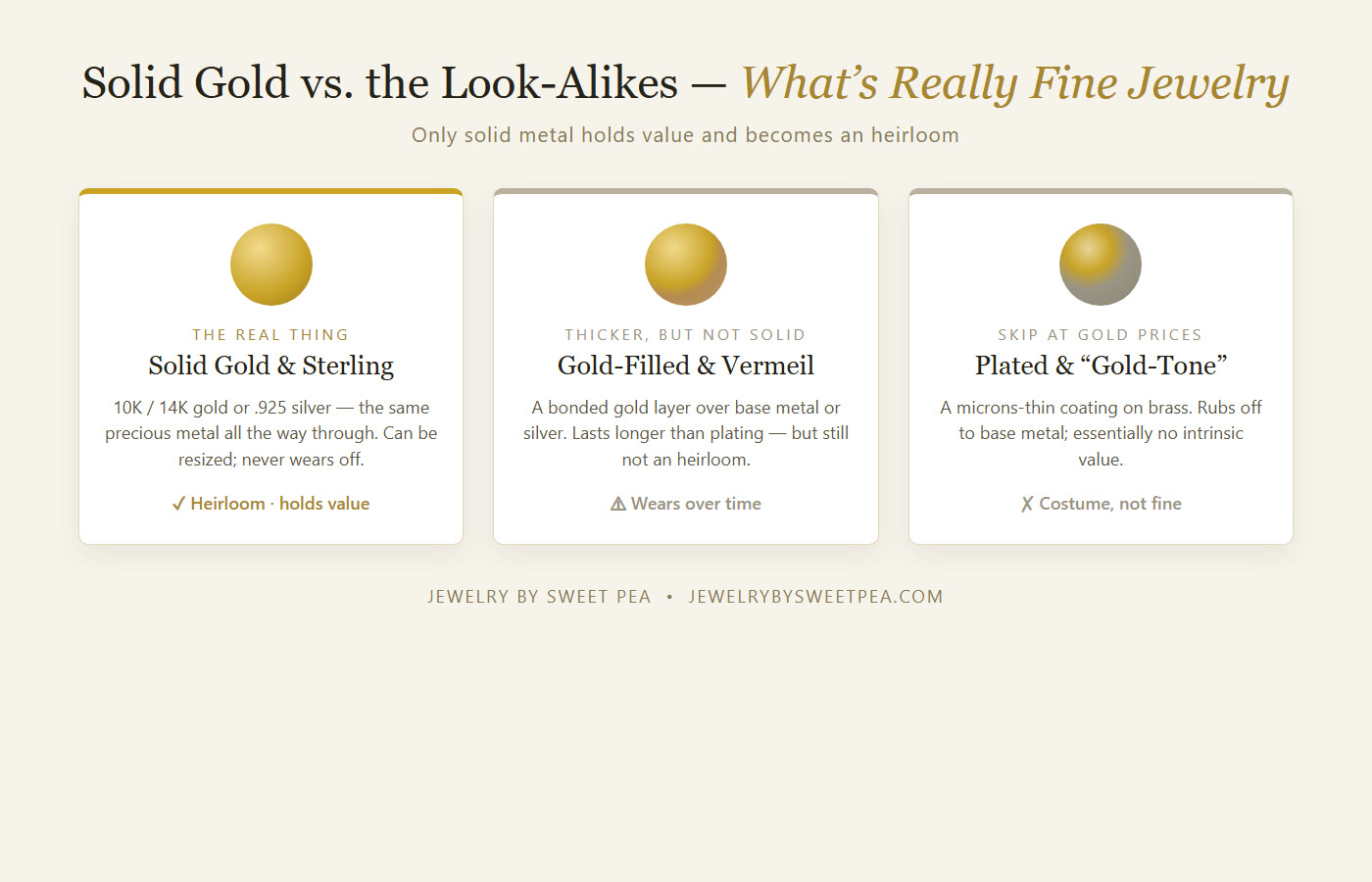
"Fine jewelry" is not a vibe — it's a material definition. It means solid precious metal: karat gold (10K, 14K, 18K), platinum, or sterling silver (.925). Everything else is fashion or costume jewelry, no matter how it photographs. The traps to know by name:
- Gold-plated / gold-tone / "18K gold over brass": a microns-thin gold layer on base metal. It wears off, and it has essentially no intrinsic value.
- Gold-filled: better than plated (a thicker bonded layer), but still not solid gold — and not an heirloom.
- "Vermeil": gold over sterling silver. Real silver underneath, but the gold still wears.
- Solid 10K/14K gold & sterling silver: the same material all the way through. This is what we sell, and it's what lasts generations.
If a listing leans on words like "tone," "plated," "filled," "overlay," or "looks like 14K," it is telling you it isn't solid. That's not always a scam — plenty of honest sellers sell costume jewelry — but you should never pay fine-jewelry prices for it.
How can you tell a trustworthy jewelry listing from a risky one?
A good listing answers a jeweler's questions before you have to ask. A risky one hides behind glamour shots. Here is the red-flag checklist we use:
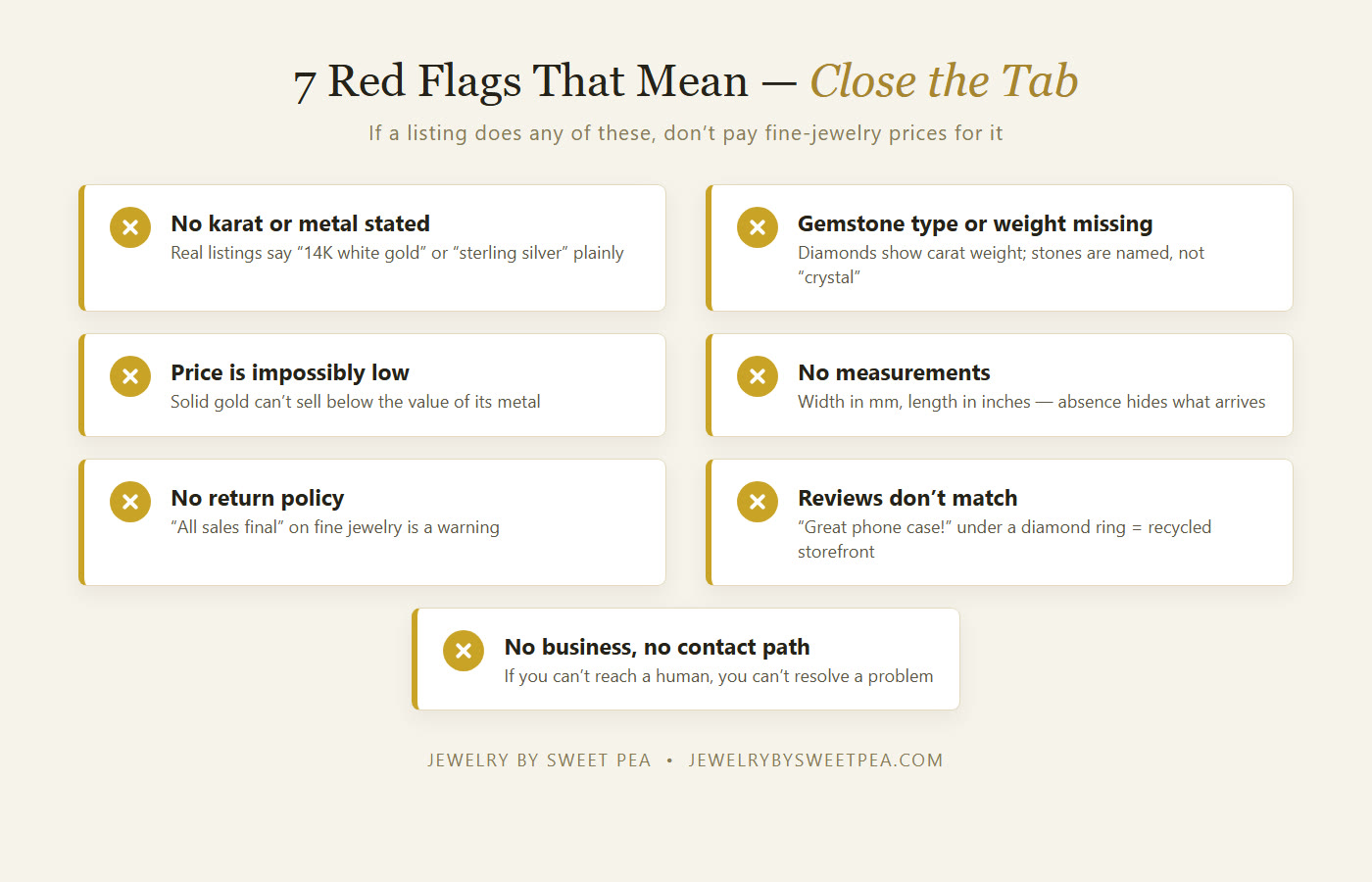
- No karat or metal stated. A real fine-jewelry listing names the metal plainly: "14K white gold," "sterling silver." Vagueness is the single biggest tell.
- Gemstone weight or type is missing. Diamonds should show carat weight (e.g. ".40 ct"); colored stones should name the actual stone, not "crystal" or "diamond-like."
- The price is impossibly low. Solid gold has a floor: it can't sell below the value of the metal in it. A "14K gold" chain for $19 is not 14K gold.
- No measurements. Chain width in millimeters, length in inches, pendant dimensions — their absence means you can't picture what arrives.
- No return policy, or "all sales final." Reputable sellers let you return jewelry that isn't right. Disappearing return links are a warning.
- Reviews that don't match the product. Hundreds of five-star reviews for "phone case" on a "diamond ring" listing is a recycled storefront.
- No physical business, no contact path. If you can't reach a human, you can't resolve a problem.
How do you read a listing the way a jeweler does?
The fastest way to learn this is to look at a listing that does it right. Notice how each of these names the metal, the karat, and the stone specifics — nothing is left to your imagination.
Take the 14K Yellow Gold Diamond & Sapphire Birthstone Pendant (about $127). The title alone tells you the karat (14K), the metal color (yellow gold), the center stone (sapphire), and that there's a genuine diamond accent — not "crystal," not "simulated." That's a listing written by someone who expects you to know the difference.
Same with a chain. The 10K Yellow Gold 1.75mm Diamond-Cut Rope Chain (about $231) states the karat, the exact width in millimeters, and the cut. You know precisely what you're getting before it ships. And on earrings, the 14K White Gold .40Ct Black Diamond Stud Earrings (about $184) put the carat weight right in the name — the number that actually drives the price.
When you see specs like these, you can comparison-shop honestly. When they're absent, you're buying a photograph.
Does fine jewelry have to mean gold? What about silver?
No — sterling silver (.925) is genuine fine jewelry, and it's the smartest way to buy quality on a smaller budget. The key word is sterling, stamped .925, not "silver-tone" or "silver-plated." A piece like this Sterling Silver Bracelet (about $68) is solid metal you'll still own in twenty years — unlike a plated bracelet at half the price that tarnishes to the base metal within a season. Buy solid silver over plated gold every time; the material outlives the markup.
What should fine jewelry actually cost online?
Solid gold has a price floor: the gold itself. That's why honest prices cluster, and why outliers downward are the warning, not the bargain. A rough map of what real money buys:
- Under $100 — sterling silver & light gold accents. Solid .925 bracelets, small gold birthstone pieces. Genuine fine jewelry; modest metal weight.
- $100–$250 — the everyday-gold sweet spot. Gemstone pendants like the sapphire & diamond pendant (~$127), a solid 10K rope chain (~$231), colored-diamond studs (~$184). Real karat gold, wearable daily.
- $300–$500 — the heirloom tier. Higher carat weight and finer settings — for example, 4-prong white-diamond solitaires like the 10K White Gold 4-Prong .20Ct Diamond Stud Earrings (about $359). Here you're paying for diamond quality, not just gold.
Prices shown are current at the time of writing; solid gold and diamond pieces float with the metal and stone markets. Browse the Pendants & Charms, Necklaces, and Earrings collections to compare like-for-like.
Why karat stamping and the FTC rules protect you
In the United States, how jewelry may be described isn't a matter of opinion — it's regulated. The FTC Jewelry Guides (16 CFR Part 23) set out exactly how terms like "gold," "karat," and "sterling" may be used. A seller who states "14K" is making a claim they're legally accountable for; a seller who only says "gold-tone" is carefully avoiding one. If you want to understand what those karat numbers actually mean in terms of purity and durability, the Gemological Institute of America keeps a clear, jeweler-grade gold education page. Five minutes there will make every listing easier to read.
What about returns, sizing, and authenticity guarantees?
Buying jewelry you can't hold first is only safe when the after-sale terms are clear. Before you check out, confirm three things:
- Returns. A genuine seller accepts returns on unworn jewelry within a stated window. Rings often have a sizing caveat — that's normal — but "all sales final, no exceptions" on fine jewelry is a reason to pause.
- Sizing help. For rings and bracelets, a good seller publishes a size guide and tells you which pieces can be resized. Solid gold and silver usually can; plated cannot (resizing strips the plating).
- Authenticity & sourcing. Look for plain statements: stamped karat, named metal, where it ships from. We say it directly — every piece is solid 10K/14K gold or sterling silver, never plated, sourced from U.S. wholesalers and shipped from the USA. A seller confident in their goods says so in writing.
Frequently asked questions
How can I tell if gold jewelry online is real before I buy?
Read the title and specs, not the photo. Real fine jewelry states a karat (10K, 14K, 18K) or "sterling silver / .925." Words like "gold-tone," "plated," "filled," or "overlay" mean it is not solid. Then sanity-check the price: solid gold can't sell below the value of the metal in it, so an impossibly cheap "14K" piece isn't 14K.
What's the difference between gold-plated, gold-filled, and solid gold?
Gold-plated is a microns-thin gold layer over base metal that wears off. Gold-filled has a thicker bonded layer — longer-lasting but still not solid. Solid 10K or 14K gold is the same gold all the way through; only solid gold holds intrinsic value and becomes an heirloom. Pay fine-jewelry prices only for solid metal.
Is it safe to buy fine jewelry online instead of in a store?
Yes, when the listing is specific and the seller's terms are clear. The protections that matter are a stated metal and karat, gemstone details in writing, a published return policy, and a real way to contact the business. A detailed listing from an accountable seller is safer than a vague one in any setting, online or in person.
How much should I expect to spend on real gold jewelry?
Solid gold has a price floor set by the metal itself. Small gold birthstone pieces and solid sterling silver start under $100; everyday 10K and 14K gold chains and gemstone pendants run roughly $100–$250; diamond studs and heavier or higher-carat pieces move into the $300–$500 range and up. Prices below the metal's value are the warning sign, not the deal.
What should I do if jewelry arrives not as described?
Contact the seller in writing right away and use the stated return policy — that's exactly why you confirmed it before buying. Keep the original packaging and any certificate. A reputable jeweler will make it right; the inability to reach anyone is the real "burned" scenario, which is why a clear contact path is on the pre-purchase checklist.
Jewelry by Sweet Pea is a family-run fine jewelry store. Every piece is solid 10K or 14K gold or sterling silver — never plated — sourced from U.S. wholesalers and shipped from the USA. Browse the collections or ask us anything before you buy.