Professionals Explain How Licensed Team Jewelry Is Made From Design to Final Polish
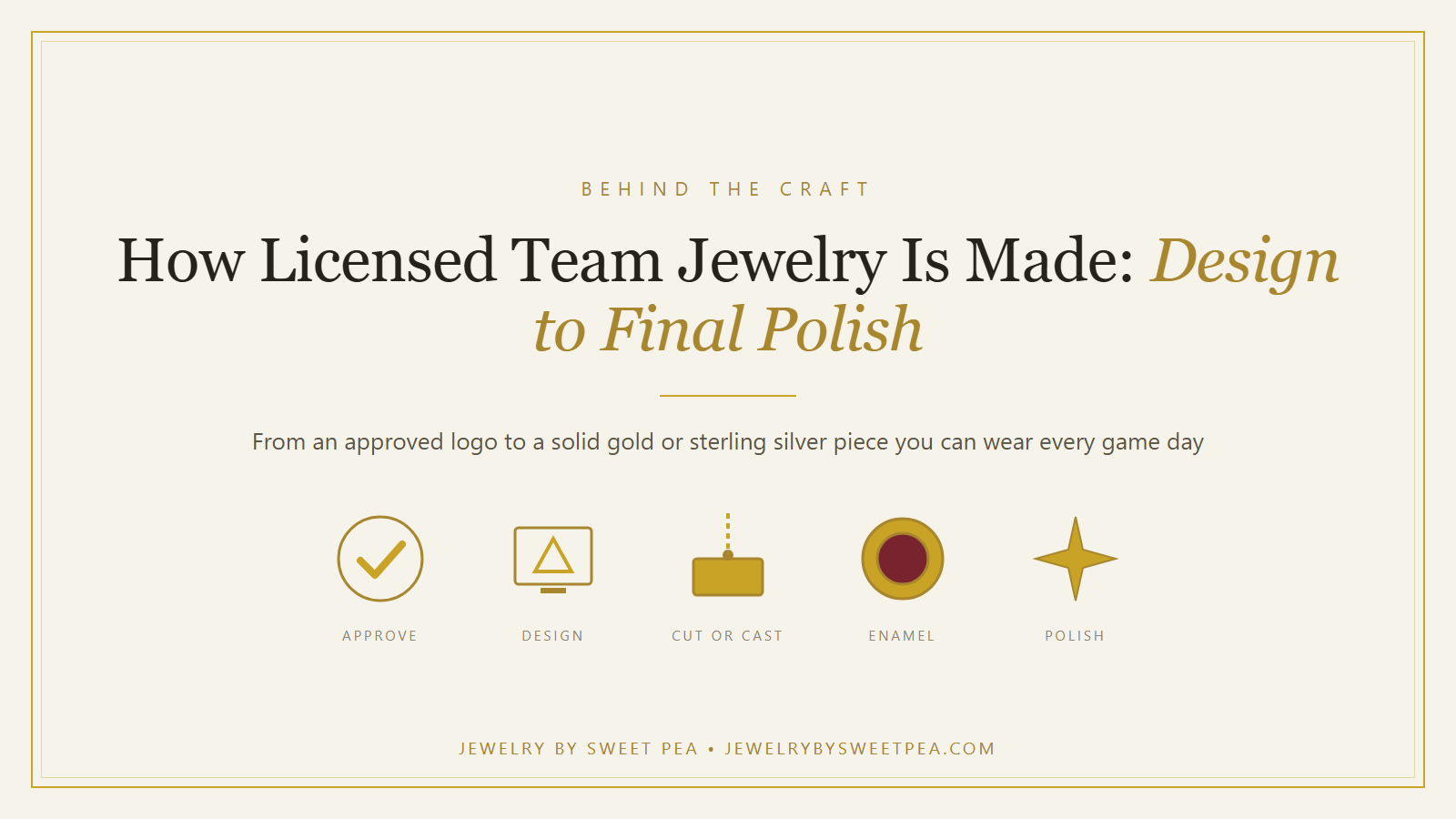
The short answer: Licensed team jewelry starts with a logo the team or school must approve. A manufacturer turns that artwork into a precise digital design, then cuts or casts it in solid gold or sterling silver. Enamel color, if any, goes on next. The piece is then filed, polished, stamped with its metal quality, and checked before it ships.
We're a small, family-run jewelry store, and team pieces are some of our favorite things to sell. A parent buying a first college pendant for a freshman, a grandfather who has cheered for the same NFL team for sixty years. People often ask us why a small gold logo costs what it does, or why it can take a little while to arrive. The answer is in how it's made. Here is the process as jewelry manufacturers and bench jewelers describe it, step by step.
What does "officially licensed" actually mean?
A team logo is a trademark. The school or league owns it, and nobody can legally put it on jewelry without permission. A licensed manufacturer signs an agreement, pays a royalty on each piece, and submits every design for approval before it goes into production. For colleges, much of this is handled through licensing agencies such as the Collegiate Licensing Company, which represents many schools.
That approval step is why licensed pieces look right. The colors, proportions and letter shapes have to match the official artwork. A knockoff from an unlicensed seller might look close, but the tiger paw is a little off, or the gold is thin plating that wears through in a season. The pieces we carry are made by LogoArt, an officially licensed maker, and most are made to order and shipped directly from them.
How is a team logo turned into a jewelry design?
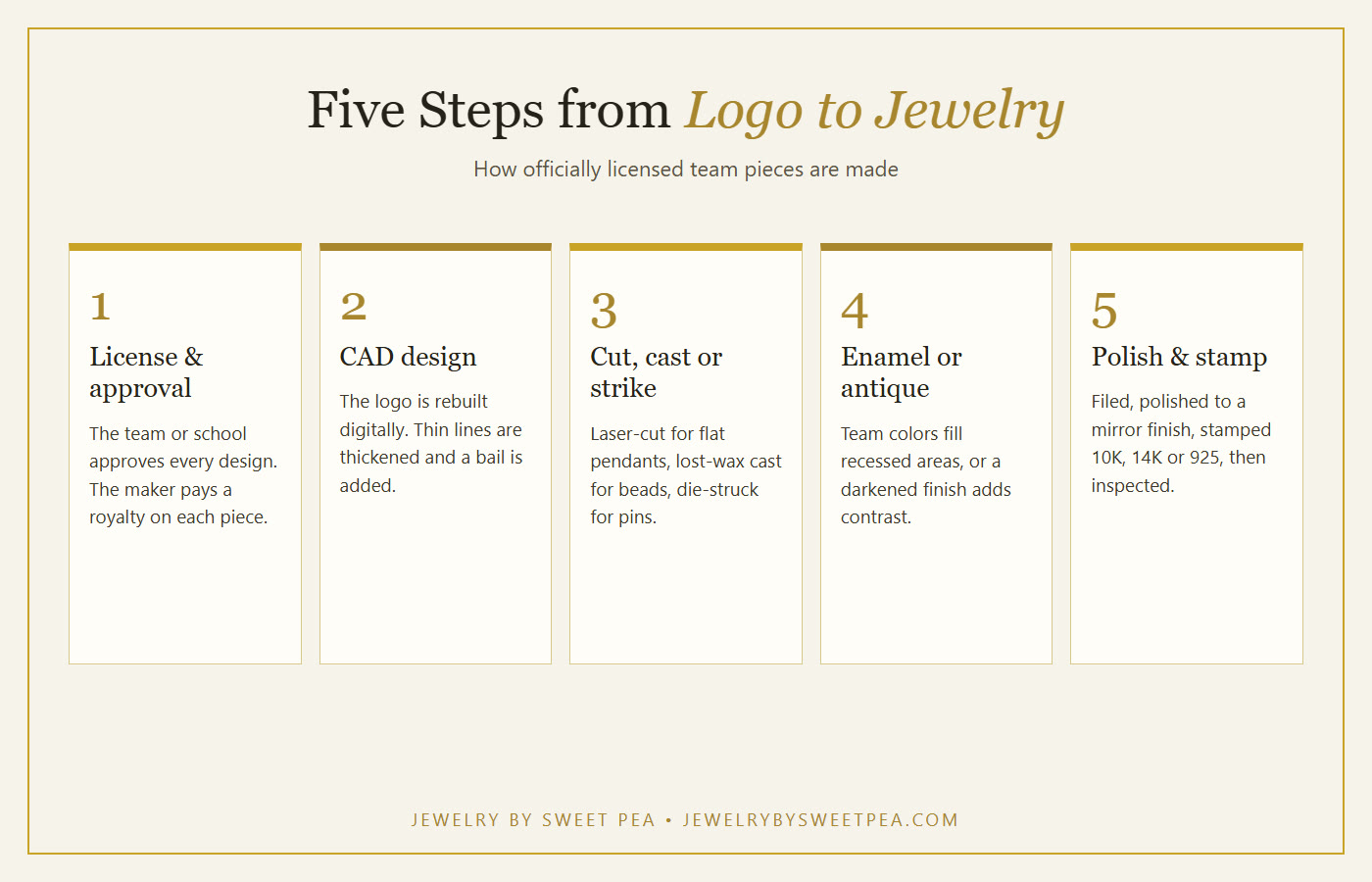
Jewelry designers start with the licensor's vector artwork and rebuild it in CAD (computer-aided design) software. This is more work than it sounds. A logo designed for a helmet or a website has to be adjusted so it can be cut from metal only about the size of a fingernail. Thin lines get thickened so they won't bend. Small openings get widened so they can be polished. A bail, the loop the chain slides through, gets added so the pendant hangs straight.
The finished design goes back to the licensor for approval. Only then does it move to production.
Is licensed jewelry cut, cast or stamped?
It depends on the shape. Professionals generally use three methods:
- Laser cutting. For flat logo pendants and letters, a laser cuts the outline from a sheet of solid gold or silver. It gives crisp, clean edges on small, detailed shapes. Many of the extra-small team pendants we sell are laser-cut.
- Lost-wax casting. For rounded, three-dimensional pieces like beads and charms, a wax or resin model is set in plaster, the wax is melted out, and molten metal fills the cavity. Lost-wax casting is thousands of years old and still the standard for detailed jewelry.
- Die striking. For pins and some charms, a hardened steel die presses the design into metal under high pressure. Struck metal is very dense and holds sharp detail.
Whatever the method, the metal matters most. At our store we carry team pieces in solid 10K gold, 14K gold and sterling silver. We don't recommend gold-plated team jewelry, even though it's out there, because the thin gold layer wears off, especially on a pendant worn every game day.
How do team colors get onto the jewelry?
Colored logos use enamel. A jeweler fills recessed areas of the design with colored enamel, then cures it so it hardens in place. Traditional vitreous enamel is powdered glass fused with heat. Many modern team charms use a colored epoxy enamel instead, which is cured at lower temperatures. Either way, the color sits inside the metal, framed by raised edges that protect it.
Some pieces skip color entirely and use an antiqued finish. The jeweler darkens the recessed areas, then polishes the raised surfaces so the logo stands out in contrast. It's a classic look, especially on sterling silver.
What happens during finishing and polishing?
This is where a piece of metal becomes a piece of jewelry. Bench jewelers file away rough edges left by cutting or casting and check that the bail is smooth so it won't catch on a chain. Then the piece goes through several stages of polishing, from coarse to fine, until it has a mirror finish. Tiny laser-cut pendants are often tumbled with polishing media so every inside corner gets reached.
Before shipping, the piece is stamped with its metal quality, such as 10K, 14K or 925 for sterling silver. The FTC Jewelry Guides set rules for how karat and silver content are described, and a karat stamp is a promise about what the piece is made of. A final inspection checks the shape against the approved design, the enamel for gaps, and the polish for scratches.
Which licensed team pieces show this craftsmanship best?
Here are in-stock examples from our shop that show the different techniques. Prices are approximate and move with the gold market.
- 10K Yellow Gold Florida State University F-S Extra Small Pendant, about $154. A simple laser-cut letter logo, and one of our most affordable solid gold team pieces.
- 10K Yellow Gold Clemson University Tiger Paw Extra Small Pendant, about $244. The paw's rounded toes show why CAD adjustments matter at this small size.
- 10K Yellow Gold University of Georgia Letter G Extra Small Pendant, about $326. Clean edges and a mirror polish on a bold letter.
- 10K Yellow Gold University of Michigan Letter M Extra Small Pendant, about $344. The block M's sharp corners show what careful finishing looks like.
- 14K Yellow Gold US Naval Academy Lapel Pin, about $878. A solid 14K pin for an alumnus or a commissioning gift.
- Sterling Silver Enameled Cincinnati Bengals NFL Bead, about $28. A good look at enamel color set into sterling silver.
- Sterling Silver Antiqued Jacksonville Jaguars NFL Bead, about $28. The antiqued finish in action, with dark recesses and bright raised details.
Pendants are sold without a chain. A simple 10K Yellow Gold 1mm Cable Chain (about $191) suits the extra-small sizes. Browse every team on our licensed jewelry page or our collegiate jewelry page.
Sterling silver, 10K or 14K: which should you choose?
The process is similar for all three metals. What changes is how the finished piece wears and what it costs.
- Sterling silver (about $25 to $100): Great for beads, charms and younger fans. It will tarnish over time, but a polishing cloth brings it back.
- Solid 10K gold (about $150 to $350): The sweet spot for most team pendants. 10K is harder than 14K, so it resists scratches on a piece worn every day.
- Solid 14K gold (about $450 and up): A richer gold color and a true heirloom. A good choice for a graduation, retirement or milestone gift.
Frequently asked questions
Why does licensed team jewelry cost more than unlicensed jewelry?
The maker pays a royalty to the team or school on every piece, and each design goes through an approval process. Licensed pieces are also usually made in solid metal rather than plated base metal.
Why is some licensed jewelry made to order?
There are hundreds of schools and teams, each with several logos, sizes and metals. Rather than stock every combination, many licensed makers produce pieces when they're ordered, which is why some items take a little longer to ship.
How can I tell if team jewelry is officially licensed?
Buy from a seller who names the licensed manufacturer, and look for a karat or 925 stamp on the piece. Prices far below the cost of the metal are a warning sign.
Will the enamel on a team charm chip?
Enamel is recessed inside raised metal edges, which protects it from most everyday wear. Avoid dropping it on hard floors and remove it before swimming or using harsh cleaners.
Can licensed team jewelry be engraved?
Most extra-small laser-cut pendants are too small to engrave. We don't offer engraving, but a local jeweler can tell you whether a larger piece has room for initials.