
Solid Gold vs Gold-Plated Jewelry: What Most Online Shoppers Do Not Realize
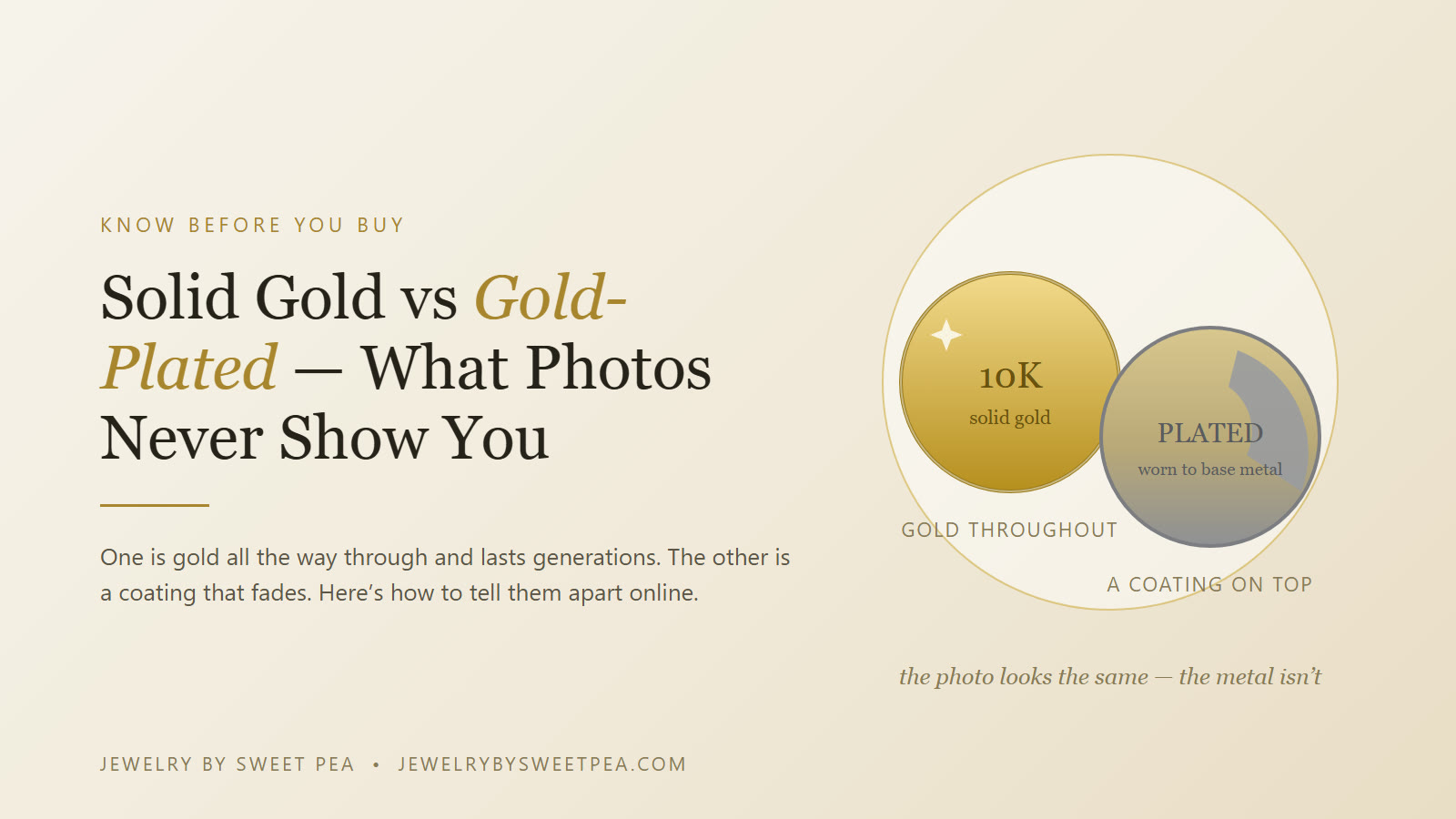
The short answer: "gold" in an online listing can mean two completely different things. Solid gold (10K or 14K) is gold all the way through and lasts for generations. Gold-plated is a microscopically thin layer of gold over brass or silver that wears off in months to a couple of years — and the two can look identical in a photo. The price gap is real because the amount of actual gold is wildly different.
If you have ever bought a "gold" necklace online that turned your neck green or faded to gray, you did not do anything wrong. You bought plated jewelry that was photographed to look like the real thing. Here is exactly how to tell them apart before you spend a dollar.
What does "gold-plated" actually mean?
Gold-plated jewelry is a base metal — usually brass, copper, or nickel — with a gold coating bonded to the surface. That coating is often just 0.5 to 2.5 microns thick (a human hair is roughly 70 microns). Everyday friction from your skin, clothing, water, and lotion slowly rubs it away until the base metal shows through. There is no fixing it — once the plating is gone, it is gone.
You will also see related terms that shoppers mix up constantly. It is worth knowing the difference, because U.S. sellers are legally bound to use them precisely under the FTC's legal definitions of "gold-filled," "gold-plated," and "vermeil":
- Gold-plated / gold electroplate — the thinnest coating; the least durable.
- Gold-filled — a thicker bonded layer (at least 1/20th of the item's weight in gold). Longer-lasting than plated, but still not solid.
- Vermeil — gold over sterling silver specifically, with a required minimum thickness. Nicer base metal, but the gold still sits on the surface.
- Solid gold (10K, 14K, 18K) — the gold is the metal, not a coating. Nothing to wear off.
None of these are scams by themselves — plated and vermeil pieces have a place for costume and trend jewelry. The problem is when a listing blurs the line so a $19 plated chain reads as if it were the same thing as a solid gold one.
Why does solid gold cost so much more?
Because you are buying meaningfully more gold. A solid 10K gold chain contains 41.7% pure gold by weight, throughout the entire piece. A plated chain contains a coating so thin it is measured in millionths of a meter. When gold trades around modern prices, the material cost alone explains most of the gap — you are comparing grams of gold to a whisper of it.
That is also why solid gold holds value and plated does not. A solid 10K or 14K piece has real intrinsic worth you can feel in the hand; a plated piece is worth its base metal once the coating fades. One is a small store of value you keep for decades. The other is a look you rent for a season.
How to tell solid gold from plated before you buy
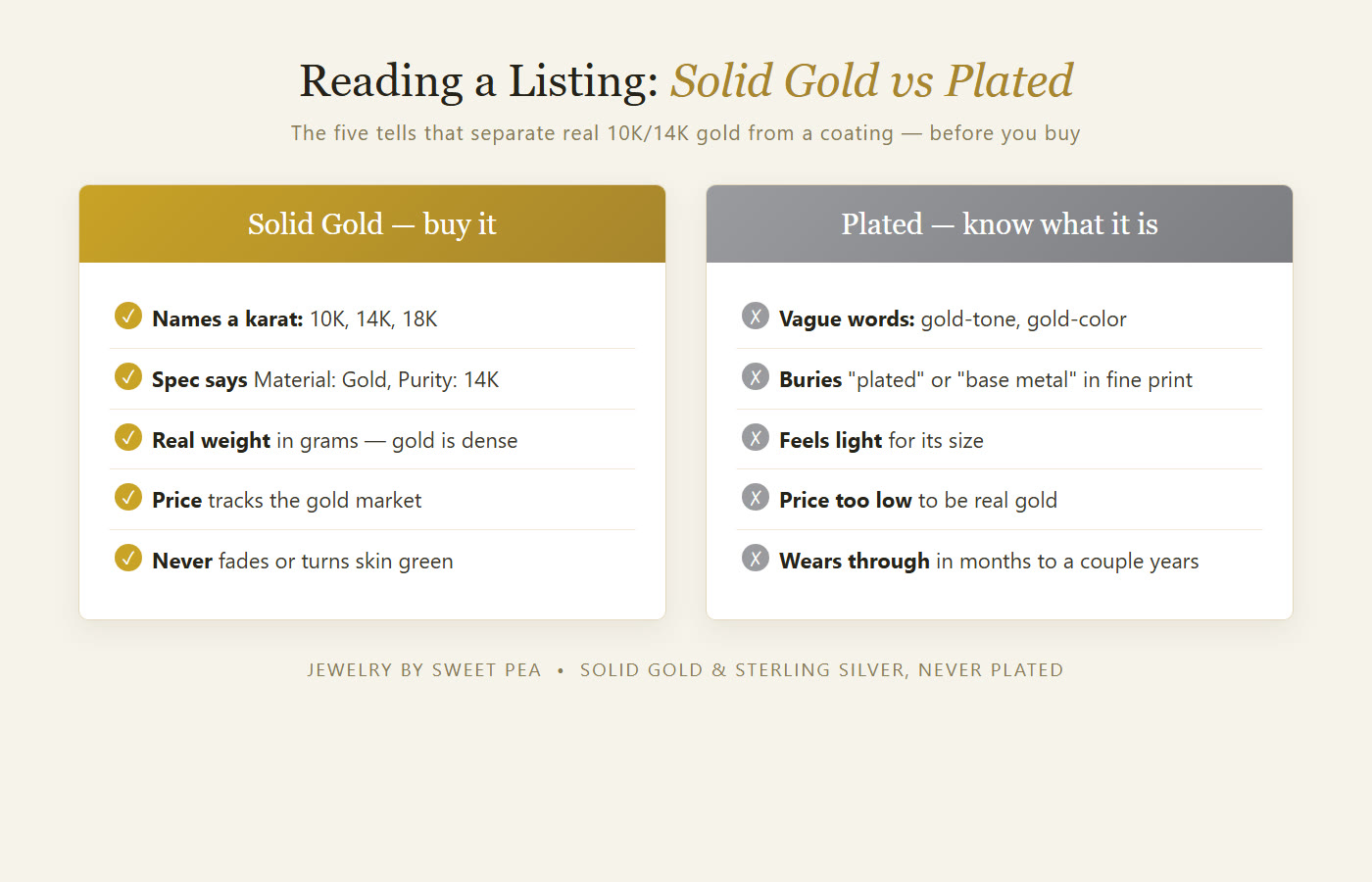
You cannot bite it through a screen, so read the listing like a detective. Five tells:
- Look for a karat number, stated plainly. "10K," "14K," or "18K" means solid gold. "Gold-tone," "gold-color," "18K gold plated," or "gold over ___" means plated. A listing that just says "gold" and never names a karat is dodging the question.
- Check the metal field, not the marketing. Scroll to the specifications. Real listings state Material: Gold, Purity: 14K. Plated listings bury "plated" or "base metal" in the fine print.
- Weight in grams tells the truth. Solid gold is dense. If a "14K gold" statement chain weighs almost nothing and costs $25, it is plated.
- The price has to make sense. Solid gold has a floor set by the gold market. A genuinely solid 10K gold chain simply cannot cost $15 — the raw metal is worth more than that.
- A trustworthy seller states it without being asked. Every piece we sell names its karat up front. When a shop makes you dig for whether it is solid, that is the answer.
The gold-content wording itself is regulated — the FTC Jewelry Guides (16 CFR Part 23) govern how a U.S. seller may describe gold. A listing that is vague about karat is often vague on purpose.
What solid gold actually costs: real picks by price
Here is the part that surprises people most: solid gold is not out of reach. Because a piece's price tracks its gold weight, small solid pieces are genuinely affordable. Every item below is solid 10K or 14K gold — never plated, in stock at time of writing.
Under $200 — solid gold on a budget
- 10K White Gold Cross Pendant — about $92. Proof that "solid gold under $100" is real. Small, delicate, and it will never wear down to base metal.
- 10K Yellow Gold Cross Pendant — about $159. A little more presence, classic yellow gold, solid through and through.
- 10K Yellow Gold 1.5mm Diamond-Cut Rope Chain — about $193. The everyday chain a plated "gold" one is pretending to be. This one you keep.
$200–$300 — the everyday heirloom
- 10K Yellow Gold Hoop Earrings — about $222. Hoops take constant wear, which is exactly where plated fails first — solid gold shrugs it off.
- 14K Yellow Gold Hoop Earrings — about $270. The same hoop in richer 14K gold — a perfect side-by-side of what the karat number buys you.
$300+ — the piece with real gold weight
- 10K Yellow Gold 2mm Diamond-Cut Rope Chain — about $598. Heavier gauge, more gold, more presence. The price reflects the grams of solid gold in it — and that is the whole point.
Prices shown are at the time of writing; solid gold pieces move with the gold market. Browse the full Necklaces collection or our Pendants & Charms for more solid-gold options.
Is 10K gold "real" gold? (And 10K vs 14K)
Yes — 10K is real, solid gold. The karat number is the purity: 14K is 58.3% pure gold (richer color, the fine-jewelry standard) and 10K is 41.7% pure (slightly paler, harder, more scratch-resistant, and more affordable). Both are solid gold; both are stamped; both last for decades. The remainder in each is alloy metals that give gold its strength — pure 24K is too soft to hold up to daily wear.
This is the opposite of plating. With solid gold, even the "budget" option (10K) is gold throughout. With plating, even the "premium-looking" option is base metal under a coating. That is the distinction the price tag is really telling you about.
When is gold-plated or vermeil the right call?
Plated and vermeil have honest uses: a trend piece you will wear for one season, a bold statement look you do not need to last, or a color you want to try before committing. There is nothing wrong with buying plated when you know that is what it is. The trouble is only ever the surprise — paying solid-gold-adjacent money for a coating, or gifting something you believed was forever that fades by next year.
Our rule of thumb: for anything you want to wear daily, gift for a milestone, or keep for years, buy solid gold — even a small piece. For pure fashion you will rotate out, plated is fine, as long as the listing is honest about it. We chose to sell only solid gold and sterling silver, never plated, precisely so there is never a surprise a year later.
Frequently asked questions
Does gold-plated jewelry turn your skin green?
It can, once the thin gold layer wears through to the base metal. Brass and copper bases react with skin oils and moisture to leave a green or gray mark. Solid 10K and 14K gold does not do this — there is no base metal underneath to be exposed, because the piece is gold throughout.
How long does gold-plated jewelry last?
Typically a few months to about two years of regular wear, depending on the plating thickness and how often it meets water, lotion, and friction. "Gold-filled" lasts longer than "gold-plated," but neither is permanent. Solid gold has no coating to lose, so with basic care it lasts generations.
Is 10K gold real gold or is it fake?
10K is real, solid gold — 41.7% pure, with the balance made of alloy metals for durability. It is stamped "10K," holds intrinsic value, and will not wear down to another metal. It is simply a lower purity (and lower price) than 14K or 18K, not a lesser kind of gold, and it is not plated.
How can I tell if a gold necklace is solid or plated online?
Look for a plainly stated karat number (10K/14K/18K = solid; "gold-plated," "gold-tone," or "gold over" = not), check the specifications for the exact metal, note the weight in grams, and sanity-check the price against real gold value. A listing that never names a karat, or prices "gold" absurdly low, is telling you it is plated.
Is vermeil better than gold-plated?
Yes, somewhat — vermeil is gold over solid sterling silver with a required minimum gold thickness, so the base metal is nicer and it holds up better than ordinary plating. But the gold still sits on the surface and can wear over time. It is a step up from plated, not the same as solid gold.
Jewelry by Sweet Pea is a family-run fine jewelry store. Every piece is solid 10K or 14K gold or sterling silver — never plated — sourced from U.S. wholesalers and shipped from the USA. Browse our solid gold necklaces or ask us anything before you buy.