
Sterling Silver vs Gold Jewelry: Which Is the Smarter Choice for Everyday Wear?
The short answer: both are smart — as long as they're solid. Sterling silver is the smarter choice when budget leads: it costs a fraction of gold, lasts decades, and its only real drawback is occasional tarnish you polish away in a minute. Solid 10K or 14K gold is the smarter choice when maintenance and longevity lead: it never tarnishes, shrugs off daily wear, and holds its value for a lifetime. The only un-smart choice is plated jewelry pretending to be gold — it wears through and can't be fixed.
If you're deciding what to wear every single day — the chain that never comes off, the hoops you sleep in, the bangle that's just you — the metal matters more than the design. Here's an honest comparison from a family jeweler that sells both, with real prices, so you can pick the metal that fits your life rather than the one an ad picked for you.
What actually separates sterling silver from gold?
Sterling silver is 92.5% pure silver alloyed with copper for strength (that's what the "925" stamp means). It's a true precious metal — solid all the way through — and it will outlive you. Its one quirk: the copper reacts with sulfur in the air, so sterling slowly darkens. That tarnish isn't damage; it's surface chemistry, and a 60-second pass with a polishing cloth restores the shine. Sterling worn daily actually tarnishes less, because friction and skin oils keep it bright.
Solid gold jewelry in the U.S. is usually 10K (41.7% gold) or 14K (58.3% gold), alloyed for hardness — pure 24K is too soft to wear. Gold's superpower for everyday wear is that it doesn't react with air, water, sweat, or perfume. No tarnish, no polishing, no thinking about it, for decades. That inertness — plus gold's bullion value — is what you're paying the premium for. (If you're curious how karat purity works, Wikipedia's fineness article is a good plain-English primer.)
The everyday-wear scorecard
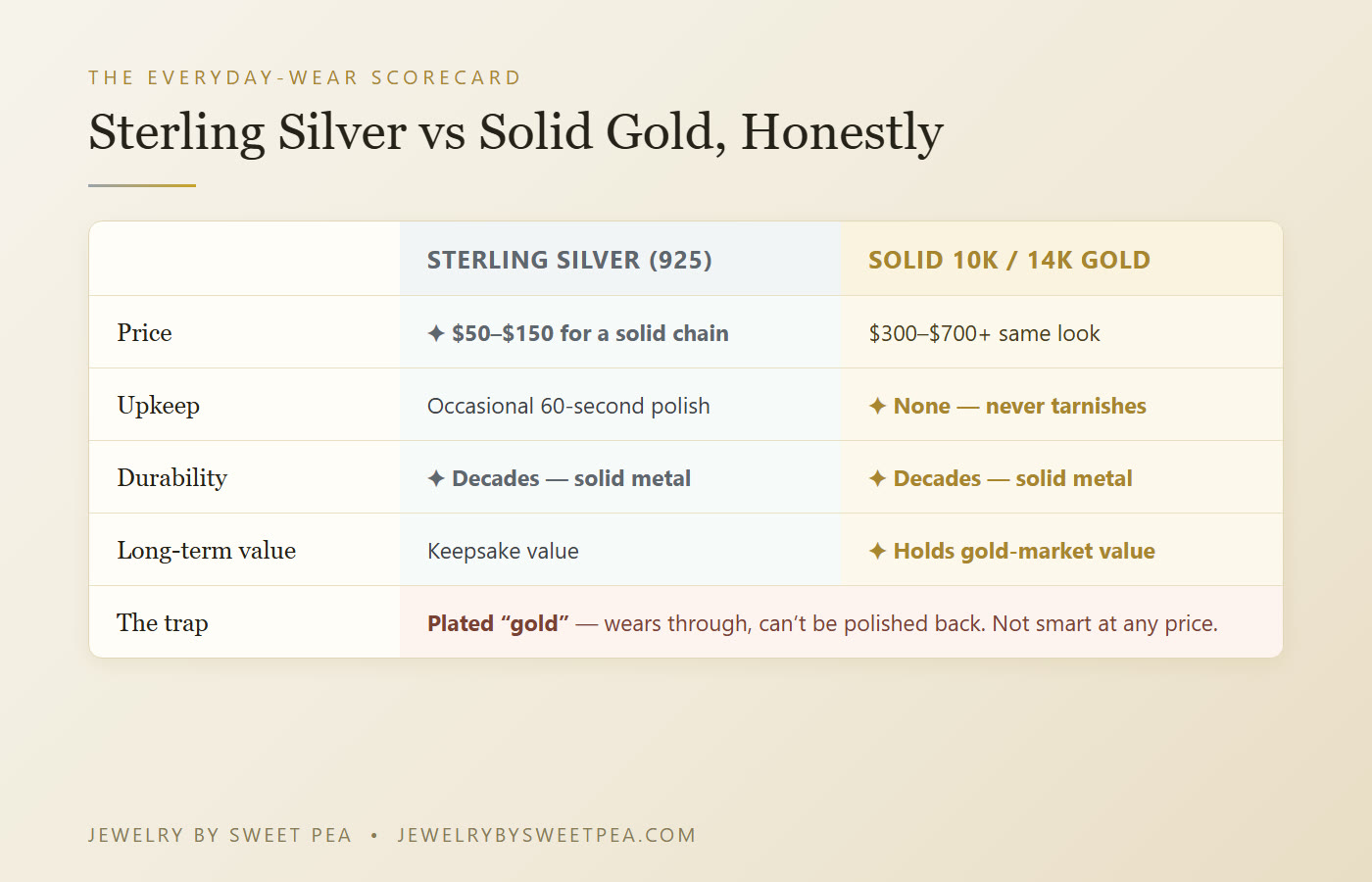
- Price: Silver, by a mile. A solid sterling chain runs $50–$150; the same look in solid gold is $300–$700+. If gold prices make you wince, sterling is how you wear real precious metal now.
- Maintenance: Gold. Zero upkeep versus an occasional polish. If you know you'll never baby your jewelry, gold quietly wins.
- Durability: Even. Both are solid metal that can be worn daily for decades and re-polished or repaired by any jeweler. 10K gold is slightly harder than 14K; sterling scratches a touch easier but those scratches buff out.
- Sensitive skin: Slight edge to sterling and to white metals generally — sterling and rhodium-finished sterling are friendly to most skin. Solid 10K/14K gold is also well tolerated; it's cheap plated base metal that causes most "jewelry rash."
- Long-term value: Gold. Sterling holds sentimental and wear value; gold holds market value. A 14K chain is the piece your kids argue over.
When sterling silver is the smarter choice
Choose sterling when you want maximum jewelry per dollar, you like a bright white metal, or you're building an everyday wardrobe of several pieces instead of one. A classic sterling silver bangle (about $48) is the kind of piece you put on in your twenties and are still wearing in your sixties. The sterling silver 2.9mm domed curb chain (about $82) is a do-everything daily necklace — solid links, real weight, polishes like new. Want more presence? The 3.9mm double diamond-cut curb chain (about $127) has the flash of a much more expensive piece because the diamond-cut facets catch light the way tarnish never gets a chance to dull.
The honest downside: if you swim in chlorinated pools daily, work with sulfur-heavy materials, or simply know you'll never touch a polishing cloth, sterling will look tired faster than you'd like — and that's the moment people mistakenly conclude silver is "cheap." It isn't; it's just chemistry.
When solid gold is the smarter choice
Choose gold for the piece you plan to never take off. Gold's zero-maintenance nature is exactly what a 24/7 piece needs — shower, gym, sleep, repeat. And entry into solid gold costs less than most people think: 10K yellow gold textured oval hoop earrings are about $80 — genuinely solid 10K gold at a sterling-silver price, because the hollow construction keeps the weight down. For a daily-wear necklace with real substance, the 10K yellow gold 4mm semi-solid diamond-cut rope chain (about $323) gives you bold gold that's engineered to be comfortable all day. And if you want the one-and-done forever piece, the 14K yellow gold adjustable 1.2mm diamond-cut rope chain (about $693) is a buy-it-for-life classic — the adjustable length means it works at every neckline, on every person, for decades.
Prices shown are at the time of writing; solid gold and silver pieces move with the metal markets. Browse more in our Necklaces, Earrings, and Bracelets collections.
Smart everyday picks by budget
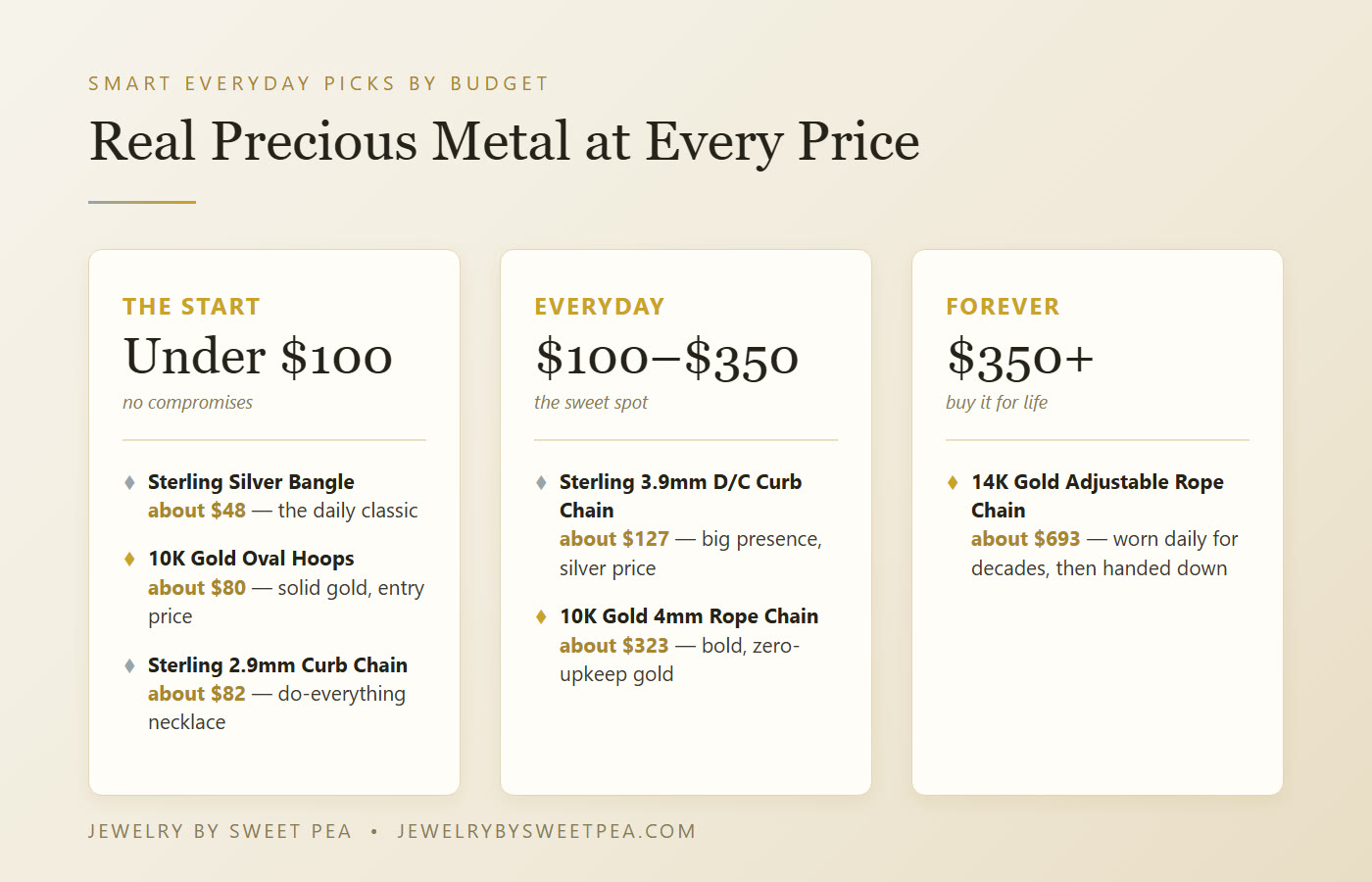
Under $100 — real precious metal, no compromises
- Sterling Silver Bangle — about $48. The everyday classic that never dates.
- 10K Yellow Gold Textured Oval Hoops — about $80. Proof that solid gold has an entry door.
- Sterling Silver 2.9mm Domed Curb Chain — about $82. The do-everything daily necklace.
$100–$350 — the everyday sweet spot
- Sterling Silver 3.9mm Double Diamond-Cut Curb Chain — about $127. Big-chain presence, silver price.
- 10K Gold 4mm Semi-Solid Rope Chain — about $323. Bold, zero-maintenance daily gold.
$350+ — the forever piece
- 14K Gold Adjustable Diamond-Cut Rope Chain — about $693. Wear it for life, then hand it down.
The choice that isn't smart: plated jewelry sold as "gold"
Here's where everyday shoppers get burned. "Gold-plated," "gold electroplate," and "vermeil" all mean a microscopically thin layer of gold over another metal — U.S. law defines each of these terms precisely (16 CFR 23.4), and none of them is solid gold. Worn daily, that layer wears through at the pressure points in months to a couple of years, exposing the base metal — and unlike tarnish on sterling, plating loss cannot be polished away. A $30 plated "gold" chain worn daily is a disposable; a $48 sterling bangle worn daily is a keepsake. Sellers are bound by the FTC Jewelry Guides (16 CFR Part 23) on how metal content must be described — read the fine print, and if a "gold" price looks too good, it's plated. Every piece we sell is solid 10K/14K gold or genuine sterling silver — never gold-plated pretending otherwise.
Frequently asked questions
Is sterling silver good enough for everyday wear?
Yes. Solid sterling silver (stamped 925) can be worn daily for decades. It will tarnish gradually, but tarnish is surface-level and polishes off in a minute — and daily wear actually slows it, since friction and skin oils keep the metal bright.
Which lasts longer, sterling silver or gold?
Both last generations if they're solid. The practical difference is upkeep: solid 10K/14K gold never tarnishes and needs essentially no care, while sterling needs an occasional polish. Plated jewelry of any kind is the only one with a short lifespan.
Is 10K or 14K gold better for daily wear?
Both are excellent. 10K is slightly harder and more scratch-resistant with a softer yellow color and lower price; 14K is richer in color and holds a bit more intrinsic gold value. For a never-take-it-off piece, either beats any plated alternative by years.
Why is my "gold" necklace turning silver or gray?
That's plating wearing through to the base metal underneath — it means the piece was gold-plated, not solid gold. It can't be polished back. Solid gold is the same metal all the way through, so it can never "turn."
Can I wear sterling silver in the shower?
Occasionally, yes — water itself doesn't harm sterling. But chlorinated water and sulfur (some well water, hot springs) speed up tarnish, so it's smart to take silver off for pools and to dry it after showers. Solid gold doesn't care either way — one more reason it's the better 24/7 metal.
Jewelry by Sweet Pea is a family-run fine jewelry store. Every piece is solid 10K or 14K gold or genuine sterling silver — never plated sold as gold — sourced from U.S. wholesalers and shipped from the USA. Browse our Necklaces and Earrings collections, or ask us anything before you buy.