
What Estate Jewelry Appraisers Say Makes Certain Pieces Gain Value Over Decades
The short answer: estate appraisers keep coming back to the same few things. Pieces that hold or gain value over decades are made of solid gold or platinum with a real weight to them, carry natural stones of good quality, stay in original condition, and come with maker marks, receipts or grading papers. Trendy styles and plated metal rarely survive the decades with their value intact.
We are a family-run jewelry store, and we hear this question most often when someone is buying a piece they hope to pass down. Nobody can promise a piece will be worth more in thirty years. What you can do is buy the kind of jewelry that appraisers consistently treat as having lasting value, and keep the records that let them prove it.
What do appraisers actually look at first?
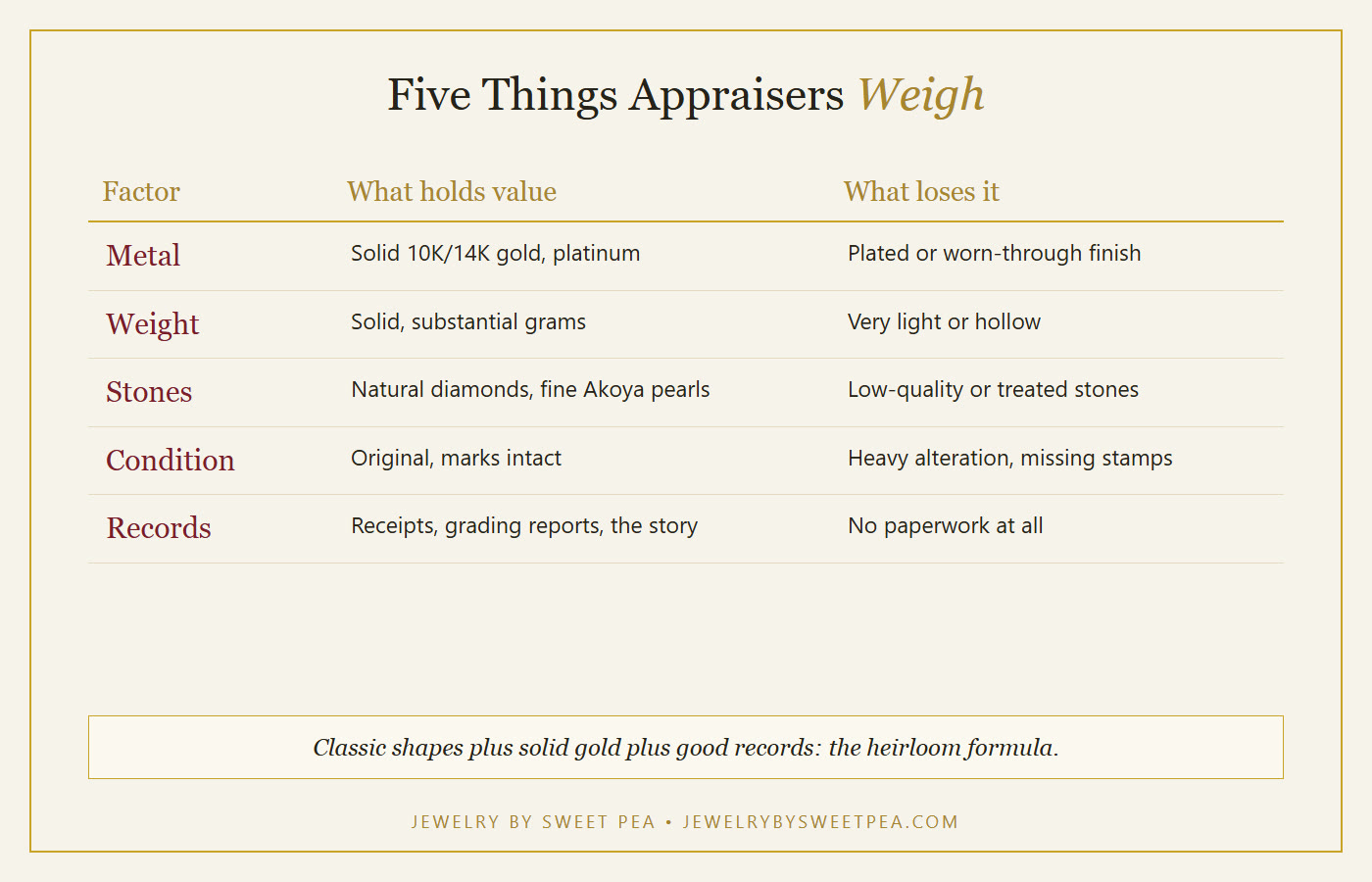
When an estate appraiser picks up a piece, the first questions are simple: what is it made of, how much does it weigh, and what are the stones? Precious metal is the floor under the value. A solid 14K gold chain will always be worth at least its gold content, and that number moves with the gold market rather than with fashion.
That is why the stamp on the clasp matters so much. In the US, the Federal Trade Commission's Jewelry Guides (16 CFR Part 23) set the rules for how karat gold, gold-filled and plated metals can be marked and described. A "14K" stamp on solid gold means something very different from "14K GF" or "14K HGE," and an appraiser will check for it right away.
Why does solid gold hold value when plated jewelry does not?
Plating is a microscopically thin layer over a base metal. It wears through, and once it does there is nothing of value left underneath. Solid 10K or 14K gold is gold all the way through. It can be polished, repaired, resized and worn for generations, and its metal value never goes to zero.
Weight is the other half of the story. A heavier solid chain or bangle holds more gold than a hollow or very light one. If you are buying with the long term in mind, compare gram weights, not just prices. Our gold chains list the metal so you can see what you are getting.
Do natural diamonds and pearls really hold their value?
Natural stones are where much of an estate piece's value beyond the metal comes from, but only when the quality is there. For diamonds, appraisers look at the familiar four Cs. For pearls, they look at luster, surface, shape and nacre. The GIA's pearl quality factors page is a good plain-English guide to what separates a strand that keeps its beauty from one that dulls.
Saltwater Akoya pearls with good luster are a classic heirloom for a reason. A well-kept strand from the 1960s can look just as bright today. Natural diamond studs are another piece families pass down again and again, because the style never really changes.
Lab-grown diamonds are a different conversation. They are real diamonds and a beautiful choice for wearing, and we sell them. But the resale market for lab-grown stones is still young and prices have been falling as production grows, so most appraisers would not count on one gaining value. Buy lab-grown for the look and the budget, and buy natural if long-term value is part of the reason.
Which styles tend to stay desirable for decades?
Classic designs age better than trend pieces. The styles that keep showing up in estate cases looking just as wanted as the day they were made include:
- Rope and curb chains in solid gold. Simple, strong, and easy to wear with anything.
- Diamond stud earrings. A shape that has not changed in a century.
- Pearl strands and pearl studs. Especially Akoya pearls with sharp luster.
- Plain gold bangles and heart pendants. Easy to engrave, easy to pass down.
- Signet and ID pieces. Personal, and the engraving becomes part of the family story.
Real heirloom-quality picks from our store
These are pieces we have in stock now. Prices float with gold, so treat each as "from about":
- 14K yellow gold 1/10 ct natural diamond stud earrings, from about $164. A small, natural first diamond that can be worn daily for decades.
- 14K 5-6mm white Akoya saltwater cultured pearl necklace, 16 inch, from about $209. A classic first pearl strand.
- 14K 2.8mm semi-solid rope chain, 20 inch, from about $231. Real 14K gold with a sturdy lobster clasp. Semi-solid means lighter than a fully solid rope, so a fully solid chain will carry more gold weight if that is your priority.
- 14K rose gold polished slip-on bangle, from about $258. Simple enough to stack and never look dated.
- 14K rose gold 3-D rope heart pendant, from about $100. A small, solid gold keepsake.
You can browse more on our pearl jewelry and earrings pages.
How do natural and lab-grown studs compare as heirlooms?
| Question | Natural diamond studs | Lab-grown diamond studs |
|---|---|---|
| Example in our store | 14K 1/10 ct natural, about $164 | 14K 1/5 ct lab-grown, about $166 |
| Size for the money | Smaller | About twice the carat weight |
| Established resale market | Yes | Still developing |
| Best reason to choose | Long-term keepsake value | Bigger look on a budget |
| Gold setting value | Same: solid 14K either way | Same: solid 14K either way |
What can you do today so a piece keeps its value?
- Keep the paperwork. Receipts, grading reports and appraisals in a folder with the jewelry. Provenance is often what turns a nice piece into a valuable one.
- Do not over-polish or alter. Original condition matters to appraisers. Resizing is fine when needed; heavy re-plating or removing marks is not.
- Store pieces apart. Pearls and gold scratch each other. Soft pouches keep surfaces clean.
- Restring pearls every few years if they are worn often, and check prongs on diamond studs once a year.
- Write down the story. Who bought it, for what occasion. Sentimental value does not show on an appraisal, but it is why families keep pieces long enough to gain value.
Frequently asked questions
Does gold jewelry go up in value over time?
The gold content follows the gold market, which has risen over many long periods but also falls at times. Solid gold jewelry always keeps a metal value; plated jewelry does not.
Is 14K or 10K better for an heirloom?
Both are solid gold. 14K has more gold per gram, so it carries more metal value. 10K is harder and wears very well. Either is a good heirloom; plated or gold-filled pieces are not.
Will lab-grown diamonds gain value?
Most appraisers would not expect it. Lab-grown prices have been dropping as supply grows. They are a lovely choice to wear, but buy natural if resale value matters to you.
What paperwork should I keep with jewelry?
The receipt, any diamond or pearl grading report, a written appraisal, and a note about who it belonged to. Together they make the piece easier to value and insure.
How often should heirloom jewelry be appraised?
Many families update an insurance appraisal every few years, or after a big move in gold prices, so the coverage keeps up with replacement cost.
If you would like help choosing a piece meant to be passed down, our family is happy to talk it through. Look for solid gold, classic shapes and natural stones, and keep the paperwork. Those are the habits estate appraisers reward.