
What Gold Jewelry Can a Nurse Wear During Twelve-Hour Hospital Shifts Without Problems
The short answer: two pieces reliably survive a twelve-hour shift — small solid gold post earrings, 3–5 mm, and a thin gold chain worn under your scrub top. Skip bracelets, dangles and stone-set rings: they catch on gloves, sit in the way of hand hygiene, and take the most abuse. A plain band is usually the only ring worth wearing to work.
Why does a hospital shift ruin jewelry that survives everywhere else?
It is not one dramatic event. It is repetition. Over twelve hours your hands go in and out of gloves constantly — gloves are required any time contact with blood or other potentially infectious material is reasonably anticipated, under OSHA's bloodborne pathogens standard — and every cycle drags nitrile across whatever is on your fingers. Add handwashing and alcohol gel between patients, gowning and de-gowning, and a scrub top coming off over your head at the end.
Solid gold handles all of that without complaint. Soap and sanitizer do not harm 10K or 14K gold; they leave film that dulls the shine until you rinse it. What fails is everything around the gold: plating wears through at the contact points, spring rings clog with soap and stop closing, and ear-nuts loosen a little more with every mask strap.
That is the practical case for solid metal at work. Plating is a microscopically thin gold layer over a cheaper base metal, and the FTC's Jewelry Guides require sellers to disclose the difference precisely because the two wear nothing alike. We do not carry plated jewelry — everything below is solid 10K or 14K gold, or sterling silver.
Which earrings actually make it through twelve hours?
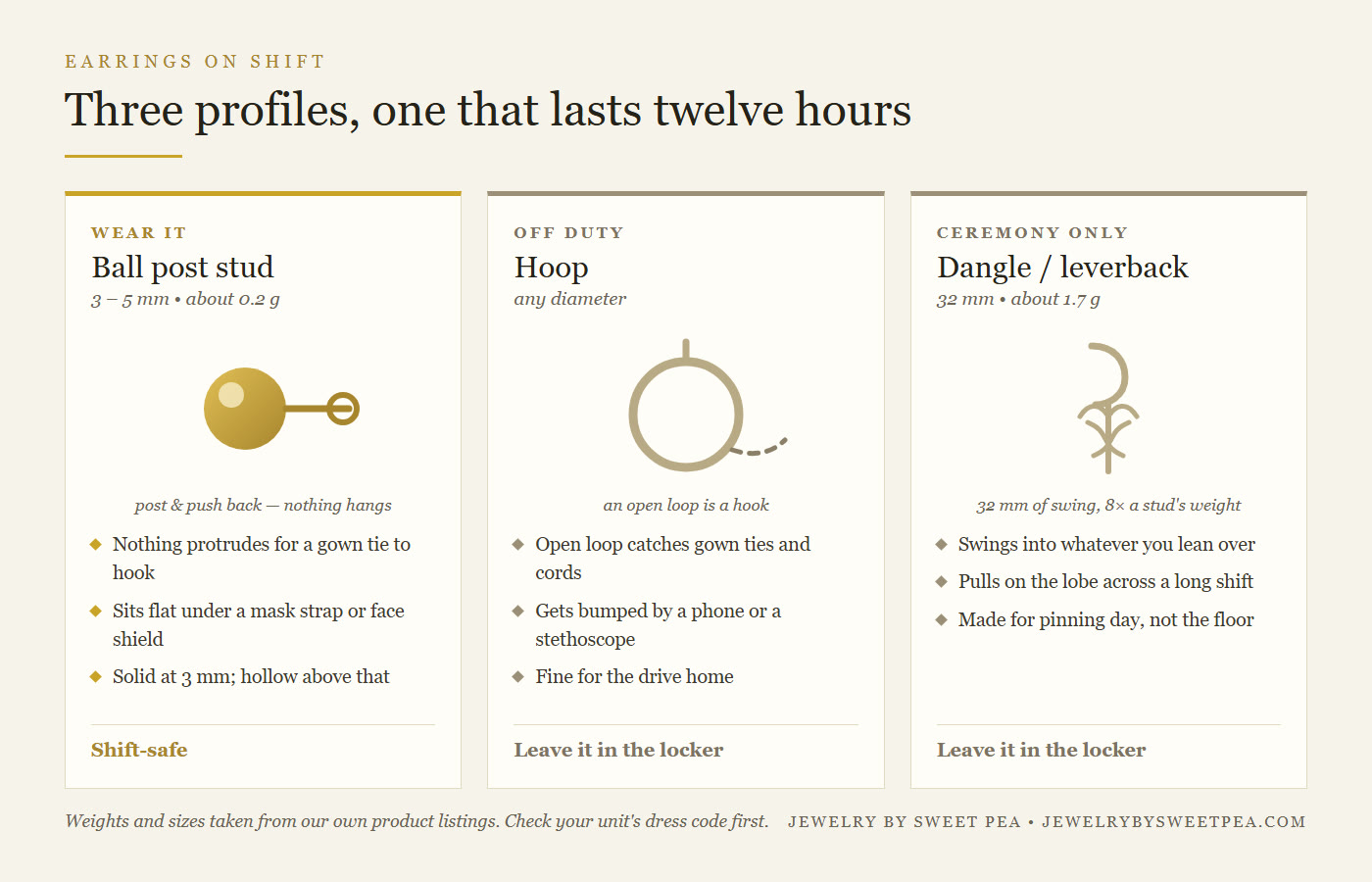
Posts — specifically small ball posts, because the profile is round with nothing to hook. A stud sits flat enough to live under a mask strap, a face shield band and a phone held to your ear, with no loop for a gown tie or a confused patient's hand to catch.
Size is the whole decision, and it is smaller than most people guess. At 3 mm a stud disappears; at 8 mm it sits proud of the lobe and catches mask elastic:
- 14K yellow gold polished 3 mm ball posts — about $58. Solid 14K, roughly 0.2 g the pair. The safest size if your unit is strict or your ears are sensitive.
- 14K white gold polished 4 mm ball posts — about $63. Hollow and light, about 0.23 g, rhodium finished so they read bright white against a scrub top.
- 10K white gold polished 5 mm ball posts — about $57. Hollow ball, about 0.21 g, and the most visible size we would still call shift-safe.
One honest note, because the listings say it plainly: the 4 and 5 mm balls above are hollow, which is how a bigger ball stays light and affordable. Hollow is still real gold through its walls — but a hollow ball dents if it is crushed and a solid 3 mm one will not. If your earrings live in a scrub pocket rather than a box, size down and buy solid.
The push-back is the part that actually fails. Check both ear-nuts before you leave the house, not at the end of the shift, and keep a spare pair in your locker. More in earrings.
Can you wear a necklace on shift?
Yes — under the scrub top, not over it. Tucked away it is out of reach of equipment, patients and the gown that comes off over your head, and it is not swinging into a sterile field when you lean over a bed.
Choose the chain for its weave. A wheat or spiga weave is a dense four-strand braid that resists the kinking which finishes off a thin rope or box chain. Our 10K yellow gold 1 mm wheat chain runs about $257, carries roughly 2.19 g of solid gold, closes with a lobster clasp rather than a spring ring, and comes in 16 through 24 inch lengths.
Two details matter more than the chain itself. Use a lobster clasp — a spring ring's tiny slot fills with soap and lotion, and that is how chains are lost. And pick a length that puts the pendant below your neckline so nothing rides against a stethoscope. Browse chains for other weaves.
What about rings?
Here policy outranks preference, so check your own unit's dress code first; it is usually stricter than the hospital-wide one, and some areas allow nothing at all.
Where rings are permitted, the rule of thumb is a plain band and nothing else: no prongs to snag a glove, no setting for soap to sit under, no stone to work loose while you are moving a patient. An engagement ring with a raised setting fails all three, which is why so many nurses wear theirs on a chain under their scrubs and put it back on in the parking lot. See wedding bands.
When do the RN and caduceus pieces make sense?
These are gift pieces — pinning ceremonies, graduation, a first day on a new unit — and they work on shift for the same reason a plain pendant does: they hang under the top, out of the way. The sizes below are real millimeters from the listings, because a pendant that looks modest on screen can be surprisingly large in the hand.
- Sterling silver RN caduceus pendant — about $25. 15 × 12.5 mm, about 0.54 g. The smallest and least expensive way to mark the credential.
- 10K yellow gold RN caduceus pendant — about $81. 22.5 × 10.5 mm, about 0.53 g. Tall and narrow, so it reads as a longer line under a neckline.
- 10K yellow gold solid Registered Nurse charm — about $94. 25 × 11 mm, diamond-cut, made in the USA.
- 14K yellow gold caduceus pendant — about $128. 23 × 12.5 mm, about 0.68 g, polished with a textured back.
- 14K yellow gold RN caduceus charm — about $174. 25 × 21 mm, about 0.93 g — the boldest of the group; measure it against your hand first.
All of these are sold as the pendant alone; the chain is separate. The exception is the 10K gold RN caduceus leverback earrings, about $232 — a 32.65 mm dangle weighing about 1.69 g, roughly eight times a small stud. Lovely for a pinning ceremony or a nurses' week dinner. They are not shift earrings, and we would rather say so than sell you a pair that catches on a gown tie. More in pendants and charms.
What does a shift-proof set actually cost?
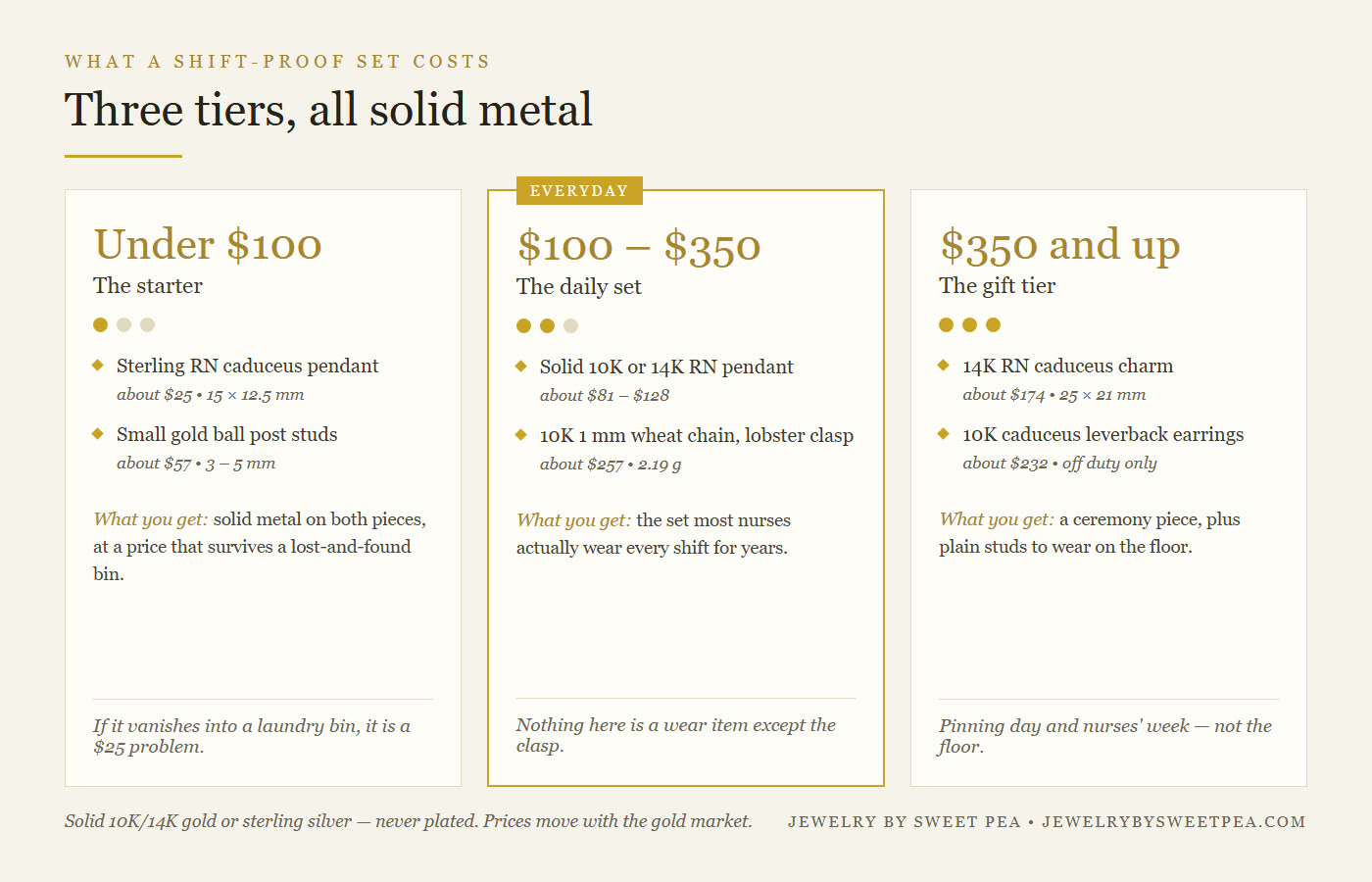
Under $100 — the starter. Sterling RN pendant at about $25 plus small gold studs at about $57. Solid metal on both counts, and if a pendant vanishes into a laundry bin it is a $25 problem.
$100 to $350 — the everyday set. A solid gold RN or caduceus pendant, roughly $81 to $128, on the 10K wheat chain at about $257. This is the version worn daily for years, because nothing in it is a wear item except the clasp.
$350 and up — the gift tier. The 14K charm at about $174 on a heavier chain, or the leverback earrings at about $232 as the off-duty piece. Prices move with the gold market, so treat every figure here as approximate.
Questions nurses ask us
Will hand sanitizer damage gold? Not solid gold. Alcohol gel does not attack 10K or 14K; it leaves residue that dulls the finish until you rinse it in warm water with a drop of dish soap. It is much harder on plated jewelry, where repeated exposure at the same contact points helps wear the layer through.
Can I wear my engagement ring to work? Check your unit's policy first. Where rings are allowed, a raised setting is still the piece most likely to snag a glove or collect soap under the stones. Wearing it on a chain under your scrub top is the common workaround.
Is 10K or 14K better for a nurse? For shift wear, 10K has a slight edge: more alloy, so it is a little harder, and it costs less for a piece that lives in a hospital. 14K holds a richer color and more metal value. Solid versus hollow matters more than either number.
What length chain works under scrubs? Around 18 to 20 inches for most adults, so the pendant sits below the V of a scrub top rather than at the neckline where it rubs a stethoscope. A 16 inch chain sits high on the throat.
How do I clean jewelry after a shift? Warm water, a drop of dish soap, a soft toothbrush on the back of a pendant and inside the clasp, then rinse and dry completely. Weekly is plenty. Skip ultrasonic cleaners for anything hollow or stone-set unless a jeweler has cleared it.
Shopping for a nurse and unsure what she owns? Small studs and a plain chain are the safest gifts on this page — they get worn. We are a small family jewelry business and we are glad to answer a sizing question by email before you order.