
What Is Continuum Silver? The Wedding Band Metal That Wears Like Gold
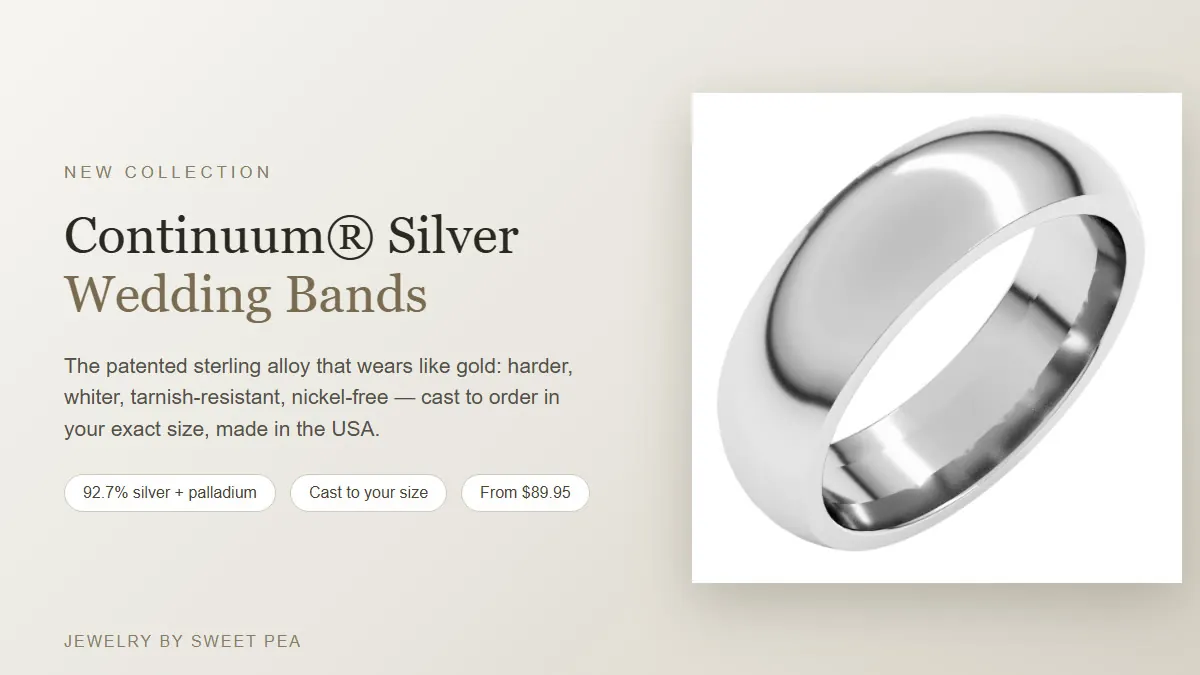
Continuum® sterling silver is a patented silver alloy, developed by the American manufacturer Stuller, that replaces most of the copper in traditional sterling with palladium — a platinum-family metal. The result is a metal that is 92.7% pure silver (above the 92.5% legal sterling standard), dramatically harder than standard sterling, far more resistant to tarnish, and completely nickel-free. Customers have been asking us for it by name, and today we are launching a dedicated collection: Continuum Silver Wedding Bands, every one cast to order in your exact size in the USA.
What exactly is Continuum sterling silver?
Traditional sterling silver is 92.5% silver and 7.5% copper. That copper is what makes sterling tarnish: it reacts with sulfur in the air and skin, and it is also the usual reason sterling stays relatively soft. Continuum keeps the silver but swaps most of the copper for palladium, along with a little zinc. The published composition is 92.7% silver and 2.8% palladium, which puts the total precious-metal content above 95% — higher than standard sterling, and achieved with a metal from the platinum family (Stuller, the alloy's developer, publishes the details here).
Under U.S. law, anything sold as "sterling" must be at least 925 parts per thousand silver (16 CFR § 23.5, the FTC Jewelry Guides' silver rule). Continuum's 927 parts per thousand clears that bar — it is genuine sterling silver, just built better.
How much harder is it, really?
Hardness in metals is measured on the Vickers scale (HV). Standard sterling typically casts around 60–80 HV. Continuum casts about 35% harder than that, and because the alloy responds to heat treatment, it can be age-hardened to roughly 150 HV — comparable to as-cast 14K gold (Wikipedia's sterling silver article covers why conventional sterling softens and tarnishes; Continuum was engineered specifically against those two failure modes).
For a ring you wear every day, hardness is not an abstraction. It is the difference between a band that goes dull and dented in its first year and one that holds its polish and its shape. A wedding band takes more abuse than any other piece of jewelry you own — door handles, dumbbells, steering wheels, dish water — and that is exactly the use case this alloy was designed for.
Continuum vs. white gold vs. platinum
The honest comparison, since a wedding band shopper is usually deciding between these three:
- Against 14K white gold: similar everyday durability and a naturally white color — but white gold is usually rhodium-plated to look its whitest and most contains nickel, the most common cause of metal skin reactions. Continuum is nickel-free, needs no plating, and costs a fraction as much.
- Against platinum: the same bright-white look and hypoallergenic character. Platinum is denser and the most durable of the three, but a plain platinum band runs well over a thousand dollars. Continuum gives you most of that look and wear for under $300.
- Against standard sterling silver: Continuum wins on every measure that matters for daily wear — hardness, tarnish resistance, and skin-friendliness — at a modest premium. For an occasional-wear ring, standard sterling is fine; for a wedding band, the upgrade is worth it.
Cast to order in your exact size — why that matters
Every band in our new collection is cast fresh in your size, from 4 to 14 including half sizes (the hammered band runs to 15). That is different from — and better than — buying a stock size 7 and having it resized. A resized band has been cut, stretched or compressed, and soldered; a cast-to-order band is seamless and full-strength at every point, with no thin spot at the bottom of the shank. It also means half sizes and large men's sizes cost only a small casting surcharge instead of being unavailable.
The trade-off is time: your band is made in the USA after you order and ships in 8 to 12 business days. If your wedding is this weekend, we would rather tell you that plainly than surprise you.
The new collection
We are launching with twelve bands chosen to cover the classic profiles, from $89.95:
- Classic comfort-fit half-round bands in 3, 4, 5, 6, and 8 mm — the traditional domed wedding band, in widths from delicate to substantial. The 6 mm is the classic men's choice; the 3 mm is its slimmer partner.
- Vintage milgrain bands in 3 mm and 6 mm — a beaded edge detail straight out of the 1920s.
- Modern flat profiles — a 6 mm round-edge flat comfort-fit and a wide 8 mm flat band.
- A 5 mm hand-hammered comfort-fit band — rustic texture, no two exactly alike.
- Slim stackers — a 2.5 mm half-round and a 2.5 mm twisted rope band, our $89.95 entry point.
Every order ships free with a gift box. Browse the full collection here: Continuum Silver Wedding Bands.
Caring for a Continuum band
There is not much to do, which is the point. Wipe it with a soft cloth now and then; wash with mild soap and warm water if it picks up lotion or grime. Because the alloy resists sulfur tarnish, you can skip the silver-dip routine entirely — and you should never use abrasive polish on any fine band, because polish works by removing metal. Store it like any fine jewelry, ideally not loose in a drawer with harder stones that could scratch it.
Common questions
Is Continuum legally sterling silver?
Yes. At 92.7% silver it exceeds the FTC's 92.5% minimum for the word "sterling" (16 CFR § 23.5). It can be hallmarked 925.
Is it hypoallergenic?
It is nickel-free, and nickel is by far the most common jewelry-metal allergen. The alloying metal is palladium, from the platinum family, which is widely used precisely because it is skin-friendly.
Will it tarnish?
Far less than standard sterling, because most of the copper — the metal that actually tarnishes in sterling — has been replaced. Normal wear plus an occasional wipe keeps it bright.
Why is it more expensive than regular silver but so much cheaper than gold?
You are paying for palladium content and made-in-USA casting on a silver base. Silver, even at today's historically high prices, still costs a small fraction of gold per gram — so a substantial band that would be several thousand dollars in gold lands under $300.
Can I return a cast-to-order band?
Because your band is cast in your exact size, sized bands are final sale except for manufacturing defects, which we always make right. If you are not sure of your size, any local jeweler can measure you in a minute, free.