
What Jewelers Tell Customers About Insuring Fine Jewelry and When It Is Worth It
The short answer: Your homeowners or renters policy already covers jewelry, but with a dollar cap that is usually much lower than people expect. Below that cap, a receipt and a photograph are enough. Above it — and for anything you would genuinely grieve — a scheduled rider is worth its small annual cost, because it insures that specific piece at a stated value.
This reaches us more often than any other non-sizing question, usually a week or two after a big purchase, and almost always phrased as "do I need to do something about this?" We are jewelers, not insurance agents, and nothing here replaces reading your own policy. But we have had the conversation a great many times, and there is a version of it that is genuinely useful.
What does a standard homeowners policy actually cover on jewelry?
Jewelry is covered personal property under a standard homeowners or renters policy. But the Insurance Information Institute's plain-English summary of what a standard homeowners policy covers puts the catch in one sentence: expensive items like jewelry are covered, but there are usually dollar limits if they are stolen. That cap is called a sublimit, and it is not your overall contents limit.
Two things about that number surprise people. First, it is often a cap on the whole category rather than on each piece — if a jewelry box walks out the door, the sublimit can be what you collect for everything that was inside it. Second, it attaches to specific causes of loss: a standard policy pays on listed perils such as fire and theft, while a stone that drops out of a setting or a ring that goes down a drain is a different kind of event entirely. That gap is the main reason scheduled coverage exists.
The only number that matters is the one on your own declarations page. It varies by insurer and by policy, and there is no useful national figure to quote you. Go find yours first — it takes about four minutes, and the whole decision rests on it.
So when is a rider actually worth it?
A rider — you will also hear floater, endorsement, or scheduled personal property — lists one specific piece at one specific value. The Institute's guidance is direct: to insure valuables to their full value, you buy a special personal property endorsement or floater and insure the item for its appraised value.
Here is the rule of thumb we give across the counter. Schedule a piece if any one of these is true:
- It is worth more than your policy's jewelry sublimit on its own. One piece over the cap makes the cap meaningless for everything else you own.
- It leaves the house on you, regularly. Daily-wear rings and everyday earrings are lost in parking lots and hotel sinks far more often than they are burgled.
- It cannot be replaced with an identical piece. An engagement ring, a christening bracelet, anything engraved, anything inherited.
- Losing it would be a genuinely bad week. This one is not financial and we mean it seriously. If the answer is yes, schedule it, whatever the arithmetic says.
And the honest other side, which most articles on this subject skip: most jewelry is not worth scheduling. A sterling chain, a pair of small gold hoops, a pendant under a couple of hundred dollars — those sit comfortably under any sublimit, and the paperwork and premium are not worth your afternoon. Keep the receipt, take a photograph, move on.
What do you need before you can schedule a piece?
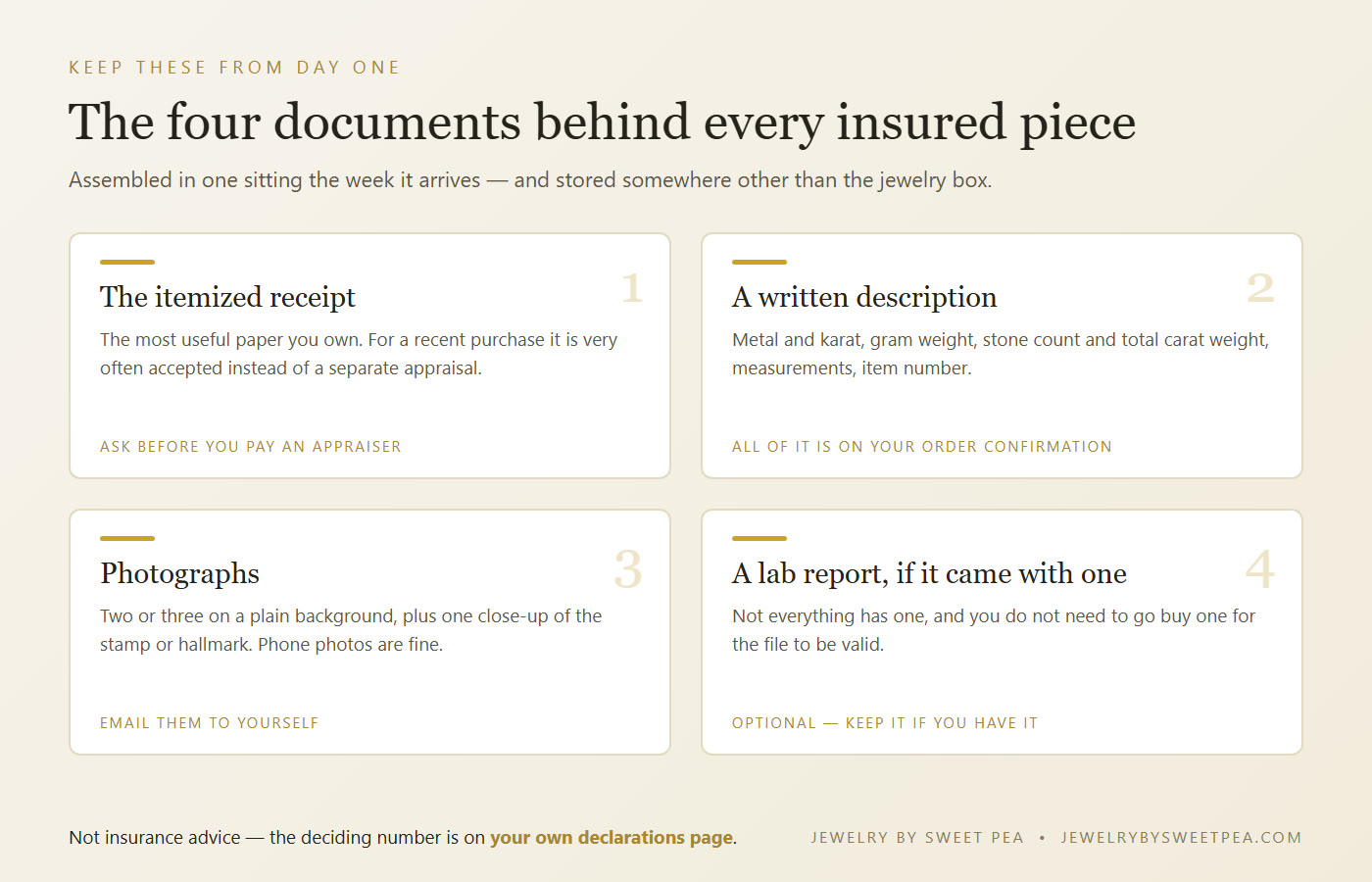
An insurer wants to know what the thing is and what it is worth. Four documents cover it, all assembled the week the piece arrives:
- The itemized receipt. The single most useful piece of paper you own. For a recent purchase it is very often accepted in place of a separate appraisal — ask before you pay an appraiser.
- A written description with the specifics. Metal and karat, gram weight, stone count and total carat weight, measurements, and the manufacturer's item number. All of it lives on our product pages and your order confirmation; copy it into a note.
- Photographs. Two or three on a plain background, plus a close-up of any stamp or hallmark. Phone photos are fine — email them to yourself so they live somewhere other than the phone.
- A lab report, if the piece came with one. Not everything does, and you need not go buy one.
Those stamps inside a band or on a clasp are regulated: the FTC's Jewelry Guides govern what "14K," "sterling" and "gold-plated" may legally describe, which is exactly why a photograph of the stamp belongs in the file. It is also why everything we sell is solid 10K or 14K gold or solid sterling silver, never plated base metal — a plated piece has very little metal value to insure.
Where the line falls, piece by piece
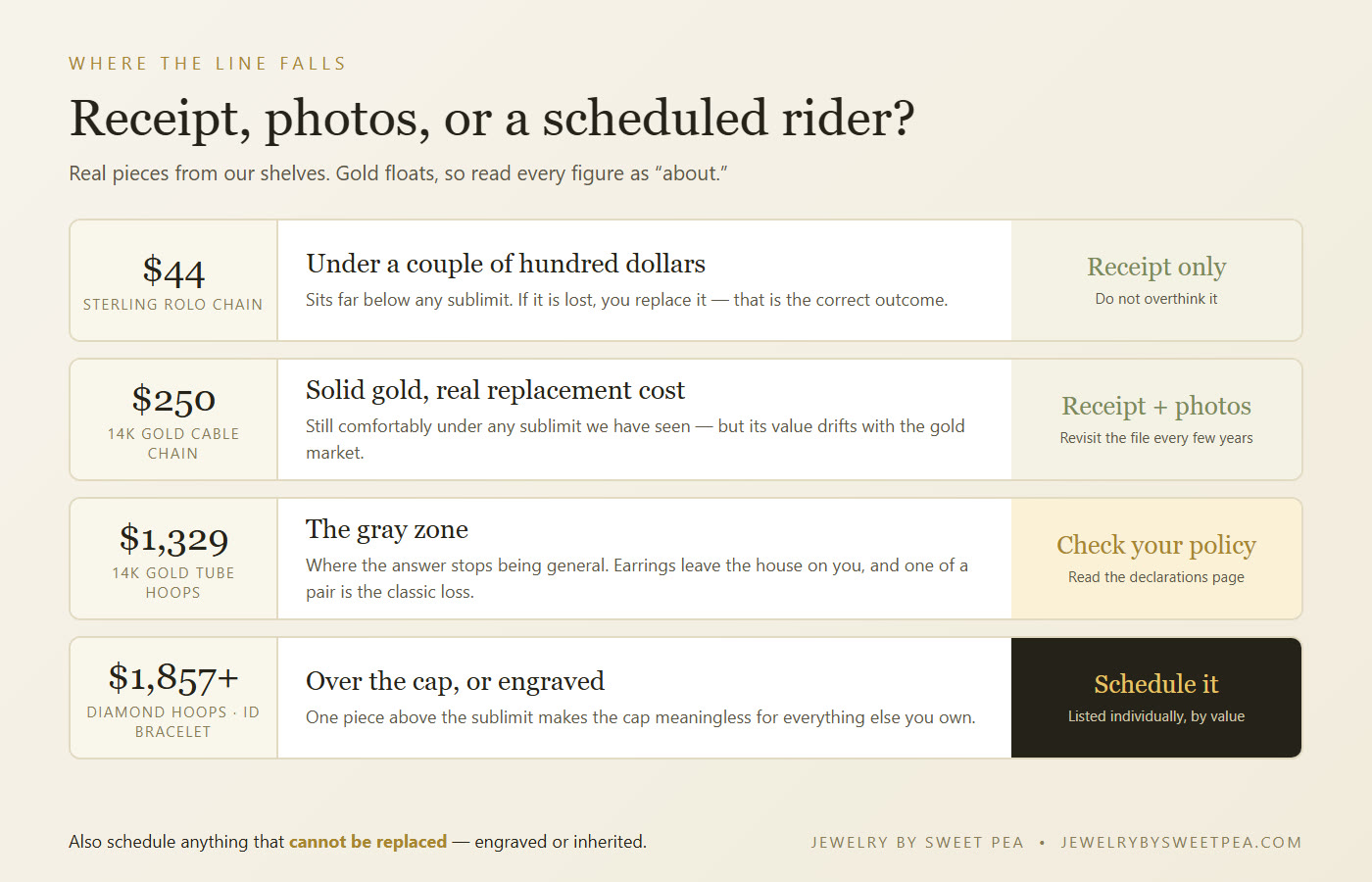
Real pieces off our own shelves, priced today. Gold moves, so read every figure as "about."
Receipt only — do not overthink it. A sterling silver rhodium-plated 2 mm rolo chain is about $44. Nobody schedules a $44 chain. If it is lost you replace it, and that is the correct outcome — as it is for most of what people wear every day.
Receipt plus photographs. A 14K yellow gold 16-inch .9 mm diamond-cut cable chain runs about $250 — solid gold, real replacement cost, still comfortably under any sublimit we have seen. Photograph it and file the receipt. Its replacement cost drifts with the gold market, which argues for revisiting the file every few years, not for a rider.
The gray zone — go read your declarations page. A pair of 14K yellow gold polished 5 mm tube hoop earrings is about $1,329, and this is exactly where the answer stops being general and starts being about your policy. Earrings also fail the second test badly: they leave the house on you, and one of a pair is the classic loss.
Schedule it. A pair of 14K white gold diamond hinged hoop earrings, two rows of natural diamonds at about 0.96 ctw, is about $1,857. A 14K yellow gold diamond ID bracelet with about a quarter carat of diamonds is about $2,003 — and an ID bracelet is usually engraved, which makes it unreplaceable in the way that actually matters. Both of these get scheduled individually, by value.
The same ladder runs through our necklaces, earrings and bracelets. The decision is about the number and the wear pattern, never about the category.
Does storage change anything?
It changes your risk more than your premium. Insurers do care where valuables live — a locking box or a safe is occasionally worth a small credit, so raise it with your agent. But the honest reason to own one is that it prevents the two most common household losses, neither of them burglary: the piece swept into a drawer and forgotten, and the piece a guest or a child moves.
A locking wooden jewelry chest with a drawer and hidden storage is about $281, and there are simpler options in our jewelry storage section. Whatever you use, keep the documentation somewhere else. A box holding both the jewelry and the only copies of the paperwork is one event away from a very bad afternoon.
What does a rider cost?
Riders are quoted as an annual rate applied to the scheduled value, and that rate varies enormously by insurer, by state, by where the piece is kept and by whether it travels with you. Anyone quoting a single national percentage is guessing. Call your agent with the value and the description and ask for the real number — for a piece in the low thousands, most people find the annual figure small enough that deliberating costs more than the coverage.
Two questions worth asking on that same call: does the endorsement cover loss and damage or only theft, and is the payout the scheduled amount or the replacement cost at the time of loss. Those two answers are what you are actually buying.
Common questions
Do I need a separate appraisal for something I just bought? Often not. For a recent purchase, an itemized receipt is frequently accepted as the statement of value. Ask your insurer before paying an appraiser — appraisals matter most for inherited pieces and for jewelry bought years ago.
How often should I update the value? Every three to five years, and sooner if metal prices have moved sharply. A piece scheduled at a value set a decade ago is under-insured today by roughly whatever gold has done since, and that tends to be discovered at the worst possible moment.
What if I inherited it and have no paperwork at all? That is the case an appraisal genuinely exists for. Take it to an independent appraiser rather than to whoever might want to buy it from you, and keep the report with the photographs.
Does a rider cover a stone that falls out? Sometimes — and that is precisely the sentence to read carefully. Scheduled coverage is generally broader than a standard policy's listed perils, but the specifics live in the endorsement wording. Ask directly: is damage included, and is a lost stone treated as damage or as loss?
Should I photograph everything, even the small pieces? Yes, in one sitting. Lay it all out on a plain towel, shoot it in groups, then shoot anything over a couple of hundred dollars on its own. Ten minutes, once.
The short version
Read your declarations page and find the jewelry sublimit. Keep a receipt and a photograph for everything. Schedule the pieces that exceed the cap, leave the house on you daily, cannot be replaced, or would genuinely hurt to lose — and stop worrying about the rest, which is most of it.
If you bought from us and want the metal weight, carat weight or item number for your file, email us and we will send it. We are a small family-run shop and we answer our own email. Every order ships free, arrives in a gift box, and can go back within 30 days.