
What Jewelry Gift Helps a New College Graduate Feel Confident Walking Into Job Interviews
The short answer: one small, quiet, real piece — pearl or crystal studs, or a single fine chain with a simple pendant. Interview jewelry should be forgotten the moment she sits down. Buy something in sterling silver or solid gold that she can wear every day for years, not a bold statement piece she will second-guess in the parking lot.
Every fall we get the same call from a parent: their daughter just finished her degree, she has three interviews lined up in the next two weeks, and they want to send her in with something. Not a costume. Something real, small, and hers.
It is a good instinct, and the reason has nothing to do with impressing a hiring manager. Interviewers are not grading jewelry. What a well-chosen piece does is settle the person wearing it — the same way a jacket that fits properly does. Here is how we help those parents choose.
What actually makes a piece of jewelry work in an interview?
Three things, in this order.
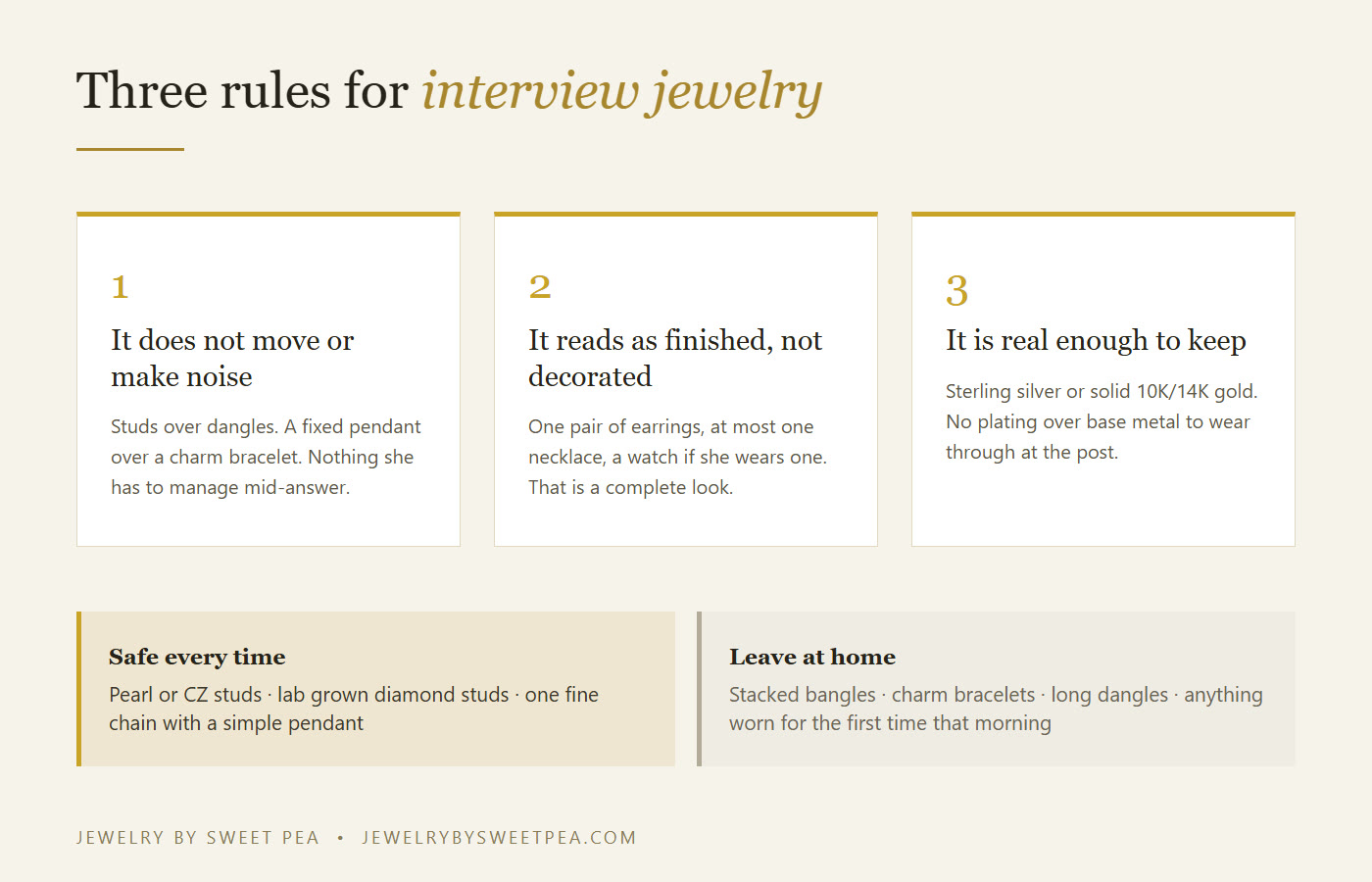
1. It does not move or make noise. Anything that swings, jingles, or slides down her wrist becomes something to manage while she is trying to answer a question about her greatest weakness. Studs beat dangles. A fixed pendant beats a charm bracelet. This is the single most useful filter, and it eliminates about half of what a nervous shopper would otherwise buy.
2. It reads as finished, not decorated. One pair of earrings and, at most, one necklace. A watch if she wears one. That is a complete look for a first interview and it always has been.
3. It is real enough to keep. A gift that tarnishes green in three months teaches her that jewelry is disposable. Sterling silver or solid 10K/14K gold costs more up front and then simply keeps working. We do not sell plated base metal, and this is exactly why.
Why do pearls and small studs keep showing up in interview advice?
Because they solve the problem completely and cost less than people expect.
A pearl stud is small, matte rather than flashy, and neutral against every skin tone and every suit color. It also happens to be the one piece of jewelry that has never looked dated in a professional setting in the past hundred years. That is not a marketing line — it is just what the photographs show.
Worth knowing if you are buying pearls for the first time: cultured does not mean fake. A freshwater cultured pearl is a real pearl grown in a real mollusk, and it is graded on luster, surface, shape, color, size and nacre thickness — the same factors GIA uses to describe pearl quality. Only an imitation pearl is glass or plastic, and by federal rule it has to say so; the FTC's Jewelry Guides require the word "imitation" or "simulated" right in the name. If the listing says freshwater cultured, the pearl came out of the water.
Crystal and CZ studs do the same job with more sparkle, and lab-grown diamond studs do it with the real thing at a fraction of the mined price. All three are correct answers. The differences are budget and how much shine she likes.
What should I actually buy? Six picks that work
These are in stock as we write this, arranged from the smallest gesture to the piece she will still own at forty. Prices move a little with the gold market, so treat them as close, not exact.
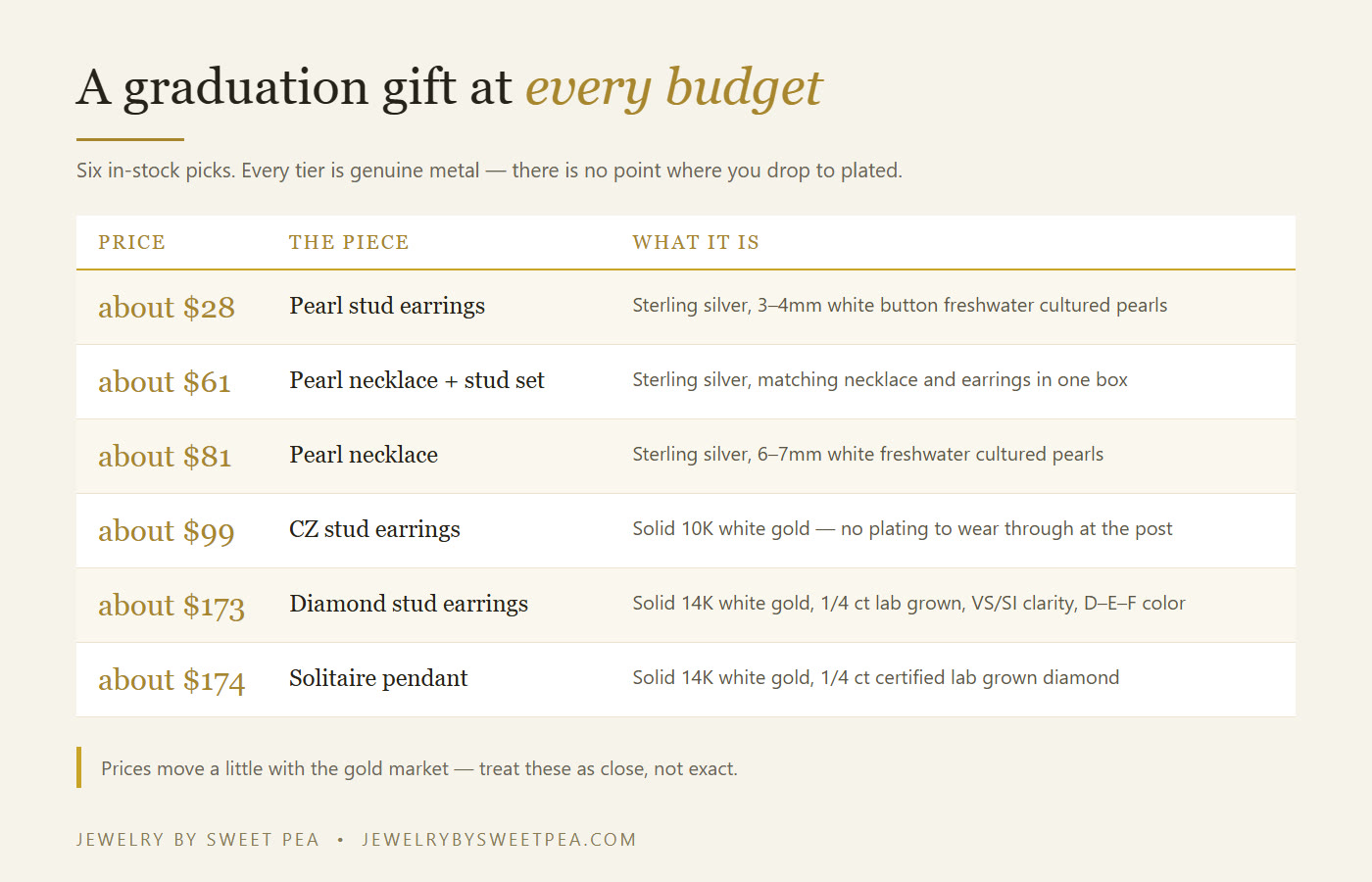
1. Sterling Silver 3-4mm White Button Freshwater Cultured Pearl Stud Earrings — about $28. Genuine freshwater cultured pearls on sterling posts, and deliberately small. At 3-4mm they sit close to the lobe and read as part of her, not as an accessory. If you buy one thing on this page, buy this one. It arrives in a gift pouch.
2. Sterling Silver Freshwater Cultured Pearl Necklace and Stud Earring Set — about $61. The whole interview answer in one box: matching studs and a pearl necklace. For a graduate starting from nothing, a coordinated set removes the decision entirely on a morning when she has enough to think about.
3. Sterling Silver 6-7mm White Freshwater Cultured Pearl Necklace — about $81. A proper strand at a size that photographs well and sits right against a collared shirt. This is the piece she borrows back from her own daughter in thirty years.
4. 10K White Gold Polished CZ Stud Earrings — about $99. For the graduate who wants sparkle rather than pearl. Solid 10K white gold, so there is no plating to wear off at the post — the failure point on cheap studs and the reason so many pairs end up in a drawer.
5. 14K White Gold 1/4 Carat Lab Grown Diamond Solitaire Stud Earrings — about $173. Real diamonds, VS/SI clarity in the D-E-F colorless range, three-prong settings in solid 14K. This is the graduation-gift tier: a pair she will wear to the interview, the offer dinner, and every year after.
6. 14K White Gold 1/4 Carat Certified Lab Grown Diamond Solitaire Pendant — about $174. If she already has studs she loves, give her the necklace instead. A single certified stone on a fine chain is the definition of a piece that does not compete with anything she wears.
More in Earrings, Necklaces and Pearls.
What if my budget is under $50? Under $100?
Every tier here buys something real. There is no tier at which you have to drop down to plated metal.
- Under $50 — sterling silver pearl studs, about $28. Small, genuine, and the single most-worn item on this list.
- Under $100 — the pearl necklace and earring set at about $61, the 6-7mm strand at about $81, or the solid 10K gold CZ studs at about $99. Any of the three is a complete gift.
- $150 to $200 — lab grown diamond studs or a certified solitaire pendant in solid 14K, about $173 to $174. This is where a graduation gift becomes something she keeps in a box rather than a drawer.
One note on the sterling pieces: they are rhodium-plated, and that is a good thing. Rhodium is a bright white finish applied over solid sterling silver to slow tarnish. It is not the same as costume jewelry plated over brass — the metal underneath is real silver either way.
What should she avoid wearing to an interview?
Short list, and none of it is about taste.
- Stacked bangles or charm bracelets. They click against the table every time she gestures, and she will hear it even if no one else does.
- Long dangle earrings. On video calls especially, movement near the face pulls the eye off her.
- Anything she has not worn before that day. A new piece that pinches, spins, or slips is a distraction she does not need. Give it early enough that she has worn it twice before the first interview.
- Rings on the handshake hand, if they are wide or sharp. A thin band is fine. A cocktail ring is a handshake problem.
What is genuinely fine, despite what the internet says: a nose stud she already wears, a watch of any color metal, mismatched metals, and a necklace she never takes off. Interviewers hire people, not outfits.
Solid gold, sterling silver, or plated — does it matter for a first job?
It matters for how long the gift lasts, not for how it looks on day one.
Plated costume jewelry is a thin layer of gold or silver color over a base metal. On earring posts — the part that gets handled daily and sits against skin — that layer wears through fast, and what is underneath is often what causes irritated ears. Sterling silver and solid 10K or 14K gold do not have that problem, because there is no layer to wear through.
For a graduate, that difference is the whole point. She is building a small set of things she will own for a long time. Two real pieces beat six that will not survive the year.
Frequently asked questions
How much should I spend on a graduation jewelry gift?
Most of the graduation gifts we ship land between $50 and $200. Under $50 buys genuine sterling silver pearl studs; around $175 buys solid 14K gold with real lab grown diamonds. Spend where it fits your family — the piece matters more than the number.
Are pearls too old-fashioned for a twenty-two-year-old?
Small pearls are not. A 3-4mm or 6-7mm pearl reads as modern and minimal; it is the multi-strand, large-pearl look that dates. Buy small and she will wear them with a t-shirt on Saturday too.
Should I buy earrings or a necklace?
Earrings, if you are buying one thing. They are visible on video calls, they need no adjusting, and almost every graduate already has pierced ears. Choose the necklace if you know she rarely wears earrings.
Is a lab grown diamond a real diamond?
Yes. It is the same material and the same crystal structure as a mined diamond, grown in a lab rather than in the ground, and it must be disclosed as lab grown under the FTC Jewelry Guides. The practical difference for a gift like this is that a quarter carat costs a fraction of the mined equivalent.
What if I get the wrong thing?
Send it back. We ship free, we return free for 30 days, and everything on this page arrives gift-ready. A graduation gift should not come with a risk attached.
The one-line version
Buy her something small, real, and quiet — pearl studs at about $28, or lab grown diamond studs at about $173 if this is the big gift. Give it a week before the first interview so it is already familiar. Then let her walk in and forget she is wearing it, which is precisely the job it was bought to do.
Questions about sizing, metal, or what suits a particular graduate? We are a family-run shop and we answer our own email — ask us before you buy.