
What Jewelry Gift Is Appropriate for a College Senior Heading to Graduate School
The short answer: give something small, solid and wearable every single day — a simple pendant, a pair of modest gold hoops, or a slim bangle in solid 10K or 14K gold or sterling silver. Skip anything showy. A student going straight into a lab, a clinic or a classroom needs jewelry that survives gloves, sinks and long days without being noticed.
Parents ask us this every spring and again in August, and the question underneath it is usually the same: we already did the graduation gift, so what is this one? It is a fair question. Undergraduate commencement is a finish line, and finish-line gifts tend to be commemorative. Starting a master's, a PhD or a professional program is not a finish line. It is a first day. That changes what the right piece looks like.
How is a grad-school gift different from a graduation gift?
A commencement gift is allowed to be sentimental and occasional. A charm engraved with a year, a framed photo, a keepsake that lives in a drawer between anniversaries — all appropriate, all appreciated.
A grad-school gift is a working gift. It gets put on at 6 a.m. and taken off at midnight, five or six days a week, for two to seven years. That reframes the whole decision around three practical questions:
- Will it survive the environment? Bench chemistry, hospital hand-washing, kiln rooms, machine shops, field work and daycare rotations are all hard on jewelry — and some programs prohibit rings and dangling pieces outright.
- Will it read as professional? Graduate students teach undergraduates, present at conferences, sit for oral exams and meet patients or clients. Jewelry that is quiet in those rooms is jewelry they will actually wear.
- Is it made to last the program? Plated jewelry wears through in months of daily use. Solid gold and sterling do not. Everything in our store is solid 10K or 14K gold or sterling silver, never plated base metal, and that is the difference between a gift that finishes the degree and one that turns green by Thanksgiving.
What will they actually wear in a lab, clinic or classroom?
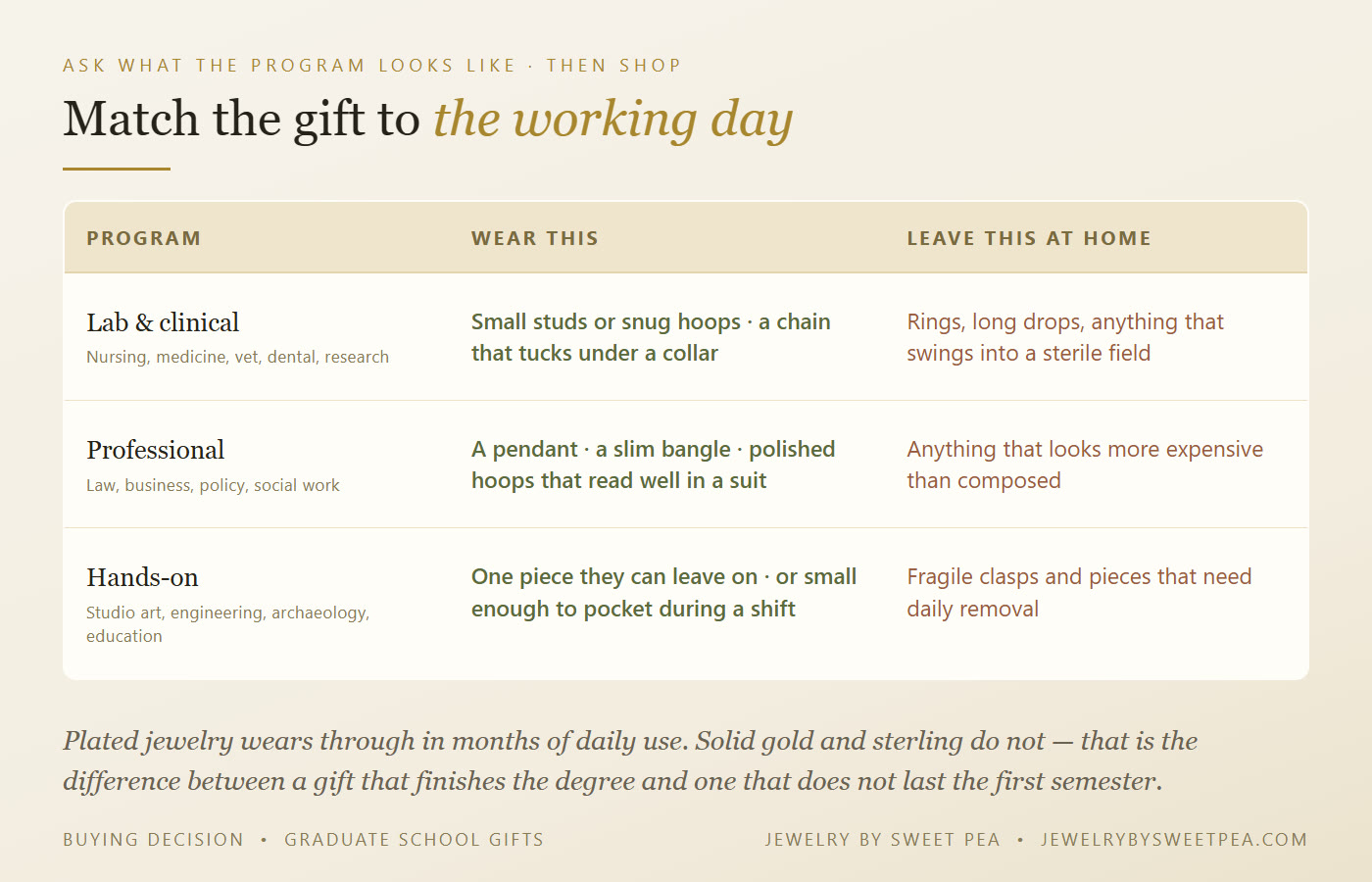
Ask what the program looks like before you shop. It narrows the field faster than any style question.
Lab sciences, nursing, medicine, veterinary, dental. Small studs or snug hoops and a chain that tucks under a collar. No rings, no long drops, nothing that swings into a sterile field or catches on a glove cuff. Many of these programs have written policies limiting hand and wrist jewelry, so the neck and ears are the safe places to give.
Law, business, public policy, social work. More latitude. A pendant, a slim bangle, or hoops that read polished in a suit all work. This is the student most likely to be sitting across a table from someone who is evaluating them, so the gift should look composed rather than expensive.
Studio art, engineering, archaeology, education. Hands are busy and often dirty. Give something they can leave on, or something small enough to slip into a pocket during a shift.
Which pieces work best, and what do they cost?
These are pieces we actually stock, chosen because they hold up to daily wear. Prices move with the gold market, so treat them as close approximations rather than quotes.
- Sterling silver 3-D graduation cap pendant with a moveable tassel — about $35. The most affordable way to mark the milestone in real metal. A nice piece to send with a card when the big gift is something else.
- 10K yellow gold polished and satin hoop earrings — about $93. Small, close to the ear, nothing to catch. If you buy one thing on this page for a student in a clinical program, this is it.
- 10K yellow gold graduation charm — about $148. Commemorative but small enough to live on a chain or a bracelet without announcing itself in a seminar room.
- 10K yellow gold polished oval locket — about $160. For a student moving far from home. A locket is the one sentimental piece that still works as everyday jewelry, because the sentiment is on the inside.
- 10K yellow gold 1.5mm diamond-cut slip-on bangle — about $171. Slim, rigid, no clasp to fail. Slides off in one motion when hands need to be bare.
- 14K yellow gold solid polished 3-D graduation cap pendant — about $336. The version meant to be kept for decades and handed down, not worn to lab.
If none of those is quite right, the broader pendants and charms, earrings and bracelets categories have far more, and remember that most pendants need a chain, which is sold separately — see our necklaces and chains.
What should I spend?
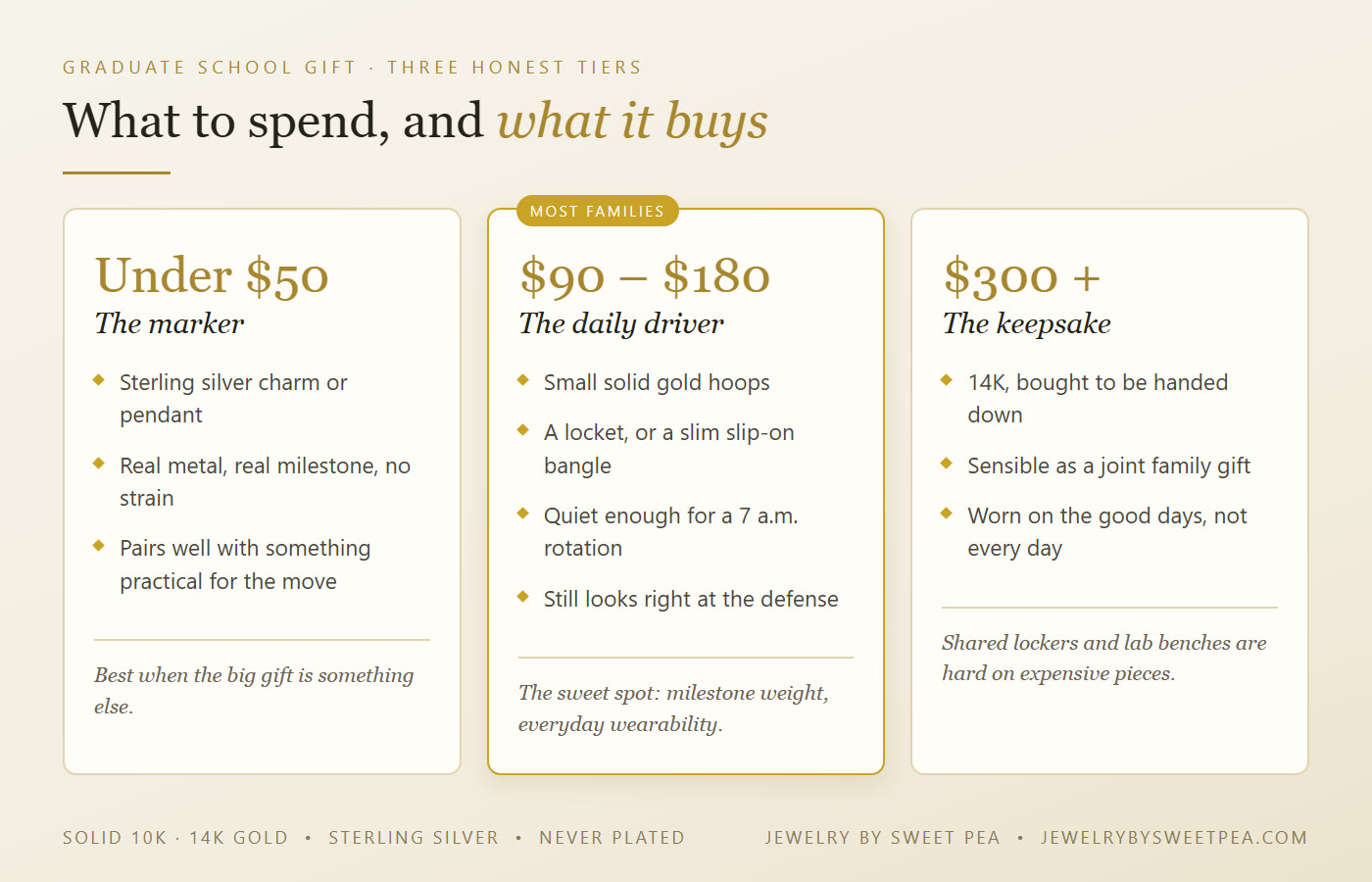
There is no correct number, but there are three honest tiers, and the middle one is where most families land.
- Under $50 — the marker. A sterling silver charm or pendant. Real metal, real milestone, no financial strain. Pair it with something practical they need for the move and it lands beautifully.
- $90 to $180 — the daily driver. Small solid gold hoops, a locket, a slim bangle. This is the sweet spot: substantial enough to feel like a milestone gift, plain enough to wear to a 7 a.m. rotation, and durable enough to still look right at the defense.
- $300 and up — the keepsake. A 14K piece bought to last. Reasonable if this is a joint gift from several family members, or if it doubles as a graduation-plus-birthday gift.
One caution on the top tier: an expensive piece worn daily in a program that involves shared lockers, gym bags and communal lab space is a piece that can go missing. If you spend at that level, expect it to be worn on the good days, not every day.
Keepsake or everyday? A quick comparison
A keepsake piece — the 14K cap pendant, an engraved charm, a locket with a family photo inside — carries meaning immediately and gets worn occasionally. An everyday piece — hoops, a plain bangle, a simple chain — carries meaning slowly, because it becomes part of how the person looks in their own mind during the hardest years of their education. Both are right. If you can only choose one, and the student is entering a demanding clinical or research program, choose everyday. If they are staying close to home or entering a program with a strong professional dress culture, the keepsake will get more air.
Pearls deserve a mention because they are the traditional academic gift. A pair of pearl studs is genuinely appropriate for a graduate student who will be presenting and interviewing, but pearls are soft and hate hand sanitizer, hairspray and perfume. If you go that direction, learn what actually drives quality first — the GIA pearl quality factors explain luster, surface and nacre far better than a product page will.
How do I know what I am actually buying?
Metal claims in the United States are regulated, not decorative. The FTC's Jewelry Guides set the rules for terms like "14K gold," "sterling silver" and "gold-filled," and any honest seller can tell you exactly which one applies. "Gold tone," "gold finish" and "gold overlay" are not gold. For a gift meant to survive a multi-year program, that distinction is the whole decision — a plated piece and a solid 10K piece can look identical in a photograph and behave nothing alike after six months of daily wear.
Frequently asked questions
Is jewelry an appropriate gift for a graduate student, or is it too personal?
It is appropriate from family and close friends. From a professor, mentor or colleague, jewelry reads as too personal — a book, a pen or a contribution toward conference travel is the better gift in that relationship.
Should I buy gold or sterling silver?
Silver if the budget is under about $60 or if the student already wears silver-toned pieces. Solid 10K or 14K gold if you want it to look the same in ten years with minimal care — gold does not tarnish, and silver will need occasional polishing. Match whatever they already wear rather than switching them.
What about engraving the graduation year?
Engraving makes a keepsake more meaningful and an everyday piece slightly less versatile. Our rule of thumb: engrave a charm, a locket or a disc, but leave hoops, chains and bangles plain so they work with everything.
Is a ring a good grad-school gift?
Usually not. Ring sizing is easy to get wrong as a surprise, many clinical and lab programs restrict hand jewelry, and a ring can be read as something it is not. If you want to give a ring, ask first — and note that our ring sizing is handled by request rather than as a standing service.
They are moving out of state. Does that change anything?
It argues for one good piece rather than several, and for a locket or a pendant over a bracelet — a piece worn at the neck stays on through packing, moving and a first apartment. It also argues for buying early enough to handle an exchange before they leave, since sizing and length questions are much easier to solve while everyone is in the same house.