
What Jewelry Gift Should Parents Split the Cost on for a Major Graduation Milestone
The short answer: Split the cost on one solid gold piece the graduate will wear for decades, not two smaller gifts. For most families that is a pair of diamond stud earrings, a classic pearl strand, a lab-grown diamond solitaire necklace or a plain gold bangle. Two parents pooling about $300 to $700 lands squarely in that range, and the gift reads as one shared milestone rather than two separate ones.
We're a small, family-run jewelry store, and the "we'd like to go in on this together" conversation is one we have every spring. Sometimes it's a married couple deciding on one meaningful piece instead of a stack of gift cards. Sometimes it's parents who are no longer together and want their graduate to receive one gift from both of them. Either way, the question is the same: what piece is worth pooling money on, and how much should each side put in? Here's how we'd answer it.
Why split the cost on one piece instead of buying two gifts?
A graduation is one of a handful of moments where a piece of jewelry becomes a keepsake rather than an accessory. Twenty years from now, the graduate will remember who gave them their first real diamond earrings. They will not remember two mid-range gifts from the same week.
Pooling money also moves the budget into the range where solid gold and real stones become possible. One parent spending $200 buys a nice charm. Two parents spending $200 each buys diamond studs, a pearl necklace or a gold bangle that will outlast every phone, laptop and car the graduate owns. The jump in quality between those two price points is bigger than it looks.
And for parents who live in separate households, one shared gift has a quiet benefit: the graduate gets a single, unified "we are proud of you," with no comparing of boxes.
What makes a jewelry gift graduation-worthy?
Before picking a piece, run it through four quick tests. A gift that passes all four is one you'll feel good about for a long time.
- Solid gold or sterling silver, never plated. Plated jewelry wears through at the edges within a year or two. A milestone gift should be solid 10K or 14K gold, or sterling silver with a solid gold accent. The FTC's Jewelry Guides spell out what "gold" and "plated" are allowed to mean, and the difference is exactly why we don't sell plated pieces.
- Wearable every day. A graduate heading to a first job or graduate school needs jewelry that works with a blazer and with a t-shirt. Studs, a simple pendant, a thin bangle and a pearl strand all do.
- Timeless, not trendy. Skip anything tied to this year's look. Classic shapes are the ones still in rotation at age forty.
- Upgradeable. Studs can be swapped for larger ones later. A charm can move to a new chain. A bangle can be stacked. A gift that grows with the graduate feels like a beginning, not a finish line.
What are the best jewelry gifts for parents to split the cost on?
These are the pieces we recommend most often when two people are going in together. Each one is solid gold, each one is a classic, and each one lands in a different budget band so there's a fit whether you're pooling $150 or $700.
Diamond stud earrings
The single most popular "split" gift we see. Studs go with everything, they're the first piece on in the morning and the last off at night, and the graduate can trade up to a larger carat weight on a future milestone. If you only remember one recommendation from this article, it's this one.
A classic pearl strand
Pearls have a long history as a graduation gift, and for good reason: a single strand works for a first interview, a wedding and a holiday dinner. Akoya pearls are the traditional round, high-luster choice. Freshwater pearls give you more size for less money. Either way, look at luster and surface before size, which is the same order the GIA uses in its pearl quality factors.
A lab-grown diamond solitaire necklace
A single diamond on a fine chain is the understated "grown-up" piece. Lab-grown stones have made a certified, eye-clean solitaire affordable for two parents to split without stretching, and the sparkle is identical to a mined diamond of the same grade.
A plain gold bangle
A thin slip-on bangle in 14K gold is the gift for a graduate who doesn't wear earrings or necklaces. It's quiet, it stacks with a watch, and it's the kind of piece that becomes a signature.
An initial charm on a gold chain
The budget-friendly version of a milestone gift. A solid gold letter charm on a diamond-cut chain feels personal, and the charm can move to a new chain or bracelet for years. For a graduate with a faith tradition, a simple gold cross on the same chain fills the same role.
Our picks in solid gold
Here's what each of those looks like from our own case. Prices float with the gold market, so treat these as "about," and check the product page for today's number.
- The classic split gift: 14K yellow gold 0.40 carat total weight diamond stud earrings, G-I color, with secure thread-on backs, about $670. Two parents at $335 each.
- Diamond studs on a tighter budget: 14K yellow gold 1/4 carat total weight diamond stud earrings, about $285. Still real diamonds, still solid gold, and about $145 a side.
- The pearl strand: 14K gold 7-8mm white round Akoya cultured pearl necklace with a pearl clasp, from about $281 depending on length. The traditional choice.
- Pearls under $200: 14K gold 10-11mm freshwater cultured pearl rope necklace, about $165. Bigger pearls, lower price, and a 14K clasp.
- The solitaire: 14K gold 1/3 carat certified lab-grown diamond solitaire necklace, 18 inch chain included, about $290. D-E-F color, VS clarity, and it photographs beautifully.
- The bangle: 14K yellow gold 1.5mm diamond-cut slip-on bangle, about $272. No clasp to break, nothing to lose.
- The personal pick: 14K gold slanted block letter initial charm (every letter is in stock), about $71, on a 14K 0.8mm diamond-cut Forzantine cable chain, from about $141. Together, about $210. A 14K white gold polished cross pendant, about $93, is the faith-based version on the same chain.
Browse more in our earrings, pearls, necklaces and bracelets collections. Every piece in those categories is solid gold or sterling silver.
How much should each parent chip in?
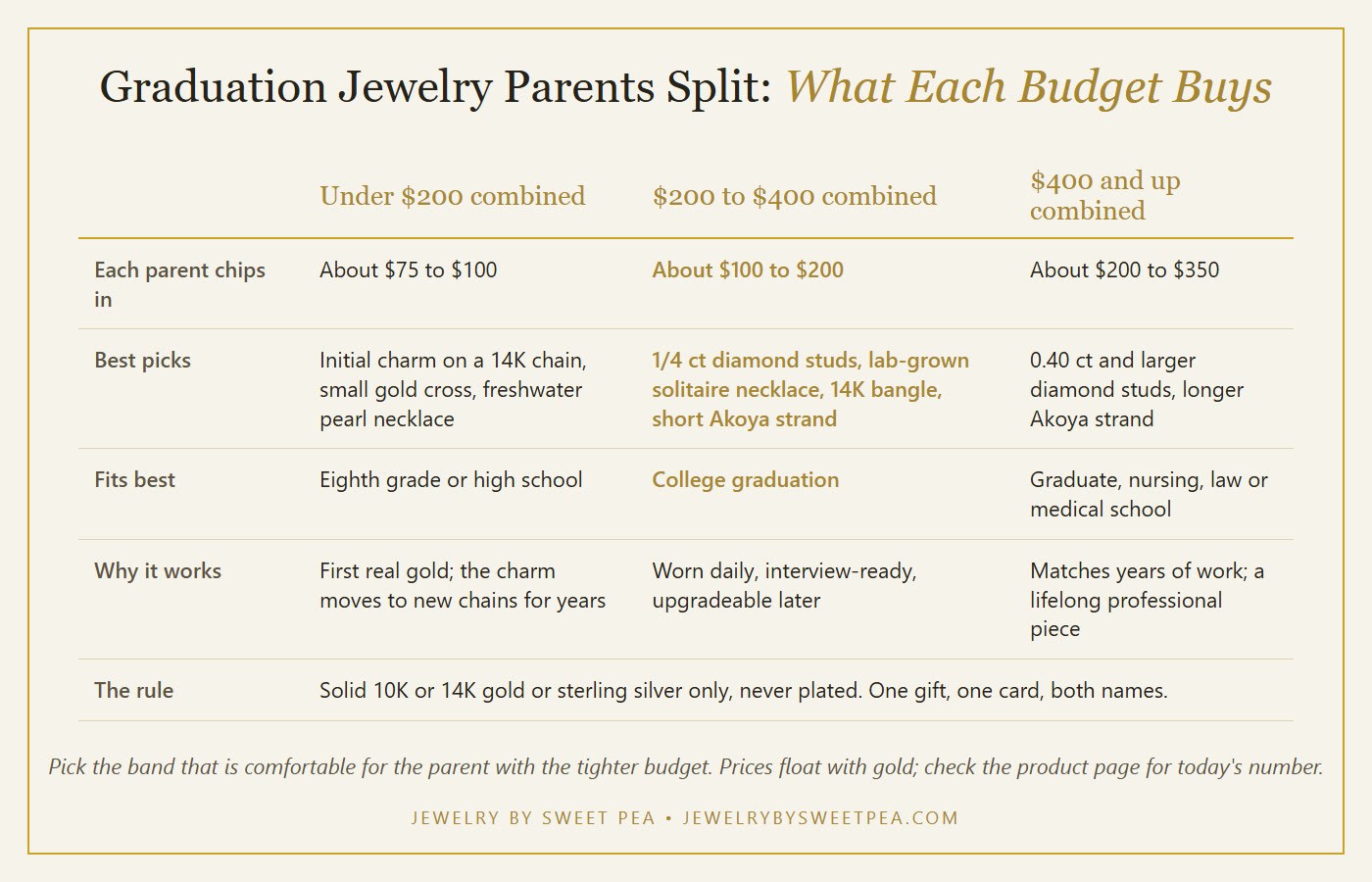
There's no rule, but there is a pattern. The gifts that families feel best about afterward tend to fall into three bands.
- Under $200 combined, about $75 to $100 each. An initial charm on a solid gold chain, a small gold cross, or the freshwater pearl rope necklace. Real gold, a real keepsake, no strain on either budget. Right for a high school graduation or an eighth-grade promotion.
- $200 to $400 combined, about $100 to $200 each. The sweet spot. Quarter-carat diamond studs, the lab-grown solitaire necklace, the gold bangle or the shorter Akoya strand. This is where most college graduation gifts land.
- $400 and up, about $200 to $350 each. Larger diamond studs or a longer Akoya strand. Fits a graduate school, nursing, law or medical graduation, where the degree took years and the gift should feel like it.
Our honest advice: pick the band that's comfortable for the parent with the tighter budget, and let the other parent cover a small extra like a jewelry box or a cleaning kit if they want to do more. An uneven split that nobody mentions is fine. An uneven split that gets mentioned to the graduate is not.
How do you split a gift when the parents aren't together?
This comes up more than you'd think, and it works well when you keep it simple.
- One person orders. Pick whoever is more comfortable shopping online. The other reimburses their half before the gift is given, so nobody is chasing money after the party.
- One card, both names. The point of a shared gift is that it arrives as one. Sign it together, even if you write your lines separately.
- Agree on the piece before anyone buys. Send the product link, agree on the price, then order. Surprises between the two of you are what cause friction, not the gift itself.
- Keep the receipt with the orderer. If it needs an exchange for a different length or size, one person handles it.
Which gift fits which graduation?
Match the weight of the gift to the weight of the milestone.
- Eighth grade or high school. An initial charm, a small cross, or a freshwater pearl necklace. First real gold, and the start of a collection.
- College. Diamond studs, the solitaire necklace, the gold bangle or an Akoya strand. The graduate is about to interview, and every one of these works in that setting.
- Graduate, nursing, law or medical school. Step up the carat weight or pearl size. This person has worked for years and will wear the piece in a professional setting for decades.
How should you present a shared gift?
Give it in person if you can, on the day, from both of you. Let the card say what the piece is for: "for your first interview," "for every day you earned this." If the graduate is walking into a career, a note about wearing it on the first day of work gives the gift a job to do. And have it shipped a week early. Graduation week is not the week to find out a chain needs to be exchanged for a longer one.
Frequently asked questions
What is the most popular graduation jewelry gift for parents to give together?
Diamond stud earrings. They work with any outfit, they're worn daily, and the graduate can upgrade to a larger size on a later milestone. A classic pearl strand is the traditional alternative.
How much should parents spend on graduation jewelry?
Most families pool $200 to $400 for a college graduation, which buys solid gold diamond studs, a lab-grown diamond solitaire necklace or a gold bangle. Under $200 buys an initial charm on a gold chain or a freshwater pearl necklace. Graduate-degree gifts often run $400 and up.
Is a pearl necklace still a good graduation gift?
Yes. A single strand of Akoya or freshwater pearls works for interviews, weddings and formal events, and pearls never go out of style. Choose a strand with good luster and a clean surface, and make sure the clasp is solid gold.
Should a graduation gift be real gold or is gold-plated okay?
A milestone gift should be solid 10K or 14K gold or sterling silver. Plated jewelry wears through at the edges within a year or two and can't be repaired or resized, which makes it the wrong choice for a keepsake meant to last decades.
How do divorced parents split the cost of a graduation gift?
Agree on the exact piece and price first, have one parent order it, and have the other reimburse their half before the gift is given. Present it with one card signed by both so the graduate receives a single shared gift.