
What Jewelry Industry Veterans Say About Caring for Gold So It Lasts Generations
The short answer: people who have spent their lives at the jeweler's bench agree on a simple formula — put gold on last and take it off first, wash it a few times a year in nothing stronger than warm water and dish soap, store each piece in its own soft pouch, and have clasps and prongs checked once a year. Do those four things to a solid 10K or 14K gold piece and it will outlive you — gold is almost never lost to age, only to a worn clasp, a harsh chemical, or a scratchy jewelry box.
Ask anyone who's spent thirty years repairing jewelry what kills a gold chain, and you'll get the same half-smile: "Nothing kills gold. People lose it, snag it, or soak it in the wrong thing." Solid gold is chemically stable for centuries — the routine veterans recommend isn't about protecting gold from time, but from us. Here it is, in order.
The daily habit: "last on, first off"
The single rule bench jewelers repeat most often is the order you get dressed. Gold goes on after lotion, perfume, hairspray, and sunscreen — and comes off before the gym, the pool, the dishes, and bed. Cosmetics won't destroy gold, but they build a dull film that steals its shine.
A few more daily habits the trade swears by:
- Take rings off for real work. Gardening, weights, moving furniture — a band can be bent or gouged in a second. As the old repair-counter line goes: "We can polish scratches; we can't un-crush a ring."
- Keep chains out of the pool and hot tub. Chlorine genuinely attacks the alloy metals in karat gold — repeated exposure makes solder joints and links brittle enough to snap.
- Give it a two-second wipe. A soft-cloth pass when you take a piece off removes the day's skin oils before they harden into film — veterans say this habit does more than any cleaning product.
Cleaning gold the way the pros do (it's cheaper than you think)
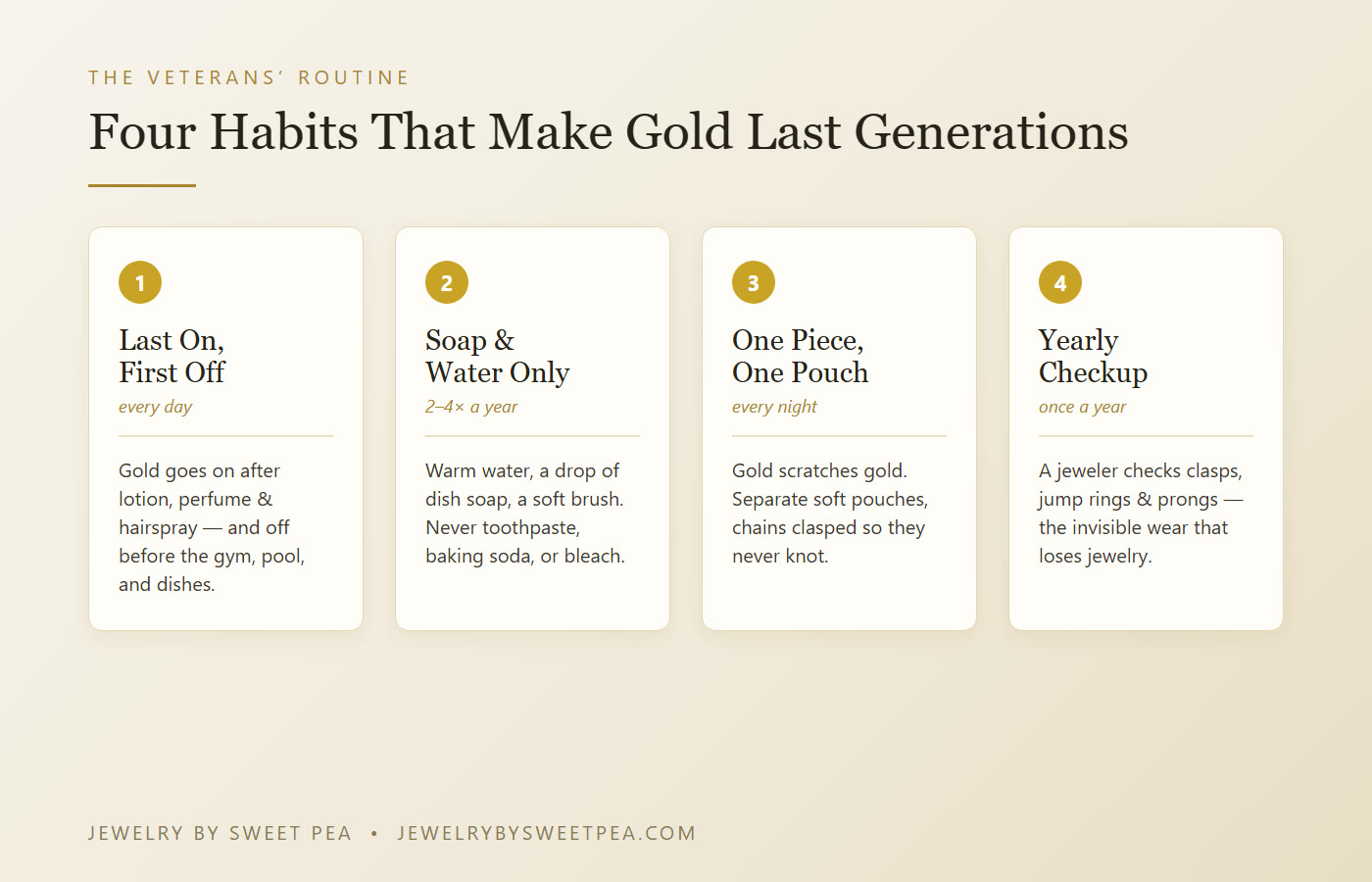
Ask any workshop how they clean a customer's gold chain and the answer is almost embarrassing: warm water, a drop of mild dish soap, and a soft brush. Soak the piece ten to fifteen minutes, work a baby-soft toothbrush gently into the links or behind a stone, rinse, and pat dry with a lint-free cloth. That's the whole professional secret, safe for solid 10K and 14K gold every time.
Just as important is what veterans tell you not to use:
- No toothpaste, no baking soda. Both are abrasives — they "work" by sanding off a microscopic layer of your gold, and over years a diamond-cut finish visibly softens.
- No bleach, ever. Chlorine bleach can pit and embrittle karat gold in a single careless soak.
- Careful with home ultrasonic machines. Fine for a plain solid chain; risky for anything with stones, which can loosen. Pros use them daily — but they check every prong afterward.
How often? Two to four times a year is plenty. Gold cleaned gently and rarely outlasts gold scrubbed hard and often.
Storage: where most damage actually happens
Here's the counterintuitive one: a bench jeweler will tell you more gold gets scratched in the jewelry box than out in the world. Gold is a soft metal, and pieces tossed together in one tray scratch each other every time the drawer opens.
- One piece, one pouch. A soft cloth pouch or lined compartment per item — the cheapest heirloom insurance there is.
- Clasp your chains before storing. Fasten the clasp and lay the chain flat or hang it; a fine rope chain that tangles into a hard knot often can't be saved without cutting a link.
- Skip the bathroom. Humidity speeds tarnish on nearby sterling silver, and it's where perfume and hairspray live. A cool, dry bedroom drawer is ideal.
The professional checkup: once a year, without fail
Veterans are unanimous that the pieces which survive generations are the ones that saw a jeweler regularly. An annual visit — most shops do it free or nearly so — covers the failure points you can't see: worn clasp springs, thinning solder joints, stretched jump rings, loosened prongs. A five-dollar jump ring replaced on time is what keeps a pendant off the sidewalk.
Ask for a professional polish only every few years — each polish removes a whisper of metal, and an heirloom's engraving is worth preserving. In between, an untreated soft cloth at home keeps the shine up without removing anything.
What actually damages gold (and what only looks like damage)
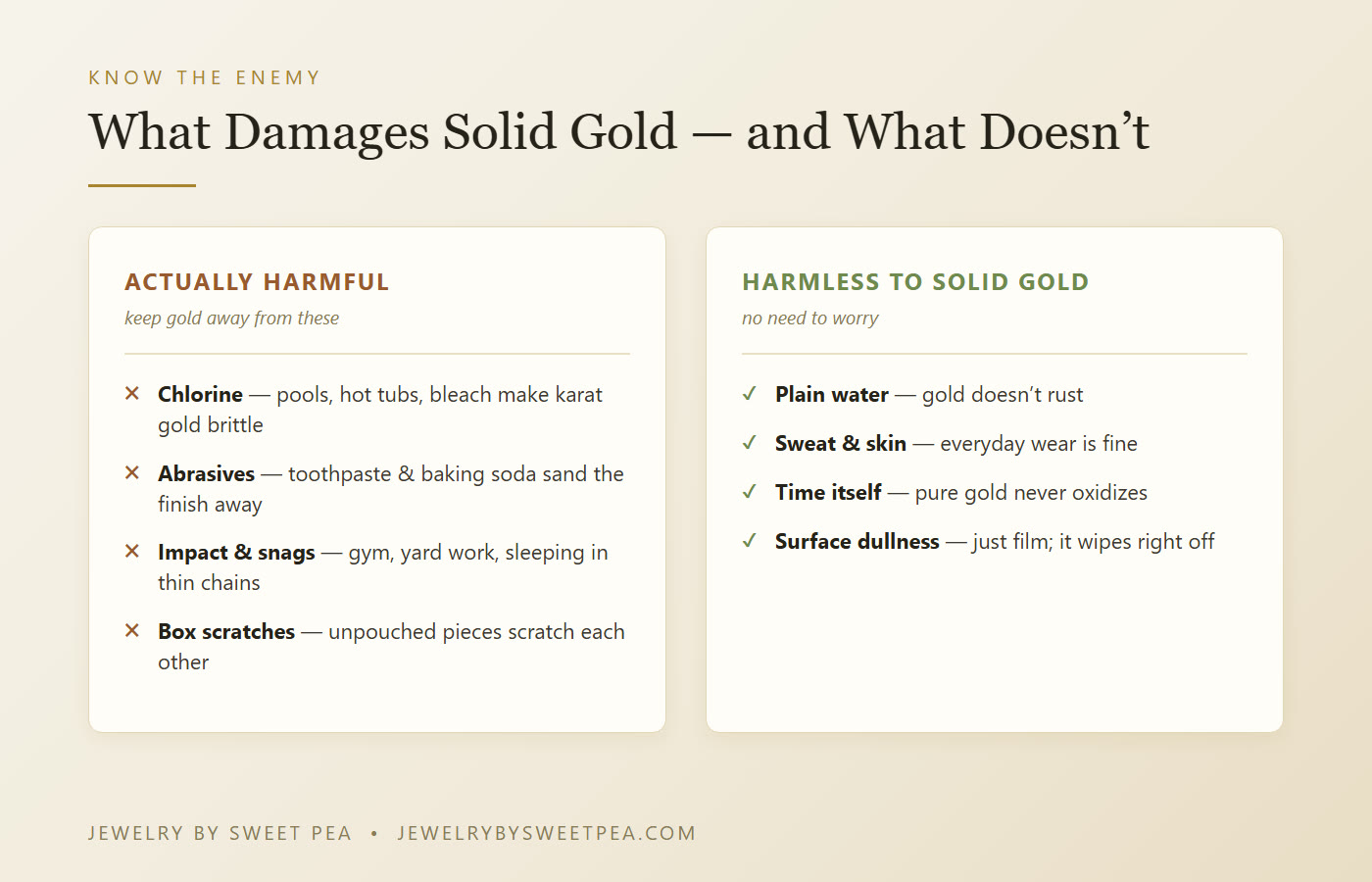
Solid gold's real threats are a short list: chlorine (pools, spas, bleach), abrasives (toothpaste, baking soda, gritty cloths), impact and snags (gym, yard work, sleeping in thin chains), and box scratches from unpouched storage. Mercury from older thermometers permanently stains gold on contact — every old-timer has a horror story about it.
Meanwhile, the things people worry about — plain water, sweat, skin contact, time itself — are harmless to solid gold. Pure gold doesn't oxidize; a 10K or 14K piece can slowly dull only because of the copper and silver alloyed into it for strength, a chemistry explained well in this overview of gold alloys and their colors. That surface film wipes away; it is not decay.
One caveat veterans insist on: everything above applies to solid gold. Gold-plated jewelry is a micron-thin layer over base metal — no routine can stop it wearing through, which is why plated pieces don't become heirlooms. U.S. sellers must describe gold content accurately under the FTC Jewelry Guides (16 CFR Part 23), so read the listing: "10K gold" means solid; "gold-plated" means care can only slow the inevitable. Every piece we sell is solid 10K or 14K gold or sterling silver — never plated — because care should be rewarded.
Gold worth caring for: solid pieces at every budget
The routine only pays off on solid gold. Here are in-stock solid 10K and 14K pieces built to be maintained for decades, from about $100 to about $700:
Around $100–$170 — the starter heirlooms
- 10K Yellow Gold Cross Pendant — about $104. No stones, no moving parts: the lowest-maintenance heirloom there is.
- 10K Yellow Gold Fancy Small Hoop Earrings — about $134. Small hoops live a gentle life; an occasional soapy bath keeps them new.
- 10K Yellow Gold 1.5mm Diamond-Cut Slip-On Bangle — about $167. No clasp, one less failure point; pouch it separately to protect the sparkle.
Around $200–$350 — the everyday workhorses
- 10K Yellow Gold 2mm Diamond-Cut Lightweight Rope Chain — about $222. Rope link is the pattern repairers praise for durability; clasp it before storing.
- 10K White Gold .20Ct. Diamond Stud Earrings — about $316. The classic daily pair — this is the piece that most needs its yearly prong check.
Around $700 — the generational piece
- 14K Yellow Gold Adjustable 1.2mm Diamond-Cut Rope Chain — about $693. Adjustable to any wearer — the chain that's worn daily for forty years, then handed down.
Prices are at the time of writing; solid gold moves with the market. Browse more in our Necklaces and Bracelets collections.
Frequently asked questions
Can I wear my gold jewelry in the shower?
Plain water won't harm solid gold, so an occasional shower is fine. Veterans still suggest taking it off: soap leaves the film that dulls shine, and drains are where chains go to disappear. It's a shine-and-loss issue, not a damage issue.
How often should gold jewelry be professionally cleaned and inspected?
Once a year. The inspection matters more than the cleaning — clasps, jump rings, and prongs wear invisibly, and catching them early keeps a piece alive for generations. Between visits, a soapy soak at home a few times a year is plenty.
Does 10K gold last as long as 14K gold?
Yes — both are solid karat gold and both last generations. 10K has a higher share of harder alloy metals, so it resists scratches slightly better; 14K has richer color. With the same care routine, the difference over a lifetime is cosmetic, not structural.
What is the safest way to clean gold at home?
Soak the piece 10–15 minutes in warm water with a drop of mild dish soap, brush gently with a soft toothbrush, rinse, and pat dry. Never use toothpaste, baking soda, or bleach, and be cautious with home ultrasonic cleaners on anything holding stones.
Why does my solid gold jewelry look dull if gold doesn't tarnish?
Pure gold doesn't oxidize, but the copper and silver alloyed into 10K and 14K gold can form a faint film, and skin oils add haze on top. Both wipe away with a soft cloth or a soapy soak — dullness on solid gold is surface film, never decay.
Jewelry by Sweet Pea is a family-run fine jewelry store. Every piece is solid 10K or 14K gold or sterling silver — never plated — sourced from U.S. wholesalers and shipped from the USA. Browse our Necklaces and Bracelets collections, or ask us anything before you buy.