What Jewelry Represents Family Legacy and Generational Success Across the Decades
The short answer: the pieces that become family legacy are the ones made of enduring material and personal meaning — solid gold lockets that hold a photograph, cultured pearl strands that pass from mother to daughter, and gold cross pendants worn at every generation's milestones. In solid 10K or 14K gold and real cultured pearls, they physically outlast the person who first wore them.
Every family has that one piece. The locket a grandmother wore to church. The pearls that came out for weddings and graduations. They aren't the most expensive things a family owns — they're the most continuous. Here is what actually turns a piece of jewelry into a family heirloom, which styles have carried generational meaning across the decades, and the solid-gold pieces we'd choose to start that story today.
What makes a piece of jewelry become a family heirloom?
Not every necklace becomes an heirloom. Three things separate the pieces that get passed down from the ones that get forgotten in a drawer:
- It's made of material that lasts. Solid gold and real cultured pearls survive generations of daily wear. Gold-plated pieces wear through to base metal in a few years and can't be handed down — the plating is gone before the sentiment sets in. This is why heirlooms are almost always solid karat gold, sterling silver, or genuine gemstones and pearls.
- Its style is timeless, not trendy. A locket, a pearl strand, a simple cross — these forms have looked "right" for a hundred years and will look right in another hundred. Fashion pieces date themselves to a decade; classic forms don't.
- It carries a specific memory. The piece that gets passed down is the one attached to a story: the graduation, the wedding, the "this was your great-grandmother's." Meaning is what makes an heir want to keep it.
One practical note that protects the "lasts for generations" promise: buy from a seller who states the karat plainly. In the U.S., how gold content may be described is governed by the FTC Jewelry Guides (16 CFR Part 23). A listing that dodges the karat question is telling you something. Every piece we sell is stamped, solid gold or sterling silver — never plated.
The heirloom that holds a memory: the gold locket
No piece of jewelry is more literally about family legacy than a locket — it is designed to carry a photograph of the people who matter. It's the heirloom that arrives already holding its own meaning.
The 10K White Gold Heart Locket (about $154) is the classic starting point: a solid gold heart that opens to hold two small photos, understated enough to wear every day. For something with a little more presence — and a message built in — the 10K Yellow Gold with Rhodium 21mm Oval Guardian Angel Locket (about $233) pairs the keepsake function with a protective symbol that has meant "watched over" across many generations.
A locket is the rare gift that gets more valuable to a family over time: each generation adds a photo, and the piece itself becomes a tiny, wearable family album.
The strand that crosses generations: cultured pearls
If you picture an heirloom in your mind, there's a good chance it's a strand of pearls. Pearls have signaled family standing and been passed mother-to-daughter for centuries precisely because they are timeless, neutral, and appropriate at every age — a 16-year-old and an 80-year-old wear the same strand and both look right.
For a first "real pearls" piece, the 10K Yellow Gold 6–7mm White Freshwater Cultured Pearl Necklace (about $140) is an honest, wearable strand on a solid gold clasp. Stepping up to saltwater Akoya pearls — rounder and with the higher luster most people picture as "the good pearls" — the 14K Yellow Gold 5–6mm Round White Akoya Cultured Pearl Necklace (about $344) is the classic bridal-and-beyond length. For the strand meant to be the family heirloom, the 14K Yellow Gold 7–8mm Round White Akoya Cultured Pearl Necklace (about $488) has the larger pearl size and luster that reads as a serious, generational piece.
Pearls are graded on real, measurable factors — luster, surface, shape, size and color. If you want to understand what you're actually paying for (and what makes one strand worth passing down over another), the Gemological Institute of America's pearl quality guide is the plain-English standard. The short version: luster matters most, and a well-cared-for strand of cultured pearls easily lasts a lifetime and beyond.
Faith and continuity: the gold cross
Across many families, the piece that marks every generation's milestones — baptism, communion, confirmation, a coming-of-age — is a gold cross. It's handed down not just as jewelry but as a thread of continuity, and its simple form never dates.
A solid piece like the 10K Yellow Gold Cross Pendant (about $156) is substantial enough to become the family cross — the one a child receives, wears for decades, and eventually passes to the next. Because the form is so classic, it pairs with any chain and reads as "timeless" rather than "of its year."
Heirloom jewelry by budget
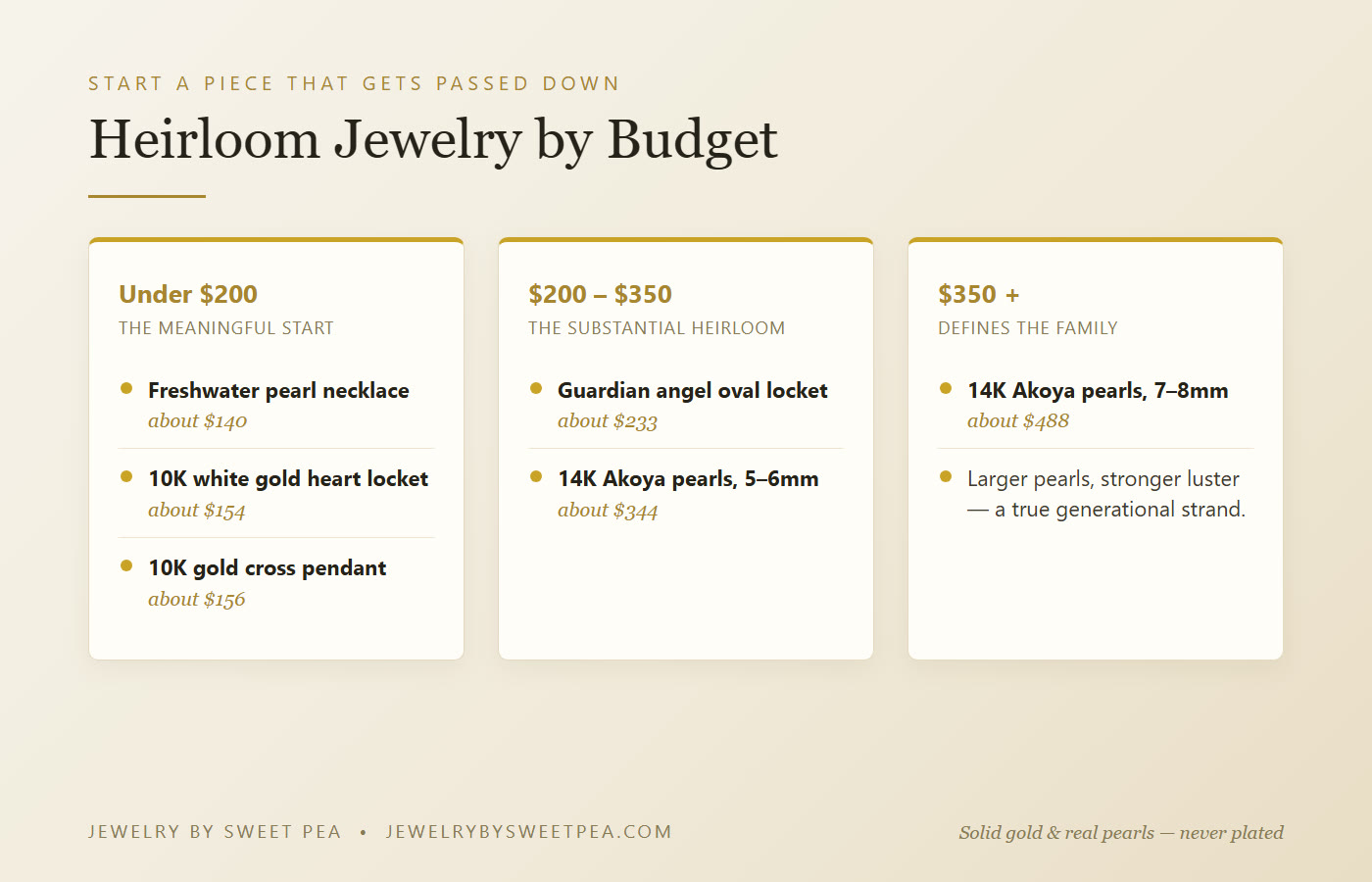
You do not need to spend a fortune to start a piece that gets passed down — you need to spend on solid material rather than size. Here's how our picks fall:
Under $200 — the meaningful starting piece
- 10K Gold Freshwater Cultured Pearl Necklace — about $140. A real pearl strand a young person can grow into.
- 10K White Gold Heart Locket — about $154. Solid gold, holds two photos, wearable daily.
- 10K Yellow Gold Cross Pendant — about $156. The classic family cross.
$200–$350 — the substantial heirloom
- 10K Guardian Angel Oval Locket — about $233. Keepsake plus a protective symbol.
- 14K Gold Akoya Cultured Pearl Necklace (5–6mm) — about $344. Higher-luster saltwater pearls.
$350+ — the piece meant to define the family
- 14K Gold Akoya Cultured Pearl Necklace (7–8mm) — about $488. Larger pearls and stronger luster; a true generational strand.
Prices shown are at the time of writing; solid gold and pearl pieces move with the gold market. Browse the full Pendants & Charms and Necklaces collections for more heirloom-worthy pieces.
How fine jewelry has signaled generational success across the decades
What a family chooses to pass down has shifted with the times, but the instinct has not. A quick tour across the decades:
- Early-to-mid 1900s: the pocket watch and the pearl strand were the classic markers — the watch handed father-to-son, the pearls mother-to-daughter, both signaling a family that had "arrived" enough to own something permanent.
- Mid-century: the gold locket and the charm bracelet became the family storytellers — a photo inside the locket, a charm for each milestone on the bracelet.
- Late 1900s: solid gold chains and cross pendants marked communions, graduations and coming-of-age moments, worn daily rather than saved for the safe.
- Today: the throughline is the same — families choose solid, classic pieces (lockets, pearls, crosses, simple gold) precisely because they read as timeless. What signals generational success isn't flash; it's the quiet confidence of something built to last and be handed on.
How to actually pass a piece down
An heirloom only becomes an heirloom if it survives and its story survives with it. Three things make that happen:
- Write the story down. A single index card — who bought it, when, and why — tucked in the box is worth more than an appraisal. The story is what makes the next person keep it.
- Care for it simply. Solid gold needs only a mild soap-and-water clean and a soft cloth. Pearls are the exception: wipe them after wear, keep them away from perfume and hairspray, and store them flat and separate so they don't scratch. Cared for this way, both last generations.
- Give it with intention. Hand a piece over attached to a moment — a graduation, a wedding, an 18th birthday — and say what it's meant to represent. "This is solid gold because that's how long we expect it to stay in the family" lands harder than any price tag.
Frequently asked questions
What kind of jewelry is best for a family heirloom?
Solid 10K or 14K gold pieces and real cultured pearls in classic forms — lockets, pearl strands, cross pendants and simple gold chains. They last generations physically and never date stylistically. Avoid gold-plated pieces: the plating wears off within a few years, so they cannot be handed down.
Is 10K or 14K gold better for a piece meant to be passed down?
Both are solid, real gold and both last generations. 14K (58.3% pure) has a richer color and is the traditional fine-jewelry standard; 10K (41.7% pure) is more affordable and slightly harder for daily wear. For an heirloom, choose the highest karat you can comfortably afford in a solid piece — purity outlasts size.
Do cultured pearls really last long enough to become heirlooms?
Yes. Well-cared-for cultured pearls easily last a lifetime and can be restrung and passed down for generations. The keys are simple: wipe them after wearing, keep them away from perfume and cosmetics, and store them separately from harder jewelry. Luster is the main quality factor to look for when buying a strand meant to endure.
How much should I spend to start a family heirloom?
You can start a genuine, pass-it-down piece for around $140–$160 — a real pearl strand, a solid gold locket, or a gold cross. Substantial heirloom pieces land in the $230–$350 range, and a true "define the family" pearl strand runs $450 and up. Spend on solid material, not size.
How do I make sure the heirloom's meaning gets passed down too?
Write it down. Tuck a short note in the box — who it was for, when, and why — and hand the piece over at a meaningful moment with the story attached. The metal preserves itself; the meaning only survives if someone records and tells it.
Jewelry by Sweet Pea is a family-run fine jewelry store. Every piece is solid 10K or 14K gold or sterling silver — never plated — sourced from U.S. wholesalers and shipped from the USA. Browse our Pendants & Charms and Necklaces collections, or ask us anything before you buy.