
What Makes Officially Licensed Sports Jewelry Different From Unlicensed Fan Merchandise
The short answer: Officially licensed sports jewelry is made with the team's or school's permission. The maker pays for the right to use the logo, and the design is approved, so the mascot, colors and lettering are correct. Unlicensed fan merchandise uses the logo without that permission. It is often lower quality, and sometimes it's simply counterfeit.
We're a small, family-run jewelry store, and we carry officially licensed LogoArt pieces for colleges and pro teams alongside our solid gold and sterling silver jewelry. Here is what the "officially licensed" label actually means, what it doesn't promise, and how to shop for a team piece you'll still be glad you bought ten seasons from now.
What does "officially licensed" actually mean?
Team names, logos, mascots and school crests are trademarks. The U.S. Patent and Trademark Office explains that a trademark identifies the source of goods, and the owner gets to decide who can use it. A university or a professional league licenses its marks to approved manufacturers. In return, the manufacturer pays royalties and agrees to the licensor's rules on how the logo looks.
For you, the buyer, three things follow from that:
- The logo is right. Licensed designs work from the official artwork, so the proportions, lettering and mascot details match what you see on the field.
- Someone approved it. Licensors review products before they're sold, which keeps out off-brand or embarrassing versions.
- Part of the price supports the team or school. For colleges, royalties typically help fund the university's programs, which is why many alumni and parents care about buying licensed.
What is unlicensed fan merchandise?
Unlicensed merchandise uses a team's name or logo without permission. It shows up at stadium parking lots, pop-up booths and on some online marketplaces. Some of it is "inspired by" designs that avoid the actual logo, and some is outright counterfeit. U.S. Customs and Border Protection runs a public campaign, Fake Goods, Real Dangers, because counterfeit goods, sports merchandise included, are seized at the border every year.
The bigger issue for jewelry is what you can't see. A counterfeit pendant has no licensor checking it and no maker whose name is on the line, so the metal description is only as good as the seller's word.
Is licensed jewelry better quality than unlicensed?
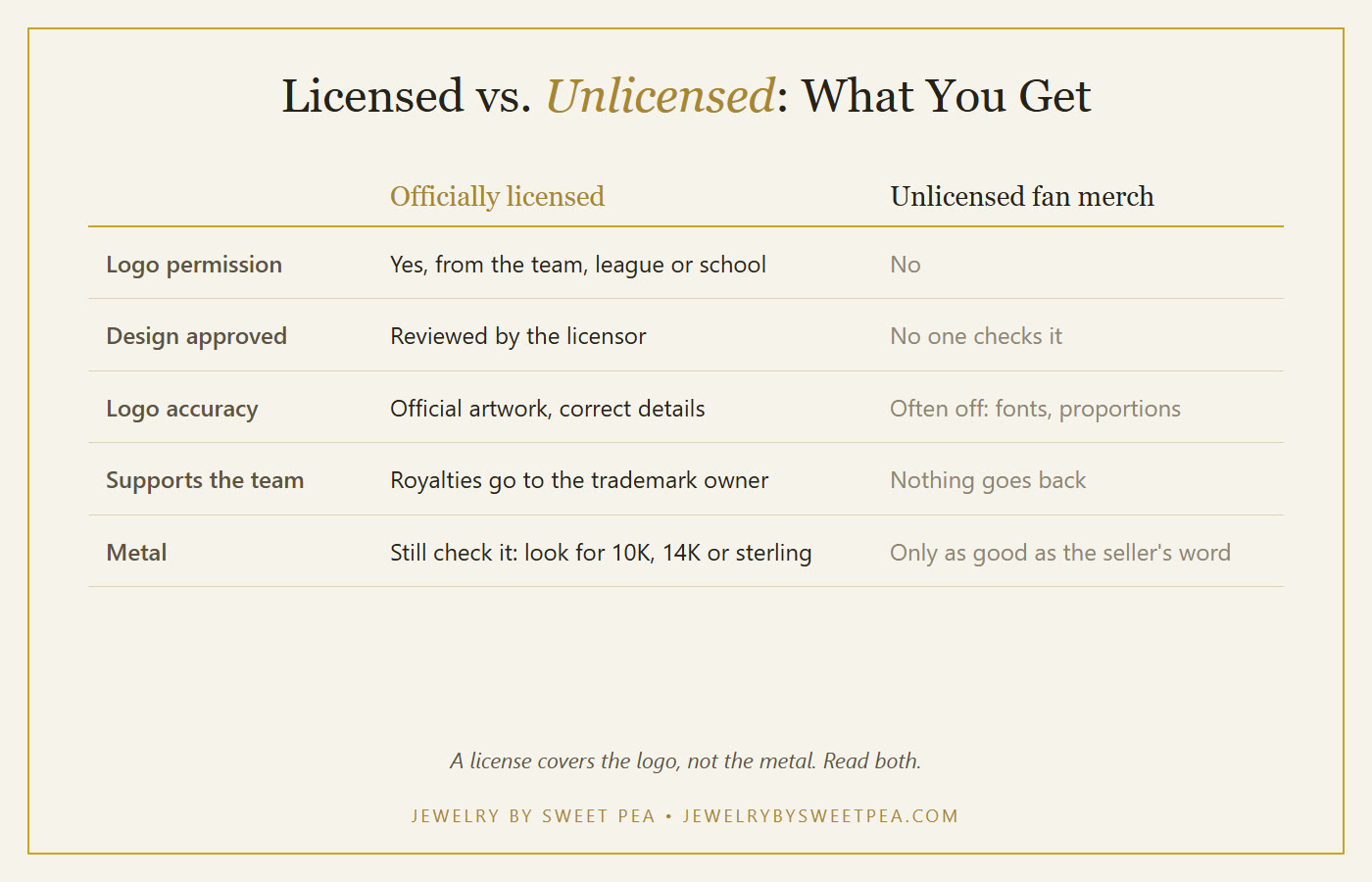
A license guarantees the logo is authorized. It does not, by itself, guarantee the metal. Licensed team jewelry is made in everything from base metal and gold-plated sterling up to solid 10K and 14K gold. That's why you should read two things on any team piece:
- Is it officially licensed? This tells you the logo is legitimate.
- What is it made of? This tells you how it will wear.
On the metal side, the FTC's Guides for the Jewelry, Precious Metals and Pewter Industries (16 CFR Part 23) say that a gold alloy must be described by its karat, and that "sterling silver" means at least 92.5% silver. A reputable seller states the metal plainly, as in "10K yellow gold" or "sterling silver," instead of something vague like "gold tone."
How can you tell if sports jewelry is officially licensed?
- Check the maker. Licensed jewelry comes from known licensed manufacturers. LogoArt is one of the long-standing makers of licensed collegiate and pro sports jewelry.
- Look for licensing language. Product pages and packaging for licensed goods usually say "officially licensed." Tags or holograms are common on licensed products, though they vary by licensor.
- Compare the logo closely. Off proportions, wrong fonts, missing trademark symbols or slightly "off" mascots are common giveaways.
- Read the metal description. Expect a karat stamp or "sterling silver," not "gold color," "silver tone" or no metal listed at all.
- Be wary of very low prices on "solid gold" logo pieces. Gold has a floor price. A "14K" team pendant priced like costume jewelry deserves a second look.
Which licensed sports jewelry is in stock right now?
Prices move with metal markets, so treat these as approximate. Every pick below is officially licensed LogoArt in sterling silver or solid 10K gold:
- Sterling silver Arizona Cardinals enamel bead, about $28. An easy first piece that fits standard bead bracelets.
- University of South Florida sterling silver USF Bulls earrings, about $85. Small, everyday studs for game day and beyond.
- Clemson University sterling silver tiger paw necklace, about $134. A bold enamel pendant on an 18-inch chain.
- Kansas State Wildcat sterling silver cuff links, about $144. A dressier gift for dads, grads and alumni.
- University of Georgia 10K yellow gold Arch small pendant, about $149. Solid gold and a lasting keepsake.
- University of Georgia 10K yellow gold Bulldog extra small pendant, about $186. Petite and solid gold, a nice everyday layer.
Browse the full selection in our Collegiate and Licensed Sports collections.
Is officially licensed jewelry worth the higher price?
For a T-shirt you'll wear for one season, maybe not. For jewelry, which people wear for years and pass down, we think it usually is. Here's how we'd decide:
- Under about $40: a licensed sterling bead or charm. It's the lowest-cost way to get a real logo in real silver.
- About $70 to $150: licensed sterling earrings, pendants or cuff links. These suit everyday fans and make great gifts.
- About $150 and up: licensed solid 10K or 14K gold. Choose this for graduations, milestone birthdays and pieces meant to be kept.
Whatever your budget, we'd steer you toward solid sterling or solid gold over plated team pieces. Logos on plated jewelry can wear unevenly once the surface layer thins.
Frequently asked questions
What does officially licensed mean on sports jewelry?
It means the maker has permission from the team, league or school to use its trademarks, pays royalties for that right, and had the design approved. The logo is authentic.
Is unlicensed team jewelry illegal?
Using a team's trademarked logo without permission can infringe the owner's trademark, and counterfeit goods can be seized. Designs that only say "go team" in generic colors may not use any trademark at all.
Does officially licensed mean solid gold?
No. A license covers the logo, not the metal. Licensed jewelry comes in many metals, so always check the description for a karat (10K, 14K) or "sterling silver."
Do licensed college jewelry purchases support the school?
Licensed products pay royalties to the trademark owner. For colleges, those royalties typically go back to the university.
What's a good first licensed piece for a fan?
A sterling silver bead, charm or pair of small earrings is a great start, usually under $90. For a keepsake gift, a small solid 10K gold pendant is a step up that lasts.