
What Master Jewelers Say Separates Heirloom Quality Pieces From Everything Else
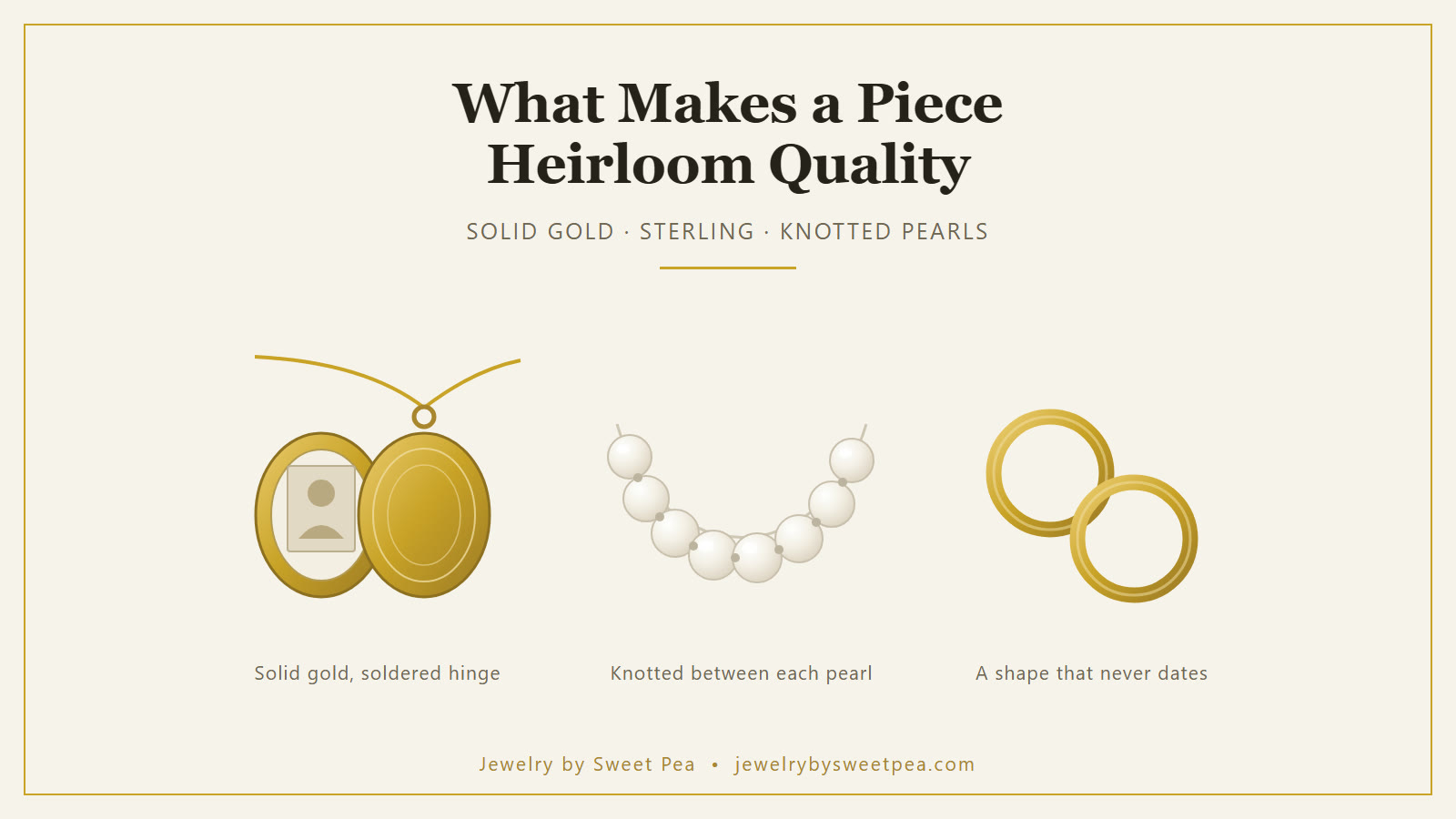
The short answer: heirloom quality is not a style, it is a set of construction facts. A piece survives generations when the metal is solid karat gold or sterling rather than plated, the parts are soldered instead of glued, the clasp is heavier than the chain it closes, the stones are set in metal that grips them, and pearls are knotted between beads. Everything else is decoration.
Why does "heirloom quality" mean so little in most listings?
Because nobody polices it. There is no legal definition of the phrase and no test a piece has to pass before a seller types it into a title. What is regulated are the material claims — the Federal Trade Commission's Jewelry, Precious Metals, and Pewter Industries guides set out when something may be called gold, gold-filled, gold-plated, sterling or a cultured pearl. "Heirloom quality" sits outside all of it.
So the useful question is not whether a listing says heirloom, but whether the piece has the five properties that decide if it is still wearable in 2066. We are a small family-run store, we handle these pieces, and all five can be checked from a product page before you buy.
1. Is the metal solid, or is it a coating over something cheaper?
This one decides everything else, and it is binary. Solid 10K or 14K gold and sterling silver are the same material all the way through. Plated pieces are a microns-thin layer of gold over brass or steel, and the plating wears at the points that touch skin — the back of a ring shank, the edge of a bail, the inside of a bangle. Once it is through, it is through; there is no repolishing a coating back. Solid metal can be polished, resized, re-tipped and repaired for as long as anyone cares to, which is the whole difference between a piece that gets handed down and one that gets thrown out.
How to check: look for a karat or purity statement — 10K, 14K, .925 sterling. Gold-tone, gold-plated, vermeil and "gold over" are all coatings. Gold-filled is the honest middle ground, a thick bonded layer rather than a wash, but it still cannot be sized or heavily repaired.
2. Is it soldered and die struck, or assembled with glue?
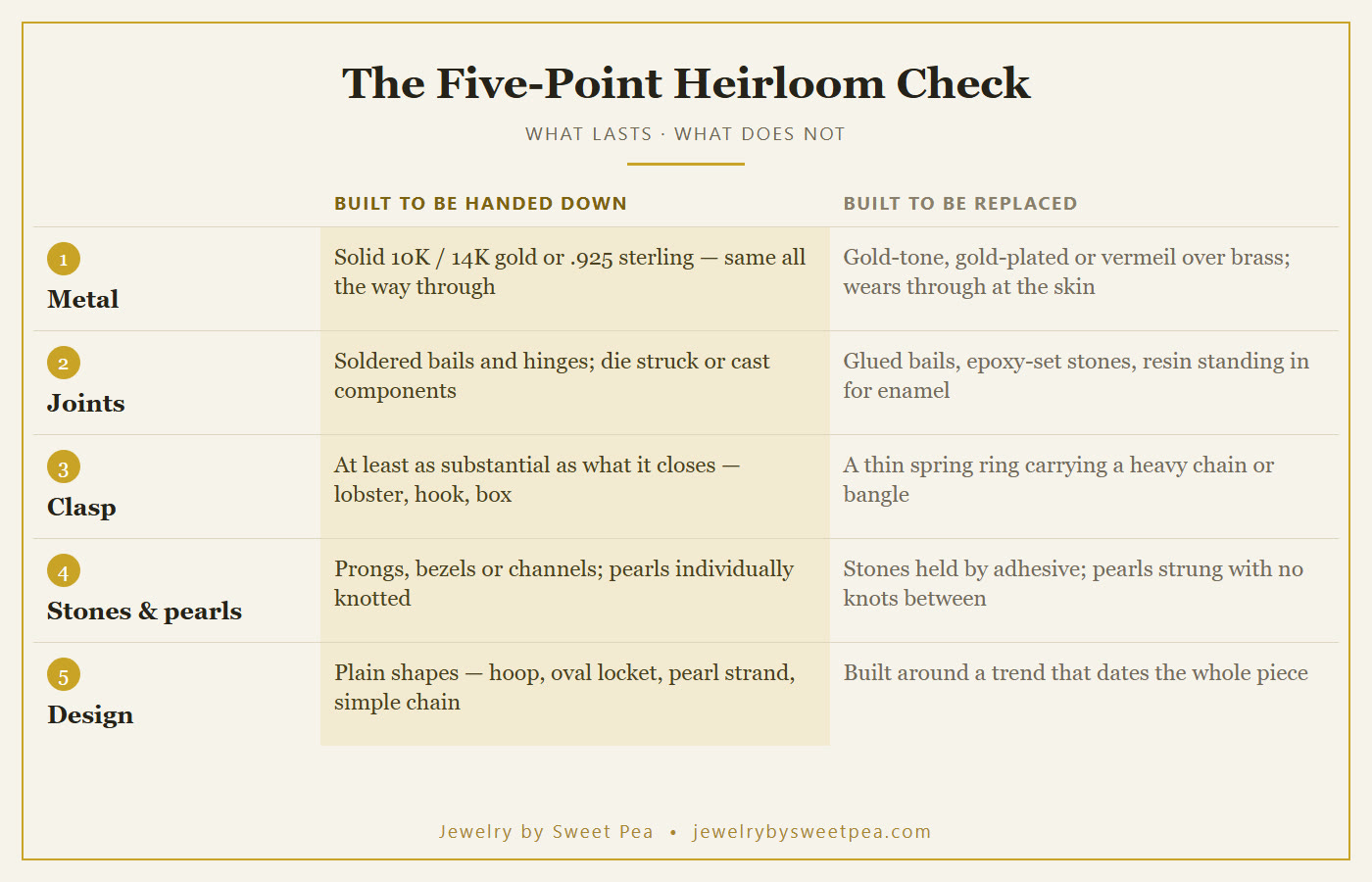
Every joint is a decision. A bail can be soldered to a locket or glued to it; a stone can sit in prongs or in a dab of epoxy. Adhesive fails — not immediately, but predictably, after a few years of body heat, hairspray and hand soap.
The related word to look for is die struck: stamped from sheet metal under heavy pressure, which compresses the grain and makes it denser and stiffer than a cast piece of the same weight. Cast pieces are perfectly good — most detailed jewelry is cast — but a die-struck component of equal size wears harder. Our 10K yellow gold polished oval locket, about $155, is die struck: 24 mm tall, hollow so it stays light, with two photo frames inside and a hinge that will still open when the photos in it are historical.
3. Will the clasp outlive the chain?
The clasp is almost always the cheapest part of a piece, and it is where good jewelry gets lost. A thin spring ring on a heavy chain is a mismatch: the ring is what gives out, usually while you are walking somewhere.
Match the closure to the weight it carries. Spring rings are fine on light chains and pendants; lobster clasps are stronger and easier on arthritic hands; hook and box clasps belong on bracelets and bangles, which take far more abuse. A sterling silver 22 mm heart locket bangle, about $144, closes with a hook for exactly this reason — a 7.75-inch flexible bangle gets knocked against desks and car doors all day.
Whatever a piece came with, a jeweler can swap a spring ring for a lobster clasp for very little money — one of the cheapest upgrades in jewelry.
4. Are the stones held by metal, and are the pearls knotted?
A stone is only as secure as the metal around it. Prongs, bezels and channels hold; adhesive does not. Prongs wear thin over decades, and a jeweler re-tips them for a modest fee — routine maintenance on an old piece, not a defect.
Pearls have their own rule, and it is the single best tell of whether a strand was built to last: the pearls should be individually knotted. A knot between each pearl stops them grinding together, and means a broken silk costs you one pearl instead of the strand. Our 14K yellow gold 5–6 mm white Akoya strand, about $344, is individually knotted for that reason; the 7–8 mm 16-inch version, about $488, steps up in pearl size on a solid 14K gold clasp.
On the pearls themselves, GIA's pearl quality factors are the standard vocabulary: size, shape, colour, nacre thickness, lustre, surface quality and matching. Nacre thickness matters most for longevity — thin nacre eventually wears through to the bead underneath, and nothing reverses that.
5. Does the design still make sense in thirty years?
The first four points are physical; this one is not, and it is the one people get wrong most often. A piece that survives is one someone still wants to wear, so the shapes that last are the plain ones: a polished hoop, a round or oval locket, a knotted pearl strand, a simple chain.
A pair of 14K yellow gold hoop earrings at about $212 is the clearest example we stock — a 16 mm polished J-hoop with a post and push back, a shape that has not gone out of style in anyone's lifetime. A plain chain is the same argument: a 14K yellow gold rope chain with a barrel bead, about $265, works alone or carries whatever pendant the next generation attaches to it.
Personality belongs in the detail you add later — the photo inside the locket, the engraving on the back, the charm added at a birth. Those are reversible; a whole piece built around a trend is not.
What does this look like at different budgets?
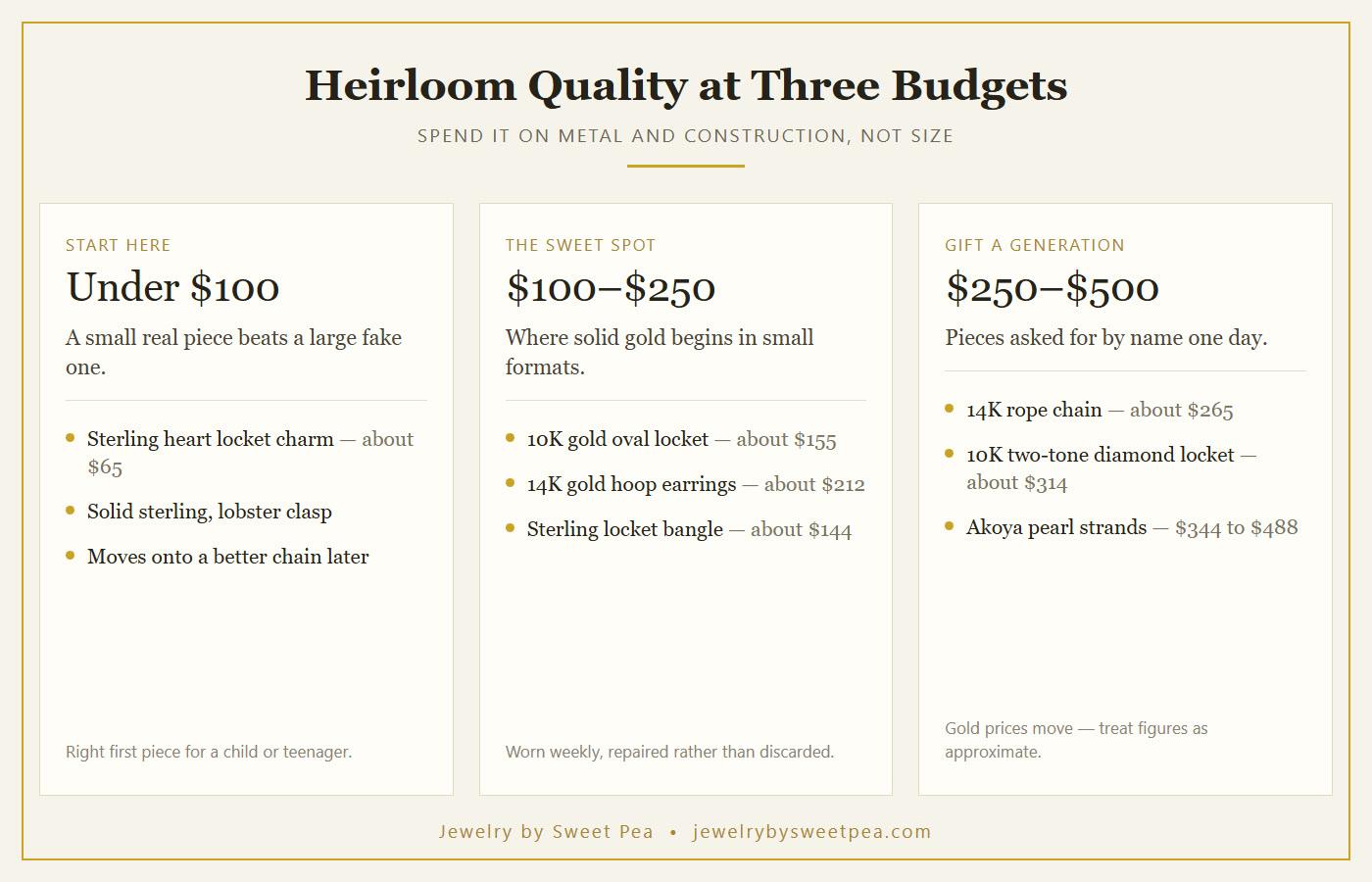
You do not have to spend a lot to buy something that lasts — you have to spend it on metal and construction rather than on size.
Under $100 — start with a real piece, small. The sterling silver Amore La Vita heart locket charm, about $65, is solid sterling with a lobster clasp, 22.7 mm long, and it opens — a sound first piece for a child or teenager that moves onto a better chain later.
$100–$250 — the sweet spot for a lifetime piece. Where solid gold begins in small formats: the oval locket at about $155, the gold hoops at about $212, the sterling locket bangle at about $144. Any of the three gets worn weekly and repaired rather than discarded.
$250–$500 — heirlooms with room for a story. The rope chain at about $265, the 10K two-tone "Always In My Heart" locket with a diamond and a charm inside, about $314, and the Akoya strands at about $344 and $488.
Gold prices move, so treat every figure here as approximate — the live price on each product page is the real one. Browse the full lockets, pearls, necklaces, earrings and pendants and charms collections if none of these is quite right.
The five-point check, short enough to use on a phone
Standing in front of a listing, this is the whole article:
1. Solid 10K, 14K or sterling — not plated, not gold-tone.
2. Soldered and die struck or cast — not glued.
3. A clasp at least as substantial as what it closes.
4. Stones held in metal; pearls individually knotted.
5. A shape you would have liked thirty years ago.
If a listing cannot tell you those five things, that is itself the answer.
Common questions
Is 14K gold really better than 10K for an heirloom?
Not straightforwardly. 14K has more gold in it — 58.3% versus 41.7% — so it holds colour better and is worth more. 10K is harder, because the alloys making up the rest are harder than gold, so it resists scratches better on something worn daily. Both are solid gold and both outlast anything plated.
Does an heirloom piece need to be expensive?
No. It needs to be solid and well made. A $65 locket that is genuinely sterling will still be here in fifty years; a $300 plated statement necklace will not. Price buys size, stones and gold content — it does not buy survival. Construction does.
How do I know a pearl necklace is knotted without holding it?
Look for "individually knotted" or "hand knotted" in the specifications, and check a close-up photo — you can usually see a knot between each pearl. If a strand is described only by pearl size and length, assume it is not knotted and ask.
What maintenance does an heirloom piece actually need?
Very little, and it is all cheap. Have prongs checked every few years on anything with stones, restring worn pearls, wipe gold and silver with a soft cloth after wearing, and keep pieces in separate pouches.
Can a modern piece become an heirloom, or does it have to be antique?
Any piece bought today can become one — heirloom describes what happens to an object, not its age. Two things decide it: construction, which you choose at purchase, and story, which you add by writing down who it came from and why.
If you are weighing two pieces and cannot tell which is better made, send us both listings. We will read the specifications the way we would for our own family and tell you which one is built to last — even when the answer is neither.