What Should You Know Before Buying Gold Jewelry as an Investment and a Gift
The short answer: solid gold jewelry holds real metal value, but it is a better gift than it is an investment. You pay for design, labor and retail on top of the gold, and resale usually pays only for the metal. Buy solid 10K or 14K gold because she will wear it for decades; if growing money is the main goal, bullion is the more direct route.
We are a small, family-run jewelry store, not financial advisors, and nothing here is investment advice for your situation. What we can do is explain how gold jewelry is priced, what the stamps mean and what to check before you buy, so that the gift you choose keeps both its beauty and its gold.
Is gold jewelry a good investment?
It is a store of value, not a growth plan. Here is the honest picture:
- The gold inside is real. A solid 14K gold chain contains a measurable weight of gold, and that metal does not tarnish away, wear out of style in a market sense or go to zero. That is why gold jewelry has been handed down for generations.
- You pay more than melt value. The price of any finished piece includes the work of making it (chain weaving, polishing, setting, clasps), plus the costs of the business that sells it. On small, light pieces, that work is most of the price.
- Selling usually returns metal value or less. A buyer of used gold typically pays based on weight and purity, often below the full spot value, and does not pay for craftsmanship. So a piece bought today and sold next month would almost always come back for less.
- Over a lifetime, the math changes. A heavier, simple piece worn for twenty or thirty years can hold a meaningful share of its cost in metal, especially if gold prices rise. That is the real "investment" case for gold jewelry: long life, daily use and a solid metal floor.
If the goal is purely financial, coins and bars from a reputable bullion dealer carry much smaller premiums over metal value. Be careful there, too: the U.S. Commodity Futures Trading Commission publishes a precious metals fraud advisory worth reading before you buy metal from anyone who calls you or promises returns.
What do 10K, 14K, 18K and 24K mean?
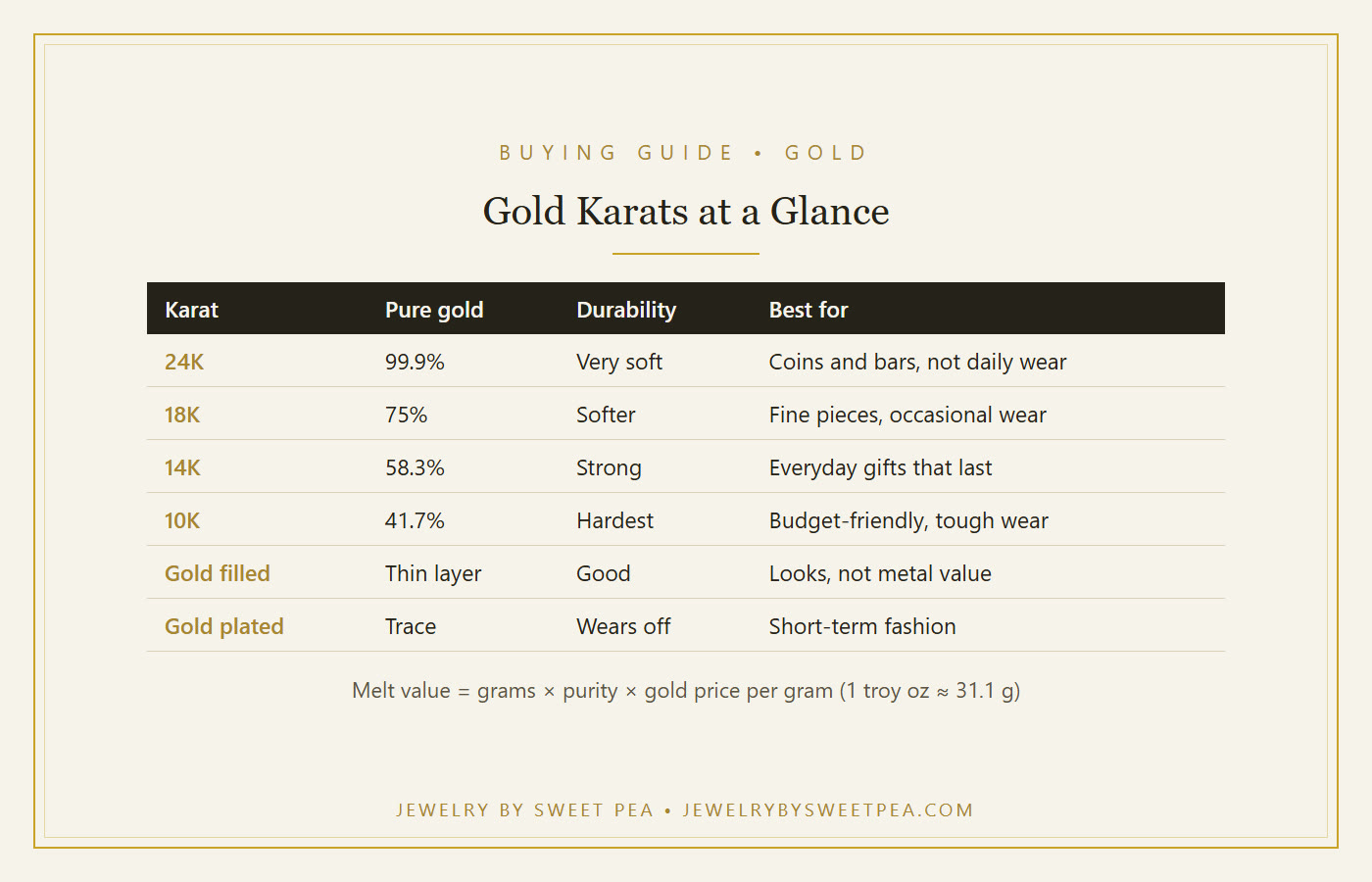
Karat measures how much of the metal is pure gold, out of 24 parts. The rest is an alloy of metals such as silver, copper and zinc that makes gold harder and sets its color.
- 24K is essentially pure gold. It is very soft, which is why it is rare in everyday American jewelry.
- 18K is 75 percent gold. Rich color, softer than 14K, common in high-end pieces.
- 14K is 58.3 percent gold. The most popular choice in the U.S. for a balance of color, durability and price.
- 10K is 41.7 percent gold. The hardest and most affordable of the four, and the lowest karat that may be marketed as "gold" in the United States.
Those rules come from the Federal Trade Commission's Guides for the Jewelry, Precious Metals, and Pewter Industries (16 CFR Part 23), which govern how karat gold, gold filled and gold plated items may be described. For a gift that will be worn every day, 14K is our usual recommendation; 10K is a sensible, tougher choice when the budget is tighter or the wearer is hard on jewelry.
Solid, hollow, filled or plated: which is which?
This is the single most important thing to check, because two pieces that look identical can hold very different amounts of gold.
- Solid gold is karat gold all the way through. It can be polished and repaired for decades.
- Hollow or "lightweight" gold is still real karat gold, formed around an empty center. It gives you a bigger look for less money, but it contains less gold and dents more easily. It is a fair choice when you know what you are buying.
- Gold filled is a layer of karat gold bonded to a base metal core. It wears far better than plating but contains only a small fraction of gold by weight.
- Gold plated is a very thin coating over base metal. It can be pretty, but it has essentially no gold value and will wear through with daily use.
Look for the karat stamp (10K, 14K, 417, 585) on the clasp or post, and read the product description for the words "solid," "hollow," "filled" or "plated."
How do you figure out the gold value of a piece?
Melt value is simple arithmetic: weight in grams × purity × the gold price per gram. Gold is quoted per troy ounce, and one troy ounce is about 31.1 grams. For illustration only, suppose gold were $4,000 per troy ounce, or roughly $128.60 per gram. A 2-gram 14K chain would contain about 2 × 0.583 × $128.60, or roughly $150 of gold. Plug in today's price to get today's number.
That calculation shows why weight matters more than size. A thick-looking hollow bracelet can hold less gold than a slim solid chain, and the gram weight is the honest way to compare.
Which gold pieces make the best gifts that keep their value?
Every pick below is real 10K or 14K karat gold. We lean toward simple shapes that never look dated, so the piece gets worn instead of stored. Prices are what our live product pages show today and move with the gold market:
- 14K yellow gold 9mm small endless hoop earrings, about $46. Tiny solid gold hoops she can sleep in.
- 14K yellow gold 3mm polished ball stud earrings, about $49. The simplest solid gold studs there are, for any age.
- 10K yellow gold 0.5mm rope chain, from about $52. A fine, tough 10K chain for a first pendant.
- 14K yellow gold 0.4mm rope chain, 16 inch, about $56. Delicate solid gold for everyday layering.
- 14K yellow gold 0.42mm curb chain, 18 inch, from about $59. A classic curb link at a gentle price.
- 14K yellow gold textured angel coin charm, about $149. A coin-style keepsake that pairs with either chain above.
- 14K yellow gold 1.3mm Franco chain bracelet, 7 inch, from about $295. A dense, sturdy link that is built for daily wear.
- 14K yellow gold 1mm diamond-cut open Franco chain, from about $369. A heirloom-style necklace with its gram weight listed right in the name.
Browse more gold and silver chains, earrings, bracelets, necklaces and our gift ideas.
What should you spend on a gold gift?
- Under $60: 14K small hoops (about $46), 14K ball studs (about $49), a 10K rope chain (from about $52) or a fine 14K rope or curb chain (about $56 to $59). Real gold, first-gift friendly.
- Around $150: pair a fine chain with the 14K angel coin charm (about $149) for a meaningful set at roughly $200 to $210 together.
- $300 and up: a solid 14K Franco bracelet (from about $295) or the open Franco chain (from about $369). This is where more of what you pay goes into the metal itself, and where a piece can truly be passed down.
What should you check before you buy?
- The karat stamp and the words solid, hollow, filled or plated in the description.
- The gram weight, when listed, so you can compare pieces honestly.
- A secure clasp: lobster clasps and spring rings on fine chains, sturdy posts and backs on earrings.
- The return policy, in case the length or style is not quite right.
- Whether she prefers yellow, white or rose gold; look at what she already wears.
Frequently asked questions
Does gold jewelry go up in value?
The gold inside it moves with the gold market, so its metal value can rise over time. The finished price you paid also includes craftsmanship and retail costs that resale usually does not return, so treat it as a lasting gift with a metal floor, not a short-term investment.
Is 10K or 14K gold better for a gift?
14K has more gold (58.3 percent) and a richer color, and it is the most popular U.S. choice. 10K (41.7 percent) is harder, more scratch resistant and more affordable. Both are real gold and both last for decades.
Is gold filled jewelry worth buying as an investment?
No. Gold filled jewelry can be durable and attractive, but only a thin bonded layer is karat gold, so its metal value is small. For any value-keeping goal, choose solid karat gold.
How can I tell if gold jewelry is solid?
Check for a karat stamp such as 10K, 14K, 417 or 585, and read the description for "solid" versus "hollow," "filled" or "plated." Weight is another clue: solid pieces feel heavier than hollow ones of the same size.
Should I buy gold jewelry or gold coins?
It depends on the goal. Jewelry is meant to be worn and enjoyed for years. Coins and bars carry smaller premiums over metal value, so they suit people whose main goal is holding metal. We are jewelers, not financial advisors, so for money decisions talk to one you trust.