
What Should You Look for When Buying Officially Licensed College Team Jewelry Online
The short answer: look for four things — proof the piece is officially licensed (the school's trademark can't be used without it), the exact metal stated in writing (solid 10K/14K gold or sterling silver, never "gold-tone" or plated), clear size and chain-length details, and a plain returns policy. Get those four right and a team piece becomes a keepsake, not a novelty that turns your skin green.
College team jewelry is one of the most-gifted categories we sell — graduations, signing days, a parent proud of an alma mater. It's also one of the easiest to get wrong online, because "college jewelry" covers everything from a $4 stamped-tin charm to a solid 10K gold pendant that lasts a lifetime. Here's how a family jeweler tells them apart, in the order that matters.
How can you tell if college jewelry is officially licensed?
A university's name, seal, and logo are registered trademarks. A seller legally can't put "Auburn" or the Ohio State "O" on a product without a license from the school (usually through a collegiate licensing agency). That license is your first quality signal — licensed manufacturers are held to material and safety standards; bootleg sellers are not.
What to look for on the listing:
- "Officially licensed" or "Licensed by: NCAA / [University]" stated in the description — not just implied by a logo in the photo.
- A named manufacturer known for licensed metals (LogoArt, for example, is a long-standing NCAA-licensed jewelry maker). A real brand name beats a blank "generic."
- The official mark rendered cleanly — correct colors, correct seal. Trademarks exist to protect exactly this; the U.S. Patent and Trademark Office explains the basics of how trademarks work, and why an unlicensed logo is a red flag rather than a bargain.
Every collegiate piece we carry is officially licensed — we source through the same U.S. wholesalers the schools authorize, so the mark on the metal is the real one.
Solid gold, sterling silver, or plated? Read the metal, not the color
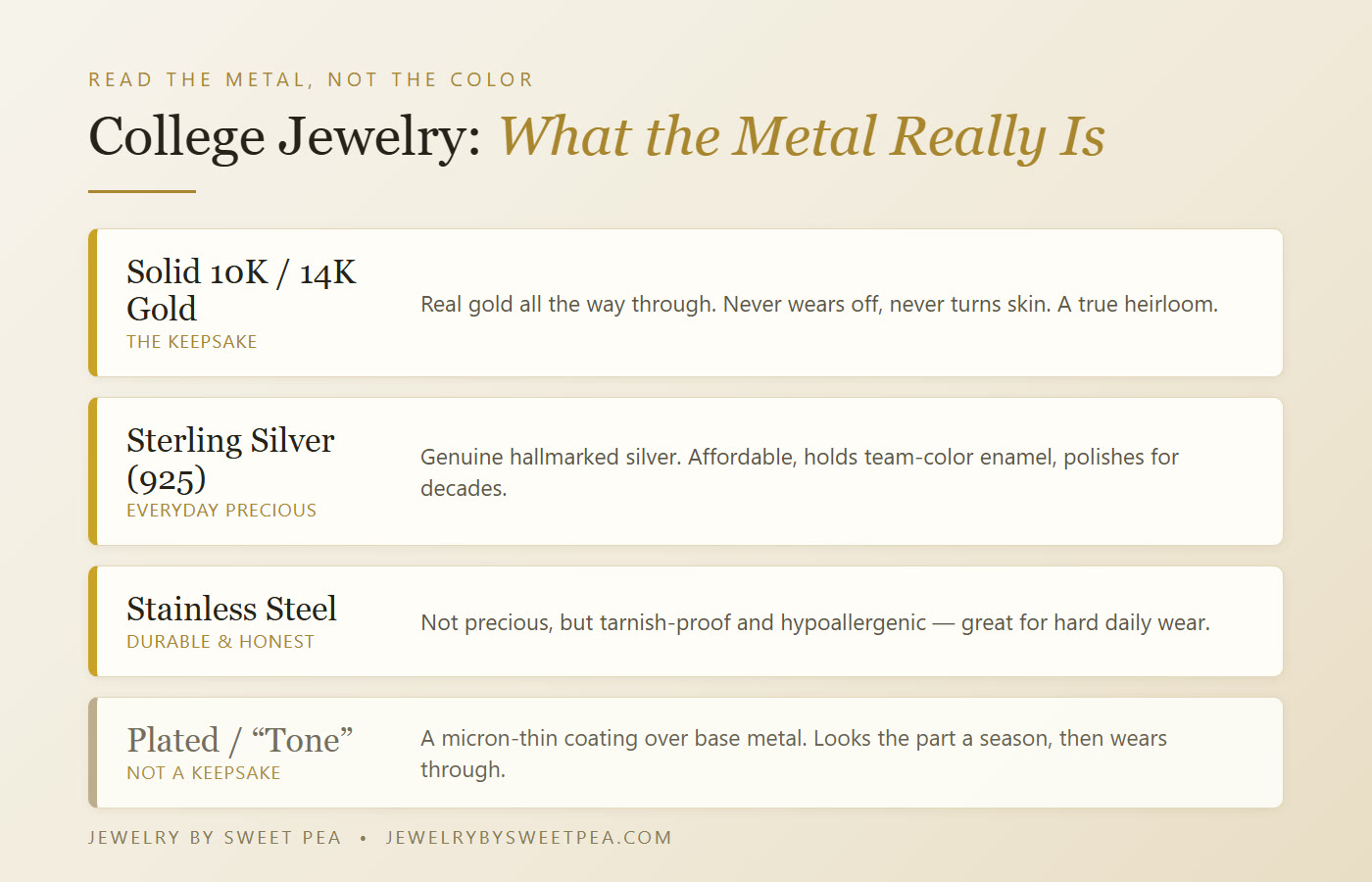
This is where most online disappointment happens. A photo can't tell you what the metal is — the words can. Watch for the difference between a real precious metal and a color pretending to be one:
- Solid 10K or 14K gold — real karat gold all the way through. Won't wear off, won't turn skin. The word to find is "10K" or "14K," never "gold-plated," "gold-filled," "gold-tone," or "gold-over."
- Sterling silver (925) — a genuine precious metal, hallmarked. Affordable, holds enamel team colors beautifully, and can be polished for decades.
- Stainless steel — not precious, but honest and durable: hypoallergenic, tarnish-proof, and a smart everyday choice for a team pendant a student will wear hard.
- Plated / "tone" / base metal — a micron-thin coating over cheap metal. It looks the part for a season, then the color wears through at the edges. Fine for a game-day novelty; not a keepsake.
U.S. sellers are legally required to describe metal content accurately under the FTC Jewelry Guides (16 CFR Part 23). So the rule is simple: if a listing won't say the metal plainly, assume it's plated and price it accordingly. If it says "10K" or "sterling silver / 925," you know what you're getting.
What should you check before you add it to cart?
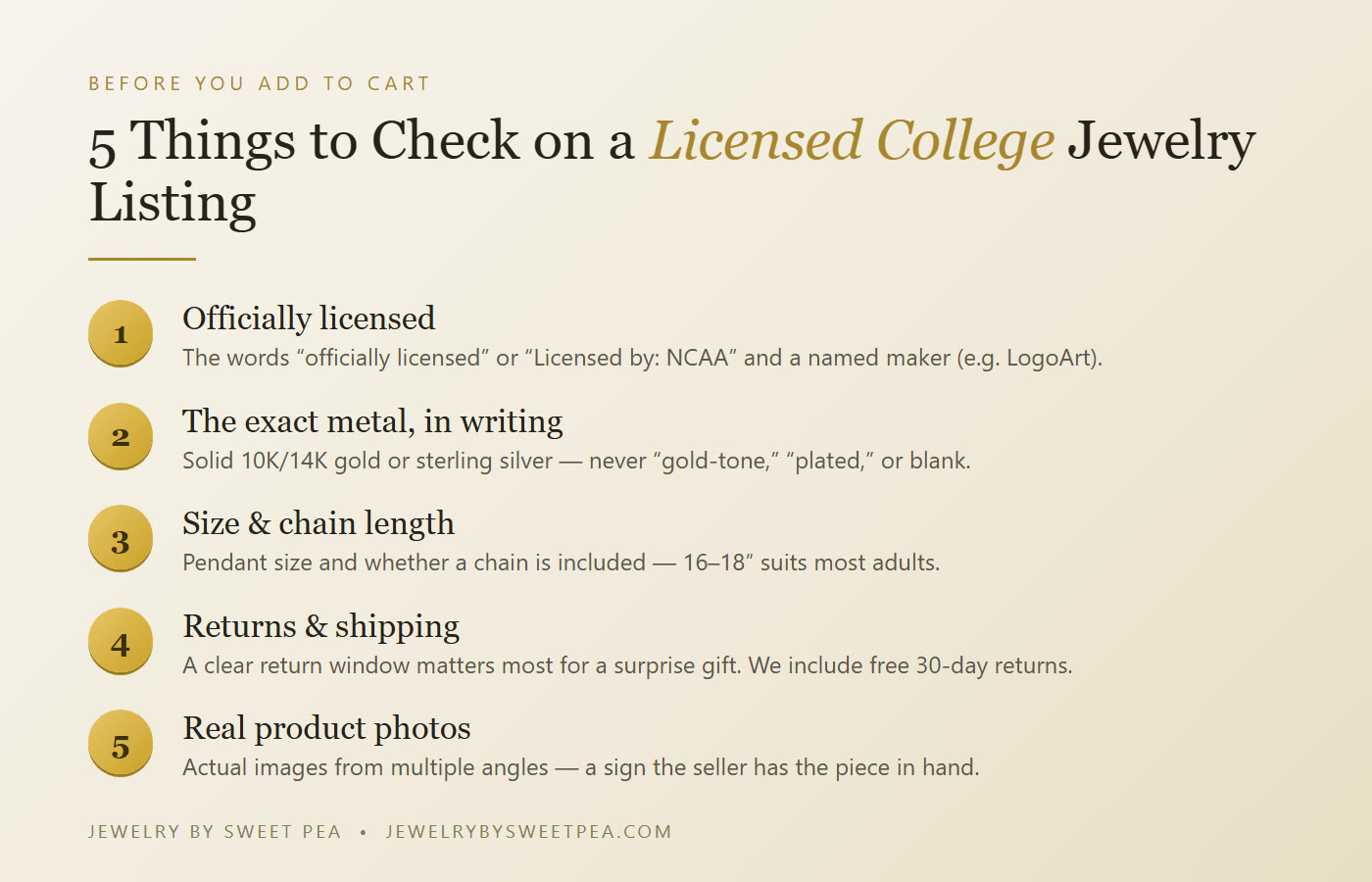
Beyond licensing and metal, a few practical details save the most returns:
- Chain length & whether one is included. Many licensed pendants are sold as the charm only. Check for an included chain and its length — 16–18 inches suits most adults; 18–20 inches for men. Some pieces (like our Ohio State pendant) come as a full 18-inch necklace with an extender, which takes the guesswork out.
- Pendant size. "Small" vs. "large" is a real difference in these lines. A small pendant is subtle for daily wear; a large one reads across a room on game day. The listed millimeter or weight tells you which.
- Ring or watch sizing. For rings, confirm the size options; for a licensed watch, check band material and water resistance if it'll be worn daily.
- Returns & shipping. A clear return window matters most when you're buying a surprise gift. We include free shipping, free 30-day returns, and a gift box on every order — so if the size or team isn't right, it's an easy fix.
- Real product photos. Actual images (not just a rendered logo) tell you the finish is real. Multiple angles are a good sign the seller has the item in hand.
How much should officially licensed college jewelry cost?
Price mostly tracks the metal — which is exactly why reading the metal matters. Here are in-stock, officially licensed pieces across every tier, so you can match the piece to the moment:
Around $25–$30 — everyday team pride
- Sterling Silver University of Florida Enameled Dangle Bead — about $25. Real 925 silver with team-color enamel; fits most bracelet systems. A genuine precious metal at a novelty price.
- Stainless Steel LogoArt Ohio State Pendant, 18" Necklace with Extender — about $28. Officially licensed, tarnish-proof, and it arrives as a complete necklace — ideal for a student.
Around $85 — the licensed everyday piece
- LogoArt Clemson University Gents Quartz Watch — about $85. NCAA-licensed, 10 ATM water resistant — a wearable-every-day gift that isn't jewelry-fussy.
Around $150–$650 — the solid-gold keepsake
- 10K Yellow Gold USC Trojan Small Pendant — about $153. Solid 10K gold, subtle enough for daily wear — the entry point to a real heirloom.
- 10K Yellow Gold USC "S-C" Post Earrings — about $301. Solid gold studs; the pair a proud grad keeps for decades.
- 10K Yellow Gold USC "S-C" Large Pendant, 18" Necklace — about $640. The statement heirloom: solid 10K gold, on a matching gold chain, made to be handed down.
Prices are at the time of writing; solid gold moves with the market. Browse the full range in our Collegiate collection, or by type in Pendants & Charms and Necklaces.
Frequently asked questions
How do I know if college jewelry is officially licensed?
Look for the words "officially licensed" or "Licensed by: NCAA / [University]" in the product description, plus a named licensed manufacturer such as LogoArt. A school's logo and seal are registered trademarks that can't legally be used without a license, so a clean, correctly-colored mark from a known maker is your best signal it's the real thing.
Is solid gold college jewelry worth it over plated?
If it's meant to last — a graduation or a keepsake — yes. Solid 10K or 14K gold never wears through and won't discolor skin, so it becomes an heirloom. Plated pieces are a thin color coating over base metal that wears off in a season. For everyday game-day wear on a budget, sterling silver or stainless steel are honest, durable middle-ground choices.
What chain length should I choose for a college pendant?
For most adults, 16–18 inches sits at the collarbone; 18–20 inches suits men or a longer look. Check whether a chain is even included — many licensed pendants are sold as the charm only. Pieces sold as a complete necklace with an extender (like our Ohio State pendant) let the wearer fine-tune the length.
Will licensed college jewelry turn my skin green?
Not if it's a real metal. Solid gold and sterling silver won't discolor skin; stainless steel is hypoallergenic. The green mark comes from copper in cheap base-metal or plated pieces once the coating wears through — another reason to read the metal on the listing before you buy.
Can I return college jewelry if I picked the wrong team or size?
With us, yes — every order includes free shipping, free 30-day returns, and a gift box, which matters most when it's a surprise gift. Before buying anywhere, confirm the return window and whether the seller charges restocking or return shipping.
Jewelry by Sweet Pea is a family-run fine jewelry store. Every piece is officially licensed and made of solid 10K or 14K gold, sterling silver, or durable stainless steel — never cheap plating — sourced from U.S. wholesalers and shipped from the USA. Browse our Collegiate collection, or ask us anything before you buy.