Which Fine Jewelry Gifts Are Most Often Passed Down From Parents to Children
The short answer: the pieces that get passed down are the plain, well-made classics — a strand of cultured pearls, a solid gold chain, diamond stud earrings, a gold bangle, and a gold cross or locket. They survive generations because they're solid (not plated), timeless in style, and worn rather than stored. Trend pieces get sold or forgotten; a simple gold chain gets inherited.
Almost every family has one: the pearls a grandmother wore, the gold cross that turns up at every christening, the chain a father never took off. These aren't the flashiest things in the jewelry box — they're the ones that quietly outlast everyone. Here's which pieces become heirlooms, why, and how to choose one now that your children will actually keep.
What makes a piece of jewelry "heirloom" material?
Three things decide whether a piece gets passed down or pawned:
- It's solid metal. Solid 10K/14K gold or sterling silver survives 50 years of wear and holds real value. Gold-plated jewelry wears through to base metal in a few years — nobody inherits it, because there's nothing left to inherit. This is the single biggest predictor.
- The style is timeless, not trendy. A round pearl, a plain gold chain, a classic stud — these looked right in 1965 and look right today. Statement pieces date themselves to a decade.
- It was worn, so it carries a memory. The pieces children fight over aren't the most expensive ones — they're the ones Mom actually wore. Wearability is what turns metal into meaning.
Buy for those three things and you're buying an heirloom, whether you spend $90 or $900.
The 5 pieces most often passed down
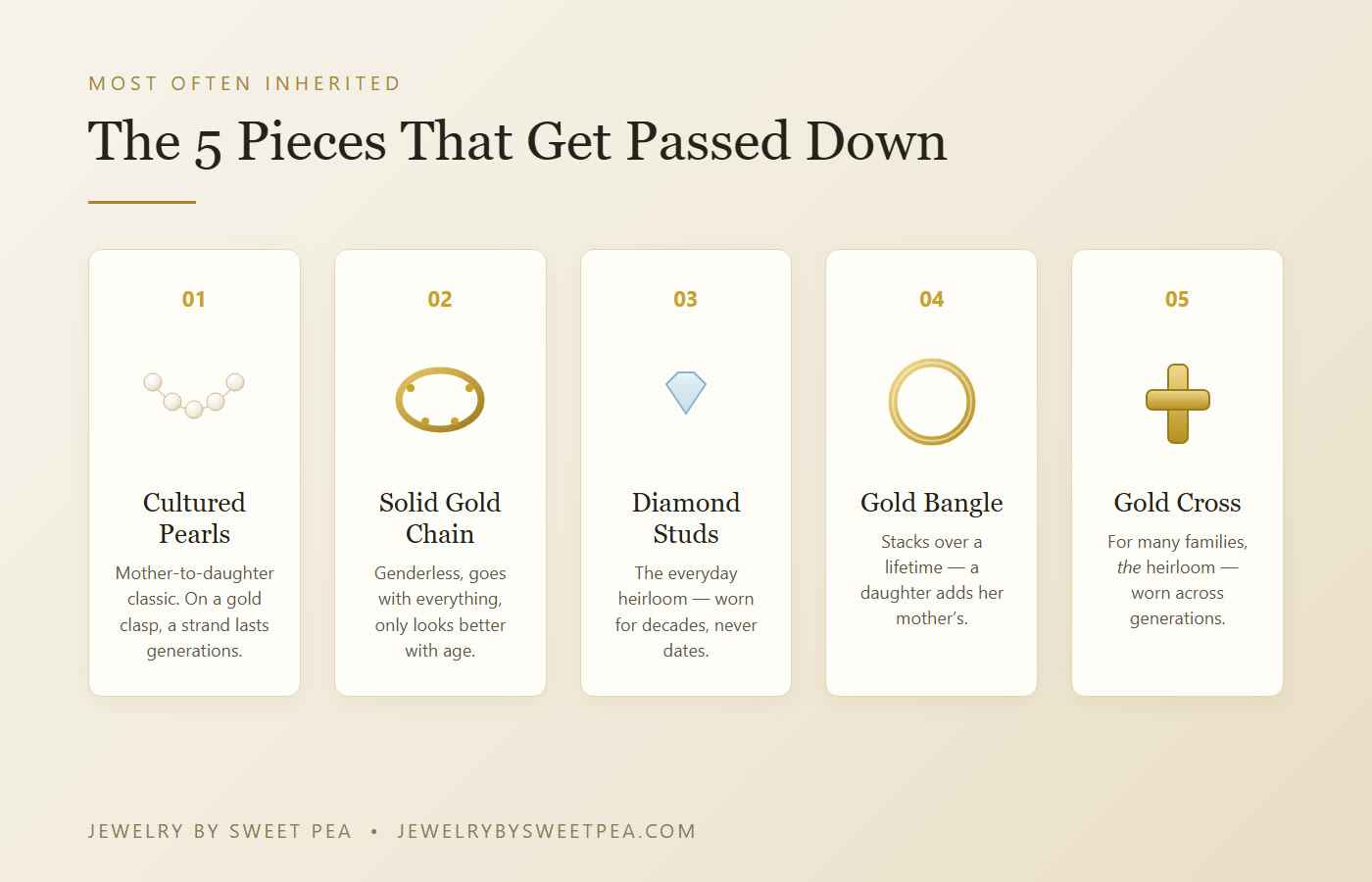
1. A strand of cultured pearls
Pearls are the most-inherited fine jewelry there is — a mother-to-daughter classic that reads as elegant at any age. A saltwater Akoya strand like the 14K Yellow Gold 7-8mm Round White Akoya Cultured Pearl Necklace (about $488) is the traditional heirloom grade: round, high-luster, on a 14K gold clasp that will outlast the string. If you want the look at an entry price, the Sterling Silver 7-8mm White Freshwater Cultured Pearl Necklace (about $87) is a lovely first-strand.
2. A solid gold chain
The most-worn heirloom of all. A quality rope chain is genderless, goes with everything, and only looks better with age. The 14K Yellow Gold Adjustable 1.2mm Diamond-Cut Rope Chain (about $693) is a buy-it-for-life piece — the adjustable length means it fits a child now and an adult later. A chain like this is often the piece a parent wears daily and a child later never takes off.
3. Diamond stud earrings
Studs are the "everyday" heirloom — worn to work, to weddings, to the grocery store, for decades. A solid-gold pair such as the 10K White Gold 4-Prong .20Ct. Diamond Stud Earrings (about $316) is the classic. Because the setting is simple, they never look dated, and a diamond doesn't wear out. This is the piece daughters most often ask for by name.
4. A gold bangle bracelet
Bangles stack, which is exactly why they get handed down — a daughter adds her mother's to her own wrist. The 10K Yellow Gold 1.5mm Diamond-Cut Slip-On Bangle Bracelet (about $156) is an easy, affordable start to a stack that can grow over a lifetime and pass to the next.
5. A gold cross or religious pendant
For many families the cross is the heirloom — worn at baptisms, confirmations, and weddings across generations. A solid 10K Yellow Gold Cross Pendant (about $130) is understated, unisex, and carries deep meaning with no upkeep. Pieces tied to family tradition are the ones least likely to ever be sold.
Prices shown are at the time of writing; solid gold pieces move with the gold market. Browse more in our Necklaces and Pendants & Charms collections.
Heirloom picks by budget
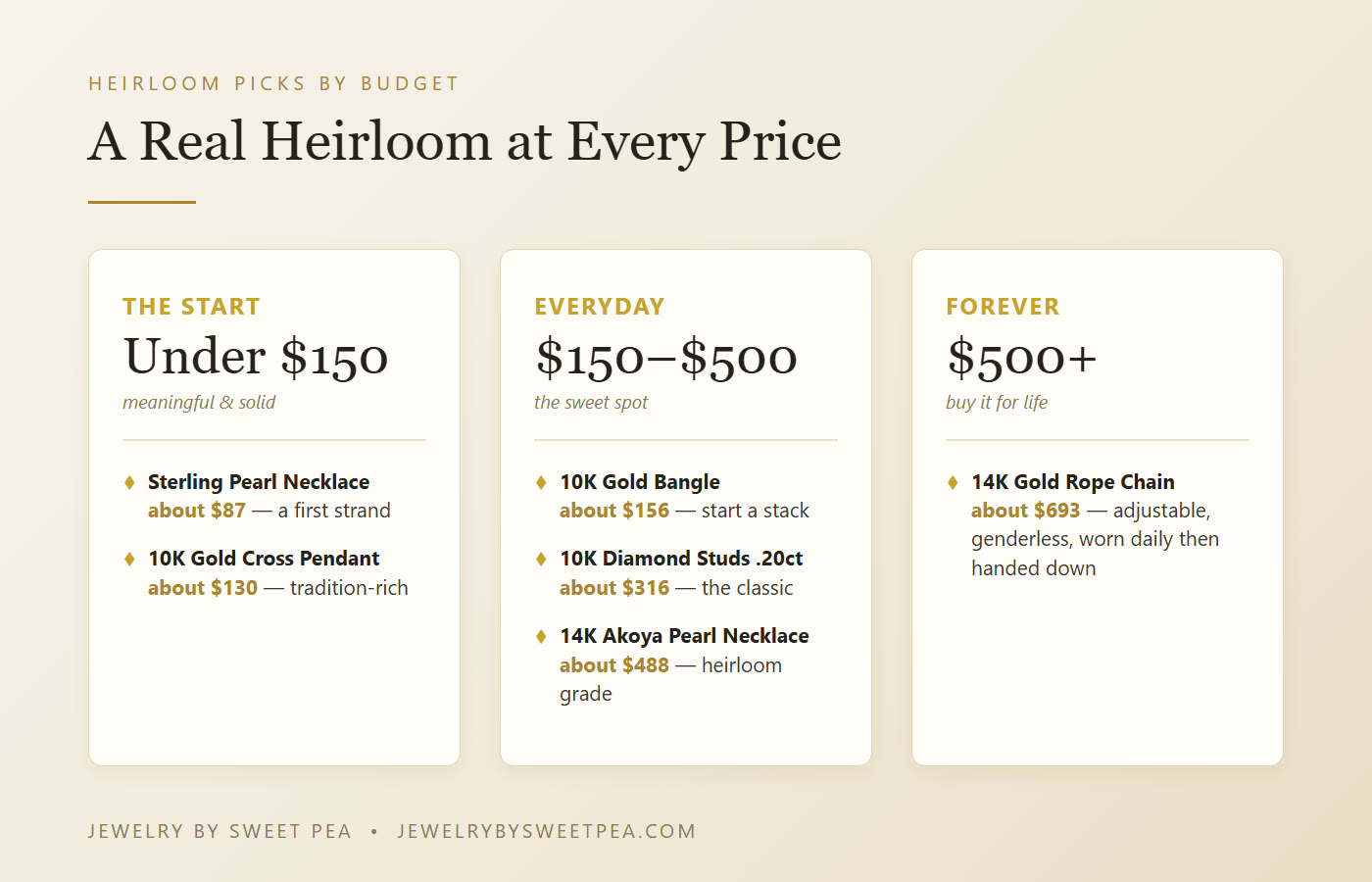
Under $150 — the meaningful start
- Sterling Silver 7-8mm White Freshwater Pearl Necklace — about $87. A first pearl strand that can be worn for decades.
- 10K Yellow Gold Cross Pendant — about $130. Solid gold, unisex, tradition-rich.
$150–$500 — the everyday heirloom
- 10K Yellow Gold 1.5mm Diamond-Cut Bangle — about $156. The start of a stack that grows across generations.
- 10K White Gold .20Ct. Diamond Studs — about $316. The everyday classic daughters ask for.
- 14K Gold Akoya Pearl Necklace — about $488. Traditional heirloom-grade pearls.
$500+ — the forever piece
- 14K Yellow Gold Adjustable Diamond-Cut Rope Chain — about $693. Adjustable, genderless, worn for life then handed down.
How do I choose pearls that will last generations?
With pearls, longevity comes down to the pearl itself and the string it's on. Look for good luster (a sharp, mirror-like reflection), a clean surface, and round shape — the four quality factors the Gemological Institute of America explains well in its pearl quality guide. Then take care of the string: pearls should be worn (your skin's oils keep them lustrous) but restrung every few years, since silk stretches and frays. A 14K gold clasp, not a base-metal one, is what lets a strand survive to the next owner.
Gold vs. silver for an heirloom — which lasts?
Both last generations if they're solid. Solid gold (10K or 14K) never tarnishes and holds the most value — it's the safest heirloom metal. Sterling silver is solid too and lasts indefinitely; it just tarnishes and needs an occasional polish (normal, not damage). What does not become an heirloom is anything plated — "gold-filled" or "gold over silver" wears through with use. Buy from a seller who states the metal plainly; U.S. sellers are bound by the FTC Jewelry Guides (16 CFR Part 23) on how gold and silver content must be described. Every piece we sell is solid 10K/14K gold or sterling silver — never plated.
Make it an heirloom, not just a gift
The piece matters; the story matters more. Three small moves that turn jewelry into an heirloom:
- Write down where it came from. A single index card — "Bought for your 16th birthday, 2026" — kept with the piece is what makes a grandchild keep it too.
- Give it while you can tell the story. Handing a daughter your pearls and telling her when you wore them beats any note found later.
- Keep it wearable. Restring pearls, replace a worn clasp, send a thin chain along with a pendant. An heirloom that can be worn gets worn — and worn things get kept.
Frequently asked questions
What is the most commonly inherited piece of jewelry?
Cultured pearl necklaces and solid gold chains are the two most commonly passed-down pieces, followed by diamond stud earrings and gold crosses. They share the same traits: solid materials, timeless style, and frequent wear — which is exactly what carries a piece from one generation to the next.
Is gold or silver better for a piece I want passed down?
Solid gold is the safest heirloom metal — it never tarnishes and holds the most value. Sterling silver also lasts generations but needs occasional polishing. Avoid anything plated or "gold-filled," which wears through and won't survive to be inherited.
How much should I spend on an heirloom jewelry gift?
You can buy a genuine heirloom from about $90 (a sterling pearl strand or solid gold cross) up to $700+ (a 14K gold rope chain). The rule isn't the price — it's buying solid metal in a classic style rather than a larger plated piece. Purity outlasts size.
Do pearls really last long enough to pass down?
Yes — well-cared-for cultured pearls last generations. Wear them (skin oils preserve luster), keep them away from perfume and hairspray, and restring every few years. On a solid gold clasp, a good strand easily becomes a mother-to-daughter heirloom.
Can I start a "stackable" heirloom my child adds to later?
Absolutely. Gold bangles and charm-friendly chains are ideal — start with one solid gold bangle now, and it can be joined by more over a lifetime and handed down as a set. It's one of the easiest ways to build a family tradition around jewelry.
Jewelry by Sweet Pea is a family-run fine jewelry store. Every piece is solid 10K or 14K gold or sterling silver — never plated — sourced from U.S. wholesalers and shipped from the USA. Browse our Necklaces and Pendants & Charms collections, or ask us anything before you buy.