
Experts Explain Why Some Gold Chains Break Within a Year and Others Last Decades
The short answer: a gold chain that lasts decades is solid (not hollow), a durable link type like rope, curb, or figaro, in a sensible gauge, finished with a real lobster clasp. Chains that break in a year are usually hollow, plated, or too thin at the clasp — the weak point almost always fails first. Solid gold and a good clasp are what buy you thirty years.
We sell gold chains every day, and the question we hear most after a chain breaks is, "Was it just bad luck?" Almost never. A chain's lifespan is decided the moment it's made — by how it's built, not how careful you are. Here's what actually separates a chain you'll hand down from one you'll be gluing back together by next winter.
Solid or hollow? This is the biggest factor
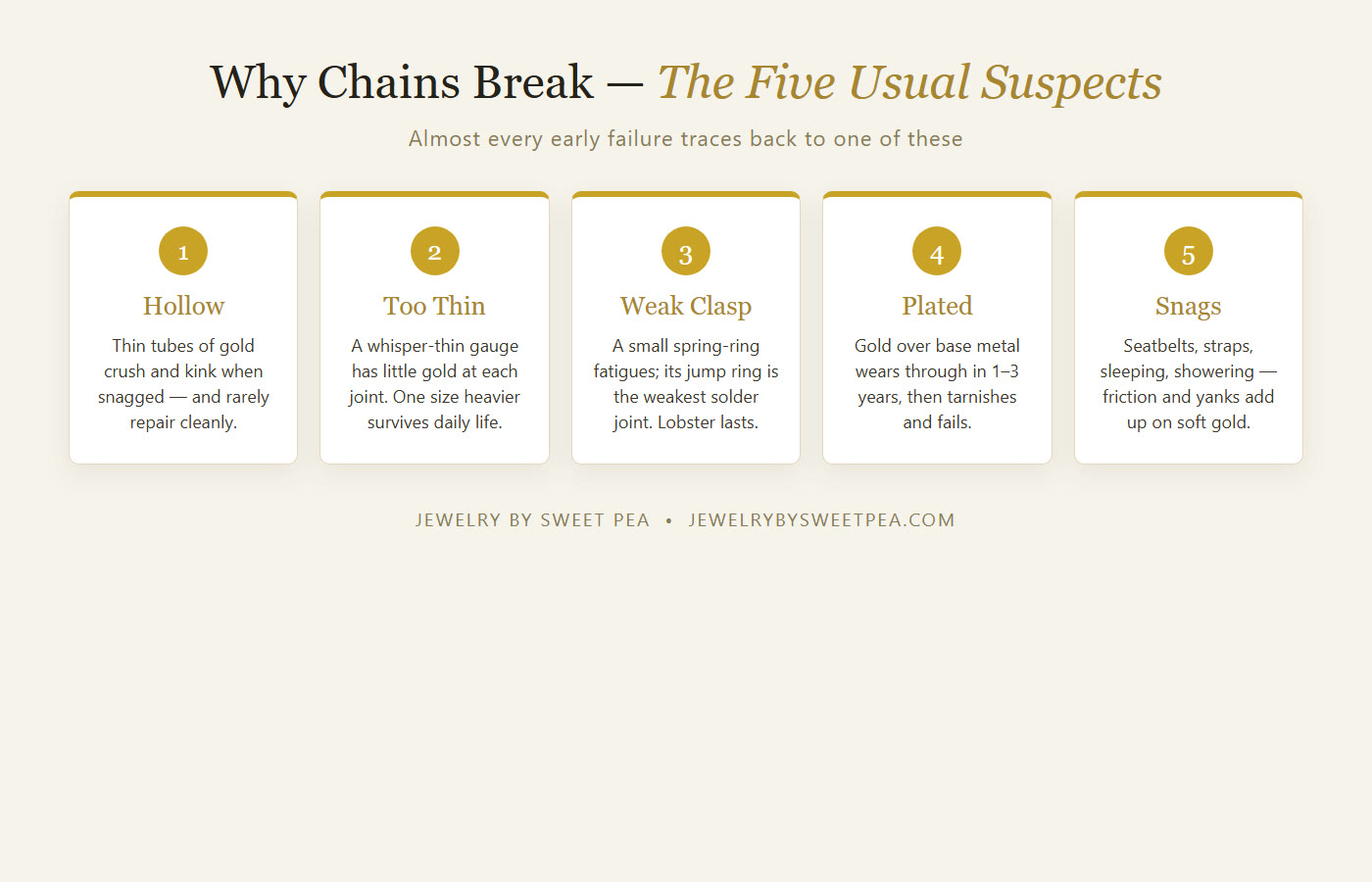
Two chains can look identical in a photo and cost wildly different amounts because one is solid gold all the way through and the other is hollow — a thin tube of gold around empty space. Hollow chains are lighter and cheaper, and for a delicate everyday necklace they can be fine. But hollow links crush and kink if they catch on a seatbelt, a purse strap, or a toddler's hand, and once a hollow link crimps it's nearly impossible to repair invisibly. Solid links just bend and spring back.
Between the two sits semi-solid construction — heavier and far sturdier than hollow, without the price of a fully solid rope. It's the everyday sweet spot, and it's what most of our best-selling chains are. The 10K Yellow Gold 2.8mm Semi-Solid Rope Chain (about $289) is a good example: substantial enough to shrug off daily wear, light enough to live on your neck without you thinking about it.
Does the link type really matter?
Yes — some patterns are simply tougher than others. A twisted rope chain spreads stress across many small links, so it resists snapping and hides the odd scuff. A figaro (the repeating long-then-short link pattern) is stout and holds up to years of on-and-off wear. Both are workhorses.
The chains that tend to fail early are the delicate ones built for looks rather than labor: very thin box, snake, and herringbone chains kink permanently if they fold the wrong way, and a kinked herringbone never lies flat again. If you want a chain you never have to baby, a solid rope or figaro is the safe pick. The 10K Yellow Gold 2.5mm Semi-Solid Figaro Chain (about $214) is our most forgiving everyday chain, and the 10K Yellow Gold 3.5mm Semi-Solid Figaro Chain (about $347) steps up the presence while staying just as tough.
How much does gauge (thickness) change the odds?
A lot. A wider chain has more gold at every link, so it takes far more force to stress a joint. A whisper-thin 1mm chain is lovely but lives a careful life; a 3mm–4mm chain takes real abuse in stride. If your last chain broke, going one gauge heavier is the single easiest fix. Our 10K Yellow Gold 3mm Semi-Solid Rope Chain (about $324) is where most everyday buyers land, and the heavier 10K Yellow Gold 4.25mm Semi-Solid Rope Chain (about $546) is a genuine "wear it for decades" piece with real heft in the hand.
Prices shown are at the time of writing; solid gold moves with the gold market. Browse the full Chains collection or the wider Necklaces collection to compare styles and gauges side by side.
Why does the clasp break first so often?
Here's the jeweler's secret: most "the chain broke" calls are actually the clasp broke. The tiny spring-ring clasp on inexpensive chains has a thin wire spring inside that fatigues, and its small jump ring is often the weakest solder joint on the whole necklace. A larger lobster clasp is easier for older hands, latches more securely, and simply lasts longer. When you buy a good chain, look at the clasp as closely as the links — and if you inherit a chain you love, a jeweler can swap a tired clasp for a fresh lobster for very little. That one upgrade can add years.
What about plated chains — don't those always fail?
Gold-plated and gold-filled chains have a microscopically thin gold layer over a base metal like brass. They look identical to solid gold on day one, but the plating wears through at the friction points — the back of the neck, the clasp — usually within one to three years, exposing the base metal, which then tarnishes and can irritate skin. That's the classic "it turned my neck green and then snapped" story. We don't sell plated chains at all: every chain we carry is stamped, solid 10K or 14K gold, because a chain meant to last should be gold the whole way through. U.S. sellers are required by the FTC Jewelry Guides (16 CFR Part 23) to disclose plating and karat honestly — if a listing dodges the karat number, take the hint.
Is 14K more durable than 10K?
Counterintuitively, 10K is actually harder. 10K gold is 41.7% pure and alloyed with more strengthening metals, so it resists scratches and dents a touch better than 14K (58.3% pure), which trades a little hardness for a richer, warmer color. Both are real solid gold that will outlive you; the choice is about hue and budget, not survival. If you want the traditional fine-jewelry look and a slightly richer yellow, 14K is worth it — the 14K Yellow Gold Adjustable 1.2mm Diamond-Cut Rope Chain (about $753) is our heirloom pick and adjusts from choker to 22 inches. If you want maximum everyday toughness for the money, solid 10K is a genuinely smart choice. (For the curious, this overview of gold alloys and karats explains how the mix changes both color and hardness.)
Chains built to last, by budget
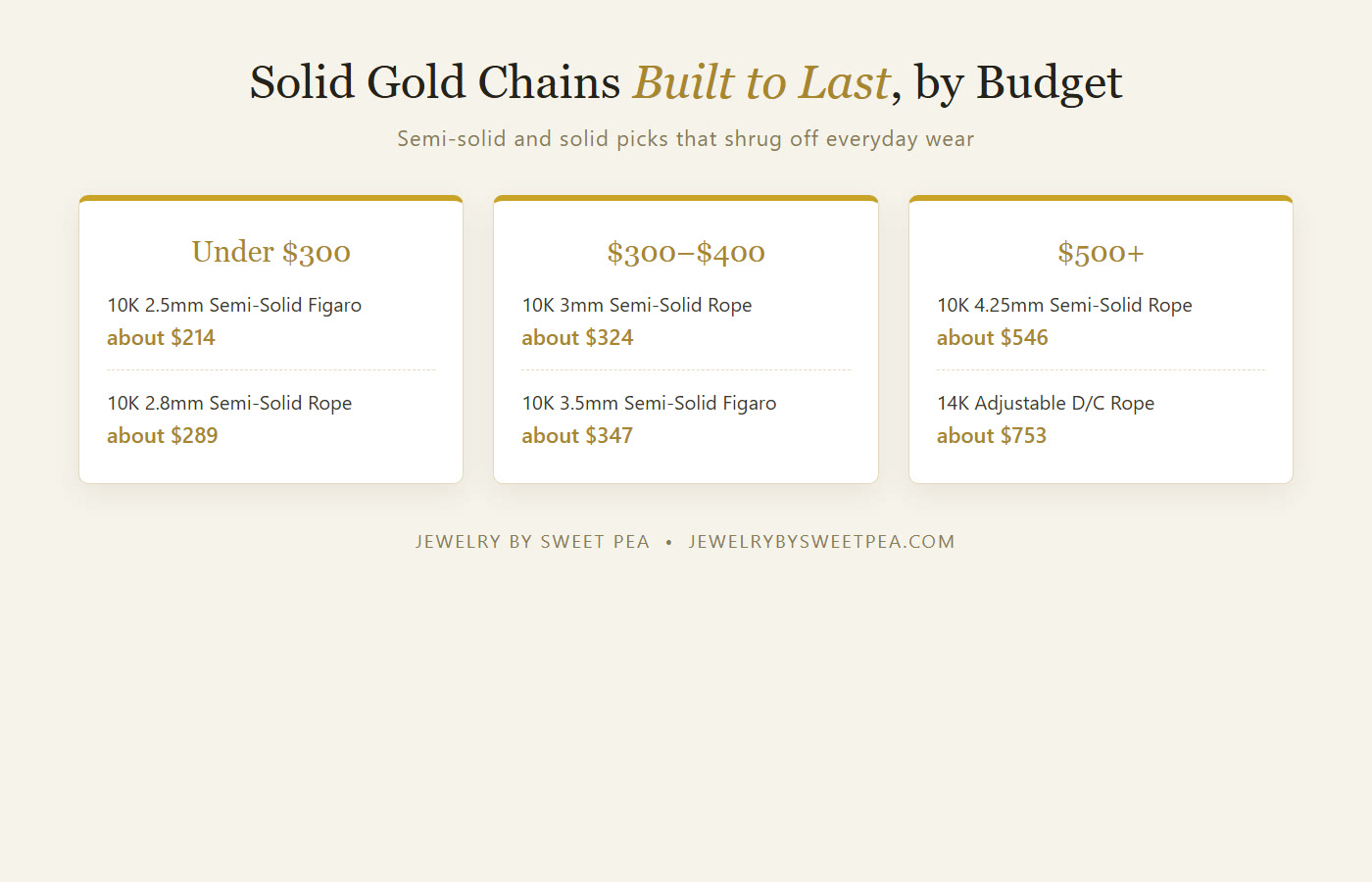
Under $300 — solid gold that holds up
- 10K Yellow Gold 2.5mm Semi-Solid Figaro — about $214. Our most forgiving everyday chain.
- 10K Yellow Gold 2.8mm Semi-Solid Rope — about $289. Sturdy, light, wears every day.
$300–$400 — the everyday sweet spot
- 10K Yellow Gold 3mm Semi-Solid Rope — about $324. Where most buyers land.
- 10K Yellow Gold 3.5mm Semi-Solid Figaro — about $347. More presence, just as tough.
$500+ — heirloom heft
- 10K Yellow Gold 4.25mm Semi-Solid Rope — about $546. Real weight; a decades chain.
- 14K Yellow Gold Adjustable Diamond-Cut Rope — about $753. Richer 14K gold, adjusts choker-to-long.
How to make any gold chain last longer
- Take it off for the rough stuff. Sleeping, showering, the gym, and heavy lifting are where snags and stretching happen. Gold is soft; friction and yanks add up.
- Store it lying flat, not tangled. A tangled chain that gets tugged is how thin links kink and snap. A flat pouch or a hook keeps it honest.
- Check the clasp and jump rings twice a year. Give a gentle tug at the clasp. If it feels loose or the jump ring has a gap, a jeweler can tighten or replace it before it fails.
- Match the pendant to the chain. Hanging a heavy pendant on a delicate chain overloads the weakest link. Heavier charms want a heavier chain.
If you're not sure whether a chain you own is solid or hollow, or which gauge suits how you wear it, send us a photo and we'll tell you honestly — that's what a family jeweler is for.
Frequently asked questions
Why did my gold chain break so quickly?
Nine times out of ten it's one of three things: the chain was hollow (thin links crush and split), it was plated over base metal (the gold wears through and the core fails), or the clasp or a jump ring — the weakest solder joint — gave out. A solid gold chain with a good lobster clasp very rarely breaks under normal wear.
Which type of gold chain is the most durable?
Solid rope, curb, and figaro chains are the toughest everyday styles because they spread stress across many links. Avoid very thin herringbone, snake, and box chains for hard daily wear — they look beautiful but kink permanently if folded the wrong way. Going one gauge heavier also meaningfully increases durability.
Is a solid gold chain worth the extra cost over hollow or plated?
For a chain you'll wear daily and want to keep, yes. Hollow chains crush and are hard to repair; plated chains wear through in one to three years. Solid gold bends and springs back, can be repaired for generations, and holds its value by weight. It's the difference between replacing a chain and handing one down.
Does 10K or 14K gold last longer?
Both last generations. 10K (41.7% pure) is actually a bit harder and more scratch-resistant because it has more strengthening alloy; 14K (58.3% pure) has a richer color and is the traditional fine-jewelry standard. Neither will "wear out" — choose based on the color you want and your budget, not durability.
Can a broken gold chain be repaired?
A solid gold chain almost always can — a jeweler can re-solder a link or replace a clasp cleanly. Hollow chains are much harder to repair invisibly once a link crushes, and plated chains generally aren't worth repairing because the base metal is exposed. This is one more reason solid gold pays off over time.
Jewelry by Sweet Pea is a family-run fine jewelry store. Every chain is solid 10K or 14K gold or sterling silver — never plated — sourced from U.S. wholesalers and shipped from the USA. Browse the Chains collection or send us a photo of your chain and we'll help you find one built to last.