Chain Styles Guide: Types of Necklace Chains Compared
Updated November 2026. By the Jewelry by Sweet Pea team, a family-owned jeweler since 2008.
The short answer: the most common chain styles are cable, curb, figaro, box, rope, wheat (spiga), snake and herringbone. For a pendant, choose a box, cable, wheat or rope chain, about 0.8 to 1.2 mm wide for a medium pendant. Rope, wheat and curb chains hold up best to everyday wear, while herringbone and snake chains kink easily and suit dressier wear.
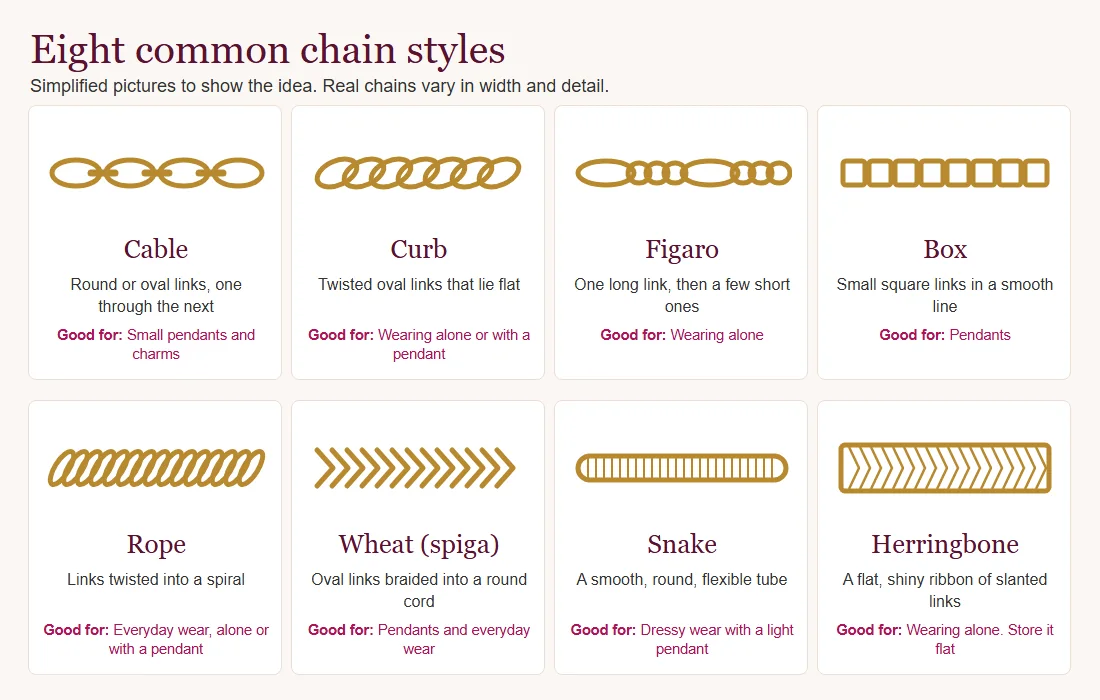
Chain names can be confusing when all you have is a small photo. This guide shows the common chain styles side by side, what each one is good for, and what to check in a listing before you choose.
Chain styles at a glance
| Style | What it looks like | Good for |
|---|---|---|
| Cable | Round or oval links, each one passing through the next. The classic chain. | Small pendants and charms. A broken link is simple for a jeweler to fix. |
| Curb | Oval links twisted and flattened so they lie flat on the skin. A Cuban chain is a thicker, closer-set curb. | Wearing alone, or with a pendant in a narrower width. |
| Figaro | A curb-style chain with a pattern: one long link, then two or three short ones. | Wearing alone. The pattern is the look. |
| Box | Small square links that form a smooth, even line. | Pendants. Store it flat or hanging, since a sharp bend can leave a kink. |
| Rope | Many small links twisted into a spiral, like a rope. Diamond-cut rope chains sparkle. | Everyday wear, alone or with a pendant. |
| Wheat (spiga) | Oval links braided into a round, flexible cord. | Pendants and everyday wear. It drapes smoothly. |
| Snake | Closely joined rings that form a smooth, round tube. | Dressy wear, with a light pendant. It can kink, so do not bend it sharply. |
| Herringbone | Flat, slanted links set close together in a shiny ribbon. | Wearing alone. It kinks easily, so store it flat and skip the pendant. |
| Singapore | Flat links twisted so the whole chain spirals and catches the light. | A light, sparkly chain, alone or with a small pendant. |
| Paperclip | Long, open links shaped like paperclips. | Layering, wearing alone, or clipping on charms. |
We also carry rolo, franco, anchor, byzantine and beaded chains. See every style on our chains page.
Which chain is best for a pendant?
Box, cable, wheat and rope chains are the usual choices for a pendant. They are round or square all the way around, so the pendant slides freely and hangs straight. Match the width of the chain to the weight of the pendant:
- A small charm or light pendant: about 0.5 to 0.8 mm.
- A medium pendant, such as a cross or locket: about 0.8 to 1.2 mm.
- A heavy pendant: 1.5 mm and up.
The end of the chain also has to pass through the loop on the pendant, called the bail. If you are not sure a chain will fit your pendant, ask us before you order.
Which chain is best for everyday wear?
Rope, wheat and curb chains hold up well to daily wear. Their links are small and closely joined, so they resist kinking. Figaro, box and cable chains wear well too, though a very thin cable chain is more delicate. Herringbone and snake chains are beautiful, but one sharp bend can leave a kink that is hard to repair, so they suit dressier wear and need gentle storage.
In every style, a wider chain is harder to bend or break than a thin one. Width matters as much as the link pattern.
What do solid, semi-solid and hollow mean?
These words describe how the links are made, not the purity of the gold. A 14K chain is 14K gold whether its links are solid or hollow.
- Solid: the links are metal all the way through. They are the heaviest and the hardest to dent.
- Semi-solid: lighter links that are partly hollow. A middle choice for weight.
- Hollow: links formed from thin tube. They give a bigger look for less weight, but they dent more easily and are harder to repair.
The product title or details say which one a chain is. If a listing does not say, please ask us before you order. Our real gold guide explains the other words you will see in a listing.
How wide should a chain be?
Chain width is listed in millimeters (mm). One inch is 25.4 mm, so a 3 mm chain is about an eighth of an inch wide.
- Under 1 mm: very fine. For small, light pendants.
- 1 to 2 mm: the usual range for a pendant chain.
- 2 to 4 mm: easy to see when worn alone.
- 5 mm and up: a bold chain that is the whole look.
Tips for choosing and caring for a chain
- Pick the length next. Our necklace length guide shows where each length sits.
- Look at the clasp. Our clasp guide shows the common types and how each one opens.
- Fasten the clasp before you put a chain away. It helps prevent tangles. Store flat chains such as herringbone lying flat.
- Take it off for the gym, the pool and bed. Chains often break when they catch on something.
- Clean it gently. Our jewelry care guide has the steps.
Keep reading and shop
Our blog compares box, cable and rope chains, ranks the most durable chain styles, and explains why some chains break. Browse our chains and necklaces.
More jewelry guides
- How to Find Your Ring Size: Measure at home with our printable sizer and size chart.
- Necklace Length Guide: See where each length sits and try it with a piece of string.
- Gold and Metals Guide: 10K or 14K, sterling silver, plated and more, compared.
- Engraving Guide: How it works, wording tips and what to check before you order.
- Is It Real Gold? A Stamp and Listing Guide: What 10K, 14K, 585, GP and GF mean, and how to check a piece.
- Hoop Earring Size Guide: Hoop sizes in millimeters and inches, side by side, and how to measure.
- Clasp Types Guide: Six common clasps, how each one opens, and how to choose.
- Gold Finishes Guide: Polished, satin, matte, diamond-cut and textured gold, and how to choose.
- Stud Earring Size Guide: Stud sizes in millimeters side by side, what ct tw means, and how to measure.
- Earring Back Guide: Push, screw, locking, lever and hinged backs, how each one works, and how to choose.
- Bracelet and Anklet Size Guide: Measure your wrist or ankle, how much room to add, and the usual lengths.
- Jewelry Care and Cleaning Guide: What is safe for each metal and stone, how to clean at home, and how to store it.
- Birthstone Chart by Month: Every month's birthstone and alternates, how hard each stone is, and which ones suit everyday wear.
- Jewelry for Sensitive Skin Guide: Which metals people with sensitive skin often choose, what causes green marks and irritation, and what to check before you order.