
Box Chain vs Cable Chain vs Rope Chain Which Gold Chain Style Lasts the Longest
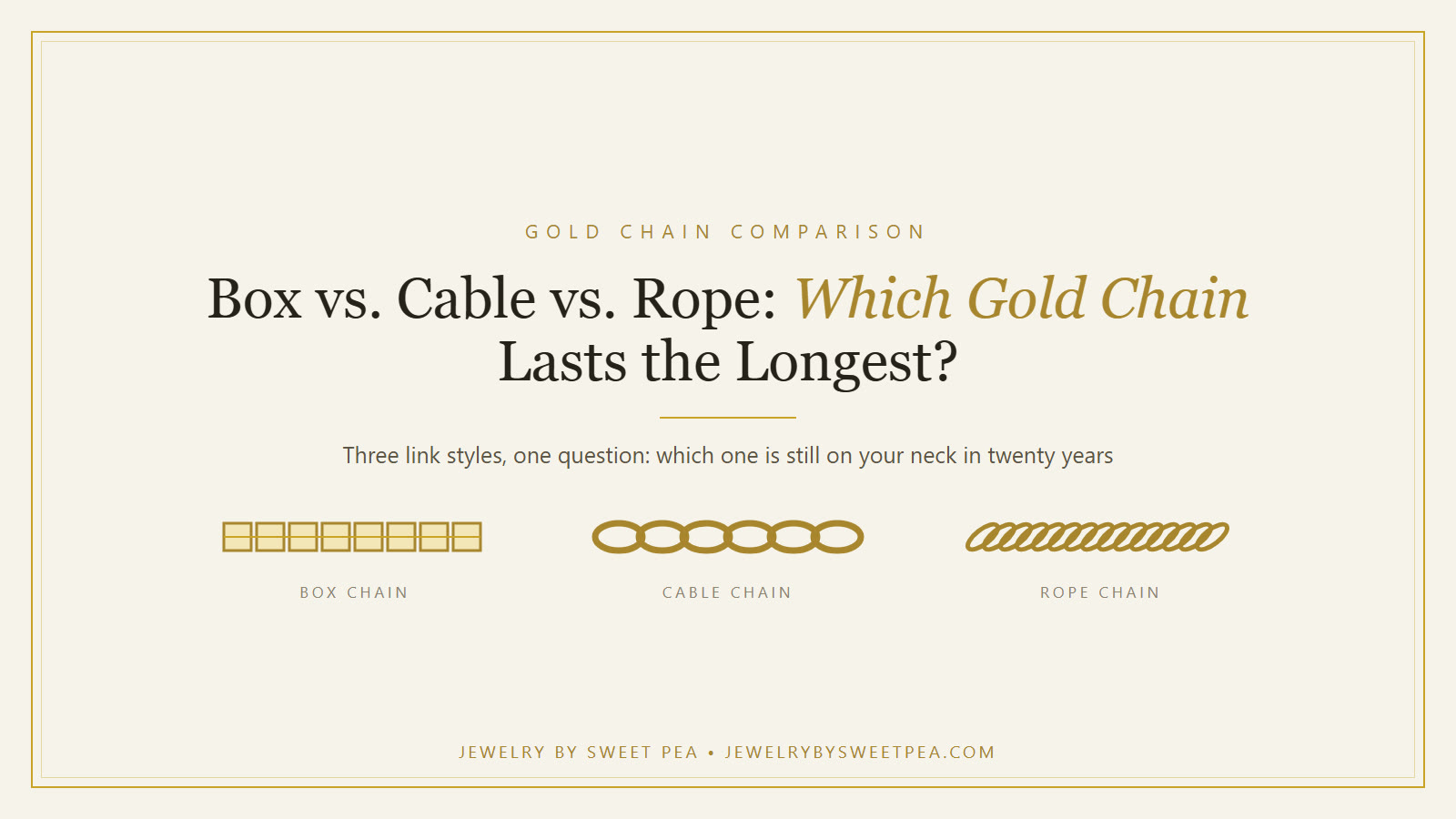
The short answer: A solid rope chain lasts the longest for everyday wear, because dozens of small interlocking links share the load and no single link carries a pendant alone. A box chain is a close second and the best choice for hanging a pendant. A cable chain is the simplest and easiest to repair, but a thin one is the first to stretch or snap. In every style, solid gold, a sensible thickness and a lobster clasp matter more than the link pattern.
We're a small, family-run jewelry store, and chains are one of the questions we get most. Which one will still be around in twenty years? Here is how the three most common styles are built, where each one tends to fail, and how to pick one you won't have to replace.
How is each chain style made?
All three are made from solid gold wire that's formed into links and soldered closed. The difference is in the shape of the link and how the links connect.
- Cable chain. The classic. Round or oval links, each one passing through the next, like a tiny version of an anchor chain. Every link is soldered shut, and the chain lies flat and simple. Diamond-cut versions have faceted edges that catch the light.
- Box chain. Square links folded so each one forms a little cube, connected edge to edge. The result is a smooth, square-profile chain that looks like a continuous line of gold rather than a row of visible links.
- Rope chain. Many small links twisted together in a spiral so the chain looks like a braided rope. A "solid" rope chain is twisted from solid wire; "semi-solid" and "hollow" rope chains use lighter or tube-shaped wire to cut weight and price.
Which chain style is the strongest?
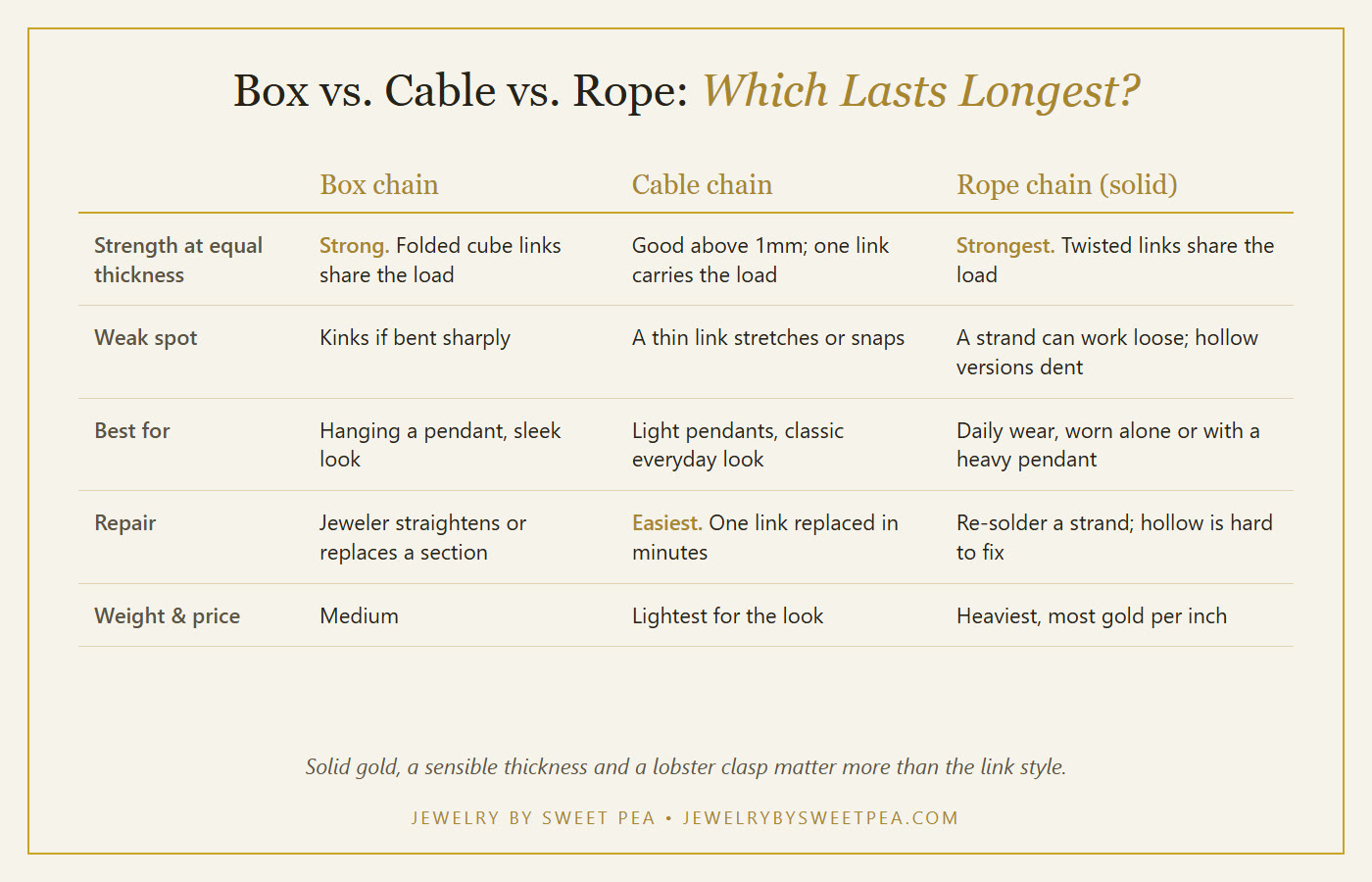
Strength is about how the load is shared. When a pendant pulls on a cable chain, the entire weight sits on one link at a time, so the chain is only as strong as its thinnest link. A box chain spreads the pull across the folded walls of each cube, which is why box chains feel stiffer and handle pendants so well. A rope chain spreads it furthest of all: the twisted strands mean several links are carrying the load at every point, so a solid rope chain of the same thickness is noticeably harder to break than a cable chain.
So, at equal thickness and all solid gold, the order from toughest to most delicate is roughly: solid rope, then box, then cable. That said, the gap narrows fast once a cable chain is 1mm or thicker, and a thick cable chain will outlast a thin rope chain every time. Thickness, measured in millimeters, is the number to compare before you compare styles.
Where does each style fail?
Every chain has a weak spot. Knowing it tells you how to treat the chain and what to look for before buying.
- Cable chains stretch and snap at a single link. Catch a thin cable chain on a sweater or a car seatbelt and one link opens up. The good news is that a jeweler can replace that one link in minutes, and a cable chain repair is the least expensive of the three.
- Box chains kink. Bend a box chain sharply and the square links can crease, leaving a visible bend that doesn't shake out. They don't break easily, but a kinked section needs a jeweler to straighten or replace it. Store a box chain flat or hanging, never balled up.
- Rope chains fray and, if hollow, dent. On a solid rope chain the first sign of wear is a single strand working loose, which a jeweler can re-solder. Hollow and semi-solid rope chains are the exception to the "rope is strongest" rule: the tube-shaped wire can be dented by a fingernail or a drawer, and dented hollow links are very hard to repair. If longevity is the goal, buy a solid rope chain.
Does 10K or 14K gold make a chain last longer?
Pure gold is soft. Jewelry gold is an alloy of gold with harder metals like copper and silver, and the karat tells you the proportion. Under the U.S. Federal Trade Commission's Jewelry Guides, "14K" means at least 14 parts gold in 24, or about 58% gold, and "10K" means about 42% gold. Because 10K has more alloy, it is a bit harder and more scratch-resistant, which is one reason 10K chains are popular for daily wear. 14K has a richer, warmer yellow and is the standard for fine jewelry. Both are solid gold all the way through, and both last for decades. We don't sell gold-plated chains, because plating wears through in a year or two no matter how the link is shaped.
If you're curious about the metal itself, the U.S. Geological Survey's gold page is a good plain-language starting point on why gold is alloyed for jewelry.
Which chain should you buy for a pendant?
If the chain's job is to carry a pendant, pick a box chain or a rope chain in a thickness that matches the pendant's weight. A rough guide from the bench:
- Small charm or a lightweight pendant: 0.5mm to 0.8mm box, cable or rope chain.
- Medium pendant, a cross or a locket: 0.8mm to 1.2mm box or rope, or a 1.2mm or thicker cable.
- Heavy pendant or a chain worn on its own: 1.5mm and up, solid rope or box.
If the chain will be worn alone, with nothing hanging from it, any of the three styles works, and the choice is about look: rope for sparkle and texture, box for a sleek line, cable for a classic, understated feel.
Our picks in solid gold
Every chain below is solid 10K or 14K yellow gold, never plated, and in stock at the time of writing. Prices float with the gold market, so "from about" is where the shortest length starts.
Box chains
- 10K Yellow Gold 0.7mm Box Chain, 16 inch, about $242. A smooth, everyday pendant chain in the harder 10K alloy.
- 14K Yellow Gold 0.9mm Diamond-Cut Twisted Box Chain, from about $331. A box chain with a twist that adds sparkle without giving up the box chain's strength.
Cable chains
- 10K Yellow Gold 1.2mm Cable Chain, from about $173. Thick enough to carry a medium pendant, and the easiest of the three to repair if it ever catches.
- 14K Yellow Gold 0.8mm Diamond-Cut Forzantine Cable Chain, 18 inch, about $179. Forzantine links are slightly elongated cable links, which lie flatter and catch less.
Rope chains
- 14K Yellow Gold 0.8mm Rope Chain, from about $150. A fine rope chain with rope's braided sparkle at a cable-chain price.
- 10K Yellow Gold 1.5mm Handmade Solid Rope Chain, from about $203. The one we'd pick to wear every day for years: solid links, 1.5mm thick, in the harder 10K alloy.
You can see the whole range, including white and rose gold and sterling silver, in our chains collection, or browse all necklaces.
What should you spend on a chain that lasts?
- Under $200: A 10K cable chain around 1.2mm, or a fine 14K rope chain under 1mm. Both are solid gold and will outlast any plated chain many times over. Keep pendants light.
- $200 to $350: The sweet spot for a lifetime chain: a 10K solid rope at 1.5mm, a 10K box at 0.7mm to 1mm, or a 14K box chain under 1mm. Any of these can carry a real pendant daily.
- Over $350: Thicker 14K rope and box chains, usually 1mm and up, worn on their own or with a heavy pendant. Here you're paying for gold weight, not durability, so buy for the look you want.
How do you make any chain last longer?
- Buy a lobster clasp. Spring rings are fine on light chains, but a lobster clasp is stronger, easier to work with and far less likely to pop open.
- Take it off to sleep and to swim. Most chain breaks happen in bed, when a chain gets wrapped and pulled, and chlorine is hard on gold alloys.
- Put the necklace on last and take it off first. Hair spray, perfume and sweaters all catch on chains.
- Store it flat or hanging. Tangles cause kinks, and kinks are where box and rope chains fail.
- Clean it gently. Warm water, a drop of dish soap and a soft brush, then dry fully. No ultrasonic cleaners on hollow chains.
- Have the clasp and jump ring checked. A jeweler can inspect both in a minute during any visit. The clasp wears out long before the chain does.
Frequently asked questions
Which gold chain lasts the longest?
At the same thickness, a solid rope chain lasts the longest, followed by a box chain, then a cable chain. Thickness and solid versus hollow construction matter more than link style, and a lobster clasp protects any of them.
Is a box chain stronger than a cable chain?
Yes, at equal thickness. A box chain's folded square links spread a pendant's weight across each link, while a cable chain carries it on one link at a time. A box chain can kink if bent sharply, though, so store it flat.
Are rope chains strong or do they break easily?
Solid rope chains are among the strongest chain styles because many twisted links share the load. Hollow and semi-solid rope chains are the weak version: they dent easily and are hard to repair. Buy solid if you want it to last.
Is 10K gold more durable than 14K for a chain?
Slightly. 10K gold has more alloy, so it is a bit harder and more scratch-resistant. 14K is richer in color. Both are solid gold, both last for decades, and the difference in wear is small compared with the difference between solid and plated.
What thickness chain do I need for a pendant?
About 0.5mm to 0.8mm for a small charm, 0.8mm to 1.2mm for a medium pendant such as a cross or locket, and 1.5mm or more for a heavy pendant. A box or rope chain is the best choice when something hangs from it.